Unlock exam success with the complete Mastering Essay Writing Bundle for Cambridge AS Level English General Paper 8021, featuring all three essential modules for crafting top-tier academic essays. Designed to take students step-by-step through every stage of the writing process, this comprehensive package includes dedicated guide slides for Engaging Introductions (hooks, background, and thesis statements), Structured Body Paragraphs (claims, evidence, and critical evaluation), and Powerful Conclusions (synthesizing arguments and final impact). Save money by getting the entire essay-building system in one ready-to-teach bundle, giving your students the exact frameworks, worked examples, and signposting tools they need to score top marks!
What’s Included in This Resource
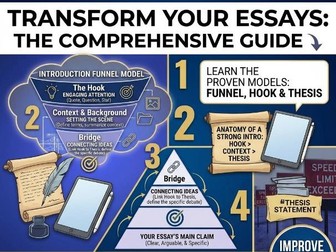
The Introduction Funnel Model
The Hook: Strategies to engage the reader from the start using powerful quotes, thought-provoking questions, or striking statistics.
Context & Background: Techniques for setting the scene, defining key terms, and providing necessary background context.
The Bridge: Clear instructions on connecting initial thoughts to the core argument, linking the hook directly to the thesis and outlining the main debate.
Anatomy of a Strong Introduction
Step-by-step breakdown of the winning formula: Hook, Context, Thesis.
Visual visual guides that illustrate how each element supports the overall argument structure
Thesis Statement Mastery
Dedicated focus on crafting clear, arguable, and specific main claims.
Scaffolded support to ensure students transition smoothly from broad introduction to precise academic argument.
Key Benefits for Teachers & Students:
Clear Structural Scaffold: Simplifies academic writing for secondary students and English Language Learners.
Versatile Application: Ideal for First Language English, Second Language English, Literature, and Humanities essay instruction.
Ready to Use: Perfect as direct teaching slides, classroom anchor charts, student reference handouts, or digital study guides.
A complete, ready-to-teach 4-lesson bundle on Unit 2: Sleep & Dreams, provided in high-resolution PDF format. Designed for 0266 IGCSE Psychology, this unit covers foundational concepts, core biological and psychodynamic theories, measurement methods, and named studies.
What’s Included
Lesson 1: Key ConceptsCircadian/ultradian rhythms, SCN & melatonin, EEG/EMG/EOG measurement methods, sleep disorders, and Siffre’s cave study.
Lesson 2: Restoration TheoryOswald’s theory of physical and cognitive repair, REM vs. NREM roles, lifespan sleep patterns, and the Robinson et al. (2008) sleep restriction study.
Lesson 3: Activation-Synthesis TheoryHobson & McCarley’s biological model, sensory/motor blockades, brainstem activation, cortical synthesis, and the Williams et al. (1992) bizarreness study.
Lesson 4: Psychodynamic TheoryFreudian framework, unconscious mind & id, manifest vs. latent content, dreamwork mechanisms (condensation, displacement, wish fulfilment), and the Iorio et al. (2021) trauma study.
Key Features:
Ready to Use: Clean, beautifully formatted PDF slide decks requiring zero prep.
Exam Focused: Includes syllabus-aligned concept checks, graph/calculation tasks, and exam-style questions.
Active Learning: Packed with paired discussions, real-world case applications, and structured revision materials.
Format: High-resolution PDF documents (.pdf)
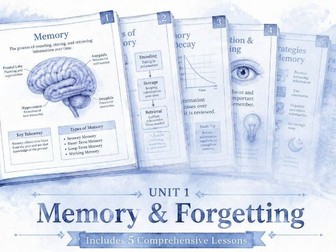
Save hours of planning with this comprehensive, ready-to-teach bundle designed specifically for Cambridge IGCSE Psychology 0266. This resource contains full, highly detailed lessons with illutrations and visual cues, covering every single aspect of Unit 1: Memory and Forgetting.
What is included:
Complete Lesson Presentations: Engaging and visually clear slides that walk students through the entire unit from start to finish.
Step-by-Step Textbook Alignment: Every topic, theory, and evaluation point is covered in the exact order of the coursebook, ensuring seamless integration with student reading and homework.
Core Studies Breakdown: Thorough coverage of the required core studies for this unit, complete with methodology, procedure, results, and critical evaluations.
Exam-Focused Structure: Key psychological terms, concepts, and methodological strengths and weaknesses are highlighted to properly prepare students for their assessments.
5 Presentations covering 1.1 to 1.5:
1.1 Key Concepts
1.2 Craik & Lockhart Levels of Processing (LoP)
1.3 Atkinson & Shiffrin’s Multistore Model (MoM)
1.4 Motivated Forgetting
1.5 The Brain in Memory & Forgetting
Why choose this resource?
Whether you are teaching the 0266 syllabus for the first time or simply looking to upgrade your existing materials, this bundle provides a stress-free, plug-and-play solution. It is built to maximize student understanding and engagement while entirely eliminating your planning time.
Cambridge AS General English 8021
Body Paragraphs
Help your students transform weak, disorganized essays into structured, persuasive academic papers! This comprehensive, visually engaging guide breaks down the art of writing powerful body paragraphs into clear, actionable frameworks that students can immediately apply to literary analysis, history essays, and argumentative writing.
Whether you’re introducing paragraph structure for the first time or remediating common writing pitfalls with senior students, this resource provides the exact scaffolding needed to elevate academic writing across your department.
What’s Included?
Proven Structural Frameworks: Clear visual breakdowns of essential writing models, including the TTEB Framework (Transition, Topic, Evidence, Brief Wrap-up), the PIE Structure (Point, Information, Explanation), and the Inverted Triangle Model.
Concrete Examples & Mentor Texts: Step-by-step breakdowns of real-world sample paragraphs covering accessible literature.
Topic Sentence Masterclass: Specific “Dos and Don’ts” that teach students how to write precise, arguable claims rather than stating simple facts or broad generalizations.
Evidence & Analysis Breakdown: Practical strategies to teach students how to integrate and analyze varied evidence, including facts, quotes, statistics, and logical reasoning, without falling into simple plot summary.
Common Pitfalls & Fixes: Directly addresses common student errors, such as overloaded paragraphs, missing transitions, unclear scope, and sudden endings.
Editing & Revision Toolkit: Includes an actionable revision checklist and step-by-step guidance to help students peer-edit and self-correct their draft paragraphs before submission.
Why Teachers Love This Resource:
Versatile & Adaptable: Perfect for direct instruction, writing workshops, essay bootcamps, revision lessons, or as a reference handbook for independent student study.
Visually Engaging: Designed with clear infographics, bulleted summaries, and organized layouts that keep students focused and reduce cognitive overload.
Key Features:
- The “Why” Behind Conclusions: Explains why the final paragraph is critical for shaping the examiner’s overall impression and safeguarding marks under AO2 (Analysis & Evaluation).
- Discursive vs. Argumentative Breakdown: Clearly distinguishes between the balanced synthesis required for discursive essays and the confident, evaluative verdicts needed for argumentative responses.
- The 3-Part Conclusion Formula: Introduces a reliable framework that students can apply to any prompt:
1- Reaffirm: Restate the thesis in fresh phrasing.
2- Draw Together: Synthesize core body arguments without a boring list.
3- Reflect & Insight: Close with a broader implication, prediction, or wider significance.
- Annotated Worked Examples: Includes complete, Cambridge-style model conclusions for both discursive and argumentative questions, complete with margin breakdowns highlighting why they score high bands.
- Essential Dos and Don’ts: Directly tackles common examiner-reported pitfalls, such as introducing brand-new evidence, using overused clichés (“To wrap things up…”), or slipping into informal contractions.
Ready-Made Phrase Bank: Provides high-level academic transitions and sentence starters for restating theses, synthesizing perspectives, and closing with insight.
Quick Self-Check Checklist: A handy final checklist for students to audit their conclusions during timed exam conditions or practice runs.
Suggested Classroom Uses
Independent Revision: An ideal handout for students to review independently ahead of mock exams or final papers.
Writing Workshops: Use the worked examples and 3-part formula as a guided modeling activity during essay-writing units.
Peer Assessment: Have students use the Quick Self-Check checklist to critique and improve each other’s concluding paragraphs.
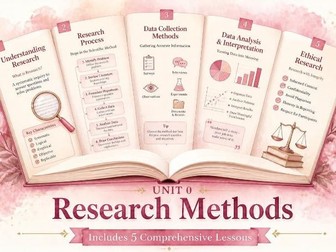
Prepare your students for success with this meticulously crafted set of 9 comprehensive lesson slides covering Unit 0: Research Methods for the new Cambridge IGCSE Psychology (0266) syllabus, effective for examinations from 2027 onwards. Designed to align seamlessly with the coursebook, these slides offer a “play-by-play” teaching sequence, ensuring every aspect of the Research Methods unit is thoroughly addressed.
Each slide deck is developed with the busy teacher in mind, providing clear explanations, engaging visuals, and direct references to the official syllabus document. This guarantees full coverage of all required learning outcomes, giving you complete confidence in your lesson delivery. The resource breaks down complex psychological research methodologies into digestible, easy-to-teach segments, making it ideal for both new and experienced IGCSE Psychology educators.
Key Features:
• Syllabus-Aligned: Explicitly designed for the new IGCSE Psychology (0266) syllabus (first examination 2027), with direct syllabus point references integrated into the slides.
• Comprehensive Coverage: Covers all essential topics within Unit 0: Research Methods, including Experimental Methods, Non-Experimental Methods (Observations, Questionnaires, Case Studies), Sampling, Validity & Reliability, Ethical Guidelines, Role of the Researcher, Materials & Procedure, and Dealing with Data.
• “Play-by-Play” Structure: Follows the typical progression of a coursebook chapter, providing a ready-to-teach sequence for each lesson.
• Pedagogically Sound: Features clear definitions, real-life examples, and application scenarios to deepen student understanding of key concepts.
• Visually Engaging: Utilizes a clean, modern, and professional design with high legibility, making complex information accessible and maintaining student focus.
• Teacher-Friendly: Reduces preparation time significantly, offering a complete, ready-to-use teaching resource that can be adapted to various classroom settings.
Empower your teaching and ensure your students grasp the foundational principles of psychological research with this essential resource. Perfect for delivering engaging and effective lessons that meet the rigorous demands of the new IGCSE Psychology curriculum.
Topics Included:
0.1 Experimental Methods
0.2 Non-Experimental Methods: Observations
0.3 Non-Experimental Methods: Questionnaires
0.4 Non-Experimental Methods: Case Studies
0.5 Sampling
0.6 Validity & Reliability
0.7 Ethical Guidelines in Psychology
0.8 Role of the Researcher, Materials & Procedure
0.9 Dealing with Data