KS4 Triple Chemistry U3 Quantitative Chemistry – Complete PowerPoint lesson on Conservation of MassQuick View
s_jackson11

KS4 Triple Chemistry U3 Quantitative Chemistry – Complete PowerPoint lesson on Conservation of Mass

(0)
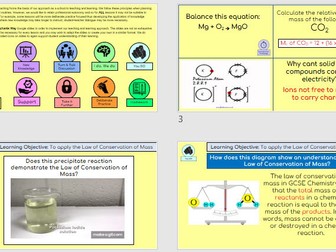
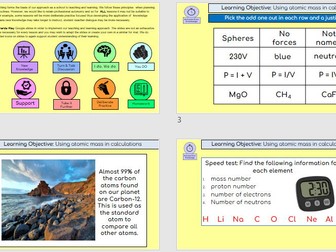
Covers content from the AQA KS4 Triple Chemistry Specification (4.3) on Quantitative Chemistry. The lesson starts with reviewing the Law of Conservation of Mass using a practical between Calcium carbonate + Hydrochloric acid to support their understanding. Students then complete a range of conceptual tasks on the CoM. The lesson then moves onto the quantitative application of CoM using balanced equations and RFM. Lesson smoothly moves from Retrieval practice to main activities (all answers on animations), to exam questions. All worksheets included. PowerPoints are bright, engaging, SEN friendly with minimal visual noise. Whole class teaching with Challenge opportunities where appropriate.
KS3 Science – Complete PowerPoint lesson on NeutralisationQuick View
s_jackson11

KS3 Science – Complete PowerPoint lesson on Neutralisation

(0)
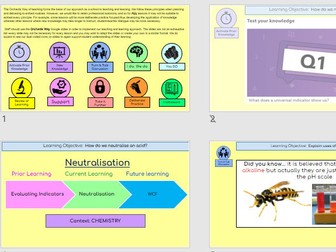
Covers content from the AQA KS3 Syllabus (3.6.2 Acids & Alkalis) focussing on the uses of A&A, word equations for neutralisation and finally an investigation into which antacid tablet is the most effective at neutralising acid. Lesson smoothly moves through a unique retrieval practice, to main activities (all answers on animations), finishing with exam questions. Power Points are bright, engaging, SEN friendly with minimal visual noise. Whole class teaching with Challenge opportunities where appropriate.
KS3 Science – Complete PowerPoint lesson on The properties of waves and calculationsQuick View
s_jackson11

KS3 Science – Complete PowerPoint lesson on The properties of waves and calculations

(0)
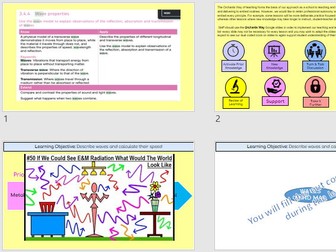
Covers content from the AQA KS3 Syllabus (3.4.3 Wave effects 3.4.4 Wave properties). The lesson starts with using various real life hooks to explore wave properties, and using morse code to send secret messages! Students describe waves and use slinky models to explore the two types. The two hour lesson concludes with calculating wave speed using both equations. Lesson smoothly moves through a unique retrieval practice, to main activities (all answers on animations), finishing with exam questions. Power Points are bright, engaging, SEN friendly with minimal visual noise. Whole class teaching with Challenge opportunities where appropriate.
KS3 Science – Complete PowerPoint lesson on IndicatorsQuick View
s_jackson11

KS3 Science – Complete PowerPoint lesson on Indicators

(0)
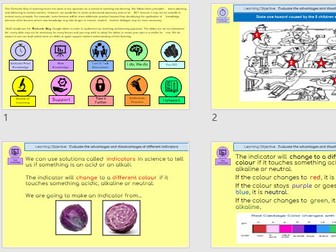
Covers content from the AQA KS3 Syllabus (3.8.2 Acids and Alkalis) focussing on the use of indicators with a practical activity ‘Making A Vegetable Indicator’. The lesson then asks students to evaluate different indicators. Lesson smoothly moves through a unique retrieval practice, to main activities (all answers on animations), finishing with exam questions. Power Points are bright, engaging, SEN friendly with minimal visual noise. Whole class teaching with Challenge opportunities where appropriate.
KS3 Science – Complete PowerPoint lesson on The Electromagnetic Spectrum and Reflection of LightQuick View
s_jackson11

KS3 Science – Complete PowerPoint lesson on The Electromagnetic Spectrum and Reflection of Light

(0)
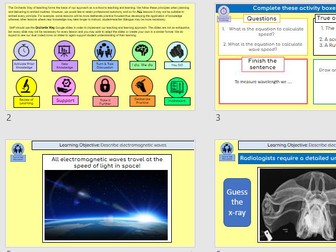
Covers content from the AQA KS3 Syllabus (3.4.3 Wave effects 3.4.4 Wave properties). The lesson starts by introducing the Electromagnetic Spectrum very basically using real life images to explore the parts of the wave. The lesson then explores the reflection of light through a practical on the Law of Reflection. Students can take this further by exploring periscopes. Lesson smoothly moves through a unique retrieval practice, to main activities (all answers on animations), finishing with exam questions. Power Points are bright, engaging, SEN friendly with minimal visual noise. Whole class teaching with Challenge opportunities where appropriate.
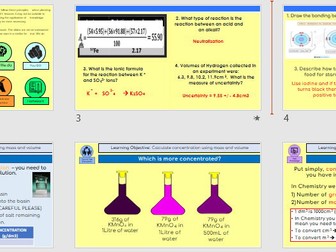
KS4 Triple Chemistry U3 Quantitative Chemistry – Complete PowerPoint on Calculating concentrationQuick View
s_jackson11

KS4 Triple Chemistry U3 Quantitative Chemistry – Complete PowerPoint on Calculating concentration

(0)
Covers content from the AQA KS4 Triple Chemistry Specification (4.3) on Quantitative Chemistry. The lesson starts with posing a problem: You have a salt solution of unknown concentration; you need to calculate the concentration of the solution. Students devise a method and take all data. The lesson moves onto how to convert units and then how to calculate concentration. Various exam style questions are offered to support the content. The lesson moves smoothly from Retrieval practice to main activities (all answers on animations), to exam questions. All worksheets included. PowerPoints are bright, engaging, SEN friendly with minimal visual noise. Whole class teaching with Challenge opportunities where appropriate.
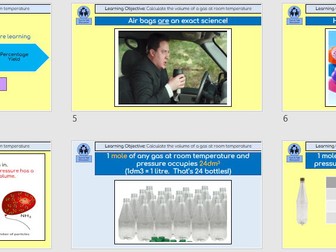
KS4 Triple Chemistry U3 Quantitative Chemistry – Complete PowerPoint on Gas VolumesQuick View
s_jackson11

KS4 Triple Chemistry U3 Quantitative Chemistry – Complete PowerPoint on Gas Volumes

(0)
Covers content from the AQA KS4 Triple Chemistry Specification (4.3) on Quantitative Chemistry. The lesson starts with discussing the importance of air bags in cars to hook students into this topic. Then the practical use of 24 x 1litre bottles to help visualise 1 mole of gas is equal to 24dm/24litres. Students practice scaffolded questions on gas volume and then independent work The lesson moves smoothly from Retrieval practice to main activities (all answers on animations), to exam questions. All worksheets included. PowerPoints are bright, engaging, SEN friendly with minimal visual noise. Whole class teaching with Challenge opportunities where appropriate.
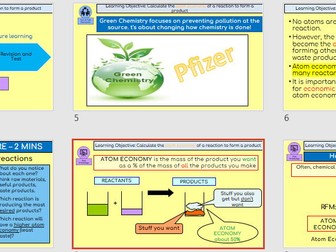
KS4 Triple Chemistry U3 Quantitative Chemistry – Complete PowerPoint Atom EconomyQuick View
s_jackson11

KS4 Triple Chemistry U3 Quantitative Chemistry – Complete PowerPoint Atom Economy

(0)
Covers content from the AQA KS4 Triple Chemistry Specification (4.3) on Quantitative Chemistry. The lesson starts with discussing green chemistry and using brand names like Pfeizer and Ibuprofen to spark interest in this topic. Various scaffolded examples are used to calculate Atom Economy and then students are given deliberate practice questions on this and Percentage Yield. The lesson moves smoothly from Retrieval practice to main activities (all answers on animations), to exam questions. All worksheets included. PowerPoints are bright, engaging, SEN friendly with minimal visual noise. Whole class teaching with Challenge opportunities where appropriate.
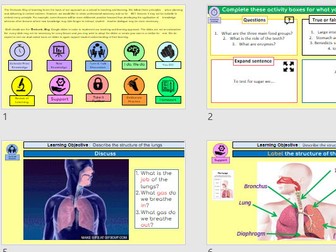
KS3 Science – Complete PowerPoint lesson on the Structure of the LungsQuick View
s_jackson11

KS3 Science – Complete PowerPoint lesson on the Structure of the Lungs

(0)
Covers content from the AQA KS3 Syllabus (3.8.3 Breathing) focussing on the structure of the lungs with an investigation into comparing lung volume with height. Lesson smoothly moves through a unique retrieval practice, to main activities (all answers on animations), finishing with exam questions. Power Points are bright, engaging, SEN friendly with minimal visual noise. Whole class teaching with Challenge opportunities where appropriate.
KS4 Triple Chemistry U3 Quantitative Chemistry – Complete PowerPoint Using Moles to Balance EquationQuick View
s_jackson11

KS4 Triple Chemistry U3 Quantitative Chemistry – Complete PowerPoint Using Moles to Balance Equation

(0)
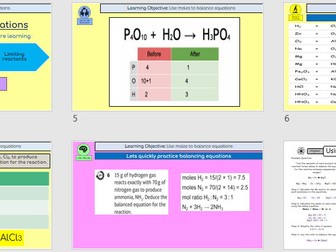
Covers content from the AQA KS4 Triple Chemistry Specification (4.3) on Quantitative Chemistry. The lesson starts with reviewing balancing equations. plenty of practice is offered. Students then move onto using moles to balance more equations. The lesson moves smoothly from Retrieval practice to main activities (all answers on animations), to exam questions. All worksheets included. PowerPoints are bright, engaging, SEN friendly with minimal visual noise. Whole class teaching with Challenge opportunities where appropriate.
KS4 Triple Chemistry U3 Quantitative Chemistry – Complete PowerPoint lesson Limiting ReactantsQuick View
s_jackson11

KS4 Triple Chemistry U3 Quantitative Chemistry – Complete PowerPoint lesson Limiting Reactants

(0)
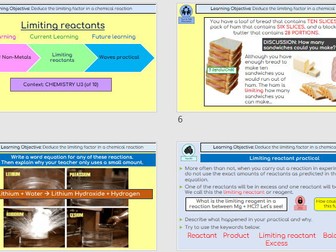
Covers content from the AQA KS4 Triple Chemistry Specification (4.3) on Quantitative Chemistry. The lesson starts with students deducing the limiting factor when making sandwiches and when reacting Alkali Metals with water. Students complete a simple practical and use this to practice vocabulary needed in this topic. Higher students then move onto using moles to determine the limiting factor in a reaction. The lesson moves smoothly from Retrieval practice to main activities (all answers on animations), to exam questions. All worksheets included. PowerPoints are bright, engaging, SEN friendly with minimal visual noise. Whole class teaching with Challenge opportunities where appropriate.
KS4 Triple Chemistry U3 Quantitative Chemistry – Complete PowerPoint lesson on MolesQuick View
s_jackson11

KS4 Triple Chemistry U3 Quantitative Chemistry – Complete PowerPoint lesson on Moles

(0)
Covers content from the AQA KS4 Triple Chemistry Specification (4.3) on Quantitative Chemistry. The lesson starts with explaining the term Mole, and then uses real life objects to help students to grasp the concept. Students then connect the term Mole with Relative Formula Mass and then move onto using the first and most somple molar equation (Moles, Mass, Mr/Ar). The lesson moves smoothly from Retrieval practice to main activities (all answers on animations), to exam questions. All worksheets included. PowerPoints are bright, engaging, SEN friendly with minimal visual noise. Whole class teaching with Challenge opportunities where appropriate.
KS4 Triple Chemistry U3 Quantitative Chemistry – Complete PowerPoint lesson on UncertaintyQuick View
s_jackson11

KS4 Triple Chemistry U3 Quantitative Chemistry – Complete PowerPoint lesson on Uncertainty

(0)
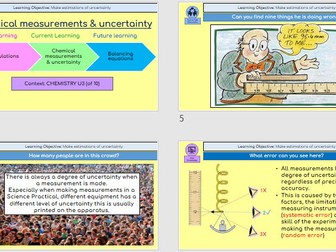
Covers content from the AQA KS4 Triple Chemistry Specification (4.3) on Quantitative Chemistry. The lesson starts with exploring why chemical measurements can be uncertain and moves onto a practical AIM: Which measuring cylinder has the biggest uncertainty? Students then complete the lesson with exam style questions. The lesson moves smoothly from Retrieval practice to main activities (all answers on animations), to exam questions. All worksheets included. PowerPoints are bright, engaging, SEN friendly with minimal visual noise. Whole class teaching with Challenge opportunities where appropriate.
KS4 Triple Chemistry U3 Quantitative Chemistry – Complete PowerPoint lesson on RAM & RFMQuick View
s_jackson11

KS4 Triple Chemistry U3 Quantitative Chemistry – Complete PowerPoint lesson on RAM & RFM

(0)
Covers content from the AQA KS4 Triple Chemistry Specification (4.3) on Quantitative Chemistry. The lesson starts with reviewing the calculation of Relative Atomic Mass and then slowly builds up to the calculation of Relative Formula Mass. Lesson smoothly moves from Retrieval practice to main activities (all answers on animations), to exam questions. All worksheets included. PowerPoints are bright, engaging, SEN friendly with minimal visual noise. Whole class teaching with Challenge opportunities where appropriate.
KS3 Science – Complete PowerPoint lesson on Gas Exchange and ExerciseQuick View
s_jackson11

KS3 Science – Complete PowerPoint lesson on Gas Exchange and Exercise

(0)
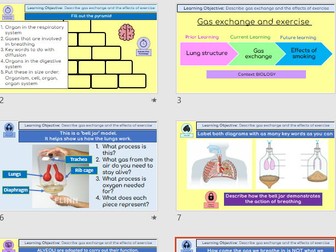
Covers content from the AQA KS3 Syllabus (3.8.3 Breathing) focussing on the mechanics of gas exchange and how exercise affects output. There are two opportunities for practical activities using a bell jar and the second using limewater before and after class activity. Both encourage a kinaesthetic approach to the lesson. Lesson smoothly moves through a unique retrieval practice, to main activities (all answers on animations), finishing with exam questions. Power Points are bright, engaging, SEN friendly with minimal visual noise. Whole class teaching with Challenge opportunities where appropriate.
Year 8 - Food Tests and EnzymesQuick View
s_jackson11

Year 8 - Food Tests and Enzymes

(0)
KS3 Science – Complete PowerPoint lesson on Food Tests and Enzymes in the Digestive System. Covers content from the AQA KS3 Syllabus (3.8.4). Lesson smoothly moves from Retrieval practice - main activities (all answers on animations) - exam questions. PowerPoints are bright, engaging, SEN friendly with minimal visual noise. Whole class teaching with Challenge opportunities where appropriate
KS4 Triple Biology Unit 3 – Complete PowerPoint lesson on Painkillers and AntibioticsQuick View
s_jackson11

KS4 Triple Biology Unit 3 – Complete PowerPoint lesson on Painkillers and Antibiotics

(0)
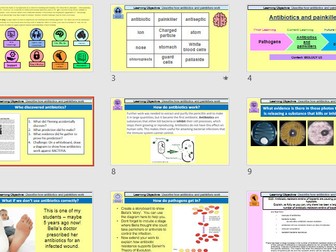
KS4 Triple Biology Unit 3 – Complete PowerPoint lesson on Painkillers and Antibiotics Covers content from the AQA KS4 Triple Biology Specification (4.3.1.8; 4.3.1.9) from how painkilers work to the discovery of Penicillin to antibiotic resistance. Lesson smoothly moves from Retrieval practice - main activities (all answers on animations) - exam questions. Worksheets included. PowerPoints are bright, engaging, SEN friendly with minimal visual noise. Whole class teaching with Challenge opportunities where appropriate.
KS4 Triple Biology Unit 3 – Complete PowerPoint lesson on Human DefencesQuick View
s_jackson11

KS4 Triple Biology Unit 3 – Complete PowerPoint lesson on Human Defences

(1)
KS4 Triple Biology Unit 3 – Complete PowerPoint lesson on Human Defences Covers content from the AQA KS4 Triple Biology Specification (4.3.1.6) on specific and non-specific defences. Lesson smoothly moves from Retrieval practice - main activities (all answers on animations) - exam questions. Worksheets included. PowerPoints are bright, engaging, SEN friendly with minimal visual noise. Whole class teaching with Challenge opportunities where appropriate.
Year 8 - Cells, tissues and the Digestive systemQuick View
s_jackson11

Year 8 - Cells, tissues and the Digestive system

(0)
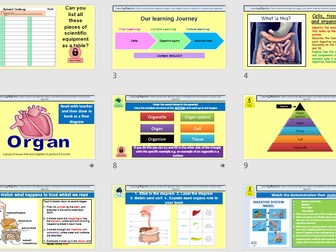
KS3 Science – Complete PowerPoint lesson on the Digestive System. Covers content from the AQA KS3 Syllabus (3.8.4) cellular hierarchy (cells to systems) and focusses on the Digestive System with a ‘Gums to Bums’ practical included. Lesson smoothly moves from Retrieval practice - main activities (all answers on animations) - exam questions. PowerPoints are bright, engaging, SEN friendly with minimal visual noise. Whole class teaching with Challenge opportunities where appropriate.
KS4 Triple Biology Unit 3 – Complete PowerPoint lesson on Discovery and Development of DrugsQuick View
s_jackson11

KS4 Triple Biology Unit 3 – Complete PowerPoint lesson on Discovery and Development of Drugs

(0)
Covers content from the AQA KS4 Triple Biology Specification (4.3.1.9) on the Discovery and Development of Drugs. State how traditional drugs were extracted from plants and organisms (Digitalis, Aspirin and Penicillin) Describe the process of discovery of new medicines Describe the process of development of new medicines including preclinical and clinical phases Lesson smoothly moves from Retrieval practice - main activities (all answers on animations) - exam questions. Worksheets included. PowerPoints are bright, engaging, SEN friendly with minimal visual noise. Whole class teaching with Challenge opportunities where appropriate.
KS4 Triple Biology Unit 3 – Complete PowerPoint lesson on Bacteria and ProtistsQuick View
s_jackson11

KS4 Triple Biology Unit 3 – Complete PowerPoint lesson on Bacteria and Protists

(0)
Covers content from the AQA KS4 Triple Biology Specification (4.3.1.3; 4.3.1.5) on Viruses and Fungi. Describe salmonella, gonorrhoea and malaria Describe how the spread of these diseases can be reduced or prevented Explain how bacteria may produce poisins (toxins) that damage tissue and make us feel ill. Lesson smoothly moves from Retrieval practice - main activities (all answers on animations) - exam questions. Worksheets included. PowerPoints are bright, engaging, SEN friendly with minimal visual noise. Whole class teaching with Challenge opportunities where appropriate.