Whole School Serious Behaviour Tracker | Behaviour Analysis, SEND & PP  | SLT, Governors & OfstedQuick View
cbennett65

Whole School Serious Behaviour Tracker | Behaviour Analysis, SEND & PP | SLT, Governors & Ofsted

(0)
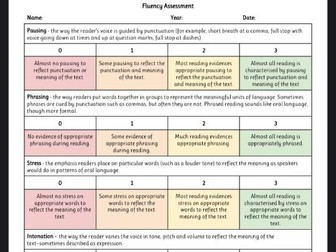
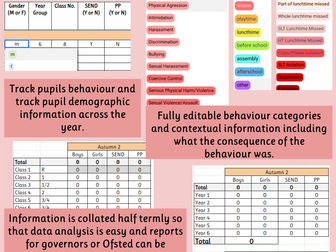
Whole-School SERIOUS Behaviour Tracker | Behaviour Monitoring, Analysis & Reporting Tool - This is to track and monitor extreme / serious behaviours that face sever consequences including exclusion. An easy-to-use, comprehensive Whole-School Behaviour Tracker designed to help school leaders monitor, analyse and evaluate behaviour across their school. This resource allows you to record individual behaviour incidents whilst automatically collating data to identify patterns, trends and areas requiring further support. Key Features: Behaviour Incident Recording: Record pupil information, the date, nature and frequency of incidents, and consequences or actions taken. Pupil Demographics: Track behaviour across key pupil groups, including boys, girls, SEND and Pupil Premium (PP). Half-Termly Data Analysis: Behaviour data is collated into half-termly summary tables, organised by year group and class. Identify Patterns and Trends: Monitor the frequency and nature of incidents, identify recurring behaviours and evaluate the impact of behaviour strategies. Leadership Reporting: Provides valuable quantitative evidence to support SLT discussions, governor reports, school self-evaluation and Ofsted inspections. Strategic Decision-Making: Use data to identify priorities, target interventions and inform whole-school behaviour improvement. Ideal For: Headteachers and Deputy Headteachers Senior Leadership Teams (SLT) Behaviour and Pastoral Leads SENDCos School Governors Why Use This Resource? Effective behaviour management relies on more than simply recording incidents. This tracker helps school leaders move from recording behaviour to analysing trends, evaluating provision and making informed decisions. With clear, half-termly summaries and demographic breakdowns, it provides a practical way to evidence behaviour monitoring, identify potential inequalities and demonstrate the impact of school behaviour policies. A valuable tool for maintaining oversight of behaviour across your school and supporting evidence-informed school improvement. Please ensure pupil information is stored securely and managed in accordance with your school’s GDPR and data protection policies.
Whole School Behaviour Tracker | Behaviour Analysis, SEND & PP Monitoring | SLT, Governors & OfstedQuick View
cbennett65

Whole School Behaviour Tracker | Behaviour Analysis, SEND & PP Monitoring | SLT, Governors & Ofsted

(0)
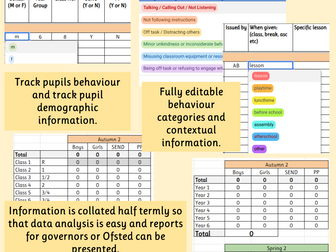
Whole-School Behaviour Tracker | Behaviour Monitoring, Analysis & Reporting Tool (Low Level Behaviours) An easy-to-use, comprehensive Whole-School Behaviour Tracker designed to help school leaders monitor, analyse and evaluate behaviour across their school. This resource allows you to record individual behaviour incidents whilst automatically collating data to identify patterns, trends and areas requiring further support. Key Features: Behaviour Incident Recording: Record pupil information, the date, nature and frequency of incidents, and consequences or actions taken. Pupil Demographics: Track behaviour across key pupil groups, including boys, girls, SEND and Pupil Premium (PP). Half-Termly Data Analysis: Behaviour data is collated into half-termly summary tables, organised by year group and class. Identify Patterns and Trends: Monitor the frequency and nature of incidents, identify recurring behaviours and evaluate the impact of behaviour strategies. Leadership Reporting: Provides valuable quantitative evidence to support SLT discussions, governor reports, school self-evaluation and Ofsted inspections. Strategic Decision-Making: Use data to identify priorities, target interventions and inform whole-school behaviour improvement. Ideal For: Headteachers and Deputy Headteachers Senior Leadership Teams (SLT) Behaviour and Pastoral Leads SENDCos School Governors Why Use This Resource? Effective behaviour management relies on more than simply recording incidents. This tracker helps school leaders move from recording behaviour to analysing trends, evaluating provision and making informed decisions. With clear, half-termly summaries and demographic breakdowns, it provides a practical way to evidence behaviour monitoring, identify potential inequalities and demonstrate the impact of school behaviour policies. A valuable tool for maintaining oversight of behaviour across your school and supporting evidence-informed school improvement. *Please ensure pupil information is stored securely and managed in accordance with your school’s GDPR and data protection policies.
Ofsted Readiness Toolkit - Inclusion (September 2026)Quick View
cbennett65

Ofsted Readiness Toolkit - Inclusion (September 2026)

(0)
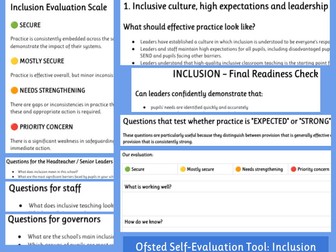
A comprehensive Ofsted Inclusion Readiness Toolkit for state-funded primary schools in Word format - fully editable. This practical resource supports headteachers, senior leaders, SENCos, inclusion leads, pupil premium leads and governors to evaluate how effectively their school identifies and supports pupils who may face barriers to learning or wellbeing. The toolkit includes: What effective practice should look like Ofsted-style questions for leaders, staff, governors, pupils and parents Suggested evidence for each area SEND and Assess–Plan–Do–Review checks Pupil premium and disadvantaged pupil prompts Support for pupils known or previously known to children’s social care Reasonable adjustments and accessibility Alternative provision and inclusion base checks Transition and external agency involvement A final inclusion readiness check Questions to help distinguish between Expected and Strong practice The resource is designed to help schools move beyond compliance and focus on how well needs are identified, barriers are reduced and provision is adapted in response to evidence. Ideal for Ofsted preparation, inclusion audits, SEND reviews, pupil premium reviews, governor monitoring, mock inspections and school improvement planning.
Ofsted Readiness Toolkit: Safeguarding (September 2026)Quick View
cbennett65

Ofsted Readiness Toolkit: Safeguarding (September 2026)

(0)
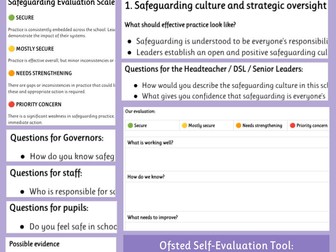
A comprehensive Ofsted Safeguarding Readiness Toolkit designed specifically for state-funded primary schools preparing for inspection under the current Ofsted framework (September 2026). This practical resource helps senior leaders, DSLs, safeguarding governors and school improvement leads evaluate how effectively safeguarding is working across the school — not simply whether policies and paperwork are in place. The toolkit is structured around 15 key safeguarding areas and supports schools to review practice, identify strengths, spot potential gaps and prepare confidently for professional dialogue with inspectors. It includes: Detailed safeguarding self-evaluation prompts Clear indicators of what effective practice should look like Suggested evidence schools may use to demonstrate impact Red / Amber / Green readiness checks Possible questions inspectors may ask Questions for Headteachers, DSLs, staff, governors and pupils Case-file sampling prompts Safer recruitment and Single Central Record checks Online safety and filtering/monitoring questions Child-on-child abuse and behaviour considerations Attendance, children missing education and alternative provision checks SEND and vulnerable pupil safeguarding prompts Multi-agency working and referral questions Medical needs and allergy safety checks Concerns and allegations about adults Governance and strategic safeguarding oversight Pupil voice questions A final safeguarding readiness scorecard Action-planning space for identified priorities This toolkit can be used for: ✓ Ofsted preparation ✓ Safeguarding audits ✓ SLT self-evaluation ✓ DSL reviews ✓ Governor monitoring ✓ Mock inspections ✓ School improvement planning ✓ Staff safeguarding refreshers Rather than creating unnecessary inspection paperwork, the resource is designed to help schools test whether safeguarding systems are understood, consistently implemented and effective in practice. An ideal resource for primary school leaders who want a structured, thorough and manageable way to ask: “If Ofsted inspected safeguarding tomorrow, how confident would we be?”
Class Information TrackerQuick View
cbennett65

Class Information Tracker

(0)
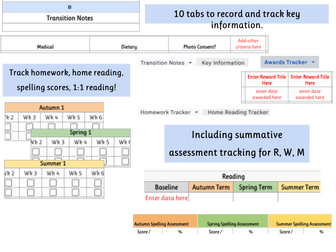
Here is an essential class information tracker. Here transition notes can be added, along with crucial key information such as dietary, medical etc. Assessment data can be recorded, along with homework tracking, 1:1 reading and home reading. Spelling scores and any other assessments can also be added. This Google sheet or Excel doc can record everything you would ever need documenting for your class for the year. Also perfect to hand over at the end of the year to next year’s class teacher.
Individual Support Plan (ISP / TSP) TrackerQuick View
cbennett65

Individual Support Plan (ISP / TSP) Tracker

(0)
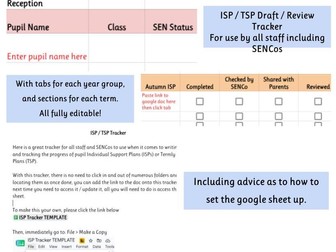
Here is a great tracker for all staff and SENCos to use when it comes to writing, reviewing and tracking the progress of pupil Individual Support Plans (ISPs) or Termly Support Plans (TSP). With this tracker, there is no need to click in and out of numerous folders and spend time locating them as once done, you can add the link to the doc onto this tracker. Then, the next time you need to access it / update it, all you will need to do is access this google sheet. Teachers, SLT and SENCos can track the progress of ISPs/ TSPs using this single doc - helping to streamline what can be a huge task!
Securing an Interview: Application Support Guide for Teachers (inc ECTs)Quick View
cbennett65

Securing an Interview: Application Support Guide for Teachers (inc ECTs)

(0)
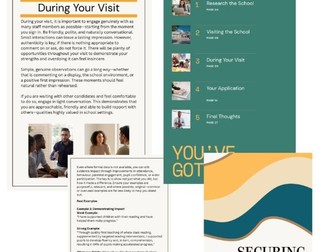
Struggling to secure a teaching interview? Many strong candidates miss out—not due to lack of ability, but because they don’t fully understand what schools are looking for. Written by a Deputy Headteacher with extensive recruitment experience, this 28 page practical guide offers clear, honest advice to help you stand out and secure more interviews. Inside, you’ll learn how to: Make a strong impression during school visits Effectively evidence the person specification Avoid common application mistakes Strengthen your responses with real examples Whether you are an ECT or an experienced teacher, this guide will help you approach applications with confidence and clarity.
KS2 Reading Content Domain Visuals PostersQuick View
cbennett65

KS2 Reading Content Domain Visuals Posters

(1)
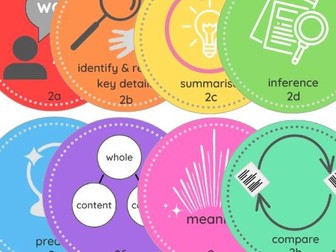
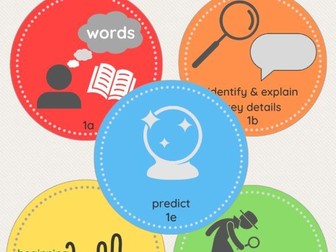
These visual aids support the cognitive domain required in answering questions relating to the KS2 content domains. Each content domain has a colour and a visual which supports a range of learners to associate the skills required in answering a question to a question type. It breaks down the ‘wordy’ content domain into something more simple and use friendly. these should be displayed, feature next to questions on sheets and on slides next to question types. They will need teaching explicitly before full roll out. Dyslexia Sparks (a dyslexia specialist school) stated how fantastic these were in aiding dyslexic learners who already have barriers to overcome when it comes to reading. The colours are also progressive from KS1 - please see my other resource.
School SEF (Self Evaluation) in line with NEW Oftsed 2025 Framework (Primary)Quick View
cbennett65

School SEF (Self Evaluation) in line with NEW Oftsed 2025 Framework (Primary)

(0)
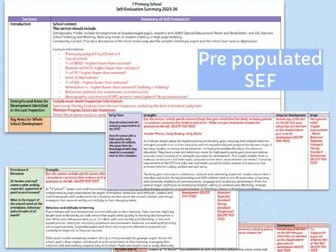
Here is a School Self Evaluation (SEF) for Primary Schools that has been aligned with the NEW Oftsed Framework 2025. Each section covers the main areas of investigation from Ofsted: -Safeguarding -Inclusion -Curriculum and Teaching -Achievement -Attendance and Behaviour -Personal Development and Well-being -Leadership and Governance -Early Years Each section is pre-populated to support primary schools in evidencing the expected standard of strong standard. With some suggested points of reference. This is 14 page document is to serve as a template and needs to be edited to refer specifically to your setting. It provides a sound baseline to build upon.
Pupil Progress Meeting Template (Primary)Quick View
cbennett65

Pupil Progress Meeting Template (Primary)

(0)
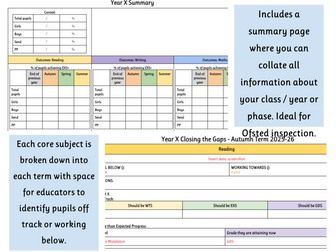
This comprehensive document is designed to help teachers, subject leaders, and school leaders monitor and track pupil progress across Reading, Writing, and Maths throughout the academic year. It combines clear data recording with actionable insights, making it easier to identify gaps in learning and plan targeted interventions. Key features include: Year Group Summary: Quickly capture cohort context, including total pupils, gender splits, SEND, and disadvantaged pupils (PP). Termly Tracking: Record attainment and progress for each pupil every term, highlighting those Off Track, on Track, or achieving More than Expected Progress. Closing the Gaps: Identify pupils working Well Below or Towards the Expected Standard and plan specific actions to support them. Group Analysis: Compare attainment and progress across key groups (girls/boys, SEND, PP, higher attainers) to ensure equity and targeted support. Action Planning: Provides space to record interventions, teaching adjustments, and strategies for challenging more able pupils. Integration with Assessment Tools: Designed to complement the Termly Core Subject Assessment Cribsheet (available separately) for consistent and reliable data analysis. By using this template, schools can efficiently track progress, highlight trends, and make informed, evidence-based decisions to improve outcomes for all pupils. It saves time, supports accountability, and ensures that gaps are addressed proactively.
SEF Template Populated with NEW Oftsed 2025 Framework (Further Education and Skills)Quick View
cbennett65

SEF Template Populated with NEW Oftsed 2025 Framework (Further Education and Skills)

(0)
Here is a School Self Evaluation (SEF) for FE and Skills Settings that has been aligned with the NEW Oftsed Framework 2025. Each section covers the main areas of investigation from Ofsted: -Safeguarding -Inclusion -Leadership and Governance -Contribution to Meeting Skills Needs -Curriculum, Teaching and Training -Achievement -Participation and Development Each section is pre-populated with expected, strong and exceptional standard criteria to support the completion of a personalised SEF. This is 13 page document is to serve as a template and needs to be edited to refer specifically to your setting. It provides a sound baseline to build upon.
Summative Data Assessment Analysis Cribsheet (Primary)Quick View
cbennett65

Summative Data Assessment Analysis Cribsheet (Primary)

(0)
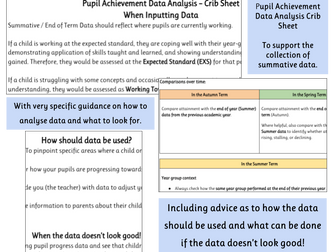
This crib sheet is designed to support teachers, subject leaders, and school leaders in efficiently inputting, analysing, and interpreting pupil achievement data. It provides clear guidance on how to assess pupils at each attainment level (Working Towards, Expected, Greater Depth) and ensures consistency across the school when recording end-of-term or summative data. With step-by-step instructions, the crib sheet helps users: Track pupil progress: Identify knowledge gaps and monitor whether pupils are meeting age-related expectations. Analyse trends and gaps: Quickly highlight patterns by cohort, gender, SEND, disadvantaged pupils, and higher attainers, comparing progress over time and against benchmarks. Inform teaching and interventions: Use data to make evidence-based adjustments to curriculum planning, teaching approaches, and targeted interventions. Support reporting and communication: Provide clear, structured data for parents’ evenings, end-of-year reports, and leadership meetings. By making data analysis straightforward and actionable, this resource saves time, ensures consistency, and empowers educators to make informed decisions that directly impact pupil outcomes.
Electronic Writing Assessment Frameworks (Y1-Y6)Quick View
cbennett65

Electronic Writing Assessment Frameworks (Y1-Y6)

(0)
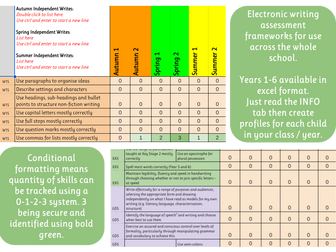
Fully editable excel writing assessment frameworks for use across school. Each child can have their own tab with a record of the skills used. Conditional formatting will show none (pale orange) to secure (bold green) with shades to show emerging in between. These work much better than paper copies and are much more efficient (especially when used as a Google sheet!) Literacy leads can access these across the school and monitor assessment as well as gaps in attainment. Please see INFO tab for details.
Whole School Curriculum Assessment Spreadsheet/Tracker (Google Sheet)Quick View
cbennett65

Whole School Curriculum Assessment Spreadsheet/Tracker (Google Sheet)

(0)
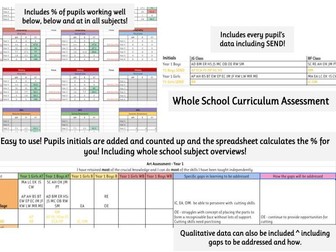
A fully formatted whole school curriculum assessment Google sheet complete with setup instructions AND staff training slides on how to use. All staff are required to do is input children’s initials and add the total number of pupils in each column. The spreadsheet will then calculate percentages and you will have: -Year group % of pupils working: well below, below and at. -Subject overviews (how pupils are performing in each subject with specific subject areas (sculpture, drawing etc.) -ALL foundation subjects (including Science) are included Setup instructions are included (this is where you will download your sheet from) as well as slides presentation for staff roll out. Excel format coming soon!
KS1 Recommended Reads QR Code BookmarksQuick View
cbennett65

KS1 Recommended Reads QR Code Bookmarks

(0)
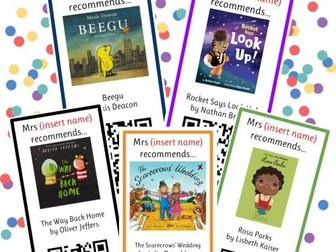
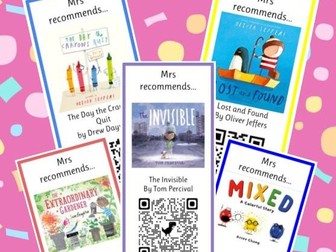
These ‘Recommended Reads’ Bookmarks come with a QR code for children to scan. This will then take them to a quality retelling of that story. Suitable for children in Y1 and Y2, there are enough for each school week of the year. These can be edited by uploading the doc to Canva, or please search ‘how can i edit a pdf file for free?’ on google and Adobe will enable you to do this too. These can be sent home / shared weekly with families or used in reading corners / areas. What’s more these could also be uploaded to school websites. Great for Ofsted’s vision of encouraging a love of reading and reading for pleasure. N.B. QR codes were all working at time of upload (March 2023) This is Set 1 - Set 2 is also available - please see my other items.
KS1 Homophones Spelling PosterQuick View
cbennett65

KS1 Homophones Spelling Poster

(0)
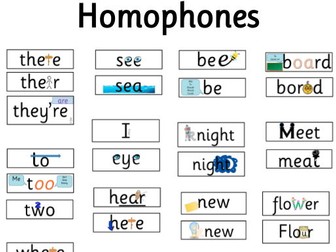
This poster displays key homophones for pupils in KS1 and on entry to KS2. Each word is represented visually. this can be included as an insert in planners, stuck in books or displayed on writing / spelling walls.
KS1 Recommended Reads QR Code Bookmarks - Set 2Quick View
cbennett65

KS1 Recommended Reads QR Code Bookmarks - Set 2

(0)
These ‘Recommended Reads’ Bookmarks come with a QR code for children to scan. This will then take them to a quality retelling of that story. Suitable for children in Y1 and Y2, there are enough for each school week of the year. These can be edited by uploading the doc to Canva, or please search ‘how can i edit a pdf file for free?’ on google and Adobe will enable you to do this too. These can be sent home / shared weekly with families or used in reading corners / areas. What’s more these could also be uploaded to school websites. Great for Ofsted’s vision of encouraging a love of reading and reading for pleasure. N.B. QR codes were all working at time of upload (March 2023) This is Set 2 - Set 1 is also available - please see my other items.
Grammar - Word Types Display PostersQuick View
cbennett65

Grammar - Word Types Display Posters

(0)
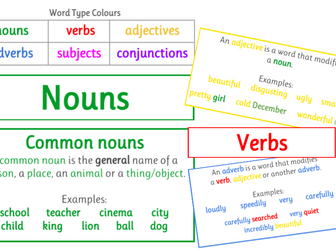
These posters describe the four word types: nouns, verbs, adjectives and adverbs. Each word type adheres to a school-wide agreed colour system: verbs = red nouns = green adjectives = yellow adverbs = blue These are also stated in poster form on this pdf. Colour association helps visual learners. It has been profound for children when constructing sentences and overwriting - knowing which word type is where, what its role is within the sentence and what it could be replaced with. Such visual strategy helps deepen the children’s understanding of word types and grammar - especially when used across the whole school.
Reading Fluency Assessment (Child Version)Quick View
cbennett65

Reading Fluency Assessment (Child Version)

(0)
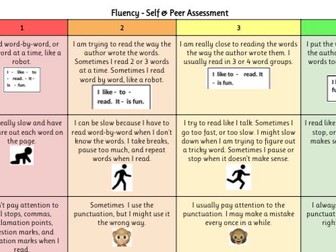
This fluency assessment can be used by a child to assess a their reading fluency. this is usually done in collaboration with a learning partner/peer or an adult. N.B. Reading Fluency is NOT the speed in which a child reads. It covers: Phrasing, Rate, Punctuation, Intonation, Integration etc… This is the Child friendly Please see the detailed Adult friendly version in my shop.
Reading Fluency Assessment (Adult Version)Quick View
cbennett65

Reading Fluency Assessment (Adult Version)

(0)
This fluency assessment can be used to assess a child’s reading fluency. N.B. Reading Fluency is NOT the speed in which a child reads. It covers: Phrasing, Rate, Punctuation, Intonation, Integration etc… This is the Teacher / Adult version Please see child friendly version in my shop.
KS1 Reading Content Domain VisualsQuick View
cbennett65

KS1 Reading Content Domain Visuals

(0)
These visual aids support the cognitive domain required in answering questions relating to the KS1 content domains. Each content domain has a colour and a visual which supports a range of learners to associate the skills required in answering a question to a question type. It breaks down the ‘wordy’ content domain into something more simple and use friendly. these should be displayed, feature next to questions on sheets and on slides next to question types. They will need teaching explicitly before full roll out. Dyslexia Sparks (a dyslexia specialist school) stated how fantastic these were in aiding dyslexic learners who already have barriers to overcome when it comes to reading. The colours are also progressive for KS2 - please see my other resource.