Debate Club | Staying Calm Under Pressure | KS2 Oracy | Ages 6-12Quick View
ConfidentLifeSkills

Debate Club | Staying Calm Under Pressure | KS2 Oracy | Ages 6-12

(0)
Teach students to stay composed, clear, and confident — even when things get difficult. This no-prep KS2 oracy lesson teaches students aged 6–12 how to stay calm when they are challenged, interrupted, or misunderstood. One of the most transferable skills in the entire programme — it applies directly to debate, classroom discussion, and everyday life. Fully scripted with three highly engaging speaking games, structured student workbook tasks, and a printable homework task included. What’s Included Task 1 — Recap and introduction: what staying calm means in debate, why it matters, and what happens when we do not stay calm — full teacher script included Task 2 — Skill of the Week: Staying Calm Under Challenge — student workbook writing section covering what it means, why it matters, four tools for staying calm, helpful calm phrases, and a worked example. Includes a “Your Turn” rewriting task and a stretch challenge Task 3 — “Is This What You Said?” main game: one student explains a simple process step by step while the teacher deliberately misunderstands at every step — the student must correct calmly and clearly without getting frustrated. Three fully scripted examples included: How to Lay the Table, How to Get Ready for School, and How to Make a Sandwich Task 4 — Mini Practice: teacher says increasingly silly statements and students practise responding calmly using key phrases (“I see what you mean, but…” / “I understand your idea, but…”). Four scripted statements with model calm responses plus a bank of extra prompts across everyday life and weather and nature categories Task 5 — Quack Quack Stay on Track game: one student speaks for one minute on a topic while the teacher interrupts at random with “QUACK QUACK” — the student must pause, stay calm, and continue without restarting or rushing. Ten topic options provided with full instructions and teacher prompts Task 6 — Reflection questions with model answers aligned to every task Homework task — printable reinforcement activity to practise staying calm under pressure at home Skills Developed Staying composed when challenged, interrupted, or misunderstood Responding clearly without frustration or raised voices Using calm, polite language under pressure Maintaining control of voice and thinking in debate Building emotional regulation through speaking practice Perfect For
Debate Club Part 1 | 12-Week No-Prep KS2 Oracy, Rebuttal & Public SpeakingQuick View
ConfidentLifeSkills

Debate Club Part 1 | 12-Week No-Prep KS2 Oracy, Rebuttal & Public Speaking

(0)
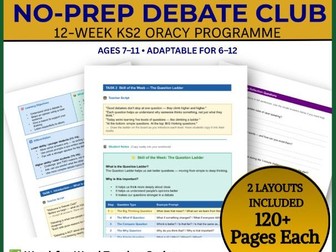
This 12-week Debate Club course is designed for tutors, teachers, and homeschool educators who want to build confident speakers and strong thinkers — without planning, researching, or debating expertise required. Every lesson is fully scripted, clearly structured, and ready to use. Just open the PDF and teach. What This Course Builds Over 12 weeks, students learn how to: Speak clearly and confidently Ask better questions, not just opinions Think deeply about fairness, consequences, and different viewpoints Stay calm, respectful, and organised in discussion Avoid repeating ideas and copy-paste answers This is not competitive debating. It’s thinking-first debating, perfect for primary age groups. What Makes This Different No prep required Step-by-step teacher scripts (say-it-as-written) Clear question frameworks (WHAT / WHY / HOW / WHAT IF / WHO WINS) Homework included every week Works with mixed ages and abilities Ideal for tutors, clubs, enrichment groups & homeschool settings You do not need debate experience to run this course successfully. What’s Included 12 full weekly lessons (revision weeks included) Clear lesson goals + timings Teacher prompts and exact wording Structured class debates Written thinking tasks Weekly homework activities Reflection questions Fully printable PDF (100+ pages) Lesson Length Each session runs 45–60 minutes, with flexible pacing options. Who This Is For Tutors running small groups Primary teachers (Years 1–6) Homeschool educators Debate / speaking clubs After-school enrichment programmes No Preparation. No Research. No Stress. Everything is already done for you, including what to say, what to write, and how to manage discussion. Just print (or display) and teach.
The Boy Who Grew Dragons | KS2 Whole Class Reading | 28 Weekly LessonsQuick View
ConfidentLifeSkills

The Boy Who Grew Dragons | KS2 Whole Class Reading | 28 Weekly Lessons

(0)
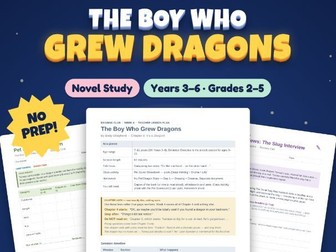
Run a whole year of reading lessons on The Boy Who Grew Dragons by Andy Shepherd with no planning at all. This complete novel study gives you 28 ready-to-teach, 60-minute weekly sessions: one chapter a week, from the opening pages to the very last line, with a lesson plan, class activity, homework and answer sheets for every week. WHAT’S INCLUDED (EVERY WEEK) • Teacher lesson plan with the answer straight after every question • Class activity sheet for children, done in pairs • Class activity answer sheet for teachers and helpers • Homework sheet for children • Homework answer sheet for parents, with a hint to give first and then the answer 28 weeks · 140 documents · 448 pages · print-ready PDFs WHAT EACH LESSON PLAN COVERS • Chapter Lock: the exact first and last lines to read, so nobody reads too far • 60-minute timeline, plus a 45-minute “short on time” version • Recap of last week’s chapter • Hook with possible answers • Six vocabulary words (five in the final week): meaning, the line in the book, and why the author chose the word • Read Together with three pause points and what to listen for • Ten retrieval questions • Twelve deeper questions tagged by reading skill (vocabulary, infer, predict, explain, retrieve, summarise), each with a model answer and a follow-up • Evidence Detective for ages 9–11: find the exact words that prove a point • Spot It! for ages 7–8: a simpler word hunt for younger readers • A class activity with step-by-step timings, roles, an “if stuck” box, easier and harder versions, and what a strong answer sounds like • A close with predictions and a key takeaway ACTIVITIES CHILDREN LOOK FORWARD TO Every week mixes funny, creative, drawing, drama and deep-thinking tasks: Pet Score Showdown, Freeze Frame, Hot Seat, Breaking News reports, Kind or Honest?, and many more. The final week ends with a whole-book review that children write themselves. WHY TEACHERS USE IT • Every question has an answer, so any adult can run the session confidently • Questions come only from that week’s chapter, so there are no spoilers • Answer sheets are separate, so children never see answers on their own sheets • No prep: print and teach PERFECT FOR Whole-class reading, guided reading, after-school reading clubs, intervention groups and homeschool. Designed for UK Years 3–6 (US grades 2–5, ages 7–11). PLEASE NOTE You need your own copy of The Boy Who Grew Dragons (the book is not included). This is an independent teaching resource and is not affiliated with or endorsed by the author, illustrator or publisher. Try before you buy: download Week 1 free from my store.
The Boy Who Grew Dragons | FREE Week 1 | KS2 Whole Class Reading LessonQuick View
ConfidentLifeSkills

The Boy Who Grew Dragons | FREE Week 1 | KS2 Whole Class Reading Lesson

(0)
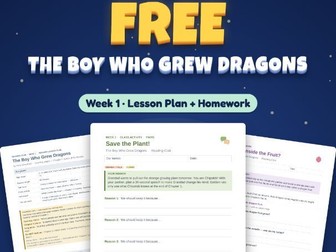
Try the first week of this KS2 whole class reading scheme for The Boy Who Grew Dragons free. A complete one-hour lesson on the opening pages and Chapter 1, “Battle of the Bongle”, for Years 3–6. YOU GET 5 PRINTABLE PDFs Teacher lesson plan with the answer straight after every question and a “SAY THIS” script Class activity for pairs: Save the Plant! Class activity answer sheet for teachers and TAs Homework sheet: What’s Inside the Fruit? Homework answer sheet for parents, with hints INSIDE THE LESSON PLAN Chapter Lock: the exact first and last lines to read A 60-minute timeline, plus a 45-minute version A hook, six vocabulary words, and Read Together with three pause points 10 retrieval questions and 12 deeper questions with model answers Evidence Detective (Years 5–6) and Spot It! (Years 3–4) ENJOYED IT? The full scheme covers the whole book in 28 weekly lessons: 140 PDFs and 448 pages, with answers for everything. [Link to the full pack] You need your own copy of the book; it is not included. This is an independent teaching resource and is not affiliated with or endorsed by the author, illustrator or publisher.
Fantastic Mr Fox Novel Study: 14 Scripted Lessons, Activities + Homework (KS2)Quick View
ConfidentLifeSkills

Fantastic Mr Fox Novel Study: 14 Scripted Lessons, Activities + Homework (KS2)

(0)
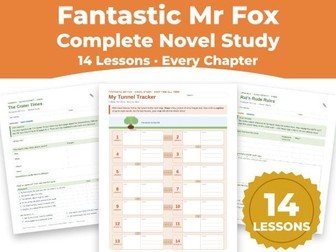
Fantastic Mr Fox Novel Study: 14 Scripted Lessons, Activities + Homework (KS2) DESCRIPTION A complete, ready-to-teach unit for the whole of Fantastic Mr Fox. It has 14 fully scripted one-hour reading lessons covering every chapter, plus a bonus Whole-Book Review lesson. Every question has its answer written straight after it, so a supply teacher, cover teacher or TA can pick it up and teach with confidence. What’s included (290 pages, PDF) Every lesson comes as 5 separate files: Lesson Plan: learning objective, success criteria, a 60-minute plan and a 45-minute version, and a “SAY THIS” teacher script. Also vocabulary with “why the author chose this word”, read-aloud pause points, retrieval and deeper questions tagged with VIPERS (each with a model answer), and support, stretch and EAL notes plus common misconceptions. Class Activity: a different paired activity every lesson. Also Find the Proof! (Years 5–6), Spot It! (Years 3–4), a fast finisher, exit tickets and word wall cards. Class Activity Answers: hints to give first, then full answers. Homework: fun, creative tasks children actually want to do. Homework Answers: a hint and answer for every task, written for parents. Plus Who’s Who character chart: pupils draw and profile the three farmers and Mr Fox, then add new characters as they appear. Tunnel Tracker: a map each pupil fills in, one stop per lesson, building a visual summary of the whole book. It’s spoiler-free. Bonus Whole-Book Review: story-order cards, character change, a debate about the ending, and the Fantastic Book Awards with a class vote. The lessons Chapters 1–2: Farmer Top Trumps Chapter 3: Freeze-Frame the Sneak-Out Chapter 4: Above and Below comic strip Chapter 5: Sound Storm poem Chapters 6–7: The Crater Times front page Chapter 8: Snatch or Stay? role-play Chapter 9: The Secret Plan Envelope Chapter 10: Five-Senses Chicken House Chapters 11–12: Whose Fault? Chapter 13: Pack the Pushcart Chapter 14: Is It Stealing? (both sides) Chapter 15: Rat’s Rude Rules Chapter 16: Tension Thermometer Chapters 17–18: Raise a Toast Why teachers like it Each lesson gives the exact first and last lines to read, so it works with any edition and doesn’t rely on page numbers. Questions come only from that lesson’s chapters, so there are no spoilers. It covers vocabulary, inference, prediction, explaining author’s choices, retrieval and summarising. Answers are kept on separate sheets, so children never see them. It suits whole-class reading, guided reading groups, reading clubs and home education. Please note A copy of Fantastic Mr Fox by Roald Dahl is needed (not included). This is an independent teaching resource. It is not affiliated with or endorsed by the author, illustrator, publisher or rights holders. Licensed for use by one teacher.
FREE Fantastic Mr Fox Lesson 1: Scripted Reading Lesson, Activity + Homework (KS2)Quick View
ConfidentLifeSkills

FREE Fantastic Mr Fox Lesson 1: Scripted Reading Lesson, Activity + Homework (KS2)

(0)
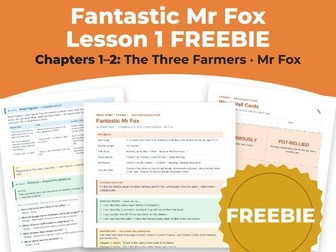
Try a complete, ready-to-teach lesson on Chapters 1–2 of Fantastic Mr Fox, free. It’s fully scripted, so a class teacher, supply teacher or TA can pick it up and teach it in one hour with no preparation. What’s included (21 pages, PDF) Read Me First: what’s in the folder, printing tips and terms of use. Lesson Plan: learning objective and success criteria; a 60-minute plan and a 45-minute version; “SAY THIS” teacher script; six vocabulary words with “why the author chose this word”, and read-aloud pause points; retrieval and deeper questions tagged with VIPERS, each with a model answer; support, stretch and EAL notes, plus common misconceptions. Class Activity: Farmer Top Trumps (pairs). Pupils score Boggis, Bunce, Bean and Mr Fox, then prove each score with a clue from the book. Also Find the Proof! (Years 5–6), Spot It! (Years 3–4), a fast finisher, exit tickets and word wall cards. Class Activity Answers: hints to give first, then full answers. Homework: Invent a Fourth Farmer! Pupils create, draw and describe a new farmer as disgusting as the other three, then explain how clever Mr Fox would get past him. Homework Answers: a hint and answer for every task, written for parents. Why teachers like it It gives the exact first and last lines to read, so it works with any edition. Questions come only from Chapters 1–2, so there are no spoilers. Answers are kept on separate sheets, so children never see them. Love it? The full pack covers the whole book: 14 scripted lessons, a different class activity every lesson, fun homework, a Who’s Who character chart, a Tunnel Tracker map and a bonus Whole-Book Review. Search “Fantastic Mr Fox Novel Study” in my Tes shop. Please note: A copy of Fantastic Mr Fox by Roald Dahl is needed (not included). This is an independent teaching resource. It is not affiliated with or endorsed by the author, illustrator, publisher or rights holders.