The Great Fire of London Knowledge Organiser – KS1 History (Pudding Lane, Samuel Pepys & ChristopherQuick View
Aq1988

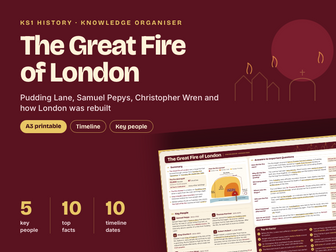
The Great Fire of London Knowledge Organiser – KS1 History (Pudding Lane, Samuel Pepys & Christopher

(0)
A stylish, modern A3 knowledge organiser covering the Great Fire of London in 1666 – how it started, why it spread so quickly, how it was put out and how London was rebuilt. Carefully fact-checked and organised into five colour-coded sections: Summary – key dates, what was destroyed and how many died, plus an original illustrated map showing how the fire spread day by day Key People – Samuel Pepys, Thomas Farriner, King Charles II, Robert Hubert and Sir Christopher Wren Answers to Important Questions – 7 big questions (How did the fire start? Why did it spread so quickly? Who put it out? How do we know?), each with a “Did you know?” fact Top 10 Facts – from the 10-month drought to the Monument and the first fire insurance Timeline – 10 key dates, from 1am on 2nd September 1666 to the completion of the Monument in 1677 Key facts are highlighted throughout to support retrieval practice and revision. All illustrations and the map are original artwork. Perfect for: • KS1 History – events beyond living memory that are significant nationally or globally • Lower KS2 teachers revisiting the topic • Homework, retrieval quizzes, revision and classroom displays Format: PDF, A3 landscape, print-ready in colour.
Early Civilisations Knowledge Organiser – KS2 History (Stone Age to Iron Age, Mesopotamia & AncientQuick View
Aq1988

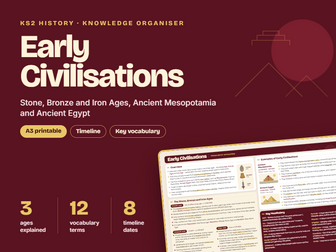
Early Civilisations Knowledge Organiser – KS2 History (Stone Age to Iron Age, Mesopotamia & Ancient

(0)
A stylish, modern A3 knowledge organiser covering early human history and the first civilisations – from the earliest stone tools to Ancient Mesopotamia and Ancient Egypt. Carefully checked for historical accuracy, with clear, child-friendly content organised into five colour-coded sections: Overview – the three ages, the move from hunting and gathering to farming, and why the first civilisations grew up in river valleys The Stone, Bronze and Iron Ages – dates, tools, daily life and key changes in each age, including the Palaeolithic, Mesolithic and Neolithic, plus a note on when each age reached Britain Examples of Early Civilisations – Ancient Mesopotamia and Ancient Egypt: rivers, farming, cities, rulers, religion and writing (cuneiform and hieroglyphs) Key Vocabulary – 12 essential terms, including BCE/CE, civilisation, irrigation, settlement, pharaoh and cuneiform Timeline – 8 key dates, from the first stone tools over 3 million years ago to the Roman invasion of Britain in 43 CE Key facts are highlighted throughout to support retrieval practice and revision. All illustrations are original artwork. Perfect for: • KS2 History – changes in Britain from the Stone Age to the Iron Age • KS2 History – the achievements of the earliest civilisations (Ancient Sumer and Ancient Egypt) • Homework, retrieval quizzes, revision and classroom displays Format: PDF, A3 landscape, print-ready in colour.
Windrush Knowledge Organiser – KS2 History (Empire Windrush, Windrush Generation & Scandal)Quick View
Aq1988

Windrush Knowledge Organiser – KS2 History (Empire Windrush, Windrush Generation & Scandal)

(0)
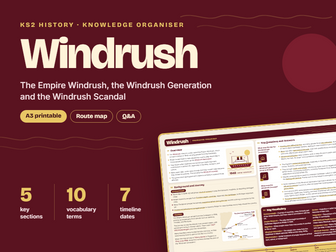
A stylish, modern A3 knowledge organiser covering the story of the Empire Windrush and the Windrush Generation – from Britain’s post-war worker shortage to the Windrush scandal and compensation scheme. Clear, child-friendly content is organised into five colour-coded sections, so pupils can find key information at a glance: Overview – what Windrush was and why it matters Background and Journey – why Britain invited Commonwealth workers, plus an illustrated route map of the 1948 voyage from Trinidad, Jamaica, Mexico and Bermuda to Tilbury Docks, with dates and passenger numbers Key Questions and Answers – What was life like for the Windrush Generation? What did they bring to Britain? What was the Windrush scandal? Key Vocabulary – Ten essential terms, including Commonwealth, migration, discrimination, integration and immigration laws Timeline – 7 key dates from 1945 to 2017–18 Key facts are highlighted throughout to support retrieval practice and revision. All illustrations, icons and the route map are original artwork. Perfect for: • KS2 History – a study of an aspect or theme in British history beyond 1066 • KS3 units on migration and post-war Britain • Black History Month (October) • Windrush Day (22nd June) • Homework, retrieval quizzes, revision and classroom displays Format: PDF, A3 landscape, print-ready in colour (also prints well on A4).
Ancient Greece Knowledge Organiser – KS2 History, Year 4/5 (Gods, Philosophers, Places & Daily Life)Quick View
Aq1988

Ancient Greece Knowledge Organiser – KS2 History, Year 4/5 (Gods, Philosophers, Places & Daily Life)

(0)
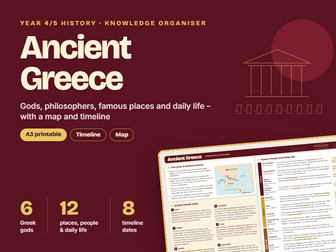
A stylish, modern A3 knowledge organiser for Years 4 and 5, covering Ancient Greek life, achievements and their influence on the western world. Carefully fact-checked and organised into four colour-coded sections: The Land of Ancient Greece – islands, city-states, climate and farming, with an original illustrated map Ancient Greek Gods – Zeus, Poseidon, Hades, Hera, Apollo and Aphrodite Places, People and Daily Life – the Acropolis, the Parthenon, Mount Olympus and Knossos; Socrates, Plato, Aristotle and Alexander the Great; homes, childhood, food and clothes – each with a key fact Timeline – 8 key dates, from the first Olympic Games in 776 BC to the Roman conquest in 146 BC Key facts are highlighted throughout to support retrieval practice and revision. All illustrations and the map are original artwork. Perfect for: • KS2 History – Ancient Greece: a study of Greek life and achievements and their influence on the western world • Years 4 and 5 topics, homework, retrieval quizzes, revision and classroom displays Format: PDF, A3 landscape, print-ready in colour.
World War Two Knowledge Organiser – Year 6 / KS2 History (The Blitz, Evacuation, Rationing & Home FrQuick View
Aq1988

World War Two Knowledge Organiser – Year 6 / KS2 History (The Blitz, Evacuation, Rationing & Home Fr

(0)
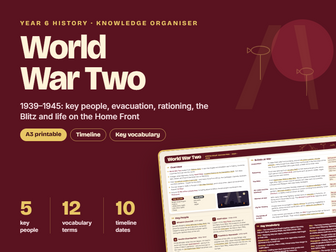
A stylish, modern A3 knowledge organiser for Year 6, covering World War Two (1939–1945) with a focus on Britain and the Home Front. Organised into five colour-coded sections: Overview – why the war started, the Allies and the Axis, the role of Commonwealth soldiers, how the war ended and the Holocaust Key People – Winston Churchill, Adolf Hitler, Neville Chamberlain, Franklin D. Roosevelt and Anne Frank Britain at War – evacuation, rationing, the Blitz, air raids and the blackout, women at war, Dig for Victory and the Battle of Britain, each with a “Did you know?” fact Key Vocabulary – 12 essential terms, including appeasement, evacuee, rationing, propaganda and Home Front Timeline – 10 key dates, from the invasion of Poland in 1939 to VJ Day in 1945 Key facts are highlighted throughout to support retrieval practice and revision. All illustrations are original artwork. Perfect for: • KS2 History – a study of an aspect or theme in British history beyond 1066 (e.g. the Battle of Britain) • Year 6 WW2 topics, homework, retrieval quizzes, revision and classroom displays • Remembrance Day lessons Format: PDF, A3 landscape, print-ready in colour.
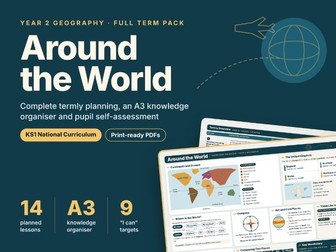
Year 2 Geography Around the World – Full Term Planning + Knowledge Organiser (KS1)Quick View
Aq1988

Year 2 Geography Around the World – Full Term Planning + Knowledge Organiser (KS1)

(0)
A complete, professionally designed term of Year 2 Geography planning for the topic “Around the World” – 14 fully planned lessons plus a matching A3 knowledge organiser and pupil self-assessment. WHAT’S INCLUDED Termly Curriculum Overview (11 pages, A4 landscape) • Curriculum intent, key Geography skills and protected History progression • 14 lessons across two half-terms, each with suggested activities, key learning, success criteria, vocabulary and engaging hook ideas • Cross-curricular English opportunities (linked to Around the World in 80 Days) • Assessment end points checklist • Prior learning from Year 1 for quick retrieval Knowledge Organiser (A3, double-sided) • Front: continents and oceans with an illustrated world map, the four countries and capital cities of the UK, seas around the UK, compass directions, hot and cold places, the full KS1 human and physical features vocabulary, a “Comparing Two Places” grid, and key vocabulary • Back: “What Can I Do?” pupil self-assessment checklist COVERS THE KS1 NATIONAL CURRICULUM FOR GEOGRAPHY • Name and locate the world’s seven continents and five oceans • Name, locate and identify the four countries and capital cities of the UK and its surrounding seas • Identify hot and cold areas of the world in relation to the Equator and the North and South Poles • Use world maps, atlases and globes • Use simple compass directions (N, S, E, W) • Use basic geographical vocabulary for key physical and human features • Compare a small area of the UK with a small area of a contrasting non-European country A strong thread runs through the unit on checking information against reliable sources, including AI-generated maps and images, so pupils learn to verify rather than just accept. Suitable for any school – lessons refer to “our town” and “our country” so you can adapt them to your own setting. All illustrations and maps are original artwork. Format: PDF (A4 landscape overview + A3 knowledge organiser).
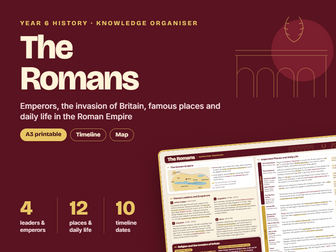
The Romans Knowledge Organiser – KS2 History (Roman Empire & Its Impact on Britain)Quick View
Aq1988

The Romans Knowledge Organiser – KS2 History (Roman Empire & Its Impact on Britain)

(0)
A stylish, modern A3 knowledge organiser covering the Roman Empire and its impact on Britain – ideal for upper KS2. Carefully fact-checked and organised into five colour-coded sections: The Roman Empire – how Rome grew, with an original illustrated map of the empire at its largest Roman Leaders and Emperors – Julius Caesar, Augustus, Claudius and Nero Religion and the Invasion of Britain – Roman gods, the rise of Christianity, Caesar’s expeditions, Claudius’s invasion and Boudicca’s revolt Important Places and Daily Life – the Colosseum, the Pantheon, Hadrian’s Wall, bath houses and the Roman army; family life, slaves, city and country life, school, food and clothes – each with a key fact Timeline – 10 key dates, from the founding of Rome to the end of Roman rule in Britain Key facts are highlighted throughout to support retrieval practice and revision. All illustrations and the map are original artwork. Perfect for: • KS2 History – the Roman Empire and its impact on Britain • Homework, retrieval quizzes, revision and classroom displays Format: PDF, A3 landscape, print-ready in colour.