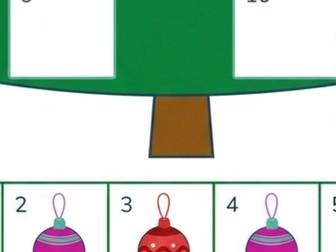
This hands-on math activity is designed for Year 1 pupils to practice sequential counting from 1 to 10. Using a festive tree template and cut-out baubles, young learners develop number sense, ordering skills, and fine motor coordination.
Quick Details
Year Group: Year 1
Duration: 30 minutes
Topic: Number and sequential counting (1–10)
Instructions
Give each pupil the resource sheet.
Have students cut out the numbered baubles.
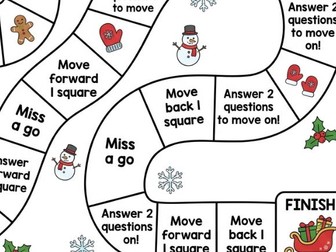
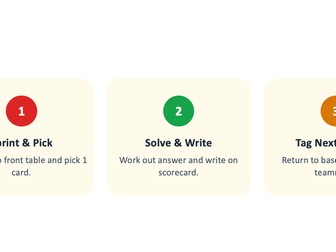
This resource is an engaging, hands-on math board game designed specifically for Year 2 pupils to practice and reinforce calculation skills involving addition and subtraction. The activity helps young learners develop essential number fluency, mental arithmetic, and problem-solving abilities as they help Santa’s reindeer complete their journey in an interactive race format.
The downloadable resource pack features a power point, a printable game board path from start to finish with special action squares, and a grid of thirty distinct addition and subtraction question cards. Pupils work in pairs or small groups, rolling dice and moving along the board while solving calculations to progress. This versatile resource is ideal for primary school math lessons, festive math centers, or homeschooling environments to make arithmetic practice dynamic and enjoyable.
Activity Overview & Details
Year Group(s): Year 2
Duration: 25 minutes
Topic: Calculation (addition and subtraction)
Materials Needed: Reindeer Addition Race resource sheets, dice, and counters or small items to represent each pupil’s reindeer.
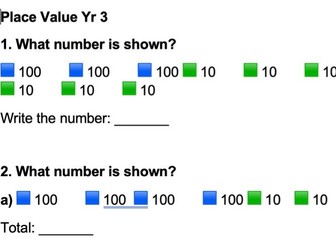
A Year 3 Maths worksheet focusing on place value up to 1,000, helping pupils understand hundreds, tens and ones.
This resource includes a range of activities designed to develop pupils’ understanding of three-digit numbers using visual representations and base-ten (Dienes) equipment.
What’s included:
Identifying numbers represented using hundreds, tens and ones.
Counting and combining base-ten blocks to find totals.
Recognising the value of each digit in a three-digit number.
Building numbers using base-ten equipment.
Identifying missing counters to make a given number.
Solving reasoning questions and explaining different answers.
Learning objectives:
Understand the value of hundreds, tens and ones.
Represent numbers up to 1,000.
Partition and build three-digit numbers.
Develop mathematical reasoning and problem-solving skills.
Suitable for Year 3 pupils, classroom activities, tutoring sessions, independent practice or revision.
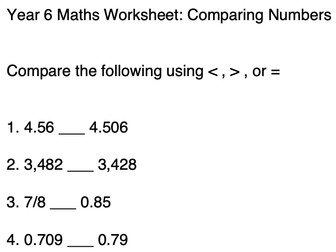
This worksheet helps Year 6 pupils develop their understanding of comparing whole numbers, decimals and fractions. Learners use the symbols <, >, and = to compare values and build confidence in place value and number reasoning.
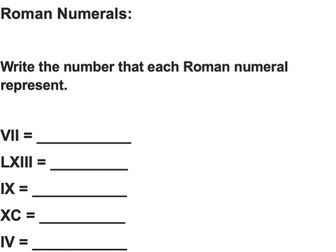
A Roman numerals worksheet designed to help students practise reading, writing and recognising Roman numerals, with an additional challenge involving number sequences.
This resource includes three activities to develop students’ understanding and confidence when working with Roman numerals.
What’s included:
Activity 1: Convert Roman numerals into ordinary numbers, including VII, LXIII, IX, XC and IV.
Activity 2: Convert ordinary numbers into Roman numerals, including 13, 101, 1457, 29 and 695.
Challenge: Complete a sequence by identifying and writing the missing Roman numerals.
Learning objectives:
Recognise common Roman numeral symbols.
Understand how Roman numerals represent numbers.
Practise converting Roman numerals into ordinary numbers.
Write numbers correctly using Roman numerals.
Recognise patterns and sequences involving Roman numerals.
Suitable for Key Stage 2 and Year 7 students, classroom practice, revision, homework or one-to-one tutoring sessions.
A useful printable resource for developing mathematical fluency and confidence with Roman numerals.
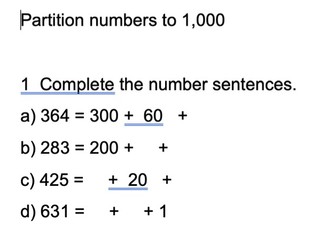
This resource helps pupils understand how numbers are made up and how each digit represents a different place value.
What’s included:
Completing number sentences by partitioning three-digit numbers.
Identifying the hundreds, tens and ones in a number.
Completing part-whole models.
Writing numbers in expanded form.
Practising number decomposition using place value.
Learning objectives:
Partition three-digit numbers into hundreds, tens and ones.
Understand the value of each digit.
Represent numbers in expanded form.
Develop confidence with number sentences and part-whole models.
Suitable for Year 3 pupils, classroom activities, tutoring sessions, independent practice or revision.
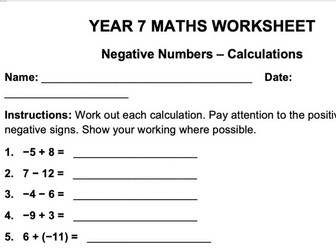
A Year 7 maths worksheet featuring 10 questions on negative number calculations, covering addition, subtraction, multiplication and division.
This resource is designed to help students develop their confidence and accuracy when working with positive and negative numbers.
What’s included:
10 questions covering negative number calculations.
Addition and subtraction involving positive and negative numbers.
Multiplication and division with negative numbers.
A range of questions, starting with simpler calculations and gradually increasing in difficulty.
An additional challenge question involving temperature changes to apply mathematical skills to a real-life situation.
Learning objectives:
Understand how positive and negative numbers work.
Practise adding and subtracting negative numbers.
Apply the rules for multiplying and dividing negative numbers.
Improve accuracy and confidence when calculating with integers.
Suitable for Year 7 students, classroom practice, homework, revision or one-to-one tutoring sessions.
A simple, printable resource that can be used independently or with teacher guidance.
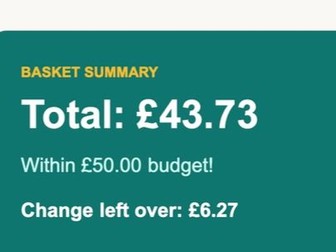
Engage your Year 4 pupils in practical money maths with this differentiated Christmas shopping budget lesson, complete with key vocabulary and support tiers. Ideal for a 1-1.5 hour classroom session, this interactive presentation guides pupils through adding decimals, calculating change and managing a £50 gift budget. Includes a fictional gift catalogue, visual scaffolding and adaptive challenges for all learners.
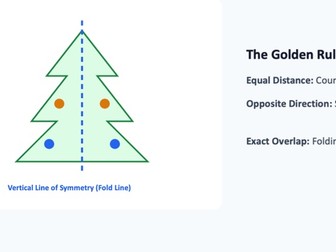
Teach Year 4 geometry and lines of symmetry with this festive Christmas tree lesson, complete with key vocabulary, visual guides and classroom adaptations. Designed for a 1-hour maths session, this interactive presentation guides pupils through folding squared paper, cutting symmetrical outlines and reflecting geometric patterns. Includes equipment checklists, common mistake comparisons and differentiated plain-paper mirror challenges.
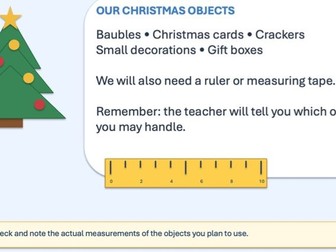
Make maths fun this Christmas with this interactive Year 3 measurement activity!
This classroom-ready PowerPoint supports children in developing their understanding of measurement, focusing on estimating and measuring the length and height of everyday Christmas-themed objects.
What’s included:
Clear explanations of length and height.
Introduction to estimating measurements.
Step-by-step guidance on using a ruler correctly.
Reminders to start measuring at zero.
A fun Christmas-themed team measuring challenge.
Opportunities for discussion and collaborative learning.
A results table to record estimates and actual measurements.
A points-based scoring system to encourage accuracy.
Sentence starters to support mathematical explanations.
End-of-lesson recap questions.
Learning objectives:
Understand the difference between length and height.
Estimate measurements before using measuring equipment.
Measure accurately using centimetres (cm).
Compare estimates with actual measurements.
Develop mathematical vocabulary and reasoning skills.
Suitable for: Year 3 pupils (ages 7–8).
Ideal for whole-class teaching, small-group activities or a festive maths lesson before the Christmas holidays.
Turn Year 5 fractions into an exciting Reindeer Relay Race with this child-friendly lesson, featuring key vocabulary, warm-ups, and all 15 answer keys. Designed for a 1-hour classroom session, this interactive presentation guides teams through adding, subtracting, multiplying, and sharing fractions in festive word problems. Includes visual strategy tips, relay rules, differentiated challenge tiers, and a whole-class answer board.


 Quick View