 Quick View
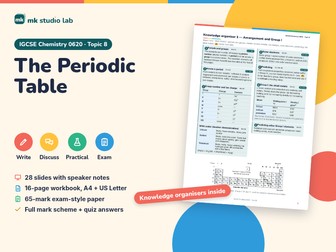
IGCSE Chemistry 0620 The Periodic Table
Groups, periods, Group I, Group VII, transition elements and noble gases in four lessons: slides, a 16-page workbook and a 65-mark paper.
For the 0620 syllabus examined 2026–2028, this pack covers all 15 statements of Topic 8 (The Periodic Table): 13 Core and 2 Supplement. Trends are worded as in the syllabus, and every melting point, boiling point and density in the slides, tables and charts is a real value from the PubChem Periodic Table (NCBI), checked in code against a stored copy of the source. Extended items carry an [E] tag, so one set of files suits a mixed class.
What you get
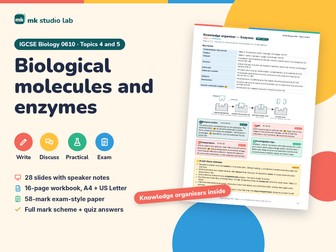
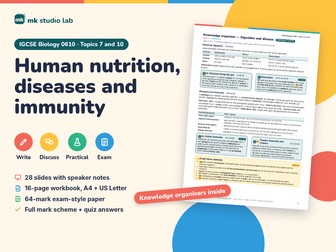
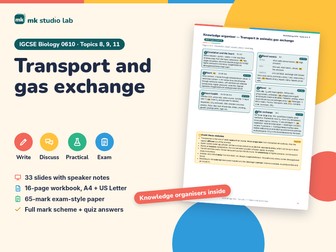
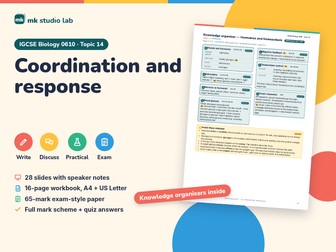
A 28-slide editable PowerPoint (16:9) in four lessons: arrangement of the table and electronic configuration; Group I; Group VII; transition elements and noble gases. Syllabus codes on each content slide, notes, three checkpoints and an exit ticket.
A 16-page workbook in A4 and US Letter PDFs with identical page numbers: coverage map, two knowledge organisers, three ten-question retrieval quizzes with answers, a 65-mark exam-style paper (6 multiple-choice marks and 59 structured marks, about 75 minutes), full marking guidance (ALLOW, IGNORE, NOT) and teacher notes.
Bar charts and tables drawn from real data, including the exceptions the data show (potassium is less dense than sodium), so students predict from evidence.
Every equation is balanced with state symbols, and every halogen displacement result follows the reactivity order, checked in code.
Accessible colour
Colours are given in words; diagrams use labelled grey shades.
Topics covered
Periods and groups; metallic to non-metallic character across a period; charges on ions from group number; outer-shell electrons and group number; noble gas electronic configuration and unreactivity; Group I physical properties, reactions with water and trends; predicting properties of other Group I elements; Group VII as diatomic non-metals, their appearance at room temperature and trends; halogen displacement reactions; predicting properties of other Group VII elements; transition elements: high density, high melting point, coloured compounds, catalysts; noble gases. [E] Predicting properties from position; variable oxidation numbers.
Using it
Core route: 59 of the 65 marks (skip the [E] parts, listed on the paper).
Strong safety notes: Group I with water is a teacher demonstration only (small pieces, safety screen); halogens are handled in a fume cupboard.
For Cambridge IGCSE Chemistry 0620, ages 14–16.
Cambridge IGCSE is a trademark of Cambridge University Press & Assessment. This resource is independently produced and is not endorsed by or affiliated with Cambridge University Press & Assessment. The mark scheme follows IGCSE conventions but is not an official Cambridge mark scheme.
Licence: Tes Teaching Resource Licence. For classroom use by the purchasing teacher; please do not redistribute, resell, or upload to shared drives or public websites.
From MK Studio Lab.