This resource is designed for students to practice free radical substitution in terms of both understanding the rationale for each step (initiation, propagation and termination) and also how the write the correct equations for each type of equation using multiple examples.
This resource is designed for students to be able to define key parts of the solubility topic in GCSE and iGCSE Chemistry within solubility. Students should use two different solubility curves to obtain data. There are 14 questions and answers at the bottom of the sheet that focus on these key points of specifications:
Defining Solubility and other key terms
Interpreting and analysing data from solubility curves
This resource is designed for students to fully understand the difference between molecular and empirical formula and work between different calculations. The resource is divided into multiple sections where it gets progressively challenging. It involves working out the molecular formula using the empirical formula and Mr and calculating the empirical formula from masses or percentages. This resource is suitable for both iGCSE and GCSE specifications.
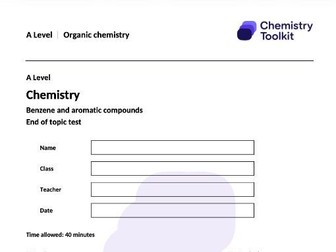
A 40-mark A Level Chemistry end of topic test on benzene and aromatic compounds. It takes 40 minutes and comes with a full mark scheme, so it’s ready to use as an assessment, a mock or a revision lesson.
The questions are written in an exam style and mix several question types:
multiple-choice questions on aromaticity, delocalisation and the nitronium ion
“spot the error” questions: correcting three misconceptions about the structure of benzene
naming and drawing aromatic compounds from skeletal formulae
reagents, conditions and equations
drawing curly-arrow mechanisms for electrophilic substitution
correcting the errors in a student’s mechanism for Friedel–Crafts acylation
a 3-mark extended explanation comparing the reactions of benzene and cyclohexene with bromine water
Topics covered:
the structure and bonding of benzene, including delocalisation, bond lengths, bond angles and planarity
why benzene undergoes substitution rather than addition
naming aromatic compounds
nitration of benzene: forming the electrophile, the mechanism, temperature control and regenerating the catalyst
reducing nitrobenzene to phenylamine
Friedel–Crafts acylation with an acyl chloride and aluminium chloride
the stability of benzene compared with alkenes
Included:
the test paper (PDF, 7 pages), with a cover page, a marks grid and answer spaces
a detailed mark scheme (PDF, 4 pages), with clear marking points and accepted alternatives
It suits AQA, OCR, Pearson Edexcel and other A Level Chemistry specifications that cover arenes and electrophilic substitution.
All questions and diagrams are original.
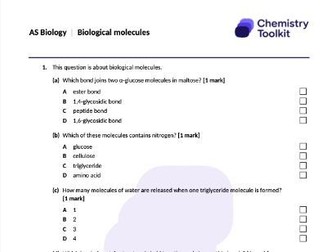
A ready-to-use 40-mark end of topic test for AS Biology Biological Molecules. It takes 40 minutes and comes with a full mark scheme, so it suits an assessment, a mock or a revision lesson.
The questions are written in an exam style and mix several question types:
multiple-choice questions
short-answer and structured questions
completing a table
interpreting a diagram, using an original amino acid structure
data analysis with rate and percentage calculations
a 6-mark extended response question marked with levels
Topics covered:
carbohydrates: glycosidic bonds, starch, glycogen and cellulose
proteins: amino acids, peptide bonds, levels of protein structure and how a change in primary structure affects enzyme function
enzymes: the effect of temperature on rate, and denaturation
lipids: triglycerides as energy stores, phospholipid bilayers, saturated and unsaturated fatty acids
water: polarity, water as a solvent and specific heat capacity
DNA: structure and how it relates to function, and base pairing calculations
The test sticks to core content shared by the major specifications, including AQA, OCR, Pearson Edexcel, WJEC/Eduqas, CCEA and Cambridge International. A teacher note in the mark scheme explains how to check it against your own board.
Included:
the test paper (PDF), with a cover page, a marks grid and answer spaces
a detailed mark scheme (PDF), with accepted alternatives, notes on answers not to credit, and level descriptors for the extended response
All questions and diagrams are original.
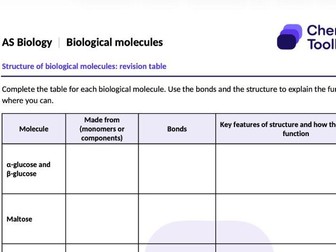
A structured revision table covering the structure and function of 17 key biological molecules for AS Biology. It works well for consolidation at the end of the topic, for exam revision or as a homework task.
For each molecule, students complete three columns:
what it is made from (its monomers or components)
the bonds involved
the key features of its structure, and how they relate to its function
Molecules covered:
carbohydrates: α- and β-glucose, maltose, sucrose, lactose, amylose, amylopectin, glycogen and cellulose
lipids: triglycerides and phospholipids
proteins: the levels of protein structure, globular proteins (such as haemoglobin and enzymes) and fibrous proteins (such as collagen)
nucleic acids and other molecules: DNA, RNA, ATP and water
The completed answer table gives clear model answers for every cell. It focuses on linking structure to function in the way the exams expect, such as why branching allows rapid glucose release and how hydrogen bonds give cellulose its strength.
It suits the major AS and A Level Biology specifications, including AQA, OCR, Pearson Edexcel, WJEC/Eduqas, CCEA and Cambridge International. Exactly what is examined varies between boards.
Included:
a blank student revision table (PDF, 2 pages)
a completed answer table (PDF, 2 pages)
All content is original.
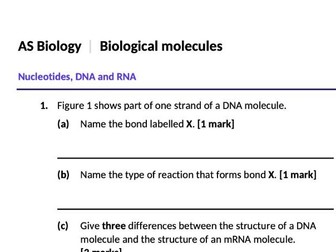
A one-page, 10-mark exam-style worksheet on nucleotides, DNA and RNA for AS Biology. It comes with a full answer sheet and works well as a lesson starter, a plenary, homework or revision.
The questions go beyond recall, asking students to apply their knowledge and interpret information:
interpreting a diagram: students name the phosphodiester bond and the condensation reaction from an original diagram of nucleotides in a single DNA strand
comparing DNA and mRNA: three structural differences
a base pairing calculation: working out the number of adenine bases from a given percentage of cytosine
applying understanding: explaining why the same calculation can’t be used for single-stranded mRNA
data interpretation: explaining why DNA from one species needs a higher temperature to separate its strands, linked to the proportion of G–C base pairs and the number of hydrogen bonds
The answer sheet gives clear marking points, with accepted alternatives and guidance on answers not to credit.
It suits the major AS and A Level Biology specifications, including AQA, OCR, Pearson Edexcel, WJEC/Eduqas, CCEA and Cambridge International. The question gives the numbers of hydrogen bonds, so students don’t need to have learned them.
Included:
the student worksheet (PDF, 1 page)
the answer sheet (PDF, 1 page)
All questions and diagrams are original.
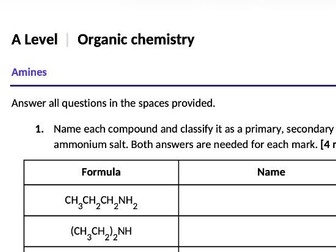
An exam-style worksheet covering the whole A Level Chemistry amines topic, with a detailed answer sheet that includes fully drawn mechanisms. It’s ideal for consolidation at the end of the topic, homework or exam revision.
The worksheet has 8 structured questions, worth 36 marks in total:
naming and classifying primary, secondary and tertiary amines and quaternary ammonium salts
making amines from haloalkanes and ammonia: conditions, the nucleophilic substitution mechanism, and why further substitution gives an impure product
a two-step route through a nitrile: the reagents and conditions, naming the branched amine formed, and the advantages of this route
amines as Brønsted–Lowry bases: equations, and explaining the order of base strength of ammonia, propylamine and phenylamine using the inductive effect and delocalisation
making phenylamine by reducing nitrobenzene
reactions of amines with acyl chlorides and acid anhydrides: the nucleophilic addition–elimination mechanism, naming the amide product, and why ethanoic anhydride is preferred in industry
quaternary ammonium salts as cationic surfactants in fabric conditioners
The answer sheet includes:
clear marking points for every question
fully drawn curly-arrow mechanisms for nucleophilic substitution and nucleophilic addition–elimination
accepted alternatives and helpful teaching notes
The content follows the AQA A Level Chemistry specification closely and is also useful for OCR, Edexcel and other boards that cover amines.
Included:
the student worksheet (PDF, 5 pages, with answer space)
the answer sheet (PDF, 3 pages)
All questions and diagrams are original.
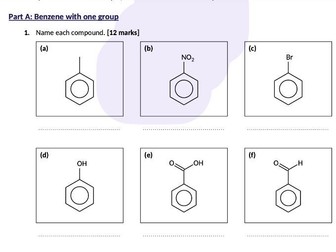
A structured worksheet for practising the systematic naming of aromatic compounds at A Level. It builds step by step from simple substituted benzenes to more demanding multi-substituted compounds, esters and side-chain compounds. A detailed answer sheet is included.
It opens with a clear notes section covering the rules for:
the benzene ring and the phenyl group
prefix groups: alkyl, halogen and nitro
groups that change the parent name: phenol, benzoic acid, benzaldehyde and phenylamine
numbering the ring and putting prefixes in alphabetical order
side-chain compounds, and esters of benzoic acid and phenol
accepted systematic and common names
The worksheet has 5 parts and 40 questions, each worth 1 mark:
Part A: benzene with one group (12 compounds)
Part B: benzene with two groups (9 compounds)
Part C: benzene with three or more groups (6 compounds)
Part D: carbonyl compounds and side chains, including ketones, esters, acyl chlorides and dicarboxylic acids (9 compounds)
Part E: the four aromatic isomers of C₈H₁₀
Every structure is drawn as a clear skeletal formula. The answer sheet shows each structure with its correct name, plus accepted alternatives and common names (such as toluene and xylene). It also notes common incorrect names not to accept, which makes it ideal for self-marking or peer assessment.
It suits AQA, OCR, Pearson Edexcel and other A Level Chemistry specifications that cover naming aromatic compounds.
Included:
the student worksheet (PDF, 6 pages)
the answer sheet (PDF, 6 pages)
All structures and questions are original.
One thing to check before you upload: the subtitle on both PDFs says “Naming and drawing aromatic compounds”, but every question in this file asks students to name structures. None ask them to draw one. You could change the subtitle to “Naming aromatic compounds”, or I can add a short drawing section so it matches.


 Quick View