Revising AQA Language Paper 2 is time consuming because it takes so long to read the long extracts. This exercise solves that by giving students only small bite-sized extracts to work with so they can focus on identifying perspectives, selecting quotations, making inferences and analysing methods and then making comparisons more speedily. There are 4 chunked questions which allows for an I do, we do, you do approach.
Includes model paragraphs for all 4 exercises on a separate sheet so students can compare their work to the high level examples.
Revising AQA Language Paper 2 is time consuming because it takes so long to read the long extracts. This exercise solves that by giving students only small bite-sized extracts to work with so they can focus on selecting quotations, making inferences and then making comparisons more speedily. There are 4 chunked questions which allows for an I do, we do, you do approach.
Includes model answers for all 4 exercises on a separate sheet so students can compare their work to the high level examples.
Success Criteria: a) Choose and embed relevant quotations b) make detailed inferences c) make comparisons.
Key tip 1: Think of it as two 4 mark paragraphs. 2 sets of quotation, inference, comparison covering both texts.
Key Tip 2: Use not only…but also… to develop your inference beyond the obvious
Misconception: Do NOT compare the writer’s feelings. Save that for question 4. Focus on the specific topic only.
A lesson that teaches students a specific method for helping to explore rather than merely explain the impact of word choices in AQA Language Paper 2 Question 3.
There are 4 sets of activities allowing for an I do, we do, you do approach in the lesson.
Model answers are provided for all 4 extracts.
Key tips covered in lesson:
Use tier 2 synonyms to help explain the impact of the words
Think of the connotations of the words
Write a lot about a little
Use phrases like ‘not only… but also …’ or ‘it’s almost as if…’ to go beyond mere explanation to explore the quotation in more depth.
A 6 part structured writing frame that gives students guidance on how to work through the gears in Paper 2 Question 5. While it is prescriptive, the clear structure allows students to focus on the job of writing interesting ideas and interesting sentences knowing the structure is taken care of.
A large collection of exam walkthrough PowerPoints that guide students through how to answer questions 2-4 primarily of various past exams from both Paper 1 and Paper 2. Contains lots of model responses and hints and tips for how to approach each exam that have proved successful for students in the past.
Includes detailed PowerPoints for the following past exams:
Paper 1:
Rosabel June 2017
Alice November 2017
Mr Fisher June 2018
Rosie June 2020
Ugwu November 2021
The Pearl November 2022
Life of Pi June 2023
Paper 2:
Surfing June 2018
Boats June 2019
Elephants Novemeber 2019
Trains June 2022
Hospitals June 2024
(Sorry if any years are slightly out)
The extracts and question papers are freely available to download from the AQA website and various other sites.
Large collection of PowerPoints giving detailed walkthroughs of questions 2-4 of various past AQA English language exams for Paper 1 and Paper 2. It includes detailed tips for how best to answer each question along with model responses.
40 slide PPT walkthrough for the UGWU Novemeber 2021 AQA Language Paper 1 with accompanying 11 page booklet. Ideal for 2 lessons to help with final exam preparation. Includes model answers and tips for questions 2-4. I have not covered the multiple choice on question 1. Question 3 is adapted for 2026 with a focus on how structure is used to build tension.
2 articles on football from a 19th and 21st century perspective in the style of AQA Paper 2 Question 4 along with a full length high grade model answer.
I struggle to find good, accessible extracts to help lower ability students with this question so I turned to AI to help with generating some extracts I could use with a lower ability class of boys. While I admit they are AI-assisted, I have taken a lot of time to edit the extracts to pitch them at a suitably challenging level to help students who really struggle with this question.
Question sheet and revision sheet that encourage students to view the tragedy of Othello through the lens of different languages of love. By doing this, students can gain a more conceptual understanding of the play.
A lesson looking at how 19th century writers use show not tell by looking at 3 extracts from famous villains: Sikes, Dracula and Mr Hyde. Students then work through a deliberately bad example of tell not show before moving on to write their own description of a villain using show not tell.
In this lesson, I have selected 10 key words from 10 key quotations that trigger strong analysable inferences. Students consider ‘why that word’ as they explore each word choice and are encouraged to have conceptual and perceptive thinking before moving to try and tie it into Golding’s wider messages about human nature in the novel.
Detailed PowerPoint that explores 10 conceptual points about the island setting in Lord of the Flies with notes to help students create their own mind map to plan a conceptual high grade response to a question about the island setting.
Model answers for AQA November Paper 2 English Language Resit where the theme of the two extracts was renovating houses.
Includes 2 model answers for each question so students can compare the merits of each side by side.
93 slide PowerPoint providing a comprehensive overview of how to answer the June 2023 Paper 2 English language question when the topic of the extracts was trains.
Also includes high level printable model answers.
A 28 slide PPT that walks through how to answer a question on Ralph. The starter looks at adjectives to describe Ralph, it revises how to embed ideas about context (WWII and the Cold War) before going through a thesis and detailed annotations of 14 key Ralph quotations to help prepare students for writing insightful analysis of this character from Lord of the Flies. Students can make notes on the table to help them with writing up the exam response.
A PowerPoint that walks students through how to write an exam response on the character of Simon. It offers detailed analysis of 12 quotations that track Simon’s progression through the novel. There is an A3 worksheet for students to make notes on as you go through the PPT.
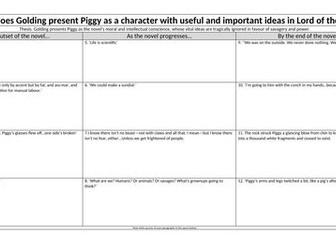
Lesson walkthroughs on the following 4 characters from Lord of the Flies: Simon, Jack, Piggy, Ralph. Each PowerPoint provides insightful analysis of the key quotations for each character and tracks their development across the novel. Students make notes on the accompanying worksheet that ties in directly.
Exam-style question walkthough for how Golding presents Jack as a character who changes. Detailed annotations for 15 quotations tracking Jack’s chronological descent into tyranny. Students record their ideas on the A3 worksheet.
 Quick View

 Quick View
 Quick View