Eduqas A-Level Drama Component 3 Complete Exam Guide Bundle (Section A, B & C)Quick View
AnnetResources

Eduqas A-Level Drama Component 3 Complete Exam Guide Bundle (Section A, B & C)

(0)
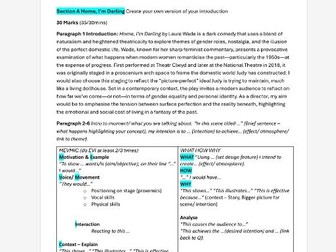
Nailing Component 3 isn’t just about knowing the text, it’s about teaching students how to structure their answers according to exact examiner expectations. I put this complete guide bundle together to break down every single section of the Eduqas A-Level paper step-by-step. While these guides are built around specific set texts (Home, I’m Darling, Brief Encounter, and The Book of Dust), Sections A and B are designed with transferable frameworks that can be effortlessly adapted for any Eduqas set text on the specification. What’s included in the bundle: Section A (10-Mark & 30-Mark Guides): Clear, structured breakdowns on how to approach shorter extract-based questions and high-tariff actor, director, or design essays without waffle. Section B Guide (40-Mark Brief Encounter Focus): A comprehensive guide tackling the live theatre integration and extended essay demands of Section B. Section C Guide: A straightforward guide to navigating the final section of the exam with confidence. Fully Adaptable: While tailored to current set texts, the structure, essay templates, and methodology can be easily swapped to fit whichever set texts your department teaches. Why it’s a department lifesaver: Revision goldmine: Hand them straight to Year 13s as independent revision booklets or use them for structured walking-talking mocks. Demystifies the marking criteria: Shows students precisely what markers are looking for across design, direction, and performance. Zero prep required: Ready to print and hand out immediately. Save your department hours of resource creation—hope it helps your students smash their exams
Directorial & Rehearsal Techniques Menu + Scheme of Work Guide (KS3–KS5 / Devising & Scripted)Quick View
AnnetResources

Directorial & Rehearsal Techniques Menu + Scheme of Work Guide (KS3–KS5 / Devising & Scripted)

(0)
We’ve all seen what happens when you give students 20 minutes of independent rehearsal time without structure - they run the scene twice, say “we’re done,” and sit down. I put this resource together to give students (and teachers!) a clear, practical toolkit for actually developing and refining their work rather than just repeating it. It splits into two massive reference grids - one for rehearsal techniques to build character/polish scenes, and one for directorial conventions to make staging more creative - plus an accompanying PowerPoint showing how to weave them straight into a Scheme of Work. What’s included in the download: Rehearsal Techniques Grid (14 practical strategies) Great for getting groups unstuck when a scene feels flat. Includes clear, student-friendly explanations. Director Techniques Grid (28 staging conventions) A go-to menu of theatrical devices to elevate devised pieces or scripted extracts. Covers everything from foundational techniques (Still Image, Thought Track, Cross-Cutting, Slow Motion, Narration) to higher-level conventions (Verbatim, Gossip Chorus, Montage, Placards, Synchronised Movement, and Echoes). Implementation PowerPoint (Scheme of Work Guide) Breaks down how to structure and embed these techniques across a unit of work so students build independence week by week. How I use this in my classroom: Laminated rehearsal menus: Print the grids back-to-back and laminate them. Hand them to groups during devising or GCSE Component 2/3 prep so they can pick their own rehearsal focus. Written log / portfolio support: Gives students the exact vocabulary they need when writing their GCSE/A-Level devising logs or rehearsal reflections. Instant extension tasks: If a group finishes early, point them to the grid and challenge them to apply two new directorial techniques to their scene. Hope this saves you some planning time! Feel free to leave a review if it works well with your classes.
Eduqas A-Level Drama & Theatre Component 3: Complete Question Bank (Old & New Set Texts)Quick View
AnnetResources

Eduqas A-Level Drama & Theatre Component 3: Complete Question Bank (Old & New Set Texts)

(0)
If you teach Eduqas A-Level Drama, you know how much time disappears just digging through past papers, SAMs, and specification updates to put together decent Component 3 essay practice. I put these documents together so my Year 12 and Year 13 students have a massive, all-in-one bank of practice questions covering both the old and new set texts. Whether you need quick 10-mark starter questions, 30-mark director/actor/design essays, or full 40-mark Section B questions, everything is pulled into one place so you don’t have to go hunting for it. What’s included: Two comprehensive question banks: Covers both the old set texts (great for adapting exam-style stems or using older papers for unseen practice) and the new set texts (including Brief Encounter and Love and Information). Broken down by section and mark tariff: Clearly organized into 10-mark, 30-mark, and 40-mark exam-style prompts so students know exactly what level of detail is expected. Role-specific focus: Includes questions targeting Actor, Director, and Designer perspectives (lighting, sound, costume/hair/make-up, set/props). “Build Your Own Question” Grid: Features a quick-reference breakdown of key Design, Director, and Actor focus areas so higher-attaining students can generate their own practice questions once they’ve worked through the bank. How I use this with my A-Level classes: Revision booklets: Print them off at the start of Year 13 so students have an ongoing menu of timed essay practice for independent study. Walking-talking mocks & planning: Pick a 30- or 40-mark question off the sheet for paired essay planning and extract-selection practice. Adapting across texts: Even if you teach a different set text from the Eduqas list, the question stems and mark structures are completely transferable—just swap in your class’s play and extracts. Hope this saves your department a few hours of admin! Leave a review if you find it useful.
Eduqas A-Level Drama Component 3: Section A Planning Sheets & Question Bank (Home, I'm Darling)Quick View
AnnetResources

Eduqas A-Level Drama Component 3: Section A Planning Sheets & Question Bank (Home, I'm Darling)

(0)
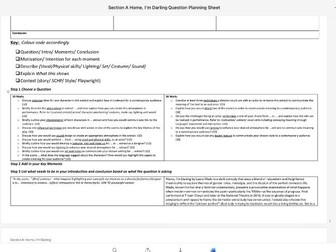
Planning a high-scoring Section A essay shouldn’t be a guessing game for students. I designed these structured planning sheets to give A-Level Drama students a clear, repeatable framework for breaking down both 10-mark extract questions and 30-mark director, actor, and design essays. Specifically tailored around Home, I’m Darling (though fully adaptable for other set texts), these sheets take students step-by-step from initial question deconstruction to a fully fleshed-out essay plan. What’s included in the resource: Dedicated 10-Mark & 30-Mark Templates: Custom-tailored layout boxes that guide students through introductions, linking sentences, moment-by-moment analysis grids, and conclusions. Built-In Colour-Coding System: A handy visual key that teaches students how to systematically track and colour-code their intro/moments, motivations, theatrical skills (vocal, physical, lighting, set, costume, sound), audience impact, and context. Step-by-Step Student Guide: Step 1: Choose your question from the embedded bank of past/specimen 10-mark and 30-mark questions. Step 2: Map out key moments across the extract. Step 3: Structure intros and conclusions using model sentences and overarching concepts (such as Laura Wade’s blend of naturalism/heightened theatricality, 1950s domesticity, gender roles, and nostalgia). Integrated Question Banks: A comprehensive list of practice questions for both mark tariffs right on the sheet so students (or teachers) never have to go hunting for a prompt. Why your students need this: Cuts Exam Panic: Gives them a reliable, visual template that breaks daunting 30-mark essays down into manageable, chunked moments. Encourages Precision: The colour-coding system forces students to balance physical/design execution with deep contextual understanding and audience impact. Zero Prep: Print them off as part of a revision booklet, use them for timed essay practice, or drop them into your pre-exam intervention sessions. Save your students hours of overthinking and give them a bulletproof roadmap to top-band marks!
Live Theatre Design Writing Guide & Terminology PowerPoint (GCSE Drama / KS3–KS4)Quick View
AnnetResources

Live Theatre Design Writing Guide & Terminology PowerPoint (GCSE Drama / KS3–KS4)

(0)
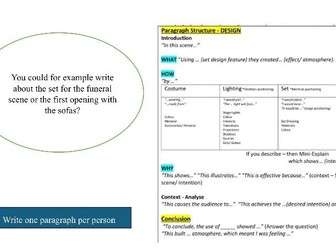
Getting students to move past basic descriptions of stage design and actually write analytical, top-band responses can be tough. I put this complete, ready-to-teach PowerPoint together to introduce students to live theatre design writing. Whether you are prepping Year 10s for GCSE exam requirements or introducing live theatre reviews further down the school, this resource provides a foolproof system that can be used with any live production seen in person or streamed online. What’s included in the PowerPoint: Comprehensive Design Terminology Banks: Detailed vocabulary and keyword breakdowns for Set Design & Props, Costume & Make-Up/Masks, Sound Design, and Lighting. Helps students instantly upgrade their technical vocabulary beyond everyday words. Structured Group-Work Tasks: Frameworks for assigning specific design focuses to groups (e.g., tracking set changes across key scenes like an opening or a funeral). The “What, How, Why” Paragraph Scaffold: A step-by-step writing frame that guides students through introductions, technical execution (“I would place…”, “wearing…”), mini-explanations of intention, and audience impact. Fully Adaptable: Works with any live theatre text or recorded stream, making it completely flexible for your curriculum. Why teachers love it: Zero Prep: Just project it on the board and go—the definitions, prompts, and paragraph structures are all right there for the students. Scaffolds Higher-Order Writing: Breaks daunting design essays down into manageable, structured sentences so lower-attaining students can access the task while pushing higher attainers to use precise technical terminology. Versatile: Perfect for introducing design questions, building revision portfolios, or structuring responses after watching digital theatre. Save your department hours of slide-building—hope it helps your students master their design writing!
The "What, How, Why" Live Theatre & Drama Evaluation Toolkit (KS3–KS5 / GCSE & A-Level Prep)Quick View
AnnetResources

The "What, How, Why" Live Theatre & Drama Evaluation Toolkit (KS3–KS5 / GCSE & A-Level Prep)

(0)
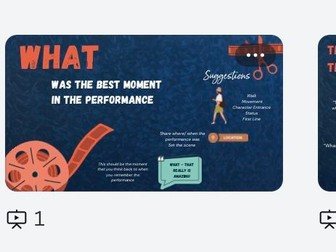
I made this resource because I got so tired of reading drama evaluations that just said “the actor was good and made me feel sad.” If your students struggle to move past plot summary and you want a foolproof way to get them writing proper, analytical responses about live theatre, this is it. It breaks down performance analysis into three simple, manageable steps: What, How, and Why. You can print and laminate these as handy desk mats for paired work, drop them straight into your PowerPoint slides as lesson prompts, or use them as a scaffolding sheet for GCSE and A-Level theatre review prep. What’s inside the pack: WHAT: Teaches kids how to zoom in on a specific, memorable moment (like an entrance, status shift, or key line) instead of retelling the entire story. Includes concrete examples so they know what a specific moment looks like. HOW: A massive bank of theatrical vocabulary split into Vocal Skills (pitch, pace, tone, volume, accent), Physical Skills (gesture, posture, gait, facial expressions), and Drama Techniques (still image, slow motion, mime). It pushes them to write descriptions that could actually be physically acted out. WHY: Helps them analyze the impact. It gets them asking: What did this choice communicate to the audience? How did it build tension or status? How did it make us feel? Why it works in the classroom: Zero prep: Print-and-go or project on the board. Real student models: Features worked examples of what a strong, detailed answer looks like so they have a template to follow. Great bridge to exams: Perfect for embedding analytical habits early in KS3 so GCSE and A-Level live theatre evaluations don’t feel like an impossible mountain to climb. Leave a review if you find it helpful - happy teaching!