Specific Heat Capacity | AQA GCSE Physics Required PracticalQuick View
PhysicsResourcess

Specific Heat Capacity | AQA GCSE Physics Required Practical

(0)
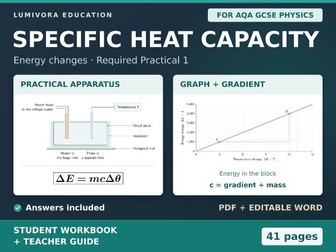
Teach and revise specific heat capacity for AQA GCSE Physics with structured worksheets, Required Practical 1 activities and detailed teacher answers. This 41-page resource combines a separate student workbook and teacher guide, supplied as printable PDFs and editable Word documents. Designed for KS4 students aged 14–16, it develops understanding, calculation skills and practical analysis through worked examples and independent tasks. What is included? 27-page student workbook. 14-page teacher guide with answers, teaching notes and assessment guidance. 91 numbered questions and tasks. 11 worked examples. Original 30-mark assessment with marking guidance. Four resource files: two PDFs and two editable DOCX documents. What does the resource cover? The meaning of specific heat capacity and the difference between temperature and energy. Thermometer readings, temperature changes and unit conversions. Applying and rearranging ΔE = mcΔθ. Energy gained during heating and energy released during cooling. Electrical energy calculations using E = Pt and E = VIt. Required Practical 1 apparatus, circuit connections, variables, method and safety considerations. Recording students’ own measurements and calculating an experimental estimate. Graph construction, best-fit lines, gradients and interpreting different axis arrangements. Simulated heating data, initial temperature lag and justified selection of a straight region. Repeated measurements, means, range and half-range. Repeatability, measurement uncertainty, energy losses and practical improvements. How can it be used? Classroom teaching and guided practice. Preparation for the specific heat capacity required practical. Processing and evaluating students’ own experimental results. GCSE revision, homework and tutoring. Blank laboratory records are included alongside clearly labelled simulated datasets for additional practice. Student activities and teacher answers are kept in separate files. The Word versions contain editable text, tables and equations. Scientific diagrams and graphs are embedded images. Designed to support AQA GCSE Physics 8463, section 4.1.1.3 and Required Practical 1.
Thermal Insulation AQA GCSE Physics | Required Practical 2Quick View
PhysicsResourcess

Thermal Insulation AQA GCSE Physics | Required Practical 2

(0)
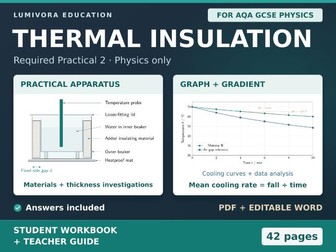
Teach thermal insulation with a structured AQA GCSE Physics Required Practical 2 resource pack, including a student workbook, teacher guide, answers and editable Word files. Guide students through comparing insulating materials and investigating thickness, from planning and practical measurements to cooling graphs, calculations and evaluation. Designed for GCSE Physics 8463, this resource supports the thermal insulation practical and related energy content in specification section 4.1.2.1. Suitable for KS4 students aged 14–16 studying Separate Physics, also commonly called Triple Science. WHAT YOU RECEIVE 25-page student workbook in PDF. 17-page teacher guide in PDF. Editable Word versions of both documents. 42 pages of content, supplied in two formats. Separate student and teacher files for straightforward printing and classroom distribution. STUDENT WORKBOOK Diagnostic questions to check prior knowledge. Explanations of thermal insulation, thermal conductivity, energy transfer and dissipation. Two investigations: comparing insulating materials and exploring the effect of insulation thickness. Clear labelled apparatus diagrams and step-by-step practical guidance. Questions on predictions, variables, fair testing and safety. Recording tables for students’ own practical measurements. Clearly identified simulated datasets for analysis practice. Graph grids for plotting cooling curves and analysing thickness results. Five worked examples covering temperature fall, mean cooling rate, interval gradient, percentage reduction, means and half-range. Tasks on repeat measurements, spread, accuracy and experimental improvements. Applications to insulation in buildings. Retrieval questions, reflection prompts and an original 30-mark assessment, including a six-mark investigation question. TEACHER GUIDE Equipment and preparation notes. A suggested setup to pilot with your available apparatus. Safety considerations and practical troubleshooting guidance. Curriculum links and a student-page reference system. Answers and worked calculations for workbook questions. Model graphs to support feedback. An assessment mark scheme and six-mark model response. HOW TO USE IT Introduce the practical using the diagnostic and concept pages. Select the relevant planning, method and recording sheets for practical lessons. Use the simulated datasets for additional graph and calculation practice. Revisit the retrieval and assessment pages during revision or intervention. Print the PDFs for a consistent layout, or adapt the Word documents to your class. Text, tables and equations are editable; scientific diagrams are embedded as high-resolution images.
Resistance Required Practical 3 | AQA GCSE Physics | PDF + WordQuick View
PhysicsResourcess

Resistance Required Practical 3 | AQA GCSE Physics | PDF + Word

(0)
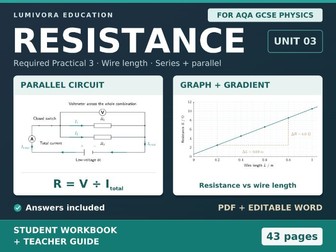
Teach resistance of a wire and resistor combinations with this AQA GCSE Physics Required Practical 3 workbook, including answers, printable PDFs and editable Word files. Designed for AQA GCSE Physics 8463, this 43-page resource takes students through practical planning, circuit setup, measurements, calculations, graph interpretation and evaluation. WHAT YOU RECEIVE Student workbook: 27 pages. Separate teacher guide with answers and marking guidance: 16 pages. Both documents supplied as PDF and editable Word files. 80 questions and practical tasks. 9 worked examples. An original 30-mark assessment, including a six-mark practical-method question. TOPICS AND SKILLS COVERED Investigating how wire length affects resistance at constant temperature. Comparing individual resistors with series and parallel combinations. Reading circuit diagrams and connecting ammeters and voltmeters correctly. Conventional current direction and branch-current rules. Calculating resistance using R = V/I and converting milliamperes to amperes. Measuring contact positions and converting wire length into metres. Recording raw measurements, processing repeats and calculating means. Plotting resistance against length, drawing a line of best fit and calculating gradients. Distinguishing direct proportionality from a graph with a non-zero intercept. Identifying anomalies, evaluating limitations and suggesting improvements. TEACHER SUPPORT Answers with student-page references. Apparatus and safety guidance. Assessment mark scheme and a model six-mark response. Graph-reading tolerances and common misconceptions. Suitable for KS4, Years 10–11, practical preparation, follow-up lessons, homework, revision and targeted intervention. Word text, tables and equations are editable. Diagrams and graphs are embedded images. An optional extension page explains the parallel reciprocal-resistance formula and is clearly labelled beyond the required AQA 8463 calculation scope. Part of the Lumivora Education GCSE Physics practical series.
Characteristics Workbook | AQA GCSE PhysicsQuick View
PhysicsResourcess

Characteristics Workbook | AQA GCSE Physics

(0)
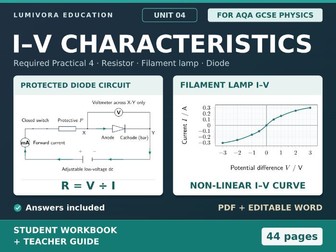
Teach I-V characteristics for AQA GCSE Physics Required Practical 4 with a student workbook, teacher guide, answers and editable Word files. This 44-page resource pack explores current-voltage relationships for a fixed resistor at constant temperature, a filament lamp and a diode. Students develop skills in circuit construction, practical measurements, resistance calculations, graph plotting and evaluation. Designed for KS4, Years 10–11, studying AQA GCSE Physics 8463. WHAT IS INCLUDED 28-page student workbook and 16-page teacher guide. Printable PDFs and editable DOCX versions of both documents. 88 coded questions and tasks, including the assessment. 9 worked examples covering conversions, resistance, gradient and repeated readings. 30-mark assessment with a mark scheme and six-mark practical-method model response. The PDF and Word versions contain the same 44 pages of content. TOPICS AND SKILLS COVERED Circuit symbols, ammeter and voltmeter connections, and measurement circuits. Current direction, supply polarity, variables and safe circuit changes. Recording readings, converting mA to A and calculating resistance using V = IR. Plotting and interpreting I-V graphs, including gradients and best-fit lines or curves. Ohm’s law, constant temperature and filament-lamp resistance. Forward and reverse diode behaviour, including protective resistors. Thermistors, LDRs and their applications. PRACTICAL AND GRAPH ACTIVITIES Results tables for resistor, filament lamp and diode investigations. Practice datasets, blank graph grids and model characteristics. Questions on repeats, means, half-range, resolution and unusual readings. Fault-finding activities and common graph misconceptions. Distinguishing resistance at a point from an I-V graph gradient. TEACHER SUPPORT Answers organised by question code and student-page references. Technician notes, apparatus guidance and diode protection. Curriculum map, worked checkpoints and assessment guidance. HOW TO USE Suitable for practical preparation, classroom investigations, graph-skills lessons, homework, retrieval practice and GCSE Physics revision. EDITABLE FORMAT Text, tables and equations are editable in Microsoft Word. Scientific diagrams and graphs are embedded images that can be resized or replaced. Unit 04 in the Lumivora Education GCSE Physics practical resource series.
Year 1 Maths Worksheets Bundle | KS1 | 13 Printable WorkbooksQuick View
PhysicsResourcess

Year 1 Maths Worksheets Bundle | KS1 | 13 Printable Workbooks

13 Resources
This KS1 maths worksheets bundle brings together 13 colourful, printable workbooks for children aged 5–7 in Year 1 and Year 2. Explore key maths topics through engaging, topic-focused activities covering numbers, calculations, fractions, shapes and measurement. Created by LUMIVORA EDUCATION, this collection is designed for classroom practice, revision and home learning. WHAT’S INCLUDED? Book 1 – Numbers & Place Value to 20 Book 2 – Numbers & Place Value to 100 Book 3 – Addition & Subtraction Within 20 Book 4 – Number Bonds Within 20 Book 5 – Counting in 2s, 5s & 10s Book 6 – Multiplication & Division – Grouping & Sharing Book 7 – Fractions – Halves & Quarters Book 8 – 2D & 3D Shapes Book 9 – Position & Direction Book 10 – Length & Height Book 11 – Weight & Capacity Book 12 – Time Book 13 – Money WHAT CAN CHILDREN PRACTISE? The collection includes activities focused on counting, place value, addition, subtraction, number bonds, grouping and sharing, fractions, shapes, position and direction, length, height, weight, capacity, time and money. Each workbook focuses on a specific topic, allowing teachers and parents to select activities that match children’s learning needs. SUITABLE FOR KS1 children aged 5–7 Year 1 and Year 2 maths practice Classroom activities and reinforcement Small-group learning Home learning and revision WHY CHOOSE THIS BUNDLE? Bring together all 13 themed maths workbooks in one convenient collection. The range of topics makes it easy to choose activities for different areas of early primary maths and revisit important skills. LUMIVORA EDUCATION Explore • Discover • Play • Learn • Grow
Density Required Practical 5 | AQA GCSE Physics WorkbookQuick View
PhysicsResourcess

Density Required Practical 5 | AQA GCSE Physics Workbook

(0)
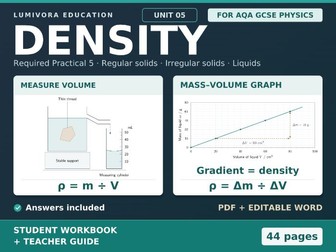
Teach AQA GCSE Physics Required Practical 5 with a density workbook and teacher guide, supplied as printable PDFs and editable Word documents. Designed for GCSE Physics 8463, this 44-page pack covers measuring the density of regular solids, irregular solids and liquids. Students develop practical methods, calculation skills and confidence interpreting results. What’s included: 28-page student workbook and separate 16-page teacher guide. 90 questions and activities, including a 30-mark assessment. 10 worked examples with step-by-step calculations. Answers, marking guidance and practical teaching support. PDF and DOCX versions, with editable text, tables and equations. Topics covered: Density, mass and volume calculations and unit conversions. Measuring dimensions, reading scales and recording results. Water displacement using measuring cylinders and an overflow can. Measuring liquid density and subtracting container mass. Mass-volume graphs, gradients, repeats and measurement uncertainty. Particle models, common errors and improvements to practical methods. Use for practical preparation, classroom investigations, homework or GCSE revision. Unit 05 of the Lumivora Education GCSE Physics Required Practicals series.
Force & Acceleration Required Practical 7 | AQA GCSE PhysicsQuick View
PhysicsResourcess

Force & Acceleration Required Practical 7 | AQA GCSE Physics

(0)
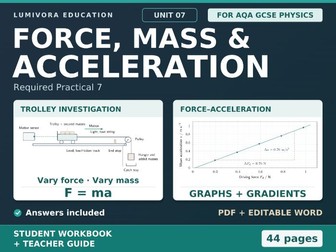
Teach force, mass and acceleration with this AQA GCSE Physics Required Practical 7 workbook, including editable worksheets, answers and a teacher guide. Designed for KS4 students aged 14-16, the pack covers both investigations: changing force at constant total moving mass, and changing mass at constant driving force. What’s included: 28-page student workbook. 16-page teacher guide with answers, marking guidance and technician notes. Two printable PDFs and two editable Word documents. 12 worked examples and 87 questions and tasks. A 30-mark assessment with a clear mark scheme. Topics and skills: Newton’s second law, F = ma, and SI unit conversions. Trolley and pulley apparatus, variables, controls and safe working. Velocity-time graphs and acceleration calculations. Force-acceleration, mass-acceleration and reciprocal-mass graphs. Repeats, means, anomalies, resistance and evaluation. Clearly labelled Higher Tier inertial-mass extension. Use the workbook for practical preparation, recording measurements, guided calculations and GCSE revision. Students move from worked examples to independent graph analysis and evidence-based conclusions. The teacher guide supports planning, feedback and assessment. Word versions allow teachers to edit text, tables and equations; diagrams can be moved, resized or replaced. Created by Lumivora Education for AQA GCSE Physics 8463.
Measuring Waves Required Practical 8 | AQA GCSE PhysicsQuick View
PhysicsResourcess

Measuring Waves Required Practical 8 | AQA GCSE Physics

(0)
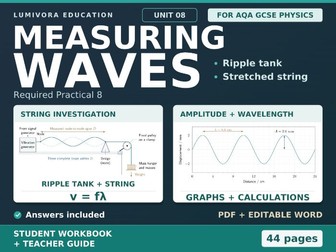
Teach AQA GCSE Physics Required Practical 8 with a structured Measuring Waves workbook and teacher guide. Includes ripple tank and stretched string investigations, worked examples, answers and editable Word files. Designed for AQA GCSE Physics 8463, KS4 students aged 14–16. What’s included: 28-page Student Workbook. 16-page Teacher Guide with answers and marking guidance. 2 printable PDFs and 2 editable DOCX files. 44 pages of content, supplied in both formats. Inside the resource: Clear apparatus diagrams and practical methods. Measuring frequency, wavelength and wave speed in water and a stretched string. Wave equation calculations using v = fλ. 12 worked examples and 87 questions and tasks. Graph interpretation, gradients and model results for analysis. Repeat readings, means, uncertainty and evaluation. Common misconceptions and practical improvements. A 30-mark assessment with answers and marking guidance. Use for practical preparation, classroom practice, revision and targeted intervention. Adapt the Word text, questions and tables to suit your class. Diagrams are supplied as high-resolution images. Part of the Lumivora Education GCSE Physics Required Practicals series.
Force and Extension AQA GCSE Physics Required Practical 6Quick View
PhysicsResourcess

Force and Extension AQA GCSE Physics Required Practical 6

(0)
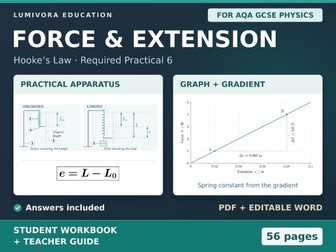
Force and extension worksheets for AQA GCSE Physics, covering Hooke’s law and Required Practical 6, with answers and editable Word files. Designed for KS4 students aged 14–16, this resource supports AQA GCSE Physics (8463), section 4.5.3: Forces and elasticity. What’s included? 34-page student workbook with 101 numbered questions and tasks. 22-page teacher guide with answers, worked solutions, marking guidance and curriculum mapping. 13 worked examples covering calculations, unit conversions and graph gradients. Original 30-mark assessment with a matching mark scheme. Student and teacher materials in PDF and editable Word formats: four files containing 56 distinct pages. What will students learn and practise? Distinguishing original length, loaded length and extension. Stretching, compression, bending, and elastic and inelastic deformation. Applying Hooke’s law, rearranging equations and calculating spring constants. Plotting force–extension graphs, drawing best-fit lines and calculating gradients. Understanding the limit of proportionality and checking elastic recovery. Calculating elastic potential energy, including unit conversions and squared quantities. Identifying anomalies, calculating means and evaluating experimental evidence. Required Practical 6 support Labelled apparatus diagram showing original length, loaded length and extension. Planning questions covering variables, equipment and suitable loading ranges. Numbered method, measurement guidance and safety prompts. Recording tables for students’ own practical measurements. Clearly labelled simulated datasets for additional graph and data-processing practice. Suitable for classroom teaching, practical preparation, homework, independent practice and GCSE Physics revision. The separate teacher guide keeps answers apart from student activities. Editing information: Word text, tables and equations are editable. Scientific diagrams are embedded images. Equipment for the live practical is required separately.
Floating and Sinking EYFS Worksheets | Reception Science | Book 3Quick View
PhysicsResourcess

Floating and Sinking EYFS Worksheets | Reception Science | Book 3

(0)
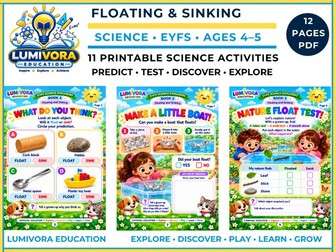
Bring science to life with this colourful 12-page Floating and Sinking EYFS activity pack, designed for Reception children aged 4–5. Part of the LUMIVORA EDUCATION – EYFS Science Explorers series, this printable resource encourages young learners to predict, investigate, observe and discover through hands-on water experiments, playful challenges and engaging illustrations. WHAT WILL CHILDREN EXPLORE? • Discover what floating and sinking mean. • Predict whether familiar objects will float or sink. • Test objects and record observations. • Investigate what happens when a floating toy is pushed underwater. • Compare big and small objects. • Design and test a simple foil boat. • Count how many blocks a floating boat can carry. • Explore floating and sinking with natural materials. • Recognise floating objects in everyday situations. • Record discoveries through drawing and discussion. • Complete a final science challenge with adult support. WHAT’S INCLUDED? • 12 colourful A4 printable PDF pages, including the cover. • 11 child-friendly science activity pages. • Practical investigations and observation activities. • Prediction and recording sheets. • Drawing, counting and discussion opportunities. • Clear visual instructions suitable for Reception learners. EYFS CURRICULUM LINKS Designed to support learning within the Early Years Foundation Stage (EYFS) in England, particularly: Understanding the World – Exploring materials, observing changes and investigating the natural world. Communication and Language – Describing observations, asking questions and discussing discoveries. Mathematics – Counting, comparing and exploring quantities. Activities encourage curiosity, practical exploration and early scientific thinking. EXPLORE THE EYFS SCIENCE EXPLORERS SERIES LUMIVORA EDUCATION is developing a coordinated 12-book science collection for children aged 4–5. Each book explores a different topic through colourful illustrations, hands-on activities and age-appropriate learning experiences. COMPLETED TITLES Book 1 – Exploring Pushes and Pulls Book 2 – Exploring Magnets Book 3 – Exploring Floating and Sinking (this resource) PLANNED FUTURE TITLES Book 4 – Light and Shadows Book 5 – Exploring Everyday Materials Book 6 – Ice, Water and Melting Book 7 – Weather Explorers Book 8 – Seasons and Nature Book 9 – Plants and Growing Book 10 – Animals and Their Habitats Book 11 – Minibeast Explorers Book 12 – Our Wonderful Natural World Together, these resources are designed to help young children explore science through play, investigation, observation and discovery. PERFECT FOR Reception classrooms, EYFS science activities, adult-led investigations, small-group learning, supervised water play and Understanding the World activities. Adult supervision is required for all water investigations. Practical equipment is not included. LUMIVORA EDUCATION Explore • Discover • Play • Learn • Grow
Light and Shadows EYFS Worksheets | Reception Science | Book 4Quick View
PhysicsResourcess

Light and Shadows EYFS Worksheets | Reception Science | Book 4

(0)
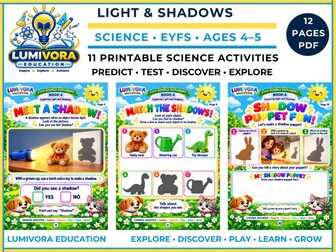
Bring science to life with this colourful 12-page Light and Shadows EYFS activity pack, designed for Reception children aged 4–5. Part of the LUMIVORA EDUCATION – EYFS Science Explorers series, this printable resource encourages children to explore light sources, investigate shadows, make predictions and share discoveries through fun, hands-on activities. WHAT’S INCLUDED? • 12 colourful A4 PDF pages, including the cover. • Light source identification activities. • Shadow matching and outdoor shadow hunts. • Big and small shadow investigations. • Exploring how light passes through different materials. • Shadow puppet activities and creative shadow art. • Drawing, observation and recording worksheets. • A final Little Shadow Explorer Challenge. EYFS CURRICULUM LINKS Supports Understanding the World, Communication and Language, and Expressive Arts and Design through practical exploration, observation and creative learning. EXPLORE THE EYFS SCIENCE EXPLORERS SERIES COMPLETED TITLES Book 1 – Exploring Pushes and Pulls Book 2 – Exploring Magnets Book 3 – Exploring Floating and Sinking Book 4 – Exploring Light and Shadows (this resource) PLANNED FUTURE TITLES Book 5 – Exploring Everyday Materials Book 6 – Ice, Water and Melting Book 7 – Weather Explorers Book 8 – Seasons and Nature Book 9 – Plants and Growing Book 10 – Animals and Their Habitats Book 11 – Minibeast Explorers Book 12 – Our Wonderful Natural World PERFECT FOR Reception classrooms, EYFS science lessons, Understanding the World activities, small-group investigations and creative learning. LUMIVORA EDUCATION Explore • Discover • Play • Learn • Grow
EYFS Pushes and Pulls Worksheets | Reception Science Activities | Book 1Quick View
PhysicsResourcess

EYFS Pushes and Pulls Worksheets | Reception Science Activities | Book 1

(0)
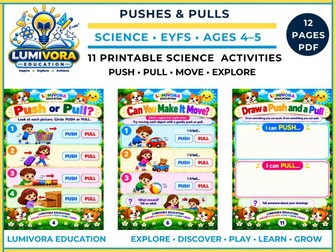
EYFS Pushes and Pulls Worksheets | Reception Science Activities | Book 1 Introduce young learners to the exciting world of forces and movement with Exploring Pushes and Pulls, Book 1 in the LUMIVORA EDUCATION – EYFS Science Explorers series. This colourful, engaging 12-page printable workbook is designed for Reception children aged 4–5, helping them discover how pushes and pulls affect the movement of everyday objects through hands-on exploration, simple predictions, observation and creative activities. WHAT’S INCLUDED? • 12 beautifully illustrated A4 pages, including the cover • Introduction to pushing and pulling • Identifying pushes and pulls in everyday situations • Predicting which way toys will move • Exploring movement using toy cars, balls and wheeled toys • Discovering how a moving toy can be stopped • Comparing gentle and slightly stronger pushes • Finding examples of pushes and pulls in familiar surroundings • Drawing activities to encourage independent thinking • A fun Little Explorer Challenge to revisit key ideas LEARNING OBJECTIVES Through these playful activities, children can: • Recognise and describe simple pushes and pulls • Explore how their actions can make objects move or stop • Make predictions and observe what happens • Develop early scientific vocabulary, including push, pull, move and stop • Communicate their observations through speaking and drawing • Build curiosity, confidence and early investigation skills EYFS CURRICULUM LINKS Designed to support EYFS Understanding the World – The Natural World, drawing on the Department for Education’s Development Matters guidance about exploring and talking about forces children can feel. The activities encourage practical, play-based learning appropriate for Reception children. PERFECT FOR • Reception classrooms (ages 4–5) • EYFS science and discovery activities • Adult-led investigations • Small-group learning • Continuous provision and classroom exploration • Home learning with adult support RESOURCE DETAILS Series: LUMIVORA EDUCATION – EYFS Science Explorers Book: 1 – Exploring Pushes and Pulls Format: Printable PDF Pages: 12, including the cover Paper Size: A4 portrait Language: British English Age Group: Reception (4–5 years) ABOUT THE EYFS SCIENCE EXPLORERS SERIES Exploring Pushes and Pulls is the first book in the LUMIVORA EDUCATION – EYFS Science Explorers series, created to introduce young children to scientific ideas through colourful illustrations, hands-on discovery, playful investigations and age-appropriate activities. Each book in the series focuses on a science-related theme, encouraging children to explore, discover, play, learn and grow. LUMIVORA EDUCATION Explore • Discover • Play • Learn • Grow
EYFS Magnets Worksheets  Reception Science Activities  Book 2Quick View
PhysicsResourcess

EYFS Magnets Worksheets Reception Science Activities Book 2

(0)
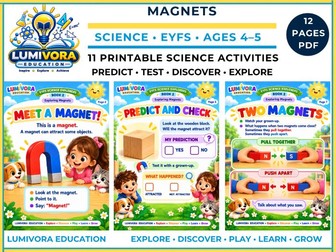
Explore magnets with this colourful 12-page EYFS science workbook, designed for Reception children aged 4–5. Featuring 11 printable activities, this resource encourages prediction, hands-on investigation, observation, discussion and drawing. Exploring Magnets – Book 2 is part of the LUMIVORA EDUCATION EYFS Science Explorers Series, a collection of engaging early years science resources designed to encourage curiosity and exploration of the world around us. What will children learn? Children will explore how magnets attract some objects, make predictions, test different materials with adult support and record what they notice. They will also investigate magnetic attraction without touching, observe two magnets pulling together or pushing apart, recognise everyday uses of magnets and share their discoveries through discussion and drawing. What’s included? 12-page A4 printable PDF 1 colourful cover page 11 illustrated science activity pages Prediction and observation activities Attracted and not attracted sorting tasks Simple magnet investigations Everyday examples of magnets Drawing and reflection activities Little Explorer Challenge Suitable for: EYFS Reception (ages 4–5) Understanding the World Early years science activities Adult-led classroom investigations Small-group learning and discussion About the EYFS Science Explorers Series LUMIVORA EDUCATION’s EYFS Science Explorers is a planned 12-book collection introducing young children to science through observation, prediction, investigation and creative activities. The series includes: Book 1 – Exploring Pushes and Pulls Book 2 – Exploring Magnets (this resource) Planned future titles: Book 3 – Floating and Sinking Book 4 – Light and Shadows Book 5 – Exploring Everyday Materials Book 6 – Ice, Water and Melting Book 7 – Weather Explorers Book 8 – Seasons and Nature Book 9 – Plants and Growing Book 10 – Animals and Their Habitats Book 11 – Minibeast Explorers Book 12 – Our Wonderful Natural World Explore more resources from LUMIVORA EDUCATION as the EYFS Science Explorers collection develops. Curriculum connection This resource supports exploratory learning within the EYFS Understanding the World area, encouraging children to investigate, observe, describe and talk about the natural world. The activities are independently developed teaching materials, not official Department for Education worksheets. Format: Printable A4 PDF. Adult support and appropriate classroom equipment are required for practical investigations. LUMIVORA EDUCATION Explore • Discover • Play • Learn • Grow
Year 1 Weight and Capacity Worksheets | KS1 Maths | Comparing & MeasuringQuick View
PhysicsResourcess

Year 1 Weight and Capacity Worksheets | KS1 Maths | Comparing & Measuring

(0)
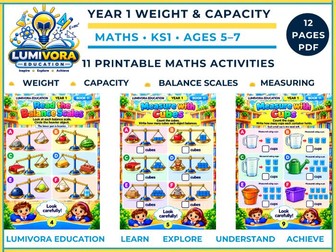
Help children develop a secure understanding of weight and capacity with this colourful, carefully sequenced Year 1 Maths workbook. Designed for Key Stage 1 pupils aged 5–7, this printable workbook introduces children to comparing weight, interpreting balance scales and exploring capacity through practical, visual activities. The tasks progress from simple comparisons to non-standard measurement and early problem-solving. Book 11 in the LUMIVORA EDUCATION Year 1 / KS1 Maths Series, this resource provides structured opportunities to practise measurement vocabulary, reasoning and independent learning. Skills covered Heavy or Light? – Identify whether a highlighted object is heavy or light compared with another object. Heavier or Lighter? – Compare pairs of familiar objects. Read the Balance Scales – Identify the heavier object using the position of the balance pans. Measure with Cubes – Count unit cubes to record an object’s weight. Heaviest and Lightest – Compare weights expressed in cubes. Full, Half Full or Empty? – Recognise different filling levels. More or Less Water? – Compare water quantities in identical glasses. Measure with Cups – Count equal-sized cups used to measure capacity. Which Holds More? – Compare the capacities of different containers. Weight & Capacity Problems – Solve four illustrated measurement problems. Weight & Capacity Challenge! – Complete nine mixed revision activities. What’s included? 12 colourful A4 portrait pages, including the cover 11 printable activity pages Clear, age-appropriate instructions Colourful illustrations and spacious answer areas A final mixed-skills challenge Printable PDF format Ideal for Year 1 Maths lessons, KS1 classroom practice, independent activities, small-group teaching, maths intervention, morning work, homework, early finishers and home learning. About the series LUMIVORA EDUCATION — Year 1 / KS1 Maths Series Book 1: Numbers & Place Value to 20 Book 2: Numbers & Place Value to 100 Book 3: Addition & Subtraction Within 20 Book 4: Number Bonds Within 20 Book 5: Counting in 2s, 5s & 10s Book 6: Multiplication & Division – Grouping & Sharing Book 7: Fractions – Halves & Quarters Book 8: 2D & 3D Shapes Book 9: Position & Direction Book 10: Length & Height Book 11: Weight & Capacity Learn • Explore • Understand • Achieve
Year 1 Telling the Time Worksheets | O'Clock & Half Past | KS1 MathsQuick View
PhysicsResourcess

Year 1 Telling the Time Worksheets | O'Clock & Half Past | KS1 Maths

(0)
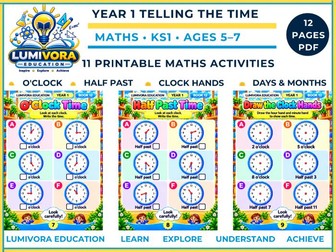
Help children develop confidence in telling the time with this colourful, carefully sequenced Year 1 Maths workbook . Designed for Key Stage 1 pupils aged 5–7, this printable time workbook introduces essential time vocabulary, daily routines, days of the week, months of the year and analogue clocks. Children progress from sequencing everyday events to reading and writing o’clock and half past times, drawing clock hands and comparing earlier and later times. Book 12 in the LUMIVORA EDUCATION Year 1 / KS1 Maths Series, this resource provides engaging opportunities to practise time-telling, develop mathematical reasoning and build independent learning skills. Skills covered Before or After? – Sequence familiar daily events using before and after. Morning, Afternoon or Evening? – Identify times of day through everyday activities. Days of the Week – Complete day sequences and practise yesterday and tomorrow. Months of the Year – Recognise and complete sequences of months. Meet the Clock – Identify the hour hand, minute hand and key clock-face positions. O’Clock Time – Read and record times to the hour on analogue clocks. Half Past Time – Read and record half past times. Draw the Clock Hands – Draw hands on analogue clock faces to show given times. Earlier or Later? – Compare times and identify which comes earlier or later. Time Problems – Apply time-telling and sequencing skills to illustrated questions. Time Challenge! – Review learning through nine mixed activities. What’s included? 12 colourful A4 portrait pages, including the cover 11 printable Maths activity pages Clear, age-appropriate instructions in British English Child-friendly illustrations and dedicated answer spaces A final revision challenge Printable PDF format Ideal for Year 1 Maths lessons, KS1 classroom practice, independent activities, small-group teaching, maths intervention, morning work, homework, early finishers and home learning. About the series LUMIVORA EDUCATION — Year 1 / KS1 Maths Series Book 1: Numbers & Place Value to 20 Book 2: Numbers & Place Value to 100 Book 3: Addition & Subtraction Within 20 Book 4: Number Bonds Within 20 Book 5: Counting in 2s, 5s & 10s Book 6: Multiplication & Division – Grouping & Sharing Book 7: Fractions – Halves & Quarters Book 8: 2D & 3D Shapes Book 9: Position & Direction Book 10: Length & Height Book 11: Weight & Capacity Book 12: Time Learn • Explore • Understand • Achieve
Year 1 Money Worksheets | UK Coins & Notes | KS1 MathsQuick View
PhysicsResourcess

Year 1 Money Worksheets | UK Coins & Notes | KS1 Maths

(0)
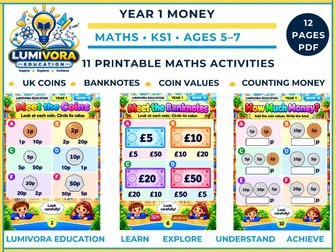
Help children develop a secure understanding of money with this colourful, carefully sequenced Year 1 Maths workbook . Designed for Key Stage 1 pupils aged 5–7, this printable UK money workbook helps children recognise British coins and banknotes, understand their values, compare and order coins, and count simple amounts in pence. Activities progress from identifying coins and notes to counting money, adding coin values and solving simple money problems. Book 13 in the LUMIVORA EDUCATION Year 1 / KS1 Maths Series, this resource supports early money recognition, mathematical vocabulary, counting skills and independent problem-solving through engaging, child-friendly worksheets. Skills covered Meet the Coins – Recognise British coins and identify their values. Match the Coin Values – Match coins to the correct amounts in pence. Which Coin Is Worth More? – Compare UK coins and identify the greater value. Order the Coins – Arrange coin values from smallest to largest. Meet the Banknotes – Recognise £5, £10, £20 and £50 notes. Coins or Notes? – Distinguish between British coins and banknotes. Count the Pennies – Count small groups of 1p and 2p coins. Count in 5p and 10p – Use counting in fives and tens to find totals. How Much Money? – Add the values of simple groups of coins. Money Problems – Solve four illustrated problems involving money. Money Challenge! – Consolidate learning through nine mixed revision activities. What’s included? 12 colourful A4 portrait pages, including the cover 11 printable Maths activity pages Clear, child-friendly instructions in British English Colourful illustrations and spacious answer areas A final mixed-skills challenge Printable PDF format Ideal for Year 1 Maths lessons, KS1 classroom practice, independent activities, small-group teaching, maths intervention, morning work, homework, early finishers and home learning. About the series LUMIVORA EDUCATION — Year 1 / KS1 Maths Series Book 1: Numbers & Place Value to 20 Book 2: Numbers & Place Value to 100 Book 3: Addition & Subtraction Within 20 Book 4: Number Bonds Within 20 Book 5: Counting in 2s, 5s & 10s Book 6: Multiplication & Division – Grouping & Sharing Book 7: Fractions – Halves & Quarters Book 8: 2D & 3D Shapes Book 9: Position & Direction Book 10: Length & Height Book 11: Weight & Capacity Book 12: Time Book 13: Money Learn • Explore • Understand • Achieve
Year 1 Length and Height Worksheets | KS1 Maths | Measuring & ComparingQuick View
PhysicsResourcess

Year 1 Length and Height Worksheets | KS1 Maths | Measuring & Comparing

(0)
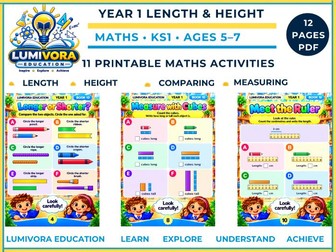
Help children develop a secure understanding of length, height and early measurement with this colourful, carefully sequenced Year 1 Maths workbook . Designed for Key Stage 1 pupils aged 5–7, this printable resource helps children compare, describe and measure lengths and heights using familiar objects, visual comparisons, cubes, paper clips and simple rulers. Activities progress from recognising long, short and tall objects towards ordering lengths and heights, counting non-standard units, measuring in centimetres and solving simple measurement problems. Book 10 in the LUMIVORA EDUCATION Year 1 / KS1 Maths Series, this workbook builds on the comparison, counting and reasoning skills developed throughout the earlier books. Skills covered Long or Short?: Compare the lengths of familiar objects. Tall or Short?: Identify taller and shorter objects. Longer or Shorter?: Compare two objects and select the longer or shorter one. Taller or Shorter?: Compare heights using clear visual examples. Longest and Shortest: Identify the longest or shortest object in a group of three. Tallest and Shortest: Identify the tallest or shortest object in a group of three. Measure with Cubes: Count equal-sized cubes to measure length and height. Measure with Paper Clips: Use repeated non-standard units to measure objects. Meet the Ruler: Explore measuring lengths in centimetres using simple rulers. Length & Height Problems: Solve simple comparison and measurement word problems. Length & Height Challenge: Consolidate learning through a final mixed-skills activity. What’s included? 12 colourful A4 portrait pages, including the cover 11 printable activity pages Clear, child-friendly instructions Long, short, tall, longer and shorter comparison activities Longest and shortest identification tasks Tallest and shortest identification tasks Measuring with cubes and paper clips Simple centimetre ruler activities Visual measurement and reasoning problems A final revision challenge Printable PDF format Ideal for Year 1 Maths lessons, KS1 classroom practice, independent activities, small-group teaching, maths intervention, morning work, homework, early finishers and home learning. About the series LUMIVORA EDUCATION — Year 1 / KS1 Maths Series Book 1: Numbers & Place Value to 20 Book 2: Numbers & Place Value to 100 Book 3: Addition & Subtraction Within 20 Book 4: Number Bonds Within 20 Book 5: Counting in 2s, 5s & 10s Book 6: Multiplication & Division – Grouping & Sharing Book 7: Fractions – Halves & Quarters Book 8: 2D & 3D Shapes Book 9: Position & Direction Book 10: Length & Height Learn • Explore • Understand • Achieve
Year 1 2D and 3D Shapes Worksheets | KS1 Maths | Printable PDFQuick View
PhysicsResourcess

Year 1 2D and 3D Shapes Worksheets | KS1 Maths | Printable PDF

(0)
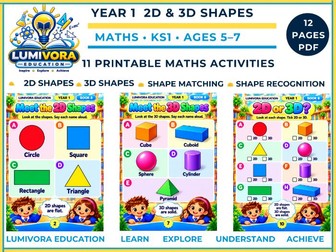
Help children develop a secure understanding of 2D and 3D shapes with this colourful, carefully sequenced Year 1 Maths workbook from LUMIVORA EDUCATION. Designed for Key Stage 1 pupils aged 5–7, this printable resource helps children recognise, name, identify, match and distinguish common 2D and 3D shapes. Activities progress from exploring flat shapes towards recognising solid shapes, connecting them to everyday objects, and solving simple shape problems. Book 8 in the LUMIVORA EDUCATION Year 1 / KS1 Maths Series, this workbook builds on the visual recognition and reasoning skills developed throughout the earlier books. Skills covered Meet the 2D Shapes: Recognise and name circles, squares, rectangles and triangles. Find the 2D Shapes: Identify named 2D shapes from groups of different shapes. Match the 2D Shapes: Match common 2D shapes to their correct names. Draw the 2D Shapes: Practise drawing circles, squares, rectangles and triangles. 2D Shapes Around Us: Recognise 2D shapes in familiar everyday objects. Meet the 3D Shapes: Recognise and name cubes, cuboids, spheres, cylinders and pyramids. Find the 3D Shapes: Identify named 3D shapes from groups of solid shapes. Match the 3D Shapes: Match 3D shapes to familiar real-world objects. 2D or 3D?: Distinguish between flat and solid shapes. Shape Detective Problems: Solve simple shape-identification problems using visual clues. Shapes Challenge: Consolidate learning through a final mixed-skills activity. What’s included? 12 colourful A4 portrait pages, including the cover 11 printable activity pages Clear, child-friendly instructions Common 2D and 3D shape recognition activities Shape naming and matching tasks Drawing and identification exercises Real-life shape examples 2D and 3D sorting and classification practice Simple shape reasoning problems A final revision challenge Printable PDF format Ideal for Year 1 Maths lessons, KS1 classroom practice, independent activities, small-group teaching, maths intervention, morning work, homework, early finishers and home learning. About the series LUMIVORA EDUCATION — Year 1 / KS1 Maths Series Book 1: Numbers & Place Value to 20 Book 2: Numbers & Place Value to 100 Book 3: Addition & Subtraction Within 20 Book 4: Number Bonds Within 20 Book 5: Counting in 2s, 5s & 10s Book 6: Multiplication & Division – Grouping & Sharing Book 7: Fractions – Halves & Quarters Book 8: 2D & 3D Shapes Learn • Explore • Understand • Achieve
Year 1 Fractions Worksheets – Halves & Quarters | KS1 MathsQuick View
PhysicsResourcess

Year 1 Fractions Worksheets – Halves & Quarters | KS1 Maths

(0)
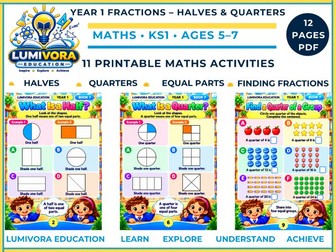
Help children develop a secure understanding of halves and quarters with this colourful, carefully sequenced Year 1 Maths workbook . Designed for Key Stage 1 pupils aged 5–7, this printable resource helps children recognise, find and name halves and quarters of shapes, objects and quantities. Activities progress from identifying two equal parts towards recognising four equal parts, finding fractions of groups, and solving simple fraction problems. Book 7 in the LUMIVORA EDUCATION Year 1 / KS1 Maths Series, this workbook builds on the counting, grouping and sharing skills explored in the earlier books. Skills covered What Is a Half?: Recognise one half as one of two equal parts of a whole. Find the Halves: Identify shapes divided into two equal parts and distinguish equal from unequal parts. Make Two Equal Parts: Draw lines to divide shapes into halves. Find Half of a Group: Find half of collections of objects using visual counting. What Is a Quarter?: Recognise one quarter as one of four equal parts of a whole. Find the Quarters: Identify shapes divided into four equal parts and distinguish equal from unequal parts. Make Four Equal Parts: Draw lines to divide shapes into quarters. Find a Quarter of a Group: Find one quarter of collections of objects. Half or Quarter?: Identify whether a shaded part represents one half or one quarter. Halves & Quarters Problems: Solve simple fraction word problems using visual representations. Fractions Challenge: Consolidate learning through a final mixed-skills activity. What’s included? 12 colourful A4 portrait pages, including the cover 11 printable activity pages Clear, child-friendly instructions Visual models of halves and quarters Equal and unequal part recognition activities Shape-dividing and colouring tasks Finding halves and quarters of groups of objects Simple fraction word problems A final revision challenge Printable PDF format Ideal for Year 1 Maths lessons, KS1 classroom practice, independent activities, small-group teaching, maths intervention, morning work, homework, early finishers and home learning. About the series LUMIVORA EDUCATION — Year 1 / KS1 Maths Series Book 1: Numbers & Place Value to 20 Book 2: Numbers & Place Value to 100 Book 3: Addition & Subtraction Within 20 Book 4: Number Bonds Within 20 Book 5: Counting in 2s, 5s & 10s Book 6: Multiplication & Division – Grouping & Sharing Book 7: Fractions – Halves & Quarters Learn • Explore • Understand • Achieve
Year 1 Position and Direction Worksheets  KS1 Maths  Turns & MovementQuick View
PhysicsResourcess

Year 1 Position and Direction Worksheets KS1 Maths Turns & Movement

(0)
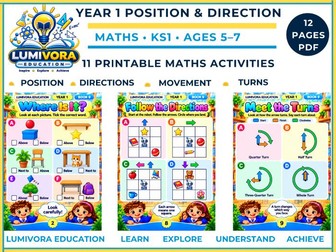
Help children develop a secure understanding of position, direction and movement with this colourful, carefully sequenced Year 1 Maths workbook . Designed for Key Stage 1 pupils aged 5–7, this printable resource helps children describe positions, recognise directions, follow simple movements and explore turns. Activities progress from everyday positional language towards following directions on grids, identifying clockwise turns and solving simple position and direction problems. Book 9 in the LUMIVORA EDUCATION Year 1 / KS1 Maths Series, this workbook builds on the visual recognition, spatial awareness and reasoning skills developed throughout the earlier books. Skills covered Where Is It?: Recognise and describe positions using above, below and next to. Inside or Outside?: Identify whether objects are inside or outside familiar spaces. Left or Right?: Recognise the position of objects to the left or right. Top, Middle or Bottom?: Identify the position of a star in a group of three objects. Between, Near and Far: Explore positional vocabulary using clear visual examples. Which Way?: Identify directional arrows and explore forwards and backwards movement. Follow the Directions: Follow arrow instructions on simple grids to identify a destination. Meet the Turns: Explore quarter, half, three-quarter and whole turns using visual models. Which Turn?: Recognise different clockwise turns from illustrated turning arrows. Position & Direction Problems: Solve simple positional and directional word problems. Position & Direction Challenge: Consolidate learning through a final mixed-skills activity. What’s included? 12 colourful A4 portrait pages, including the cover 11 printable activity pages Clear, child-friendly instructions Positional language and spatial awareness activities Left and right recognition exercises Inside, outside, above, below and between activities Directional arrows and movement practice Simple grid-based direction tasks Visual quarter, half, three-quarter and whole turns Position and direction word problems A final revision challenge Printable PDF format Ideal for Year 1 Maths lessons, KS1 classroom practice, independent activities, small-group teaching, maths intervention, morning work, homework, early finishers and home learning. About the series LUMIVORA EDUCATION — Year 1 / KS1 Maths Series Book 1: Numbers & Place Value to 20 Book 2: Numbers & Place Value to 100 Book 3: Addition & Subtraction Within 20 Book 4: Number Bonds Within 20 Book 5: Counting in 2s, 5s & 10s Book 6: Multiplication & Division – Grouping & Sharing Book 7: Fractions – Halves & Quarters Book 8: 2D & 3D Shapes Book 9: Position & Direction Learn • Explore • Understand • Achieve
Year 1 Multiplication and Division Worksheets – Grouping & Sharing | KS1 MathsQuick View
PhysicsResourcess

Year 1 Multiplication and Division Worksheets – Grouping & Sharing | KS1 Maths

(0)
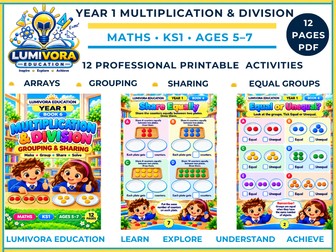
Year 1 Multiplication and Division Worksheets | Grouping & Sharing | KS1 Maths Book 6 of the LUMIVORA EDUCATION Year 1 Maths Series. Help Year 1 pupils build confidence in multiplication and division with this colourful 12-page printable KS1 maths workbook, designed to support the National Curriculum for England. Children explore equal groups, repeated addition, arrays, grouping and sharing equally through engaging picture-based activities and simple problem-solving tasks. What’s Included? Equal and unequal groups Counting and making equal groups Repeated addition and arrays Sharing equally between two and three plates Grouping objects in twos and fives Simple multiplication and division word problems Final grouping and sharing challenge Perfect For: Year 1 maths lessons, KS1 classroom activities, independent practice, small-group teaching, homework, home learning and revision. Resource Details: Series: LUMIVORA EDUCATION Year 1 Maths Series Book: 6 – Multiplication & Division: Grouping & Sharing Age Range: 5–7 Key Stage: KS1 Format: Printable A4 PDF Pages: 12 (1 cover + 11 activity pages) Language: British English Explore the Series: This workbook is part of the LUMIVORA EDUCATION Year 1 Maths Series, a growing collection of colourful, structured maths resources covering essential Year 1 skills. Discover Books 1–5 and more resources in our TES store. LUMIVORA EDUCATION Learn • Explore • Understand • Achieve