 Quick View
KS3 English: Poetic Language and Imagery in 'The Merchant of Venice'
KS3 English lesson on poetic imagery, using Shakespeare to explore how imagery creates meaning and effect through guided analysis and structured writing.
This KS3 English lesson on poetic imagery is a clear, engaging and academically rigorous resource designed to help students identify, analyse and write about imagery as a poetic technique, with a specific focus on Shakespeare.
The lesson uses a comparative lens (human body imagery vs animal imagery) to encourage precise reading and deeper interpretation. Students are guided step-by-step through scholarly reading, discussion, and analytical paragraph writing, making this ideal for building confidence with language analysis and PEE/WHAT–HOW–WHY/SO WHAT style responses.
What’s included:
A fully resourced PowerPoint (.pptx) lesson
Clear learning focus: How does Shakespeare use imagery as a poetic technique?
Do Now / Think-Pair-Share retrieval activity on imagery and poetic techniques
Precise, student-friendly definition of imagery
Guided practice spotting imagery in Shakespearean language
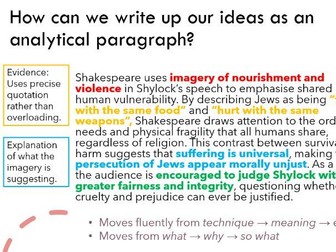
A model analytical paragraph
Scaffolded sentence starters to support independent analytical writing
Opportunities for peer critique and reflection
Exit ticket plenary to check understanding
Skills developed:
Identifying and explaining imagery
Analysing writer’s methods
Writing clear, developed analytical paragraphs
Using subject-specific vocabulary accurately
Moving from technique → meaning → effect
Designed for:
KS3 English (Years 7–9)
Easily adaptable for KS4 / GCSE English Literature
Suitable for mixed-ability classes, with built-in scaffolding and challenge
How it can be used:
As a standalone lesson on poetic imagery
As part of a Shakespeare unit
For building foundations for GCSE language and literature analysis
Ideal for observations, trainee teachers, or anyone wanting a high-expectation, low-prep lesson.