30 Python Challenges for GCSE Computer ScienceQuick View
learncomputing

30 Python Challenges for GCSE Computer Science

(0)
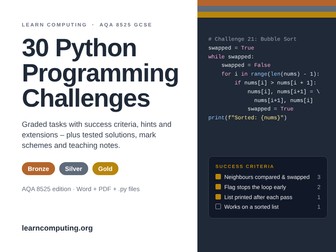
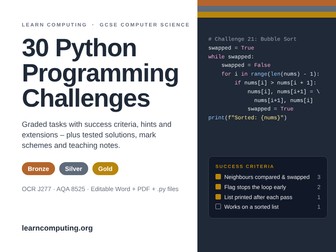
Thirty original, graded Python challenges that take students from their first input() to bubble sort, binary search, file handling and 2D lists – with a tested model solution, mark scheme and teaching notes for every one. Each challenge is a single printable page: the task, a numbered list of what the program must do, an exact example run, a success-criteria checklist with marks, a hint and an extension task. Students tick off the criteria as they go and record their marks on the progress tracker. Bronze (1–10, 6 marks each): variables, data types, input/output, selection, FOR and WHILE loops, Boolean operators. Silver (11–20, 8 marks each): string manipulation, lists, functions with parameters and return values, validation, random numbers, Caesar cipher. Gold (21–30, 10 marks each): bubble sort, linear vs binary search with comparison counts, high-score file, 2D seating plan, login system, binary converter, run-length encoding and a capstone class-results report. What you get: Student booklet (33-page PDF + editable Word) – no answers Teacher pack (42-page PDF + editable Word) – mark schemes, model solutions, common errors, specification map All 30 solutions as runnable .py files plus the sample data files Every solution has been run and checked against the example output. Solutions use only the GCSE toolkit (no comprehensions, lambdas or classes) so the logic translates directly to OCR Exam Reference Language. Written for OCR J277 and AQA 8525; suitable for Edexcel and Eduqas. File handling (three Gold challenges) is on the OCR spec but not AQA – still worthwhile practice. Use it for classwork, homework, cover lessons or Paper 2 revision. Each page is self-contained, so it works without you in the room. More GCSE and A Level computing resources at learncomputing.org.
FREE: GCSE Python Cheat SheetQuick View
learncomputing

FREE: GCSE Python Cheat Sheet

(0)
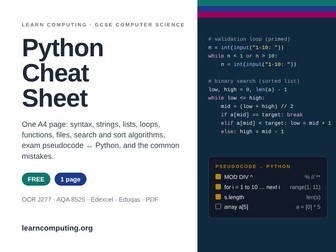
FREE one-page GCSE Python cheat sheet: syntax, strings, lists, loops, functions, files, search and sort algorithms, and exam pseudocode side by side. Everything a GCSE Computer Science student needs for the programming paper on one printable A4 page: input and output, casting, operators (including DIV and MOD), selection, count- and condition-controlled loops, the validation-loop pattern, string functions, lists and 2D lists, functions and procedures, file handling, random numbers, linear search, bubble sort and binary search in Python, a side-by-side table of exam pseudocode and Python, the essentials of robust programs and test data, and the eight most common mistakes. Print it double-sided with the student’s own notes on the back, stick it in exercise books, or hand it out before a programming test. Free to copy for your own classes. From the author of 30 Python Programming Challenges, Python Challenges Volume 2 and the GCSE question banks — all with tested solutions — at learncomputing.org and on Tes.
FREE: 5 Python Challenges SamplerQuick View
learncomputing

FREE: 5 Python Challenges Sampler

(0)
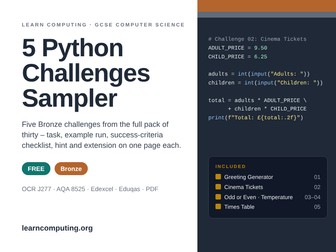
FREE: five Python programming challenges for GCSE Computer Science, each with an example run, success criteria, hint and extension. Print and go. The first five challenges from 30 Python Programming Challenges, free. Each is a single printable page: the task, a numbered list of what the program must do, an exact example run, a success-criteria checklist with marks, a hint and an extension task. Greeting Generator, Cinema Tickets, Odd or Even, Temperature Converter and Times Table cover variables, casting, arithmetic, selection and count-controlled loops — the first half-term of GCSE programming. Use them as starters, homework or cover work. The full pack has thirty challenges in three tiers with a tested model solution, mark scheme and teaching notes for every one. OCR J277, AQA 8525, Edexcel, Eduqas. More at learncomputing.org.
30 Python Challenges –- AQA editionQuick View
learncomputing

30 Python Challenges –- AQA edition

(0)
30 graded Python challenges mapped to AQA 8525 GCSE Computer Science, each with a tested model solution, mark scheme, teaching notes and spec references. This is the AQA edition: every challenge carries its 3.1–3.3 specification references first, and the teacher notes refer to AQA pseudocode. Each challenge is one printable page: the task, a numbered list of what the program must do, an exact example run, a success-criteria checklist with marks, a hint and an extension task. Bronze (1–10, 6 marks each): data types, input/output, arithmetic and relational operators, selection, iteration, Boolean operators (3.2.1–3.2.5). Silver (11–20, 8 marks each): string handling, lists, subroutines with parameters and return values, validation, random numbers, a Caesar cipher (3.2.6–3.2.11). Gold (21–30, 10 marks each): bubble sort, linear vs binary search with comparison counts (3.1.2–3.1.4), a 2D seating plan, a login system with lockout, a binary converter (3.3.2), run-length encoding (3.3.8) and a capstone class-results program. You get: student booklet (33-page PDF + editable Word, no answers); teacher pack (42-page PDF + editable Word) with mark schemes, model solutions, common errors and an AQA specification map; all 30 solutions as .py files with sample data. Every solution has been run and checked. Solutions use only the GCSE toolkit, so they translate directly to AQA pseudocode for Paper 1. Three Gold challenges use file handling, which AQA does not examine; they are flagged as optional. OCR J277 references are included for departments teaching both. More at learncomputing.org.
F201 Big Data and Machine Learning Revision Organisers: Cambridge Advanced National ITQuick View
learncomputing

F201 Big Data and Machine Learning Revision Organisers: Cambridge Advanced National IT

(0)
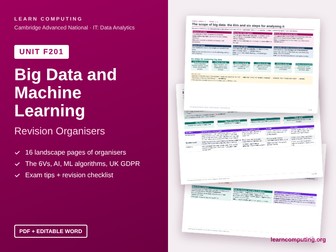
Revise F201 Big Data and Machine Learning fast: one-page graphic organisers for every topic area of the Cambridge Advanced National in IT: Data Analytics. Each topic gets one landscape page covering the specification content: definitions, process flows, tables comparing techniques, algorithms and platforms, and exam tips based on the published mark schemes. They’re ideal for revision lessons, homework and independent revision before the F201 exam. Format: a print-ready PDF and an editable Word document. Not produced or endorsed by OCR. Written to match the published specification. F200 Data Analytics Exam Questions and Mark Scheme: Cambridge Advanced National IT 271 marks of exam-style questions with a full mark scheme for F200 Fundamentals of Data Analytics, Cambridge Advanced National in IT: Data Analytics. There are 44 questions, all written for this pack in the style of the real F200 exam. They cover every topic area of the specification and every question type students will meet: tick-box, complete-the-table, complete-the-sentence, short answers set in context, and 6-mark extended “Analyse” and “Discuss” questions marked by level. The questions are in six sections, so you can set one topic at a time: A Understanding data (TA1): 12 questions, 54 marks B Managing data 1: lifecycle, assurance, gathering and storage (TA2): 11 questions, 70 marks C Managing data 2: transformation, analysis, presentation, archive and destruction (TA2): 8 questions, 55 marks D Accessing and managing data across platforms (TA3): 4 questions, 35 marks E Legal considerations (TA4): 5 questions, 34 marks F Job roles, skills and attributes (TA5): 4 questions, 23 marks The mark scheme is written in the style of the published mark schemes. It lists the points that earn credit and marking guidance for every part, plus levels-of-response grids with indicative content for the extended questions. It works for teacher marking, peer marking or self-assessment. Format: a question booklet with answer spaces and a separate mark scheme, both as PDF and editable Word. These questions pair well with the full interactive F200 course on Learn Computing, where students learn each topic with lessons and quizzes before practising: https://learncomputing.org/coursepreview/1 Not produced or endorsed by OCR. All questions are original.
F200 Data Analytics Exam Questions and Mark Scheme: Cambridge Advanced National ITQuick View
learncomputing

F200 Data Analytics Exam Questions and Mark Scheme: Cambridge Advanced National IT

(0)
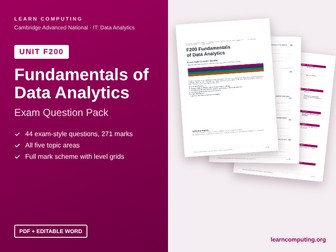
271 marks of exam-style questions with a full mark scheme for F200 Fundamentals of Data Analytics, Cambridge Advanced National in IT: Data Analytics. There are 44 questions, all written for this pack in the style of the real F200 exam. They cover every topic area of the specification and every question type students will meet: tick-box, complete-the-table, complete-the-sentence, short answers set in context, and 6-mark extended “Analyse” and “Discuss” questions marked by level. The questions are in six sections, so you can set one topic at a time: A Understanding data (TA1): 12 questions, 54 marks B Managing data 1: lifecycle, assurance, gathering and storage (TA2): 11 questions, 70 marks C Managing data 2: transformation, analysis, presentation, archive and destruction (TA2): 8 questions, 55 marks D Accessing and managing data across platforms (TA3): 4 questions, 35 marks E Legal considerations (TA4): 5 questions, 34 marks F Job roles, skills and attributes (TA5): 4 questions, 23 marks The mark scheme is written in the style of the published mark schemes. It lists the points that earn credit and marking guidance for every part, plus levels-of-response grids with indicative content for the extended questions. It works for teacher marking, peer marking or self-assessment. Format: a question booklet with answer spaces and a separate mark scheme, both as PDF and editable Word. These questions pair well with the full interactive F200 course on Learn Computing, where students learn each topic with lessons and quizzes before practising: https://learncomputing.org/coursepreview/1 Not produced or endorsed by OCR. All questions are original.
Creative iMedia R093 - Revision PackQuick View
learncomputing

Creative iMedia R093 - Revision Pack

(0)
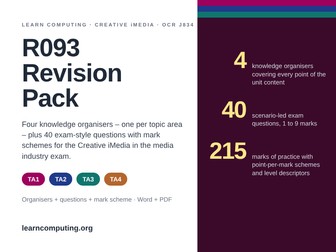
R093 Creative iMedia revision: knowledge organisers for all four topic areas plus 40 exam-style questions with mark schemes. OCR Cambridge Nationals J834. A resource to supplement the fully interactive course at learncomputing.org Knowledge organisers: one double-page organiser per topic area, written to the OCR unit content. TA1 The media industry — sectors, products, every creative, technical and senior job role and the phase it works in. TA2 Factors influencing product design — purpose and how style, content and layout follow it; client requirements and brief formats; audience segmentation; primary and secondary research, qualitative and quantitative data; technical, symbolic and written media codes. TA3 Pre-production planning — work planning, mind maps and mood boards, asset log, flow chart, script, storyboard, visualisation diagram, wireframe; privacy, defamation, data protection, intellectual property, Creative Commons and fair dealing, ASA, Ofcom, BBFC, PEGI, health and safety. TA4 Distribution considerations — platforms and media with advantages and disadvantages; image, audio and moving-image file properties and formats; lossy and lossless compression. Each page ends with an exam tip. Exam questions: 40 scenario-led questions, 215 marks, from 1-mark identify questions to 6–9 mark justify and discuss questions, with a mark scheme giving one point per mark, “accept” alternatives, and level descriptors for the extended answers. You get: knowledge organisers (9-page PDF + editable Word); question booklet (19-page PDF + editable Word) with answer lines and tables, no answers; mark scheme (19-page PDF + editable Word). Use the organisers as revision sheets, homework learning or display; use the questions as starters, a mock for one topic area, or an end-of-unit test. More at learncomputing.org.
Algorithms & Programming Question BankQuick View
learncomputing

Algorithms & Programming Question Bank

(0)
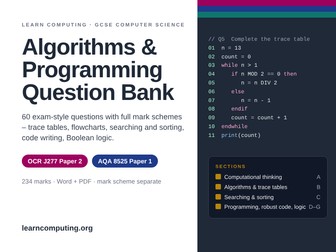
60 exam-style questions with mark schemes for the GCSE algorithms and programming paper: trace tables, sorting, searching, pseudocode, logic. OCR / AQA. Sixty original questions, 234 marks, covering everything on OCR J277 Paper 2 and the matching AQA 8525 Paper 1 content: computational thinking, trace tables, flowcharts, finding errors, writing algorithms, linear and binary search, bubble, insertion and merge sort, data types and operators, strings, arrays, subroutines, file handling and SQL, validation, testing, Boolean logic and truth tables, translators and IDEs. Every question has a mark scheme in the examiner’s style — one point per mark, with “accept” notes for alternative answers — and carries its OCR and AQA specification references. Pseudocode follows OCR Exam Reference Language. Trace-table and truth-table answers were produced by running the code, so they are correct. You get: question booklet (30-page PDF + editable Word) with answer lines, blank trace tables, truth tables and code boxes, ready to print, no answers; mark scheme (27-page PDF + editable Word) with marking points and completed tables. Seven sections (computational thinking; algorithms and trace tables; searching and sorting; programming techniques; robust programs; Boolean logic; languages and IDEs) with marks per section in the contents, so any section works as a timed test. The five trace-table questions and six sorting/searching traces target the skills students lose the most marks on. More at learncomputing.org.
20 C# Programming Challenges (A Level)Quick View
learncomputing

20 C# Programming Challenges (A Level)

(0)
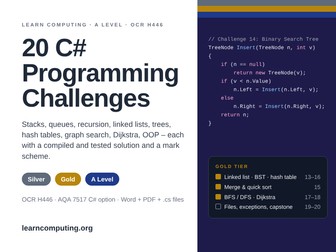
20 C# challenges for A Level Computer Science: stacks, queues, linked lists, trees, hash tables, graphs, Dijkstra, OOP. Compiled, tested solutions. H446. Almost everything on Tes for A Level programming is Python. This pack is for departments that teach C# — OCR H446 centres and AQA 7517 centres taking the C# option — and makes students build the things the exam asks them to describe. Every challenge has a model solution that has been compiled and run against the example input, a mark scheme and teaching notes. Silver (1–10, 8 marks each): temperature statistics with arrays, a number classifier, a Caesar cipher with char arithmetic, word frequency with Dictionary, a recursion toolkit with a printed call trace, an array-based stack used for bracket matching, a circular queue print simulation, bubble vs insertion sort with comparison counts, binary search iteratively and recursively, and student records sorted and tabulated. Gold (11–20, 10 marks each): an encapsulated BankAccount with exceptions and a static counter, an abstract Shape hierarchy, a linked list from scratch, a BST with in/pre/post-order traversal, recursive merge sort and quick sort, a hash table with chaining and a collision count, BFS and DFS with shortest-path reconstruction, Dijkstra’s algorithm on an adjacency matrix, a defensive CSV loader with a custom exception and an interface, and a capstone library system with file persistence. You get: student booklet (23-page PDF + editable Word, no answers); teacher pack (48-page PDF + editable Word) with mark schemes, full model solutions, teaching notes and a specification map (OCR H446 1.2.4, 1.4.2, 2.1.3, 2.2, 2.3.1; AQA 7517 4.1–4.3); all 20 solutions as .cs console programs plus the two data files. Solutions use only what students need for the exam — classes, properties, inheritance, abstract classes, interfaces, generic collections, exceptions, System.IO — and no LINQ, so the algorithms stay visible. Python and Java students can attempt every challenge. More at learncomputing.org.
Python Challenges Volume 2 – AQA editionQuick View
learncomputing

Python Challenges Volume 2 – AQA edition

(0)
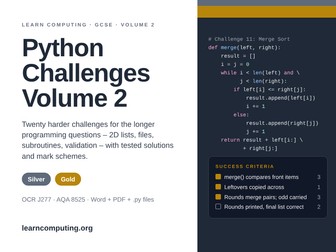
20 harder Python challenges mapped to AQA 8525: 2D lists, subroutines, merge sort, validation, string handling. Tested solutions, mark schemes and notes. For students who have the basics and need to tackle the longer programs the exam and NEA-style tasks demand. Every challenge is one printable page with the task, steps, an exact example run, a success-criteria checklist, a hint and an extension; every one has a tested model solution, a mark scheme and teaching notes. Silver (1–10, 8 marks each): word frequency with parallel lists, insertion sort with a trace, anagram checker, formatted receipt with VAT, hangman, UK postcode validator, a code-breaking game, Roman numerals, text-file statistics and a self-correcting times-table trainer. Gold (11–20, 10 marks each): merge sort printed by rounds, a library system, noughts and crosses, a password strength checker, stock control from CSV with a low-stock report, binary addition with overflow and hex, a word search generator, a till with 3-for-2 and spend offers, ISBN-13 check digits, and a capstone quiz manager with a sorted leaderboard. You get: student booklet (23-page PDF + editable Word, no answers); teacher pack (38-page PDF + editable Word) with mark schemes, model solutions, common errors and a specification map; all 20 solutions as .py files plus the seven sample data files. Every solution has been run and checked against the example output; no comprehensions, lambdas, classes or recursion, so the code reads like exam pseudocode. Mapped to AQA 8525 sections 3.1–3.3 and 3.6, with OCR J277 references too. Six challenges use file handling, which AQA does not examine; they are flagged as optional. More at learncomputing.org.
Python Challenges Volume 2 – OCR editionQuick View
learncomputing

Python Challenges Volume 2 – OCR edition

(0)
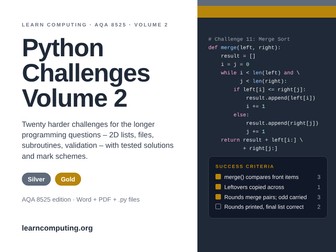
20 harder Python challenges for GCSE: 2D lists, files, subroutines, merge sort, validation. Tested solutions, mark schemes and notes. OCR J277 / AQA 8525. For students who have the basics and need to tackle the longer programs the exam and NEA-style tasks demand. Every challenge is one printable page with the task, steps, an exact example run, a success-criteria checklist, a hint and an extension; every one has a tested model solution, a mark scheme and teaching notes. Silver (1–10, 8 marks each): word frequency with parallel lists, insertion sort with a trace, anagram checker, formatted receipt with VAT, hangman, UK postcode validator, a code-breaking game, Roman numerals, text-file statistics and a self-correcting times-table trainer. Gold (11–20, 10 marks each): merge sort printed by rounds, a library system, noughts and crosses, a password strength checker, stock control from CSV with a low-stock report, binary addition with overflow and hex, a word search generator, a till with 3-for-2 and spend offers, ISBN-13 check digits, and a capstone quiz manager with a sorted leaderboard. You get: student booklet (23-page PDF + editable Word, no answers); teacher pack (38-page PDF + editable Word) with mark schemes, model solutions, common errors and a specification map; all 20 solutions as .py files plus the seven sample data files. Every solution has been run and checked against the example output; no comprehensions, lambdas, classes or recursion, so the code reads like exam pseudocode. Written for OCR J277 and AQA 8525; suitable for Edexcel and Eduqas. Follows on from 30 Python Programming Challenges but stands alone. More at learncomputing.org.
GCSE Computer Science - Computer Systems Question BankQuick View
learncomputing

GCSE Computer Science - Computer Systems Question Bank

(0)
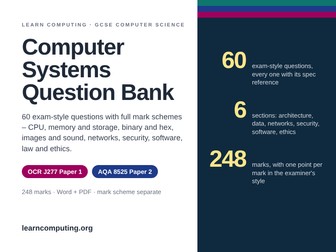
60 exam-style questions with mark schemes for the GCSE computer systems paper: CPU, binary and hex, networks, security, software, law. OCR J277 / AQA 8525. Sixty original questions, 248 marks, covering the whole of OCR J277 Paper 1 and the matching AQA 8525 Paper 2 content: the CPU and fetch-execute cycle, registers, performance, embedded systems; RAM, ROM, virtual memory and secondary storage; units, binary, hexadecimal, binary addition and shifts, character sets, images, sound and compression; LANs, WANs, hardware, topologies, the internet, DNS, the cloud, IP and MAC addresses, protocols and layers; malware, social engineering and the defences against them; operating systems and utility software; the Data Protection Act, Computer Misuse Act, copyright, licences, environmental and ethical issues. Every question carries its specification references and has a mark scheme in the examiner’s style, one point per mark with “accept” notes. The conversion and file-size calculations were checked by computer. You get: question booklet (26-page PDF + editable Word) with answer lines and tables, no answers; mark scheme (26-page PDF + editable Word). Six sections with marks per section in the contents, so any section works as a timed test or homework. The longer 4–6 mark “discuss” questions (storage choice, the cloud, environmental impact, facial recognition) give practice at the extended-response style. Pairs with the Algorithms & Programming Question Bank for the other paper. More at learncomputing.org.
GCSE Computer Science - Trace Table & Pseudocode WorkbookQuick View
learncomputing

GCSE Computer Science - Trace Table & Pseudocode Workbook

(0)
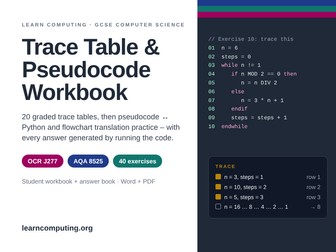
20 graded trace tables plus pseudocode, Python and flowchart translation practice; every answer generated by running the code. OCR J277 / AQA 8525. The two skills that cost GCSE students the most marks on the algorithms paper, practised properly. Section A: twenty trace tables that build one idea at a time — sequence, count- and condition-controlled loops, selection, MOD and DIV, strings, finding the smallest, nested loops, a function call, a Boolean flag, do-until, 2D arrays, inputs, the Fibonacci sequence, one pass of a bubble sort, counting comparisons in a search, and a PIN check with attempts. Section B: eight pseudocode-to-Python translations. Section C: eight Python-to-pseudocode translations. Section D: four flowchart-to-pseudocode exercises, with the flowcharts drawn. You get: student workbook (26-page PDF + editable Word) with every exercise’s blank trace table or code box, no answers; answer book (30-page PDF + editable Word) with completed trace tables, mark points and a model answer for every translation. 162 marks in total. Every trace table in the answer book was produced by running the algorithm, and every Python model answer was run against the stated inputs. Pseudocode follows OCR Exam Reference Language; AQA equivalents are accepted. Use it as a term of lesson starters, an intervention booklet for students who freeze on trace questions, or homework. More at learncomputing.org.
F200 Data Analytics Revision Organisers: Cambridge Advanced National ITQuick View
learncomputing

F200 Data Analytics Revision Organisers: Cambridge Advanced National IT

(0)
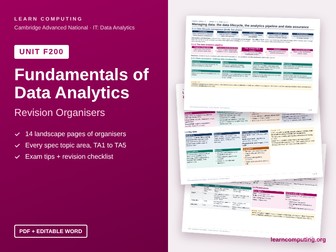
Revise F200 Fundamentals of Data Analytics fast: one-page graphic organisers for every topic area of the Cambridge Advanced National in IT: Data Analytics. Each topic gets one landscape page that pulls the specification content together: key definitions, flow diagrams, tables comparing benefits and limitations, and exam tips based on how the published mark schemes award marks. Use them for revision lessons, homework, starter activities or students’ own last-minute revision before the F200 exam. What’s inside (14 pages): Before you start: the F200 exam format, command words and how to pick up marks TA1 Understanding data: data, information, knowledge and big data TA1 Data and file formats TA1 Data types and classifications TA2 The data lifecycle, the analytics pipeline and data assurance TA2 Data gathering, data states and data stores TA2 Data storage: types, on-site and cloud TA2 Transformation, analytics and presenting data TA2 Visualising, archiving and destroying data TA3 Accessing and managing data across platforms: APIs, access controls and permissions TA4 Legal considerations: legislation and the regulator, updated for the Data (Use and Access) Act 2025 and the new Information Commission TA5 Job roles, personal attributes and communication skills F200 revision checklist, so students can RAG-rate every part of the specification Format: a print-ready PDF and an editable Word document, so you can adapt the pages for your classes. Want your students to learn F200 interactively? The full F200 course on Learn Computing has lessons, quizzes and progress tracking that teachers can follow: https://learncomputing.org/coursepreview/1 Not produced or endorsed by OCR. Written to match the published specification.
F201 Big Data Practice Papers and Mark Scheme: Cambridge Advanced National ITQuick View
learncomputing

F201 Big Data Practice Papers and Mark Scheme: Cambridge Advanced National IT

(0)
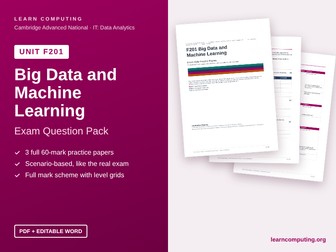
Three full 60-mark F201 Big Data and Machine Learning practice papers with mark scheme, in the real exam format for the Cambridge Advanced National in IT. Like the real F201 exam, each paper is built around a scenario that develops as students work through it. Every paper covers all five topic areas and is designed for 1 hour 30 minutes: ideal for mock exams, timed practice or homework. The papers: Paper 1, Northvale Hospitals: patient monitoring, wearables and reducing waiting times (60 marks) Paper 2, Harbourton smart city: sensors, traffic and public services (60 marks) Paper 3, DriveSure Insurance: telematics, pricing and machine learning (60 marks) Each paper has the full mix of question types: tick-box, complete-the-sentence, table questions, short answers applied to the scenario, and one 6-mark and one 9-mark extended answer marked by level. That’s 180 marks in total, all written for this pack. The mark scheme lists the points that earn credit and marking guidance for every part, plus levels-of-response grids with indicative content for the 6- and 9-mark questions, in the style of the published mark schemes. Format: a practice paper booklet and a separate mark scheme, both as PDF and editable Word. Not produced or endorsed by OCR. All questions are original.