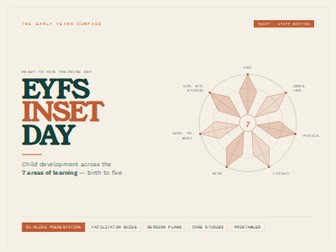
Ready-to-run EYFS INSET day on child development across the 7 areas of learning. 21 slides with speaker notes, facilitator guide, session plans, printables… The 21-slide editable presentation covers: why the first five years matter (the neuroscience, made simple) · serve and return · all 7 areas of learning mapped across babies, toddlers and preschool — what you’ll see, what to prioritise, and a model Next Step for each · writing stronger Next Steps with Intent, Implementation, Impact · built-in team activities. Every slide includes speaker notes — deliver it confidently even if you’ve never run training before. The 6-page facilitator guide adds: a minute-by-minute session plan (full day or compact 2h15) · room-management notes · three rich case studies with discussion prompts AND facilitator answers · printable Next Step planners and commitment cards · a follow-up plan that turns the day into changed practice. Perfect for INSET days, inductions and building a shared team language about child development.
Staff Meeting Shorts #1 — from a former UK nursery manager (9 years, SENCO & DSL). A complete, ready-to-deliver staff meeting on genuine parent partnership: why it’s inspected across three report-card areas · the 5-step sequence when a parent raises a concern · the Key Person mission · weak vs. strong daily handovers (with the 30-second formula your team can learn in a week) · a memorable role-play activity — “let’s pretend to be the parents” — with structured rounds and debrief · growing parents’ confidence without lecturing · commitments with built-in follow-up. Speaker notes on every slide: read it once the night before and deliver with confidence. Editable PPTX.
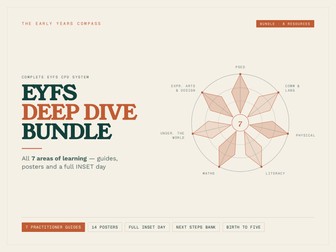
All 7 EYFS deep-dive guides, 14 printable posters and a ready-to-run INSET day, in one bundle. Written by a former UK nursery manager (SENCO & DSL, 14 yrs).
Everything your team needs to understand child development across all seven areas of learning — for INSET days, inductions and whole-setting consistency.
What’s included
7 practitioner guides — PSED · Communication & Language · Physical Development · Literacy · Mathematics · Understanding the World · Expressive Arts & Design
14 printable A4 classroom posters — two for every area of learning
The complete INSET Day Pack — a 21-slide presentation with speaker notes, plus a facilitator guide with session plans, case studies and printables
Inside every guide
A development map across the age bands, with practical provision priorities for each stage
“When to look closer” prompts to support early identification
Weak vs. strong observation examples, set side by side so the difference is obvious
A ready-to-adapt Next Steps bank
Schemas and the Characteristics of Effective Learning, explained in plain language
What inspectors’ questions are really assessing — and how to answer them from your own practice
The posters
Wall-ready A4 prints your team will actually use, including The Emotion Coaching Loop, Seven Moves That Grow Language, The Road to Writing Starts at Tummy Time and Process Over Product: Say This, Not That.
Who it’s for
Nursery managers, room leaders and EYFS coordinators who need to train a whole team without building the training from scratch. Also used for student and new-practitioner inductions, supervision conversations, CPD planning, and getting a team ready to talk confidently about their own practice.
How settings use it
As a full INSET or training day, delivered by a manager with no external trainer and no preparation
Broken into seven shorter staff meetings, one area of learning at a time, across a term
As an induction pack handed to students, apprentices and new practitioners in their first week
As a reference shelf: managers keep the guides to hand for supervisions, planning and moderation
Why it was written
Written by a former UK nursery manager with 14 years in early years settings, including SENCO and Designated Safeguarding Lead roles. Everything here started as material used with a real team on a real training day — not theory written for a marketplace.
Format
PDF throughout, plus the presentation. Print the posters as they are; adapt the guides and session plans to your own setting.
Every component is also available separately if you only need one area.
Written by a nursery manager whose setting earned Strong grades under the renewed framework — this is the guide I wish had existed before my inspection.
The new report cards use “secure fit”: miss one criterion and the whole area drops a grade. No averages. This 15-page decoder explains what that really means and what to do about it.
Inside: how report cards and the 5-point scale actually work · five field truths from a real inspection (including the change nobody talks about: they observe your whole team now) · the anatomy of a real published report card — how one weakness printed across three areas · Safeguarding as a Met/Not-met gate · all six graded areas decoded: the real gap between Expected and Strong · Ofsted’s official “we do NOT expect” list used to your advantage · real inspector questions with weak vs. strong answers · a planning-call script · 20 staff-readiness questions · a crisis triage plan · a traffic-light scorecard for honest self-location.
Sources: official Ofsted toolkit and inspection information (adapted under OGL v3.0) plus first-hand inspection experience. Independent publication, not endorsed by Ofsted.
Expressive Arts & Design Deep Dive — Complete EYFS Practitioner Guide (0-5) + 2 Posters. Description: The final part of the Early Years Compass series, by a former UK nursery manager (14 years, SENCO & DSL). EAD is the most misunderstood area of the EYFS — this guide shows your team why process beats product, and what that looks like in practice at every age. Inside: the two strands explained simply · a development map from sensory explorer to intentional creator · why symbolic play matters far beyond art · when to look closer prompts · weak vs. strong observation examples capturing children’s creative choices verbatim · a Next Steps bank including Helicopter Stories · what inspectors see in your displays. Plus 2 posters: “EAD at a glance” and “Process over product: say this, not that” — eight language swaps that protect creativity. Categorías: Main Expressive arts and design (existe tal cual) + Pedagogy/Child development.
From the author of the PSED Deep Dive: the complete C&L guide for early years teams, written by a former UK nursery manager (14 years, SENCO & DSL). Inside the 10-page guide: the two strands and what the research really says about conversational turns · a full development map across five age bands with “expansions that work” scripts · when to look closer — professional prompts for early identification (with dedicated EAL guidance so silent periods aren’t mistaken for delay) · weak vs. strong observation examples with verbatim speech · a Next Steps bank by age and strand · schemas as language engines · what inspectors’ C&L questions really assess. Plus 2 printable A4 posters: “C&L at a glance” and “Seven moves that grow language” — the no-resources-needed techniques poster your whole team will use daily. Part 2 of the Early Years Compass Deep Dive Series.
Part 5 of the Early Years Compass series, by a former UK nursery manager (14 years, SENCO & DSL). Early maths isn’t counting to 100 — it’s depth, and this guide shows your team what depth looks like at every age. Inside the 8-page guide: the two strands and the mastery principle explained simply · a development map from spatial explorer to mathematician across five age bands · subitising, cardinality, composition and part-part-whole — demystified with practical provision · when to look closer — professional prompts for early identification · weak vs. strong observation examples (what children DO with quantity, not what they recite) · a Next Steps bank by age band · what inspectors’ maths questions really assess. Plus 2 printable A4 posters: “Maths at a glance” and “What does it mean to really know 5?” — the mastery poster for your staff room. Part 5 of 7.
Part 4 of the Early Years Compass series, by a former UK nursery manager (14 years, SENCO & DSL). Early years literacy is mostly oral — this guide shows your team exactly what must happen before formal phonics, and what to do at every stage. Inside the 9-page guide: the three strands explained simply · a development map from sensory reader to code breaker across five age bands · when to look closer — including when letter-sound links won’t stick · weak vs. strong observation examples · a Next Steps bank by age band · why “kat” is a triumph and tracing isn’t teaching · what inspectors’ phonics and love-of-reading questions really assess. Plus 2 printable A4 posters: “Literacy at a glance” and “Before the letters: the ladder to reading” — the six rungs of phonological awareness every room should climb before phonics.
Part 3 of the Early Years Compass series, by a former UK nursery manager (14 years, SENCO & DSL). Physical development is not PE — it’s the gateway to everything, including writing. Inside the 9-page guide: the two strands and the centre-out, head-to-toe principle every planning decision should follow · a development map across five age bands with specific provision priorities · when to look closer — professional prompts for early identification including sensory processing differences · weak vs. strong observation examples focused on movement quality · a Next Steps bank by age and strand · why core stability must come before pencil grip (and what to do about it) · what inspectors’ PD questions really assess. Plus 2 printable A4 posters: “PD at a glance” and “The road to writing starts at tummy time” — the six-link chain from core strength to pencil grip that every parent and Reception teacher should see.
Understanding the World Deep Dive — Complete EYFS Practitioner Guide (0-5) + 2 Posters. Description: Part 6 of the Early Years Compass series, by a former UK nursery manager 9 years, SENCO & DSL). Children arrive curious — this guide shows your team how to protect and feed that curiosity with real experiences. Inside: the three strands explained simply · a development map from sensory investigator to scientist-and-citizen · when to look closer prompts · weak vs. strong observation examples built around children’s own questions · a Next Steps bank · embedding diversity all year (not festival weeks) · what inspectors’ UW questions really assess. Plus 2 posters: “UW at a glance” and “Think like a scientist — at three years old”.
Written by a former UK nursery manager (14 years in the sector, SENCO and DSL experience, Ofsted-inspected and Quality Counts audited), this is the PSED guide I wished my own team had — practical, evidence-informed and completely waffle-free.
What’s inside the 11-page guide:
PSED in plain terms — the three strands and the science of co-regulation explained simply
A full Development Map across five age bands (0-12m, 12-24m, 24-36m, 36-48m, 48-60m): what you’ll see, where to focus your practice, and “phrases that work” scripts for the hardest moments
“When to look closer” boxes — professional prompts for early identification, SENCO conversations and safeguarding awareness
Weak vs. strong observation examples — so your team finally writes observations that mean something
A ready-to-adapt Next Steps bank, organised by age band and strand
Schemas and Characteristics of Effective Learning through a PSED lens
The adult’s role: what to do, what to stop doing — including emotion coaching step by step
“If an inspector asks you about PSED” — what inspection questions are really assessing
SEND and EAL adaptation guidance + ELG readiness indicators
A free printable A4 poster for your room: Personal, Social & Emotional Development across five age bands — the core developmental task and where to focus your practice at each stage, from attachment (0-12m) to school readiness (48-60m). Pin it up where your team plans.
From the full PSED Deep Dive guide — part of the Early Years Compass series: 7 practitioner guides covering every EYFS area of learning, each with development maps, observation examples and ready-to-adapt Next Steps banks. Find the complete series in our shop.
If this poster is useful, a quick review helps other practitioners find it — thank you!


 Quick View