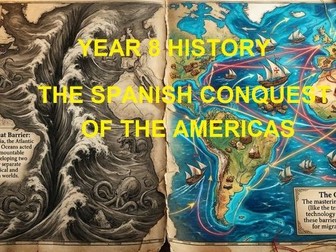
The Spanish Conquest of the Americas (c.1492–1600) – Year 8 History Full Teaching Unit (10 Weeks)Quick View
BeyondTime

The Spanish Conquest of the Americas (c.1492–1600) – Year 8 History Full Teaching Unit (10 Weeks)

(0)
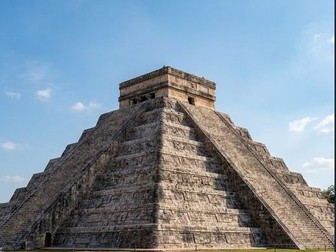
This complete 10-week Year 8 History unit introduces students to the Spanish Conquest of the Americas and its profound impact on Indigenous societies, European empires, and the wider world. Students investigate first contact, the Taíno peoples, the rise and fall of the Aztec Empire, Spanish expansion, cultural and religious change, disease, trade, slavery, and the lasting legacies of colonisation. Across eight modules, students explore key figures including Christopher Columbus, Hernán Cortés, Moctezuma II, and Malintzin while examining the Columbian Exchange, the Great Dying, the Encomienda system, and the emergence of Spanish colonial rule. Inquiry questions encourage students to analyse evidence, evaluate competing interpretations, and investigate how disease, alliances, economics, religion, geography, and human decisions shaped historical outcomes. A flexible activity bank supports learning throughout the unit through source analysis, debate, structured writing, mapping activities, role-play, historical investigations, retrieval practice, significance tasks, and creative projects. Students work with primary and secondary sources including codices, letters, artefacts, maps, archaeological evidence, and colonial accounts to evaluate reliability, bias, contestability, and significance. The unit develops transferable skills in historical inquiry, source analysis, evidence evaluation, historical significance, historiography, analytical writing, and perspective-taking. By the end of the course, students will be able to explain how the Spanish Conquest transformed societies across the Americas and contributed to the emergence of the modern global world. This resource is provided as non-editable PDFs and is not designed as editable PowerPoints. Teachers can upload slides to their LMS, print selected pages for classroom use, display them to support discussion, analysis, and writing, or upload them to presentation or design platforms if they wish to adapt the material (formatting may vary depending on the program).
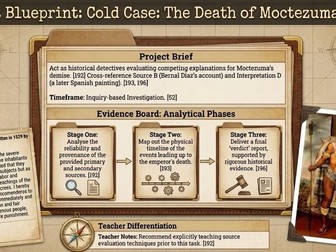
The Spanish Conquest of the Americas – Activity and Project Bank (Year 8 History)Quick View
BeyondTime

The Spanish Conquest of the Americas – Activity and Project Bank (Year 8 History)

(0)
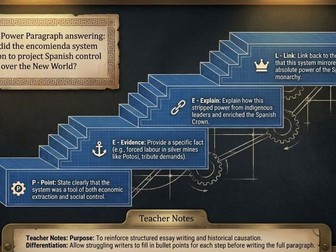
This 15 slide Year 8 History lesson sequence provides a flexible bank of learning activities and extended inquiry projects for use across the entire Spanish Conquest of the Americas unit. The resource gives teachers a comprehensive collection of adaptable tasks that reinforce core historical skills including source analysis, historical inquiry, significance evaluation, historiography, persuasive argument, structured writing, and critical thinking. Activities are organised across major unit themes including First Contact, the Taíno, the fall of the Aztec Empire, the Great Dying, the Columbian Exchange, global trade, silver mining, plantations, slavery, historiography, and historical legacy. Students engage with debates, source investigations, creative writing, mapping activities, retrieval practice, role-play scenarios, concept mapping, evidence evaluation, and structured historical argument. The project bank extends learning through sustained inquiry tasks focused on demographic collapse, global trade networks, museum curation, documentary production, historical cold cases, and the continuing legacy of 1492 in the modern world. Activities are designed to support both classroom teaching and independent inquiry while providing clear opportunities for differentiation and cross-curricular connections. The second section provides a collection of extended projects and investigations that encourage students to apply historical methods in authentic contexts. Students evaluate competing interpretations, analyse historical evidence, construct arguments, create public history products, and investigate long-term historical consequences through structured multi-lesson inquiries and research tasks. A teacher roadmap supports the sequencing of activities across an entire term, moving students from foundational knowledge toward sophisticated historical analysis and independent inquiry. The transferable skill is applying historical methods through varied tasks; the Spanish Conquest is the vehicle. This resource is provided as non-editable PDFs and is not designed as editable PowerPoints. Teachers can upload slides to their LMS, print selected pages for classroom use, display them to support discussion, analysis, and writing, or upload them to presentation or design platforms if they wish to adapt the material.
The Spanish Conquest of the Americas – Legacy, Significance and Historical Inquiry (Year 8 History)Quick View
BeyondTime

The Spanish Conquest of the Americas – Legacy, Significance and Historical Inquiry (Year 8 History)

(0)
This 15 slide Year 8 History lesson sequence introduces students to the enduring legacy and historical significance of the Spanish Conquest of the Americas. The resource helps students move beyond simplified narratives of conquest and defeat by exploring questions of destruction, transformation, continuity, and cultural persistence. Students investigate the fall of the Aztec Empire, the demographic catastrophe caused by introduced diseases, Indigenous alliances, the Columbian Exchange, global trade networks, and the survival of Indigenous cultures under colonial rule. Competing interpretations are examined throughout, encouraging students to evaluate whether the events of 1492–1521 should be understood primarily as military conquest, biological catastrophe, economic transformation, or cultural exchange. A dedicated section explores historiography and historical interpretation, demonstrating how military historians, economic historians, and social historians can reach different conclusions when examining the same events. Students analyse contrasting primary sources, interrogate historical significance, and evaluate the long-term global consequences of conquest, including agricultural change, language transfer, religious syncretism, and the emergence of a global economy. A synthesis section challenges students to determine whether the story of the Aztecs is best understood as one of devastation, persistence, or transformation. The second section provides a bank of learning activities including source analysis, historical debate, museum curation challenges, significance continuums, structured historical writing, retrieval practice, and exit tickets. Each activity includes clear student instructions, suggested timeframes, and teacher differentiation notes. The transferable skill is evaluating historical significance; the Spanish Conquest is the vehicle. This resource is provided as non-editable PDFs and is not designed as editable PowerPoints. Teachers can upload slides to their LMS, print selected pages for classroom use, display them to support discussion, analysis, and writing, or upload them to presentation or design platforms if they wish to adapt the material.
The Spanish Conquest of the Americas – Assessment, Writing and Feedback (Year 8 History)Quick View
BeyondTime

The Spanish Conquest of the Americas – Assessment, Writing and Feedback (Year 8 History)

(0)
This 15 slide Year 8 History lesson sequence prepares students for a summative historical inquiry investigating the clash of worldviews between the Spanish and the Aztecs. The resource supports analytical writing, source evaluation, evidence selection, and historical argument construction through a series of structured scaffolds, exemplars, self-assessment tools, and feedback protocols. Students review social hierarchy, worldviews, religion, economics, warfare, and cultural perspectives while refining the historical thinking skills required to construct sophisticated historical explanations. The resource guides students through source interrogation, thesis development, argument planning, corroboration of evidence, bias analysis, and peer review. Students examine how historians identify perspective and worldview within historical sources and learn how to integrate primary evidence into analytical writing. Model responses illustrate the progression from descriptive writing to evidence-based historical argument, while inquiry frameworks support students in evaluating competing interpretations of the conquest. A synthesis section brings together evidence, significance, source reliability, and historical empathy to prepare students for independent inquiry and assessment. The second section includes self-assessment checklists, peer feedback protocols, thesis-building frameworks, source interrogation tools, writing exemplars, planning organisers, historical argument scaffolds, and final revision activities. Teacher notes support differentiation and progression toward higher-order historical thinking. The transferable skill is historical inquiry and analytical writing; the Spanish Conquest is the vehicle. This resource is provided as non-editable PDFs and is not designed as editable PowerPoints. Teachers can upload slides to their LMS, print selected pages for classroom use, display them to support discussion, analysis, and writing, or upload them to presentation or design platforms if they wish to adapt the material.
The Spanish Conquest of the Americas – Beliefs, Religion and Culture (Year 8 History)Quick View
BeyondTime

The Spanish Conquest of the Americas – Beliefs, Religion and Culture (Year 8 History)

(0)
This 15 slide Year 8 History lesson sequence introduces students to the belief systems, religious practices, and cultural transformations that shaped the Spanish Conquest of the Americas. The resource helps students read religion and culture as historical evidence, demonstrating how competing worldviews influenced power, identity, land ownership, and social organisation. Students investigate Indigenous polytheistic belief systems, Spanish Catholicism, concepts of divine authority, conversion, assimilation, and the religious justifications used to support conquest and colonisation. The resource explores how religious beliefs informed both Indigenous and Spanish understandings of the world, revealing the ways cultural values shaped decisions, behaviour, and political power. A dedicated section examines the Encomienda system, missionary activity, parish organisation, and cultural assimilation, showing how religion functioned simultaneously as belief, justification, and social control. A synthesis section brings together religion, values, and power to explore how competing worldviews collided and transformed societies across the Americas. The second section includes a bank of learning activities featuring source analysis, historical debate, creative empathy writing, structured analytical responses, cultural comparison tasks, retrieval practice, and exit tickets. Each activity includes clear instructions, suggested timeframes, and teacher differentiation notes to support a range of learners. The transferable skill is reading belief systems as historical evidence; the Spanish Conquest is the vehicle. This resource is provided as non-editable PDFs and is not designed as editable PowerPoints. Teachers can upload slides to their LMS, print selected pages for classroom use, display them to support discussion, analysis, and writing, or upload them to presentation or design platforms if they wish to adapt the material.
The Spanish Conquest of the Americas – Evidence of Empire (Year 8 History)Quick View
BeyondTime

The Spanish Conquest of the Americas – Evidence of Empire (Year 8 History)

(0)
This 15 slide Year 8 History lesson sequence introduces students to the physical, written, archaeological, and cultural evidence used to reconstruct the Aztec Empire and the Spanish Conquest. The resource helps students analyse what evidence reveals and what it obscures about power, belief systems, daily life, conquest, and cultural change. Students examine monumental architecture, the Aztec Calendar Stone, the Florentine Codex, the Templo Mayor ruins, and the letters of Hernán Cortés through authorship, provenance, reliability, historical insights, and limitations. A dedicated section explores preservation and destruction, demonstrating how conquest acted as a filter on the historical record by preserving some forms of evidence while systematically erasing others. Students investigate the concept of the “blank space” in history, examining how the destruction of Indigenous records continues to shape historical understanding today. A synthesis section contrasts archaeological evidence with colonial written accounts, encouraging students to evaluate reliability, contestability, and historical perspective. The second section provides a historian’s toolkit including source analysis, evidence evaluation, structured historical writing, debate, museum curation activities, values inference tasks, retrieval practice, and exit tickets. Each activity includes clear student instructions, suggested timeframes, and teacher notes for differentiation. The transferable skill is source reliability and contestability; the Spanish Conquest is the vehicle. This resource is provided as non-editable PDFs and is not designed as editable PowerPoints. Teachers can upload slides to their LMS, print selected pages for classroom use, display them to support discussion, analysis, and writing, or upload them to presentation or design platforms if they wish to adapt the material.
The Spanish Conquest of the Americas – Leadership, Power and Case Studies (Year 8 History)Quick View
BeyondTime

The Spanish Conquest of the Americas – Leadership, Power and Case Studies (Year 8 History)

(0)
This 15 slide Year 8 History lesson sequence introduces students to leadership and power during the Spanish Conquest of the Americas through structured historical case studies. The resource helps students understand what makes an individual historically significant and how personal decisions intersect with larger political, economic, technological, and biological forces. Students investigate Hernán Cortés, Moctezuma II, and Malintzin as contrasting case studies, analysing leadership, strategy, diplomacy, communication, and historical legacy. The resource explores the conquest of the Aztec Empire through the actions of key individuals while also examining broader systems including the Encomienda system, imperial authority, Indigenous alliances, and competing interpretations of power. A dedicated section introduces students to historical contestability through competing interpretations of Malintzin, examining how historians and societies can reach different conclusions about the same historical figure. Students also investigate the competing narratives surrounding Spanish colonisation through imperial justifications, the writings of Bartolomé de Las Casas, and the development of the Black Legend. A synthesis section challenges students to weigh the influence of individual agency against broader forces such as disease, technological differences, and long-term imperial structures when explaining historical change. The second section includes a bank of learning activities featuring source analysis, historical debate, empathy writing, structured PEEL-style responses, significance ranking activities, comparative analysis tasks, retrieval practice, and exit tickets. Each activity includes clear instructions, suggested timeframes, and teacher differentiation notes to support a range of learners. The transferable skill is case study method; the Spanish Conquest is the vehicle. This resource is provided as non-editable PDFs and is not designed as editable PowerPoints. Teachers can upload slides to their LMS, print selected pages for classroom use, display them to support discussion, analysis, and writing, or upload them to presentation or design platforms if they wish to adapt the material.
Spanish Conquest of the Americas – Society, Hierarchy and Daily Life (Year 8 History)Quick View
BeyondTime

Spanish Conquest of the Americas – Society, Hierarchy and Daily Life (Year 8 History)

(0)
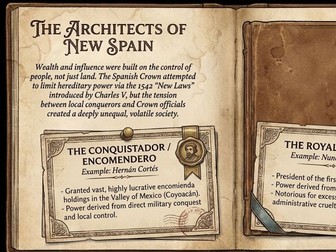
This 15 slide Year 8 History lesson sequence introduces students to the social hierarchy and daily life that emerged during the Spanish Conquest of the Americas. The resource helps students analyse who held power, how wealth and authority were exercised, and whose experiences survive or disappear within the historical record. Students investigate the Spanish Crown, royal officials, conquistadors, encomenderos, Indigenous communities, women, children, and enslaved peoples through systems of power, lived experience, and surviving evidence. The Encomienda system is examined as a mechanism of labour extraction and social control, revealing how colonial society was built upon unequal relationships and competing claims to authority. A dedicated section explores historical silences, demonstrating how official Spanish records often privilege elite voices while Indigenous codices and visual sources reveal perspectives otherwise absent from the archive. A synthesis section draws together power, exploitation, resistance, and historical evidence to answer the central inquiry question: Who held power, and how do we know? The second section provides a bank of learning activities including source analysis, historical debate, empathy writing, structured TEEL responses, ranking and reasoning tasks, retrieval activities, and exit tickets. Each activity includes clear student instructions, suggested timeframes, and teacher notes to support differentiation. The transferable skill is social structure analysis; the Spanish Conquest is the vehicle. This resource is provided as non-editable PDFs and is not designed as editable PowerPoints. Teachers can upload slides to their LMS, print selected pages for classroom use, display them to support discussion, analysis, and writing, or upload them to presentation or design platforms if they wish to adapt the material.
The Spanish Conquest of the Americas – The Force of Geography (Year 8 History)Quick View
BeyondTime

The Spanish Conquest of the Americas – The Force of Geography (Year 8 History)

(0)
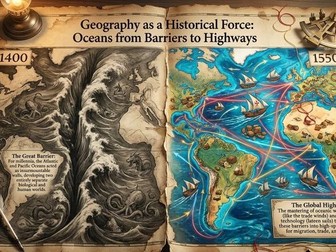
This 15 slide Year 8 History lesson sequence introduces students to the geographical and environmental forces that shaped the Spanish conquest of the Americas between 1400 and 1800. The resource helps students read oceans, landscapes, wind patterns, mineral wealth, and ecological change as historical forces, showing how the meeting of two worlds redefined global civilisation. Students examine how the Atlantic and Pacific shifted from barriers to highways, how Indigenous societies adapted to diverse regional environments, and how the physical geography of the Americas enabled the rise of a global silver economy linking Mexico, Potosí, Spain, and China. The module traces the timeline of convergence—from biological shock and imperial conquest to environmental transformation and global economic integration—highlighting how geography, biology, and ecology acted together to drive the Spanish conquest and its consequences. The second section provides a bank of learning activities including source analysis, discussion and debate, creative mapping, structured writing, timeline sequencing, think‑pair‑share tasks, and exit tickets. Each activity includes a clear student task, a suggested timeframe, and teacher notes for purpose and differentiation. The transferable skill is historical context setting; the Spanish conquest of the Americas is the vehicle. This resource is provided as non‑editable PDFs and is not designed as editable PowerPoints. Teachers can upload slides to their LMS, print selected pages for classroom use, display them to support discussion, analysis, and writing, or upload them to presentation or design platforms if they wish to adapt the material (formatting may vary depending on the program).
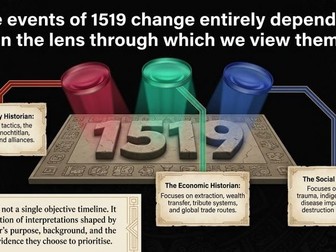
Khmer Empire – Assessment, Writing and Feedback (Year 8 History)Quick View
BeyondTime

Khmer Empire – Assessment, Writing and Feedback (Year 8 History)

(0)
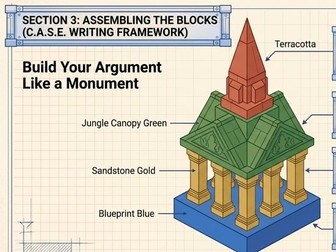
This 15 slide Year 8 History lesson sequence prepares students for a summative historical inquiry on the Khmer Empire. The resource supports structured research, analytical writing, and evidence‑based argument through clear scaffolds, exemplars, and feedback tools. Students assess their historical toolkit, practise constructing claims, assemble evidence, synthesise ideas, and evaluate arguments using the C.A.S.E. writing framework. Exemplars contrast developing, proficient, and strong historical writing, showing students how to elevate their work. Inquiry pillars guide students toward multi‑causal explanations of rise, peak, and decline. The second section includes formative checkpoints, peer feedback frames, inquiry scaffolds, OPUR source analysis, planning organisers, annotated exemplars, and target‑setting tools. The transferable skill is historical inquiry and analytical writing; the Khmer Empire is the vehicle. This resource is provided as non‑editable PDFs and is not designed as editable PowerPoints. Teachers can upload slides to their LMS, print selected pages for classroom use, display them to support discussion, analysis, and writing, or upload them to presentation or design platforms if they wish to adapt the material.
Angkor Khmer Empire – Beliefs, Religion and Culture (Year 8 History)Quick View
BeyondTime

Angkor Khmer Empire – Beliefs, Religion and Culture (Year 8 History)

(0)
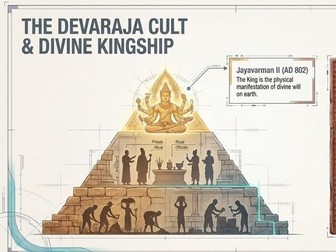
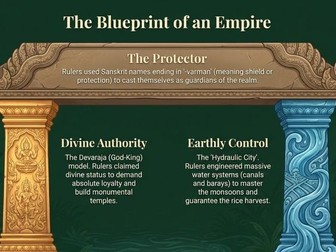
This 15 slide Year 8 History lesson sequence introduces students to the belief systems, religious practices, and cultural traditions of the Khmer Empire. The resource helps students read religion and culture as historical evidence, showing how Hinduism, Mahayana Buddhism, and local animism fused into a syncretic system that unified the empire. Students explore the devaraja cult, divine kingship, temple architecture as administrative centres, and the hydraulic city as both engineering and spiritual cosmology. A major ideological shift—the rise of Theravada Buddhism—is analysed for its political consequences, weakening divine kingship and ending the era of monumental temple building. A myth‑versus‑reality section challenges colonial narratives of Angkor as a “lost city.” The second section includes source analysis, debate, creative empathy tasks, structured writing, connection activities, retrieval practice, and exit tickets. The transferable skill is reading belief systems as historical evidence; the Khmer Empire is the vehicle. This resource is provided as non‑editable PDFs and is not designed as editable PowerPoints. Teachers can upload slides to their LMS, print selected pages for classroom use, display them to support discussion, analysis, and writing, or upload them to presentation or design platforms if they wish to adapt the material.
Khmer Empire – Evidence of Empire (Year 8 History)Quick View
BeyondTime

Khmer Empire – Evidence of Empire (Year 8 History)

(0)
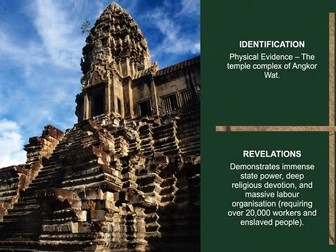
This 15 slide Year 8 History lesson sequence introduces students to the physical, written, pictorial, environmental, and epigraphic evidence used to reconstruct the Khmer Empire. The resource helps students analyse what evidence reveals—and what it obscures—about Angkor’s society, power, engineering, religion, and daily life. Students examine Angkor Wat, Zhou Daguan’s diplomatic diary, Bayon bas‑reliefs, hydraulic infrastructure, and royal inscriptions through identification, provenance, revelations, and limitations. A “tropical filter” section shows how Cambodia’s climate preserved elite stone records while erasing the voices of commoners. A synthesis slide contrasts illumination and shadow in the historical record. The second section provides a historian’s toolkit including source analysis, debate, creative museum curation, structured writing, sequencing tasks, and exit tickets. The transferable skill is source reliability and contestability; the Khmer Empire is the vehicle. This resource is provided as non‑editable PDFs and is not designed as editable PowerPoints. Teachers can upload slides to their LMS, print selected pages for classroom use, display them to support discussion, analysis, and writing, or upload them to presentation or design platforms if they wish to adapt the material.
Khmer Empire – Legacy, Significance and Historical Inquiry (Year 8 History)Quick View
BeyondTime

Khmer Empire – Legacy, Significance and Historical Inquiry (Year 8 History)

(0)
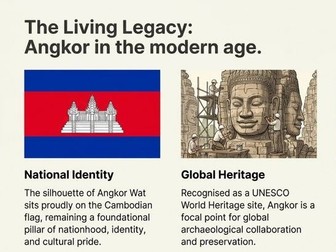
This 15 slide Year 8 History lesson sequence introduces students to the historical significance of the Khmer Empire and why Angkor still matters today. The resource helps students evaluate significance using criteria such as deep consequences, widespread change, and longevity. Students investigate missing clues, LiDAR discoveries, climate‑driven collapse, national identity, global heritage, and modern sustainability lessons. A comparative source section contrasts royal inscriptions with Zhou Daguan’s accounts, highlighting bias and perspective. A synthesis challenge asks students to judge which aspect of the empire—engineering, religion, architecture, climate vulnerability—holds the greatest historical significance. The second section provides a detective’s toolkit including retrieval mind‑maps, source investigation, structured debates, museum curation tasks, argument construction, significance continuums, and exit tickets. The transferable skill is evaluating historical significance; the Khmer Empire is the vehicle. This resource is provided as non‑editable PDFs and is not designed as editable PowerPoints. Teachers can upload slides to their LMS, print selected pages for classroom use, display them to support discussion, analysis, and writing, or upload them to presentation or design platforms if they wish to adapt the material.
Khmer Empire – Activity and Project Bank (Year 8 History)Quick View
BeyondTime

Khmer Empire – Activity and Project Bank (Year 8 History)

(0)
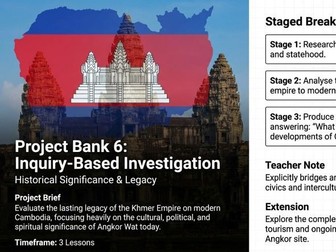
This 15 slide Year 8 History lesson sequence provides a flexible bank of learning activities and extended projects for use across the Khmer Empire unit. The resource gives teachers adaptable tasks that reinforce core skills including source analysis, inquiry, creative thinking, structured writing, significance evaluation, and historical argument. Activities span themes such as god‑kings, society, hydrology, architecture, trade, religion, warfare, decline, and legacy. Students engage with debates, creative narratives, mapping tasks, retrieval practice, museum curation, engineering models, and inquiry‑based investigations. The second section includes multi‑lesson project banks on rulers, foreign accounts, museum exhibitions, hydrology modelling, the fall of Angkor, and modern Cambodian identity. The transferable skill is applying historical methods through varied tasks; the Khmer Empire is the vehicle. This resource is provided as non‑editable PDFs and is not designed as editable PowerPoints. Teachers can upload slides to their LMS, print selected pages for classroom use, display them to support discussion, analysis, and writing, or upload them to presentation or design platforms if they wish to adapt the material.
Angkor Khmer Empire – Leadership, Power and Case Studies (Year 8 History)Quick View
BeyondTime

Angkor Khmer Empire – Leadership, Power and Case Studies (Year 8 History)

(0)
This 15 slide Year 8 History lesson sequence introduces students to leadership and power in the Khmer Empire through structured case studies. The resource helps students understand what makes a leader historically significant and how individuals shaped and reflected wider political, religious, environmental, and military forces. Students examine Jayavarman II (the Founder), Jayavarman VII (the Builder), and Zhou Daguan (the Witness), analysing catalysts, actions, legacies, and evidence. A contested history section contrasts traditional narratives of Angkor’s “collapse” with modern scientific evidence from LiDAR and climate data. A synthesis slide shows how divine authority and environmental control created stability—and how losing control of water shattered that stability. The second section includes source analysis, debate, creative decision‑making tasks, structured writing, significance ranking, pattern recognition, and exit tickets. Teacher notes support differentiation and higher‑order thinking. The transferable skill is case study method; the Khmer Empire is the vehicle. This resource is provided as non‑editable PDFs and is not designed as editable PowerPoints. Teachers can upload slides to their LMS, print selected pages for classroom use, display them to support discussion, analysis, and writing, or upload them to presentation or design platforms if they wish to adapt the material.
The Angkor Khmer Empire (802–1431) – Year 8 History Full Teaching UnitQuick View
BeyondTime

The Angkor Khmer Empire (802–1431) – Year 8 History Full Teaching Unit

(0)
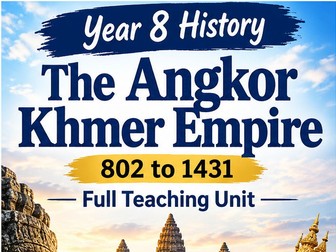
This complete 10‑week Year 8 History unit introduces students to the Angkor Khmer Empire (802–1431), one of the most sophisticated and environmentally engineered civilisations of the medieval world. The resource helps students read geography, water systems, leadership, belief, society, evidence, conflict, and collapse as historical forces, showing how the empire rose through mastery of the monsoon environment and declined when that mastery faltered. Students examine how historians reconstruct Angkor using physical remains, inscriptions, foreign accounts, climate data, and modern LiDAR technology. Across eight modules, students build core historical skills while investigating the hydraulic city, the god‑king ideology, monumental architecture, social hierarchy, trade networks, religious transformation, and the multi‑causal nature of Angkor’s decline. Each module centres on an inquiry question, guiding students to analyse what evidence survives, what has been erased by climate, and how historians interpret competing narratives. The unit highlights contested interpretations, showing how traditional explanations of sudden military collapse have been reshaped by scientific evidence revealing long‑term environmental stress. A flexible activity bank supports learning across the term. Tasks include source analysis, discussion and debate, creative and divergent thinking, structured writing, mapping exercises, sequencing tasks, museum curation, engineering modelling, and short consolidation checks. Students engage with temple architecture, bas‑reliefs, inscriptions, hydraulic infrastructure, foreign diplomatic accounts, climate data, and LiDAR scans, using a clear analytical framework to identify what sources show, infer what they suggest, consider who produced them and why, and evaluate their limitations. The unit builds transferable skills in evidence analysis, historical significance, contestability, cause and consequence, and extended historical argument. This resource is provided as non‑editable PDFs and is not designed as editable PowerPoints. Teachers can upload slides to their LMS, print selected pages for classroom use, display them to support discussion, analysis, and writing, or upload them to presentation or design platforms if they wish to adapt the material (formatting may vary depending on the program).
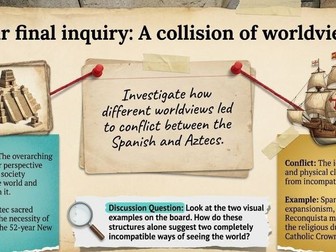
Angkor Khmer Empire – Geography, Context and Chronology (Year 8 History)Quick View
BeyondTime

Angkor Khmer Empire – Geography, Context and Chronology (Year 8 History)

(0)
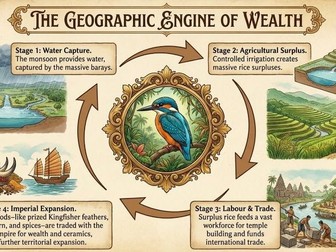
This 15 slide Year 8 History lesson sequence introduces students to the geographical and environmental forces that shaped the Khmer Empire (802–1431). The resource helps students read landscape, climate, monsoon cycles, and water systems as historical forces, showing how the empire flourished by mastering an extreme environment. Students investigate the Tonlé Sap flood pulse, the baray reservoirs, gravity-fed canals, and the agricultural surplus that powered temple building, trade, and imperial expansion. A clear chronological overview traces the empire’s foundation, peak, and decline, linking environmental conditions to political and economic change. The section closes with a synthesis drawing together geography, climate, and human engineering as the core drivers of Angkor’s rise and fall. The second section provides a bank of learning activities including source analysis, discussion and debate, creative and divergent thinking, structured writing, mapping tasks, timeline reasoning, and retrieval starters. Each activity includes a clear student task, timeframe, and teacher notes for differentiation. The transferable skill is historical context setting; the Khmer Empire is the vehicle. This resource is provided as non‑editable PDFs and is not designed as editable PowerPoints. Teachers can upload slides to their LMS, print selected pages for classroom use, display them to support discussion, analysis, and writing, or upload them to presentation or design platforms if they wish to adapt the material.
Angkor Khmer Empire – Society, Hierarchy and Daily Life (Year 8 History)Quick View
BeyondTime

Angkor Khmer Empire – Society, Hierarchy and Daily Life (Year 8 History)

(0)
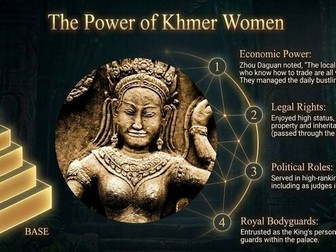
This 15 slide Year 8 History lesson sequence introduces students to the social hierarchy and daily life of the Khmer Empire. The resource helps students analyse who held power, how different groups lived, and whose experiences survive or disappear in the historical record. Students examine the god‑king (devaraja), royal family, Brahmin priesthood, bureaucrats, artisans, boat builders, peasants, women, and enslaved peoples through roles, lived experience, and surviving evidence. A dedicated section explores “lost voices,” showing how Cambodia’s monsoon climate erased perishable records and preserved only elite stone inscriptions. A synthesis matrix contrasts elite and peasant life across architecture, economy, and knowledge. The second section provides a bank of learning activities including source analysis, debate, creative writing, structured PEEL tasks, ranking exercises, retrieval starters, and exit tickets. Each activity includes clear instructions, timing, and teacher differentiation notes. The transferable skill is social structure analysis; the Khmer Empire is the vehicle. This resource is provided as non‑editable PDFs and is not designed as editable PowerPoints. Teachers can upload slides to their LMS, print selected pages for classroom use, display them to support discussion, analysis, and writing, or upload them to presentation or design platforms if they wish to adapt the material.
Shogunate Japan (c.794–1867) – Year 8 History Full Teaching UnitQuick View
BeyondTime

Shogunate Japan (c.794–1867) – Year 8 History Full Teaching Unit

(0)
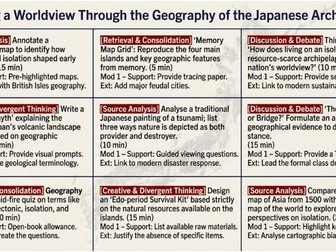
This complete 10‑week Year 8 History unit introduces students to Japan under the Shoguns (c.794–1867), one of the most enduring and culturally distinctive societies of the pre‑modern world. The resource helps students read geography, social hierarchy, leadership, belief systems, conflict, cultural change, and legacy as historical forces, showing how Japan’s political and cultural structures shaped society for over a thousand years. Students examine how geography, isolation, samurai culture, and shogunal authority influenced daily life and how historians interpret this period over time. Across eight modules, students build core historical skills while investigating the rise of warrior government, the role of the emperor and shogun, the daimyo and samurai class, village life, religious syncretism, artistic traditions, foreign contact, and the pressures that eventually destabilised the Tokugawa system. Each module centres on an inquiry question, guiding students to analyse what evidence survives, what has been lost, and how historians interpret contested narratives—from the romanticised samurai ideal to the realities of political control, social order, and isolationist policy. A flexible activity bank supports learning across the term. Tasks include source analysis, discussion and debate, creative and divergent thinking, structured writing, mapping exercises, perspective writing, significance ranking, and short consolidation checks. Students engage with artworks, architecture, legal codes, religious texts, artefacts, and historical accounts, using a clear analytical framework to identify what sources show, infer what they suggest, consider who produced them and why, and evaluate their limitations. The unit builds transferable skills in evidence analysis, social structure interpretation, comparative history, historical significance, and extended historical argument. This resource is provided as non‑editable PDFs and is not designed as editable PowerPoints. Teachers can upload slides to their LMS, print selected pages for classroom use, display them to support discussion, analysis, and writing, or upload them to presentation or design platforms if they wish to adapt the material (formatting may vary depending on the program).
Japan under the Shoguns – Assessment, Writing and Feedback (Year 8 History)Quick View
BeyondTime

Japan under the Shoguns – Assessment, Writing and Feedback (Year 8 History)

(0)
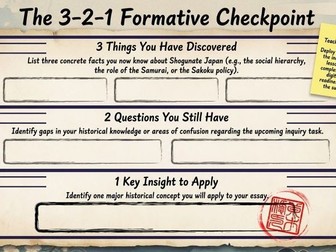
This 15 slide Year 8 History lesson sequence prepares students for a summative historical inquiry on Japan under the Shoguns. The resource supports structured research, analytical writing, and evidence based argument through clear scaffolds, exemplars, and feedback tools. The first section opens with an inquiry question asking how historians construct arguments about the past. Students examine the components of historical inquiry: question, research, evidence, interpretation, and argument. Explicit writing instruction, model paragraphs, and guidance on evaluating evidence are included. The section closes with a synthesis slide outlining expectations for the summative task. The second section includes source analysis, discussion and debate, creative and divergent thinking, structured writing, self assessment frames, peer feedback protocols, retrieval starters, and consolidation checks. The transferable skill is historical inquiry and analytical writing; Japan under the Shoguns is the vehicle. This resource is provided as non‑editable PDFs and is not designed as editable PowerPoints. Teachers can upload slides to their LMS, print selected pages for classroom use, display them to support discussion, analysis, and writing, or upload them to presentation or design platforms if they wish to adapt the material.
Japan under the Shoguns – Activity and Project Bank (Year 8 History)Quick View
BeyondTime

Japan under the Shoguns – Activity and Project Bank (Year 8 History)

(0)
This 15 slide Year 8 History lesson sequence provides a flexible bank of learning activities and extended projects for use across the Japan under the Shoguns unit. The resource gives teachers adaptable tasks that reinforce core skills including source analysis, inquiry, creative thinking, and structured writing. The first section opens with an inquiry question asking how historians use different types of tasks to build understanding of the past. Students examine short form tasks, extended projects, and inquiry based investigations, each connected to a specific historical skill. The section closes with a synthesis slide showing how varied tasks deepen understanding of Shogunate Japan. The second section includes source analysis, discussion and debate, creative and divergent thinking, structured writing, multi lesson research projects, retrieval starters, comparison prompts, and exit tickets. The transferable skill is applying historical methods through varied tasks; Japan under the Shoguns is the vehicle. This resource is provided as non‑editable PDFs and is not designed as editable PowerPoints. Teachers can upload slides to their LMS, print selected pages for classroom use, display them to support discussion, analysis, and writing, or upload them to presentation or design platforms if they wish to adapt the material.