Children’s Rights & Responsibilities – Needs vs Wants | Primary BundleQuick View
MrRobertson_

Children’s Rights & Responsibilities – Needs vs Wants | Primary Bundle

(0)
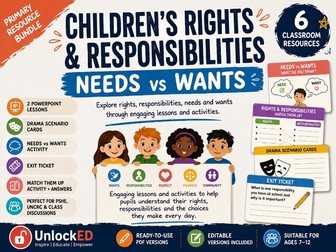
****A ready-to-use collection of 6 classroom resources designed to help primary pupils explore children’s rights, responsibilities, needs and wants. This bundle includes: Children’s Rights & Responsibilities PowerPoint - includes discussion and drama task. Needs vs Wants PowerPoint - includes interactive class activities Children’s Right’s Drama Scenario Cards Needs vs Wants – What Do You Think? Activity Rights & Responsibilities Exit Ticket Rights & Responsibilities – Match Them Up Activity + Answer Sheet The two PowerPoint lessons introduce the key concepts, with supporting activities for discussion, drama, independent work and reflection. Editable versions and ready-to-print PDFs are included, giving teachers the flexibility to adapt the resources or use them straight away. Ideal for Health & Wellbeing, PSHE, children’s rights, UNCRC and class discussions. Suitable for primary-aged learners (approximately ages 7–12).
Children's Rights and Responsibilities - Complete Primary LessonQuick View
MrRobertson_

Children's Rights and Responsibilities - Complete Primary Lesson

(0)
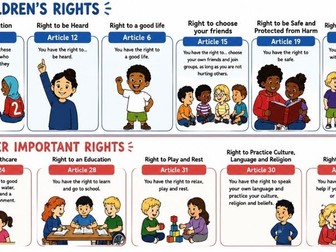
A ready-to-use primary lesson designed to help pupils understand children’s rights and responsibilities through discussion and engaging classroom activities. This resource includes: Children’s Rights & Responsibilities PowerPoint Clear explanations of rights and responsibilities Real-life examples relevant to children Class discussion questions Interactive drama activity with 6 school-baseed scenerio cards Learning intention and success criteria Editable PowerPoint and Word versions, plus ready-to-print PDFs The drama activity encourages pupils to consider responsible choices, act out different scenarios and discuss which children’s rights are involved. Ideal for Health & Wellbeing, PSHE, UNCRC, children’s rights and beginning-of-year learning. Suitable for primary-aged learners, (approximately ages 7–12).
Needs vs Wants – Complete Primary Lesson | Children’s RightsQuick View
MrRobertson_

Needs vs Wants – Complete Primary Lesson | Children’s Rights

(0)
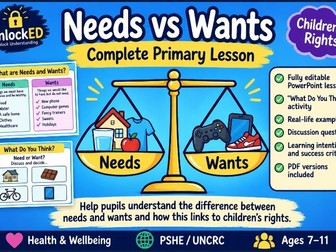
A ready-to-use primary lesson designed to help pupils understand the difference between needs and wants and explore how our needs link to children’s rights. This resource includes: Needs vs Wants PowerPoint Clear explanations of needs and wants Child-friendly examples Class discussion questions Interactive “What Do You Think?” activity Learning intention and success criteria Editable PowerPoint and Word versions, plus ready-to-print PDF versions The lesson encourages pupils to discuss, compare and justify whether different things are needs or wants while considering why our basic needs are important. Ideal for Health & Wellbeing, PSHE, UNCRC, children’s rights and beginning-of-year learning. Suitable for primary-aged learners, (approximately ages 7–12).
Grammar Classroom Posters | 7-Part Display PackQuick View
MrRobertson_

Grammar Classroom Posters | 7-Part Display Pack

(0)
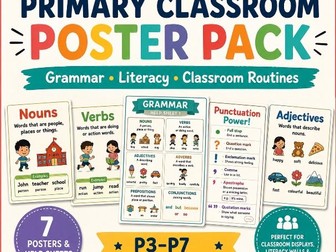
A useful collection of 7 classroom posters and help sheets designed to support primary pupils with literacy, grammar and everyday classroom routines. This pack includes: Adjectives Poster Grammar Help Sheet 1 Grammar Help Sheet 2 Group Tidy Up – 5 Simple Steps Nouns Poster Punctuation Power Poster Verbs Poster Designed with simplicity and clarity in mind, these colourful, pupil-friendly resources use clear language, simple examples and visual prompts to make key concepts easier for children to understand and remember. Ideal for classroom displays, literacy walls and pupil reference, giving children quick visual reminders they can use independently throughout the school day. Suitable for primary-aged learners (approximately ages 6–12).
Back to School Activity Pack | 6 Getting to Know You ActivitiesQuick View
MrRobertson_

Back to School Activity Pack | 6 Getting to Know You Activities

(0)
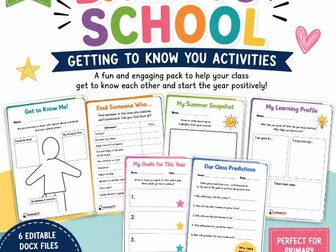
A useful collection of 6 back-to-school activities designed to help primary pupils settle into their new class, get to know one another and reflect on the year ahead. This pack includes: Get to Know Me Find Someone Who… My Summer Snapshot My Learning Profile My Goals for This Year Our Class Predictions Each activity is provided in both an editable and word format and ready-to-print PDF version. Designed with simplicity and flexibility in mind, these pupil-friendly activities provide a mixture of independent reflection, discussion and opportunities to get to know classmates. Ideal for the start of a new school year, transition activities, or getting to know a new class. Activities can be used individually or across the opening days and weeks of school. Suitable for primary-aged learners (approximately ages 7–12).
Lesson 2 - The Home Front WW2 - What Was Life Like in Britain During WW2?Quick View
MrRobertson_

Lesson 2 - The Home Front WW2 - What Was Life Like in Britain During WW2?

(0)
Teaching World War Two? Explore what life was really like in Britain on the Home Front. Everything you need is available in one download. This resource explores how everyday life in Britain changed during the Second World War. Pupils will learn about the challenges faced by ordinary people and the different ways the British public contributed to the war effort. The lesson introduces key aspects of the Home Front in a clear and engaging way, helping pupils understand that WW2 affected not only soldiers fighting overseas, but millions of people at home. This resource includes: Fully editable PowerPoint lesson. PDF version of the lesson. Printable Propaganda Posters Activity Anderson Shelter model-building activity with step-by-step instructions and a video tutorial. QR codes linking to historical sources and the companion YouTube lesson. Discussion, retrieval and recap activities. Clear explanations suitable for classroom teaching. Topics covered: What the Home Front was. Conscription and the war effort. The changing role of women during WW2. Rationing and shortages. Air raids and keeping people safe. Anderson Shelters. How everyday life changed during the war. Suitable for: Ages (7–11) with additional support for learners aged (11-14) Ideal for classroom teaching, home learning and revision. UnlockED’s goal is to help learners understand – not just memorise facts.
The Beginning of  WW2 - Complete Lesson Pack (Parts 1 & 2)Quick View
MrRobertson_

The Beginning of WW2 - Complete Lesson Pack (Parts 1 & 2)

2 Resources
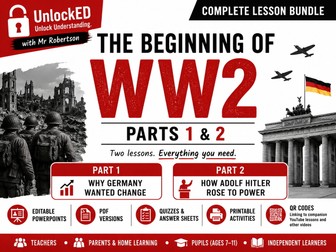
Teach the beginning of the Second World War with this complete two-lesson bundle. This bundle includes: ✅ Lesson 1 – Part 1: Why Germany Wanted Change ✅ Lesson 1 – Part 2: How Adolf Hitler Rose to Power ✅ Editable PowerPoints ✅ PDF versions ✅ Quizzes ✅ Answer sheets ✅ Road to War Sequencing Activity ✅ QR codes linking to the companion YouTube lessons and additional edcuational videos. Topics covered: Causes of the First World War Treaty of Versailles Problems in Germany The Great Depression Hitler’s rise to power Nazi support and propaganda Hitler’s Expansion Plan The Appeasement The invasion of Poland Britain and France declare war Suitable for: 📚 Teachers 👨‍👩‍👧 Parents & Home Learning 🎓 Pupils (ages 7–11), with additional support for learners aged 11–14 📖 Independent Learners
The Beginning of WW2 - Part 2: How Adolf Hitler Rose to PowerQuick View
MrRobertson_

The Beginning of WW2 - Part 2: How Adolf Hitler Rose to Power

(0)
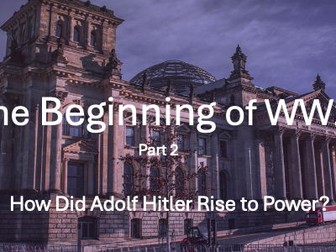
**Build on your World War Two topic with Part 2 of The Beginning of WW2. Everything you need for this lesson is available in one resource. ** Designed to complement Part 1, this lesson continues the story by showing how the problems Germany faced after the First World War helped create the conditions for Adolf Hitler’s rise to power and Europe’s move towards war. This resource helps pupils understand how Hitler gained support, became Germany’s leader and gradually expanded German territory. Pupils will explore the policy of appeasement and discover how the road to war eventually led Britain and France to declare war on Germany in September 1939. This resource includes: Fully editable PowerPoint lesson. PDF version of the lesson. Road to War Sequencing Activity. Teacher answer sheet. QR code linking to the companion YouTube lesson. Discussion, retrieval and recap activities. Clear explanations suitable for classroom teaching. Topics covered: Adolf Hitler’s rise to power. Why many Germans supported Hitler. Germany begins to rebuild its army. Germany takes over Austria. The policy of Appeasement. Germany takes over Sudetenland. Germany takes of Czechoslovakia. The invasion of Poland. Britain and France declare war on Germany. The beginning of the Second World War in Europe. Suitable for: Ages 7 - 11, with additonal support for learners aged 11-14. UnlockED’s goal is to help learners understand - not just memorise facts.
The Beginning of WW2 - Part 1: Why Germany Wanted ChangeQuick View
MrRobertson_

The Beginning of WW2 - Part 1: Why Germany Wanted Change

(0)
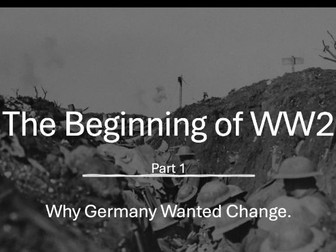
**Teaching World War Two? Not sure where to start? Everything you need is available in one download. ** These resources are the perfect starting point for any World War Two topic. They explore the key events, ideas and background that laid the foundations for World War Two, giving pupils the knowledge they need to understand why the war began. Pupils will explore why many Germans wanted change, the problems Germany faced after WW1, and how these events helped create the conditions that led to the Second World War. This resource includes: Fully editable PowerPoint lesson. PDF version of the lesson. Printable end-of-lesson quiz. Teacher answer sheet. QR codes linking to historical sources and the companion YouTube lesson. Discussion, retrieval and recap activities. Clear explanations suitable for classroom teaching. Topics covered: The end of the First World War The Armistice The Treaty of Versailles Problems in Germany after the war. The Great Depression Why many Germans wanted change. Suitable for: Ages (7 - 11), with additional support for learners aged (11 - 14) Ideal for classroom teaching, home learning and revision. UnlockED’s goal is to help learners understand - not just memorise facts.