Math HeistQuick View
ElijahReources

Math Heist

(0)
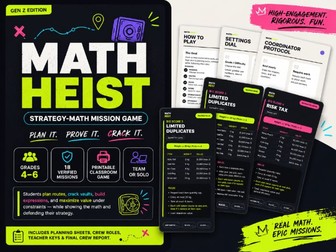
Turn maths practice into a high-stakes mission! Math Heist: Strategy-Math Mission Game is a print-and-play classroom game for Grades 4–6 that challenges students to plan routes, crack numerical vaults, build expressions, and maximise value while working within real mathematical constraints. Rather than simply answering isolated questions, students must choose a strategy, show their calculations, check the rules, and defend why their solution works. Every mission separates arithmetic accuracy from strategic reasoning, helping students develop flexible number sense, problem-solving skills, and mathematical communication. The game uses three different mission types. The Vault asks students to hit an exact target using limited quantities, bonuses, penalties, or special modifiers. The Code challenges students to build expressions using a restricted set of numbers and operations. The Big Score introduces optimisation problems in which students must maximise value while staying within weight, quantity, pick, or risk limits. Students can play individually or work as a crew with dedicated roles such as Planner, Calculator, Auditor, and Runner, making the resource particularly effective for collaborative maths lessons, enrichment, stations, intervention groups, or end-of-unit review. What’s included 18 verified maths missions 6 Vault missions 6 Code missions 6 Big Score optimisation missions Ready-to-run 4-mission core game Teacher quick-start guide Game rules and Coordinator protocol Crew role cards Mission Planning Sheet Final Crew Report Tournament and differentiation options Complete teacher answer keys Alternate solutions and strategy debriefs Verified optimisation solutions Production and maths self-audit The missions develop multi-step arithmetic, multiplication, percentages, order of operations, ratios, value-per-weight reasoning, budgeting, constraint checking, optimisation, and mathematical justification. A key feature of Math Heist is that students cannot win by guessing. A mission is only cracked when both the maths and the rules are correct. After each solve, students compare possible routes and consider questions such as: Was there a shorter route? Was another combination more efficient? Did a tempting solution break one of the constraints? This makes the resource especially useful for moving students beyond procedural calculation and into reasoning, decision-making, and problem solving.
Grammar Break-InQuick View
ElijahReources

Grammar Break-In

(0)
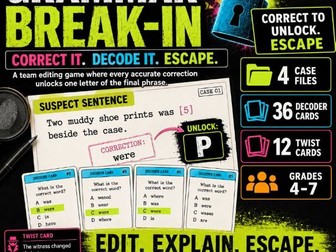
Turn grammar correction into an engaging escape-style classroom challenge with Grammar Break-In: Correct It. Decode It. Escape. Students work in teams to investigate suspect paragraphs, correct grammar errors, unlock decoder letters, and reveal a hidden final phrase. The key mechanic keeps the learning rigorous: students must write their corrections before they are allowed to use the decoder, so the cards verify genuine editing rather than encourage guessing. Designed for Grades 4–7, this printable grammar game targets verb tense, subject–verb agreement, punctuation, apostrophes, run-on sentences, sentence structure, and word form. Students are also expected to explain why a correction works, helping move grammar practice beyond simply spotting mistakes. Each investigation contains 9 numbered errors. Teams correct the paragraph first, then match each correction to the corresponding evidence decoder. Every accurate correction reveals a letter, and the nine letters combine to form the final escape phrase. The resource contains 4 complete Case Files, 36 decoder cards, and 12 optional Twist Cards. Included in this resource: 4 complete grammar mystery Case Files 36 Evidence Decoder cards 12 Break-In Twist Cards Reusable Team Investigation Record Grammar Toolkit reference sheet Teacher setup and game instructions Case Scoreboard Full corrected paragraphs Detailed teacher answer keys Grammar-rule explanations for every correction Differentiation and alternative play modes Support, Core, and Stretch options Ready-to-use hidden escape phrases for every case The four investigations increase in challenge, including The Missing Trophy, The Library Alarm, The Cafeteria Note, and The Science Fair Swap, with cases ranging from Grades 4–5 through an advanced Grades 5–7 challenge. Teachers can run the activity as a Classic Break-In, Checkpoint Race, No-Race Edit, Station Rotation, whole-class investigation, or digital display activity, making it flexible for different classroom routines and ability levels. A complete investigation takes approximately 20–35 minutes, making it suitable for a focused grammar lesson, literacy center, review activity, intervention group, team challenge, or end-of-unit consolidation. Perfect for: Grammar review, English/literacy lessons, editing practice, small groups, classroom competitions, early finishers, revision stations, and escape-room-style learning. Grades: 4–7 Subject: English / Grammar / Writing Format: Printable classroom escape game Skills: Editing, grammar correction, verb tense, agreement, punctuation, sentence structure, reasoning and proofreading Correct it. Decode it. Escape.
Hop to It! Addition & Subtraction Game | Active Math Fluency Game | Grades K–2Quick View
ElijahReources

Hop to It! Addition & Subtraction Game | Active Math Fluency Game | Grades K–2

(0)
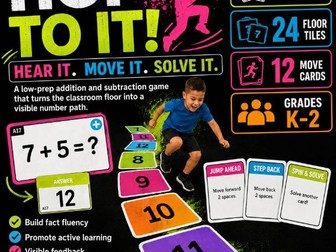
Get students moving while building addition and subtraction fluency with Hop to It!, a low-prep active math game that turns the classroom floor into a visible number path. Students hear a fact, move to the answer tile, say the complete equation, and receive immediate feedback through movement. Designed for Grades K–2, this resource combines fact retrieval, number sense, movement, and strategy practice in a flexible format that works for whole-class lessons, centers, small groups, intervention, or seated/tabletop play. Students can solve by walking, hopping, pointing, tapping, or directing a partner, making the activity easy to adapt for different learners and classroom spaces. The resource also emphasizes accuracy before speed, with the countdown completely optional. What’s included: 96 addition and subtraction fact cards 48 addition cards 48 subtraction cards Floor number tiles from 0–20 START, +, and – floor tiles 12 optional Move Cards Student progress log Teacher observation sheet Full addition answer key Full subtraction answer key Setup and safety guide Differentiation ideas Multiple game modes for support, core, and stretch learners The floor path can be set up as a straight number line, two-row path, or tabletop version, making it practical for both large and small classrooms. Flexible ways to play Use Direct Retrieval for quick fact practice, Hop the Strategy to model counting on and counting back, Partner Call for paired learning, Team Relay for cooperative review, or Missing Number for extra number-sense practice. A seated/digital option is also included. The optional Move Cards add variety with prompts such as Bunny Hops, March to It, Tiptoe Trip, Giant Steps, Tiny Steps, Point + Say, Hop + Explain, Count-On, and Count-Back while keeping safety and accessibility as the priority. Great for Math centers, morning work, intervention groups, PE/math cross-curricular activities, indoor movement breaks, whole-class review, early finishers, tutoring, and fact-fluency practice. Grades: K–2 Subject: Mathematics Skills: Addition, subtraction, number sense, fact fluency, counting on, counting back, mental math Format: Printable active-learning math game Hear it. Move it. Solve it.
Borrow or BustQuick View
ElijahReources

Borrow or Bust

(0)
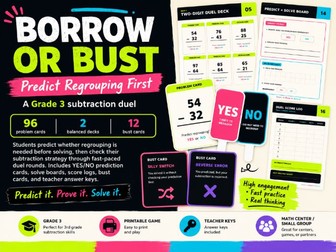
Make subtraction practice more strategic with Borrow or Bust: Predict Regrouping First, a fast-paced Grade 3 subtraction game that teaches students to recognize when regrouping is needed before they begin calculating. Instead of simply completing subtraction questions, students must first commit to YES — regroup or NO — no regroup, then solve the problem and check whether both their prediction and calculation were correct. This print-and-play resource is designed to strengthen place-value reasoning, subtraction fluency, mathematical explanation, and error analysis. Students learn to scan subtraction problems from right to left, identify the first column that requires an exchange, and distinguish between regrouping in the ones, tens, multiple columns, and across zero. The game includes 96 subtraction problem cards across two balanced decks: a two-digit duel deck and a three-digit “High Stakes” deck. The progression moves from straightforward no-regrouping questions to regrouping in one column, multiple columns, and challenging across-zero examples. Included in the resource: 96 ready-to-use subtraction problem cards Two balanced decks with regrouping and non-regrouping problems YES / NO prediction cards for two players Reusable Predict + Solve student boards 12 optional Bust Cards for extra challenge and variety Duel Score Log for tracking prediction and calculation accuracy separately Teacher observation / regrouping check sheet Full teacher answer keys for both two-digit and three-digit decks Teacher mini-lesson on predicting regrouping Differentiation ideas for support, core and stretch groups Multiple play modes including Classic Duel, Prediction Only, Team Table and Error Detective Great for Math centers, partner games, small-group intervention, whole-class review, early finishers, tutoring, assessment practice, and targeted regrouping support. What makes Borrow or Bust different is that a student cannot earn full success simply by getting the final answer right. They must also correctly predict whether regrouping is required. This helps teachers separate calculation errors from place-value and regrouping-recognition errors, giving much more useful information about what a student actually understands. Grade: 3 Subject: Mathematics Skills: Subtraction, regrouping, place value, reasoning, mental prediction, error analysis Format: Printable classroom game / math center / partner activity Predict it. Prove it. Solve it.
Julius Caesar On Trial - Tyrannicide or Treason?Quick View
ElijahReources

Julius Caesar On Trial - Tyrannicide or Treason?

(0)
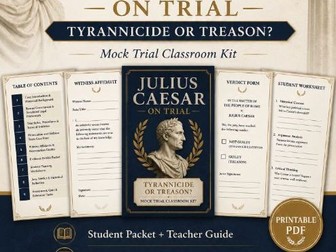
Bring the fall of the Roman Republic into your classroom with a complete, evidence-based mock trial experience. In Julius Caesar on Trial: Tyrannicide or Treason?, students investigate the assassination of Julius Caesar and decide whether Brutus, Cassius acted to defend Roman. Designed for Grades 9–12, Honors, advanced history, civics, classical studies, rhetoric, and literature courses, this classroom-ready bundle develops historical argumentation, sourcing, corroboration, public speaking, active listening, media literacy, and evidence-based deliberation. What Is Included Complete Classroom Kit Historical background on Caesar and the late Roman Republic Roman government and simulated legal framework Charges, burdens of proof, trial procedures, and evidence rules Prosecution and defense strategy guides Classroom roles and trial schedule options Evidence-based verdict and reflection activities Student Case File and Trial Workbook Prosecution and defense case-planning materials 10 reconstructed witness affidavits Direct- and cross-examination planners 12 evidence exhibits Source-analysis worksheets Opening and closing argument organizers Objection guide Jury notes and verdict forms Knowledge check, writing prompts, and student rubric Teacher Guide and Answer Key Three-day, five-day, and eight-day implementation plans Historical-accuracy guidance Witness-coaching and exhibit notes Model prosecution and defense arguments Two defensible model verdicts Debrief questions Assessment rubrics, quiz answers, and essay guidance Differentiation and enrichment ideas Jury Deliberation Packet Burden-of-proof and certainty ladder Element-coded evidence logs Prosecution and defense tracking charts Five C’s witness-credibility scale Exhibit-reliability tracker Ten-step deliberation protocol Foreperson script Structured verdict framework Minority report and juror self-assessment Courtroom Press Corps Packet Student newsroom roles and ethics code Live trial reporting log Quotation ledger Headline-writing laboratory Breaking-news report template Five-level fact-checking system Analysis-column prompt Press-conference planner Front-page layout activity Publication checklist and press rubric The jury packet requires students to connect evidence to specific charge elements rather than vote based on performance or personal preference. The press packet adds structured journalism activities involving attribution, fact-checking, headline writing, reporting, and media literacy. Skills Developed Students practice: Historical sourcing and corroboration Evidence-based argumentation Legality versus legitimacy analysis Direct and cross-examination Public speaking and rhetorical strategy Witness-credibility evaluation Jury deliberation and civil discussion News writing, attribution, and fact-checking Analytical and argumentative writing Flexible Classroom Use
Macbeth Complete Study & Teaching Pack | Grades 9–12 | 140 pages + Answer KeysQuick View
ElijahReources

Macbeth Complete Study & Teaching Pack | Grades 9–12 | 140 pages + Answer Keys

(0)
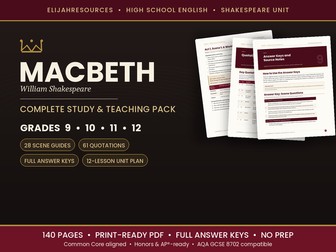
Everything you need to teach Macbeth — and nothing you’ll have to build yourself at 10pm. This is a complete 140-page unit, not a worksheet pack. It works as a teacher resource, a student study guide, or both: print Parts 1–8 as a student booklet and keep Part 9, the answer keys, for yourself. What’s inside 28 scene guides — one page per scene, every scene in the play. Setting, detailed summary, a key quotation with commentary, in-context vocabulary, literary focus, a stagecraft note, and 4 questions rising from retrieval to whole-play analysis. 112 questions, all answered. 61-quotation bank — every line checked against the public-domain text, referenced by act and scene, each explained in one sentence. Plus a memorisation method that actually works and a blank learning grid. 10 extract-based tasks — the exam-style skill of analysing a passage and linking it to the whole play. 40 questions with talking points supplied. 5 retrieval quizzes — one per act, 5 multiple choice and 3 short answer each, with keys. Ten-minute lesson starters. 10 themes, 6 character profiles, 10 minor characters, relationship map, arc tracker, symbols and methods tables. Two glossaries — 55 Shakespeare words and 29 literary terms for writing about drama. Critical approaches — five lenses, each with its own questions and its own weaknesses, plus seminar questions, debate motions, performance history, and screen adaptations. Writing and assessment — an original 4-point analytic rubric for Grades 9–12 with letter-grade conversion, 10 practice essay questions each with a thesis and a nine-step plan, timed-essay strategies for 45 and 55 minutes, an annotated model paragraph and a deliberately weak one to diagnose, and a 12-row common-errors clinic. Two pacing plans — a 12-lesson unit plan and a 30-day student revision calendar. Full answer keys for every question in the pack. Standards and exam alignment Aligned to Common Core ELA for grades 9–10 and 11–12 (codes listed, descriptions written in plain language). Also fully compatible with AQA GCSE English Literature 8702, Paper 1 Section A — extract-plus-whole-play format, AO1/AO2/AO3 guidance, and a student-friendly 30-mark rubric. Works equally well for Honors and AP®-track classes.
Complete U.S. Grade 1 Literacy Bundle | Phonics, Reading, Writing, Grammar | 219 PagesQuick View
ElijahReources

Complete U.S. Grade 1 Literacy Bundle | Phonics, Reading, Writing, Grammar | 219 Pages

(0)
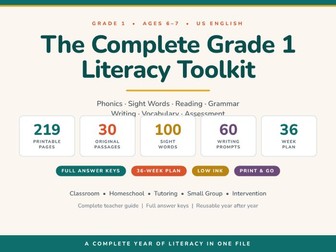
A complete year of first-grade literacy in one file — 219 printable pages, fully sequenced, with answer keys. This is one coordinated program, not a stack of unrelated worksheet packs. The phonics pattern you teach on Monday turns up again in the decodable sentences, the reading passage, the grammar page, and the writing prompt before Friday. Open the teacher guide and you know exactly what to teach, in what order, for all 36 weeks. Every passage, story, poem, sentence, word list, activity, and answer key was written from scratch for this resource. WHAT’S INCLUDED — 219 pages Teacher guide with a 36-week plan (15) · Phonics, 12 units (46) · 100 sight words (18) · 30 original reading passages (39) · Grammar, 24 activities (22) · Writing, 60 prompts (18) · Reading-response journal (11) · 10 vocabulary games (11) · Assessments and trackers (11) · Complete answer keys (16) · Bonus materials (6)
Operation Midnight Signal – Printable Espionage Escape Room (Ages 12+, 60–90 mins, 1–6 Players)Quick View
ElijahReources

Operation Midnight Signal – Printable Espionage Escape Room (Ages 12+, 60–90 mins, 1–6 Players)

(0)
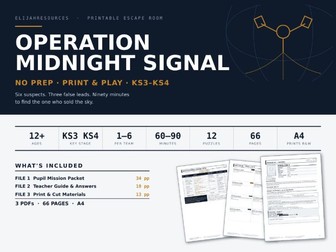
A printable espionage escape-room game for ages 12+, designed for 1–6 players and 60–90 minutes of collaborative problem-solving. Students decode ciphers, analyse evidence, eliminate suspects and stop a satellite sabotage operation using a classroom-safe, print-and-play packet with accessibility text alternatives and built-in hint cards. What’s included File 1: Player Mission Packet (34 pages) – pupil-facing documents, puzzles and evidence. File 2: Game Master / Answer Packet – full solutions, hints and facilitation notes. File 3: Print-and-Cut Sheets & Hint Cards – tokens, cut-outs and support materials. Built-in licence page with personal/single-classroom terms. How it plays Age: 12+ (KS3 / KS4, suitable for clubs and enrichment) Players: 1–6 (cooperative, team-vs-team, or solo modes) Time: 60–90 minutes Phases: 5 investigative phases with 12 linked puzzles Prep: Print the player packet for your group; keep the GM/answer packet for yourself. No colour printing required; all clues work in black and white. Licence – what you can do This purchase includes a personal / single‑classroom licence. You may: Use the game for personal, household, homeschool, youth-group, or single-classroom purposes. Print the copies needed for the participants in one game session, or for the students in one classroom taught by you. Re-print worksheets and player pages as often as you like for those same permitted uses. Photograph or film your own play session for personal memories. Licence – what you may not do You may not: Resell, re-license, sublicense, rent, trade, gift or transfer the files. Redistribute or share the files (including on file-sharing sites, cloud folders, VLEs/LMS open to other staff, forums or social platforms). Upload the files, or any page of them, to any public or semi-public website or AI training service. Print and sell physical copies, or run this game as a paid public event, without a separate written commercial licence from ElijahResources. Remove, cover, crop or alter the ElijahResources identification, footers, document numbers or licence notices, or present the work as your own. Create edits, translations or derivative products for distribution. Need a commercial licence? If you want to run paid events, use this in multiple classrooms or a business, or include it in a paid service, please contact the author to arrange a commercial licence (see separate TES listing / message for details). Curriculum links / skills Literacy: close reading, inference, evidence-based reasoning. Numeracy: patterns, codes, logic, time and sequence. PSHE / soft skills: teamwork, communication, problem-solving under time pressure. Perfect for: enrichment days, gifted & talented groups, library clubs, form-time challenges, STEM/STEAM events, and end-of-term problem-solving sessions.
Move, Sing & Speak! Action Verbs – Year 1 / Grade 1 Songs & Games (ESL)Quick View
ElijahReources

Move, Sing & Speak! Action Verbs – Year 1 / Grade 1 Songs & Games (ESL)

(0)
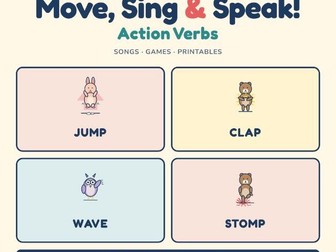
Move, Sing & Speak! Action Verbs is a cheerful 26-page Grade 1 English-language-learning resource for children aged 6–7. Students learn eight essential action verbs—jump, clap, turn, walk, stomp, wave, sit, and stand—through original songs, gestures, repetition, cooperative games, and hands-on printable activities. This resource includes: Three completely original action-verb songs Simple original melody guides and suggested movements Five active, no-elimination classroom games Large-print student lyric pages Colourable vocabulary picture cards Matching word cards Cut-and-sort action activity Draw What You Hear worksheet Action-verb exit ticket Teacher observation checklist 30–45 minute suggested lesson plan Differentiation for emerging readers, English learners, shy children, and students needing movement breaks Extension activities for confident readers Editable Word file and print-ready PDF The songs use short, predictable language that allows beginner speakers to participate confidently. No familiar melodies are required. Teachers can introduce the songs one line at a time and reuse them during transitions, movement breaks, literacy centres, morning meetings, or English-language-support lessons. The friendly animal illustrations are original black-and-white drawings that children can colour. The resource can be printed in colour or grayscale. Perfect for: Grade 1 classrooms, ESL/ELL instruction, literacy centres, homeschool lessons, intervention groups, movement breaks, and early vocabulary practice.
FREE Julius Caesar Mock Trial | Ides of March One-Period Roman Republic Activity | Grades 9-12Quick View
ElijahReources

FREE Julius Caesar Mock Trial | Ides of March One-Period Roman Republic Activity | Grades 9-12

(0)
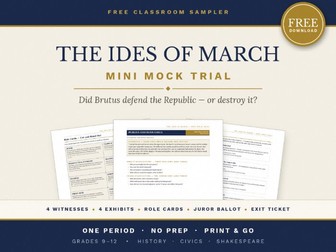
This free mini mock trial puts the Ides of March on trial. Brutus and the Liberatores stand accused of unlawfully killing a Roman magistrate. The prosecution argues that liberty cannot be defended by secret violence. The defense argues that when one man controls every remedy, legal forms become a mask. Your students argue it out, then vote. Everything a student needs to speak is printed on the page in front of them. There is no reading assignment the night before, no vocabulary list, and nothing for you to prepare. Hand out the role cards and start. WHAT’S INSIDE A 45-minute run sheet timed to the minute, with a “you do this” column for the teacher at every stage One simplified charge with three elements a student can hold in their head, plus a two-part necessity defence A one-page case brief that teaches the Roman constitutional setup — no prior reading required Four short witness affidavits (Antony, Casca, Brutus, and the tribune Marullus) with direct and cross questions already written out Four mini exhibits, each with a prosecution use and a defence use printed side by side Eight cut-out role cards covering the whole class — judge, clerk, attorneys, witnesses, jurors, press desk, foreperson A juror ballot with element gates and a stop rule A press desk page, three simplified objection cards, debrief questions, and an exit ticket WHY IT WORKS IN ONE PERIOD Most mock trials collapse under their own complexity or dissolve into invention. This one has a single rule that fixes both: witnesses may only say what is on their affidavit. “Objection — that is not in the affidavit” is one of the three objection cards, and it keeps a fast lesson historically honest. WHAT STUDENTS ACTUALLY PRACTICE Evaluating source reliability. Distinguishing what is legal from what is legitimate. Arguing from evidence to a specific claim rather than from opinion. Sitting with the fact that a defensible verdict can go either way — the debrief page is built around that, not around a right answer. GREAT FOR Ancient Rome and Roman Republic units · World History and Western Civilisation · Civics and government · Shakespeare’s Julius Caesar (pairs with Act III) · Debate and speech · Sub plans · The last week before a break · Anyone who wants one genuinely good lesson without a weekend of prep LOVE IT? THERE’S A GREAT DEAL MORE This is the compressed version of Julius Caesar on Trial: Tyrannicide or Treason? — the complete kit turns the same material into a three-day, five-day, or eight-day unit with two counts, ten witness affidavits, twelve sourced exhibits, a full jury deliberation packet, a courtroom press corps packet, a differentiation guide, rubrics, an answer key, and a teacher guide with model arguments and two defensible model verdicts. Link in the listing.
FREE Grade 1 Literacy Mini-Game Pack | Phonics, Sight Words & Sentence BuildingQuick View
ElijahReources

FREE Grade 1 Literacy Mini-Game Pack | Phonics, Sight Words & Sentence Building

(0)
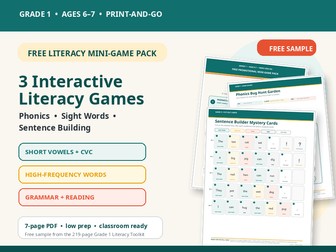
Bring interactive, low-prep learning to your literacy centers with this FREE 7-page Grade 1 Literacy Mini-Game Pack! Designed for 1-on-1 instruction, small group guided reading, literacy stations, or homeschool practice, this printable sample pack includes 3 complete, ready-to-use literacy games targeting core early reading and writing skills: Game 1: Phonics Bug Hunt (CVC Words & Short Vowels) Focus: Blending, segmenting, rhyming, and manipulating CVC words across all five short vowels. Includes: Winding 24-space garden game board, 12 phonics cut-out question cards, teacher quick key, and differentiation options. Game 2: Sight Word Speed Dash (High-Frequency Word Fluency) Focus: Target sight words (the, and, was, they, look). Focus: Sentence structure, mechanics (capitalization & punctuation), and color-coded parts of speech (nouns, verbs, adjectives, sight words). Includes: 5 sets of color-coded mystery cut-out word cards, teacher answer key, and student self-check recording sheet. Loved This Free Sample? Check out our complete, 219-page Complete Grade 1 Literacy Toolkit available on TES Resources! The full bundle features a 36-week systematic phonics sequence, 100 high-frequency sight words, 30 original decodable passages, grammar lessons, writing prompts, progress trackers, and full answer keys.
FREE Macbeth Differentiated Lesson Pack: Act 1 Scene 7 (US 9-12/GCSE)Quick View
ElijahReources

FREE Macbeth Differentiated Lesson Pack: Act 1 Scene 7 (US 9-12/GCSE)

(0)
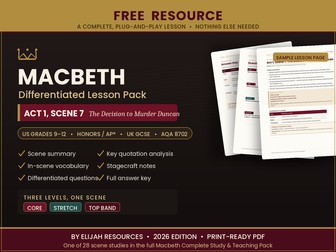
A complete, no-prep Macbeth lesson on one of the play’s hardest scenes — free. This ready-to-teach pack covers Act 1, Scene 7: Macbeth’s “vaulting ambition” soliloquy and the confrontation where Lady Macbeth talks him back into the murder. Print it and teach it as it stands — nothing else is needed. Inside this free lesson you get a clear scene summary, key quotation analysis, in-scene vocabulary, a stagecraft note, and four differentiated questions arranged by level — with a full teacher answer key. It’s built for mixed-ability classes: every task is labelled Core, Stretch (Honors), or Top Band (AP / GCSE Grade 8-9), so you can teach the whole room from one page and extend your strongest students without extra planning. Perfect for US high school English (Grades 9-12, Honors and AP®) and UK GCSE Literature (AQA 8702). Use it as a cover lesson, a revision starter, or a model of close reading. This is one of 28 scene studies in the full Macbeth: Complete Study & Teaching Pack (140 pages) — which adds context, criticism, a 61-quotation bank, quizzes, rubrics, exam practice and complete answer keys. Download the free lesson, then grab the full pack.