Product Origin CardsQuick View
CoconutBayResources

Product Origin Cards

(0)
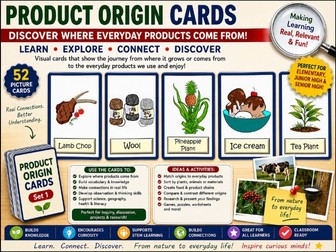
Product Origin Cards – Set 1 Help students discover where everyday products come from with Product Origin Cards – Set 1. This engaging educational resource contains 52 picture cards designed to help learners make connections between natural sources and the everyday products we use. Students can explore the relationship between plants, animals and materials and the products that come from them, making learning more visual, meaningful and memorable. The cards provide an excellent resource for developing vocabulary, general knowledge, observation, discussion, reasoning and critical-thinking skills. They can be used across a range of subjects and learning situations, including science, geography, health, literacy and research-based activities. For teachers, the cards offer a flexible resource that can be used with individual learners, pairs, small groups or whole-class teaching. They can be incorporated into existing lessons or used as a starting point for discussion, investigation and further research. The accompanying activities provide opportunities for students to match origins with products, sort and classify information, make connections, compare different origins, create product chains and explore ideas through games and puzzles. Suitable for Elementary, Junior High and Senior High learners, the cards can be adapted to different ages and abilities. Product Origin Cards is a practical, reusable classroom resource that turns familiar everyday products into opportunities for curiosity, discovery and deeper learning.
Mystery Letter Detective – Phonics CardsQuick View
CoconutBayResources

Mystery Letter Detective – Phonics Cards

(0)
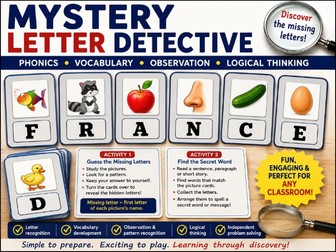
A fun phonics and vocabulary mystery game using picture cards to develop letter recognition, observation, logical thinking, vocabulary and independent learning. Mystery Letter Detective encourages children to discover answers for themselves rather than simply being given them. Students study picture cards, look for patterns and work out the missing letters before the answers are revealed. The missing letter is the first letter of each picture’s name. What students practice Letter recognition Phonics and early reading skills Vocabulary development Observation and pattern recognition Logical thinking Independent problem solving Confidence through discovery A second activity: Secret Words Once students understand the Mystery Letter Cards, they can be used with sentences, paragraphs and short stories. Students identify words in the text that match the picture cards and collect the corresponding letters. Teachers can arrange the letters to create a hidden word or message. Longer passages can be used as students become more confident. Classroom use This resource can be used as a whole-class activity, small-group activity or independent challenge. Encourage students to think quietly, avoid calling out answers and explain how they discovered the pattern. Familiar and unfamiliar vocabulary can be mixed to develop language skills. The Mystery Letter Cards turn phonics, vocabulary and reading practice into a puzzle-solving activity that encourages curiosity, careful thinking and independent discovery.
2nd Conditional PowerPointQuick View
CoconutBayResources

2nd Conditional PowerPoint

(0)
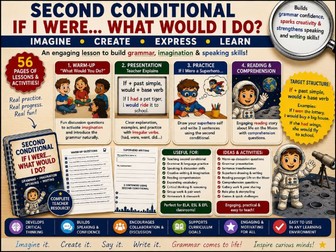
2nd Conditional – Imaginary Situations & Speaking Game Make the second conditional easier to understand, practise and use with this engaging, classroom-ready lesson. The resource introduces the structure “If + past simple, … would + base verb” and helps students recognise that the past form is being used to describe imaginary or unreal situations. The lesson begins with an interactive warm-up where students respond to imaginative questions such as what they would do if they could fly, were invisible or had a million dollars. Students then explore the grammar structure, practise pronunciation and identify the difference between real and imaginary situations. The practice stage encourages students to create their own superhero character and write sentences using the second conditional before sharing their ideas with classmates. An optional gallery walk provides another opportunity for students to read and respond to their peers’ imaginative answers. A fun, flexible resource for developing grammar accuracy, speaking, creativity and confidence, while giving students plenty of opportunities to use the target language meaningfully.
Murder Mystery Game – Detective Role PlayQuick View
CoconutBayResources

Murder Mystery Game – Detective Role Play

(0)
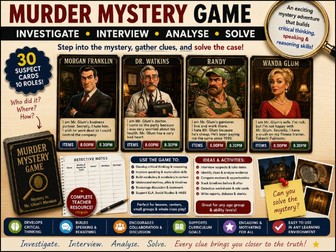
GLUM MURDER: A Classroom Murder Mystery. Mr. Glum is dead. Everyone in the mansion has a reason to be suspicious. The Butler isn’t helping matters. And somewhere among the clues, strange timelines, mysterious objects and questionable alibis lies the truth. Glum Murder is an interactive, teacher-led murder mystery designed to get students working together, discussing evidence and thinking like investigators. Students work in small teams as they question suspects, examine evidence, investigate locations and piece together the events surrounding Mr. Glum’s mysterious death. Every suspect has a story. Every object may have a purpose. And not everything is quite what it first appears to be. Some clues are obvious. Others require students to look more carefully. A curious student may even discover that a seemingly important clue has a very different explanation from the one they first assumed. The game encourages students to: • Work collaboratively and communicate their ideas. • Listen carefully and evaluate information. • Build and compare theories. • Use evidence to support their conclusions. • Recognise misleading or incomplete information. • Think critically rather than simply guessing. • Develop confidence in explaining and defending their reasoning. Glum Murder is designed to be played by teams, with the teacher controlling the investigation and revealing information as the students make their choices. But be careful… The Butler thinks everyone is a suspect. And he may have a few opinions of his own. Who killed Mr. Glum? There is only one way to find out.
Job Detective Game CardsQuick View
CoconutBayResources

Job Detective Game Cards

(0)
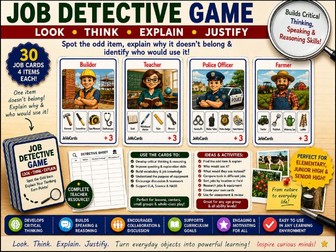
Jobs Detective Step into the world of work and become a Jobs Detective! Can you spot the item that doesn’t belong? These colourful, engaging cards introduce children to a wide variety of jobs, workplaces, tools and equipment while encouraging them to look closely, think carefully and talk about what they see. Each card presents a familiar job alongside a selection of objects. But something isn’t quite right. Children must use their knowledge, observation skills and reasoning to work out what has gone wrong. The real challenge comes when they have to explain their thinking and consider where the unusual item really belongs. With a mixture of straightforward and more challenging choices, Jobs Detective encourages children to question, discuss, justify and listen to one another. It is designed to promote vocabulary, communication and logical thinking while making learning feel like a game. The cards are ideal for small-group activities, classroom discussion, speaking practice or quick challenges between lessons. They can be used with different ages and abilities, with teachers able to adapt the level of questioning to suit their students. Look carefully. Think carefully. Explain your answer. There may be more than meets the eye on every card!
CEFR Level Suitability  A2 (Elementary): Clear, repetitive frames across 51 cards with basic high-frQuick View
CoconutBayResources

CEFR Level Suitability A2 (Elementary): Clear, repetitive frames across 51 cards with basic high-fr

(0)
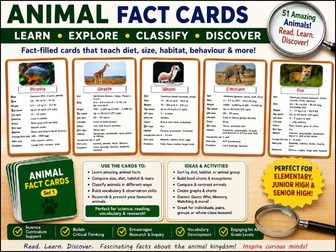
CEFR Level Suitability A2 (Elementary): Clear, repetitive frames across 51 cards with basic high-frequency data fields (diet, habitat, size, life span). B1 (Intermediate): Animal and science vocabulary (herbivore, carnivore, omnivore, nocturnal, diurnal, solitary, diurnal, predators, litter size), complex numerical ranges, and units of measurement. B2 (Upper Intermediate): Comparative analysis, data sorting, scientific classification, and complex classroom discussion tasks.Animal Fact Cards – Set 1 Suitable for all ages from young children to adults. Bring the animal kingdom into your classroom with this versatile set of 51 Animal Fact Cards, designed to encourage curiosity, discussion, reading, observation, research and critical thinking. Each card presents useful information about an animal, making the set suitable for a wide range of learning activities and adaptable to different ages and abilities. The resource can be used with young children, elementary students, junior high learners, senior high students, and even adult learners, with teachers able to adapt the level of questioning and discussion to suit their class. This is more than simply a collection of animal cards. Set 1 includes complete lessons, a classification activity and 25 classroom activities, giving teachers a ready-made resource that can be used for individual learning, pair work, small groups or whole-class teaching. The cards can support science, reading, vocabulary development, research, classroom discussion and independent learning, while giving students opportunities to compare information, develop ideas and explain their thinking. For teachers, this resource provides a flexible way to introduce animal-based learning without having to create every activity from scratch. Use the cards as a stand-alone resource, incorporate them into existing lessons, or return to them throughout the school year for different learning purposes. A flexible, engaging and reusable resource for learning about animals at almost any age.
FREE Relative Pronouns ESL PPT Lesson & Speaking Games (A2-B1).Quick View
CoconutBayResources

FREE Relative Pronouns ESL PPT Lesson & Speaking Games (A2-B1).

(0)
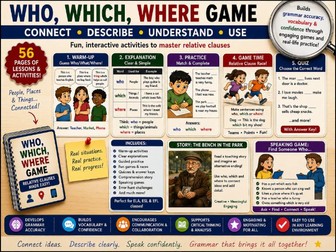
Who, Which, Where – Complete English Lesson Make who, which and where easier to understand and practise with this free, complete PowerPoint lesson. Designed to give students plenty of opportunities to recognise, correct and use the three relative words in meaningful contexts, the lesson combines explanation, guided practice, speaking and writing activities. Students work with example sentences, identify mistakes and correct them before moving into more creative activities. They can describe pictures using who, which and where, create their own sentences, take part in pair or class activities, and complete a short writing task using the target grammar. The lesson finishes with an easy exit-ticket activity that gives students a chance to produce their own examples using a person, thing and place. This is a FREE, complete PowerPoint lesson, ready to use in the classroom. The pictures included in the presentation can also be changed or replaced if they are not suitable for your particular students or teaching context, making the resource easy to personalise.