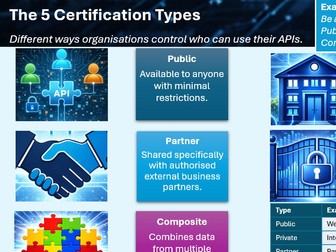
This lesson resource introduces students to API certifications and access control within the context of data analytics systems. The PowerPoint explains how organisations regulate access to APIs and explores the different certification types: Public, Private, Internal, Partner, and Composite APIs. Students learn how these access models affect security, data sharing, and system integration in real-world business scenarios.
The lesson includes a range of engaging activities such as Think–Pair–Share discussions, group research tasks, misconception checks, and exam-style application questions. Students analyse practical scenarios, evaluate risks of open data access, and justify which API certification model is most appropriate in different business contexts.
Designed for OCR Cambridge Technicals IT: Data Analytics (Unit F200 – APIs), this resource supports students in developing the analytical skills needed to identify, compare, and apply API access models in exam situations.
Ideal for:
KS5 Computing / IT lessons
Introducing API access control and security concepts
Exam preparation and application practice
Interactive classroom discussion and group work
This lesson introduces students to different API types and data formats used in data analytics. Students explore REST, SOAP, JSON-RPC and XML-RPC, learning how each API works, the data formats they use (JSON and XML), and their advantages and limitations. The lesson includes retrieval activities, research tasks, misconception correction, and an exam-style scenario question to help students practise selecting the most appropriate API for a given situation.
Designed for OCR Cambridge Nationals in IT – Data Analytics (TA 3.1.3), the resource supports students in identifying data formats, comparing API types, and explaining which APIs are most suitable for data analytics. The PowerPoint also includes a knowledge organiser, key terminology, plenary questions, and an independent study task based on a video comparing REST and SOAP.
GCSE French Writing Revision – AQA (2026 Spec)
Foundation & Higher Tier | PowerPoint
This clear, student-friendly PowerPoint helps learners prepare for the new AQA GCSE French Writing Paper. Covers all key tasks:
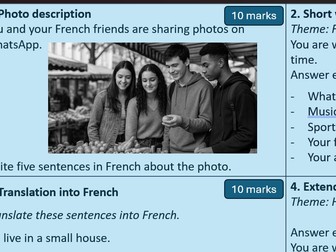
Photo description with sentence starters
50-word task on free time
90-word task on holidays (present, past, future)
Translation practice with grammar tips
150-word task on technology (Higher) with complex structures
Grammar gap-fill quiz
Perfect for revision lessons, homework, or independent practice.
Editable and ready to use.
Description of "Speaking Revision 3"
“Speaking Revision 3” is a structured revision resource designed to support preparation for the GCSE French Foundation Tier Speaking exam (AQA specification). It mirrors the exam format and provides scaffolded, exam-style practice across the three key components:
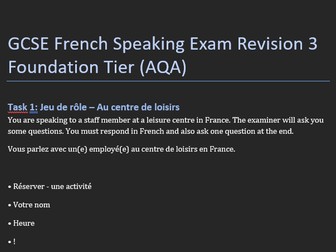
Task 1: Role-play – Au centre de loisirs – a contextualised task where students practise transactional language in the context of leisure centre activities, responding to unpredictable prompts and expressing personal preferences.
Task 2: Photo card – Un dîner en famille – a structured set of five questions linked to Theme 1: Identity and Culture, encouraging description of a family meal, use of different time frames, and expression of personal opinions about family traditions.
Task 3: General Conversation – Theme 2 – a conversation covering local area, environment, holidays, helping others.
Task 4: General Conversation – Theme 3 – a conversation coveringschool, subjects, uniform, daily routine, future education and jobs.
Assessment Objective Coverage:
AO1 (understanding spoken language): indirectly supported as students practise responding to spoken prompts.
AO2 (speaking in the target language): directly targeted across all tasks, focusing on communication, fluency, spontaneity.
AO3 (understanding written language): supported through comprehension of written prompts and bullet points.
Suggested Teaching Strategies:
Use in mock speaking exams to familiarise students with timing and structure.
Employ as a pair-work activity where students alternate examiner/candidate roles.
Set specific tasks as homework or independent practice, followed by peer review in class.
Incorporate model answers (from the correction sheet) for whole-class analysis, focusing on opinion phrases, tense variation, justification.
Differentiate by encouraging more confident students to extend answers with connectives, subordinate clauses, sophisticated vocabulary from the AQA specification.
This resource helps students build confidence, develop fluency, and practise exam-relevant skills aligned with the AQA GCSE French assessment criteria.
Please read:
These revision resources for the AQA GCSE French oral exam were created with the assistance of OpenAI’s ChatGPT. Throughout the development process, I used AI-generated suggestions, templates, and prompts to design structured role-plays, speaking cards, and revision activities tailored to the AQA specification. I collaborated with ChatGPT to ensure clarity, consistency, and accessibility, while adapting and refining the materials to meet the needs of my students. All final content was reviewed, edited, and curated by me as the author.
Please note: the photos included have been generated with AI (DALL·E) and are unique to this resource.
Description of "Speaking Revision 1"
“Speaking Revision 1” is a structured revision resource designed to support preparation for the GCSE French Foundation Tier Speaking exam (AQA specification). It mirrors the exam format and provides scaffolded, exam-style practice across the three key components:
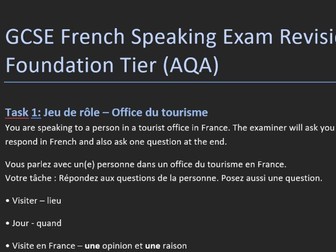
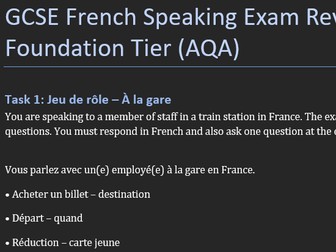
Task 1: Role-play – a contextualised task where students interact in a simulated real-life scenario, practising transactional language and responding to unpredictable prompts.
Task 2: Photo card – a structured set of five questions linked to Theme 1: Identity and Culture, encouraging description, use of different time frames, and expression of personal opinions.
Task 3: General Conversation – Theme 1 – a conversation covering family, friends, hobbies, festivals, social media.
Task 4: General Conversation – Theme 2 – conversation covering local area, travel, tourism, environmental issues.
Assessment Objective Coverage:
AO1 (understanding spoken language): indirectly supported as students practise responding to spoken prompts.
AO2 (speaking in the target language): directly targeted across all tasks, focusing on communication, fluency, spontaneity.
AO3 (understanding written language): supported through comprehension of written prompts and bullet points.
Suggested Teaching Strategies:
Use in mock speaking exams to familiarise students with timing and structure.
Employ as a pair-work activity where students alternate examiner/candidate roles.
Set specific tasks as homework or independent practice, followed by peer review in class.
Incorporate model answers (from the correction sheet) for whole-class analysis, focusing on opinion phrases, tense variation, justification.
Differentiate by encouraging more confident students to extend answers with connectives, subordinate clauses, sophisticated vocabulary from the AQA specification.
This resource helps students build confidence, develop fluency, and practise exam-relevant skills aligned with the AQA GCSE French assessment criteria.
Please read:
These revision resources for the AQA GCSE French oral exam were created with the assistance of OpenAI’s ChatGPT. Throughout the development process, I used AI-generated suggestions, templates, and prompts to design structured role-plays, speaking cards, and revision activities tailored to the AQA specification. I collaborated with ChatGPT to ensure clarity, consistency, and accessibility, while adapting and refining the materials to meet the needs of my students. All final content was reviewed, edited, and curated by me as the author.
Please note: the photos included have been generated with AI (DALL·E) and are unique to this resource.
Description of "Speaking Revision 2"
“Speaking Revision 2” is a structured revision resource designed to support preparation for the GCSE French Foundation Tier Speaking exam (AQA specification). It mirrors the exam format and provides scaffolded, exam-style practice across the three key components:
Task 1: Role-play – a contextualised task where students interact in a simulated real-life scenario, practising transactional language and responding to unpredictable prompts.
Task 2: Photo card
– a structured set of five questions linked to Theme 2: Local, National, International and Global Areas of Interest, encouraging description, use of different time frames, and expression of personal opinions.
Task 3: General Conversation – Theme 2
– a conversation covering home, town, neighbourhood, region, holidays, environment.
Task 4: General Conversation – Theme 3
– a conversation covering school, future plans, jobs, ambitions, education post-16.
Assessment Objective Coverage:
• AO1 (understanding spoken language): indirectly supported as students practise responding to spoken prompts.
• AO2 (speaking in the target language): directly targeted across all tasks, focusing on communication, fluency, spontaneity.
• AO3 (understanding written language): supported through comprehension of written prompts and bullet points.
Suggested Teaching Strategies:
• Use in mock speaking exams to familiarise students withtiming and structure.
• Employ as a pair-work activity where students alternate examiner/candidate roles.
• Set specific tasks as homework or independent practice, followed by peer review in class.
• Incorporate model answers (from the correction sheet) for whole-class analysis, focusing on opinion phrases, tense variation, justification.
• Differentiate by encouraging more confident students to extend answers with connectives, subordinate clauses, sophisticated vocabulary from the AQA specification.
This resource helps students build confidence, develop fluency, and practise exam-relevant skills aligned with the AQA GCSE French assessment criteria.
Please read:
These revision resources for the AQA GCSE French oral exam were created with the assistance of OpenAI’s ChatGPT. Throughout the development process, I used AI-generated suggestions, templates, and prompts to design structured role-plays, speaking cards, and revision activities tailored to the AQA specification. I collaborated with ChatGPT to ensure clarity, consistency, and accessibility, while adapting and refining the materials to meet the needs of my students. All final content was reviewed, edited, and curated by me as the author.
Please note:
the photos included have been generated with AI (DALL·E) and are unique to this resource.
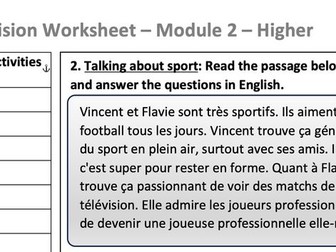
This revision is designed for AQA Year 11 French GCSE students and follows a quick revision format.
Two worksheets are provided—one for students preparing for the foundation exam and another for those aiming for the higher level.
The activities included are designed to reinforce the content covered in Module 2 of the Studio AQA GCSE textbook. These exercises help students review vocabulary related to Module 2, focusing on the theme of “what you do in your free time,” which is part of Theme 1 in the AQA specification.
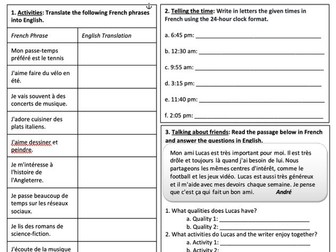
This revision is designed for AQA Year 11 French GCSE students and follows a quick revision format.
Two worksheets are provided—one for students preparing for the foundation exam and another for those aiming for the higher level.
The activities included are designed to reinforce the content covered in Module 1 of the Studio AQA GCSE textbook.
These exercises help students review vocabulary related to Module 1, focusing on the theme of “All about me, myself, and my family,” which is part of Theme 1 in the AQA specification.


 Quick View