GCSE AQA HT - Converting UnitsQuick View
hannahdoesphysics

GCSE AQA HT - Converting Units

(0)
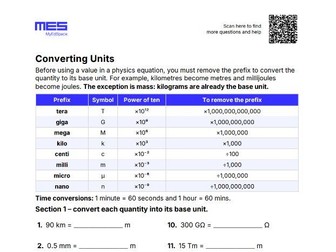
Strengthen students’ unit conversion skills with this Higher Tier resource pack. Questions cover a wide range of prefixes, large and small values, and time conversions, helping students prepare quantities for use in physics equations. What’s included: 18 practice questions, covering prefixed units and conversions from minutes and days to seconds. A prefix reference table from nano to tera, showing both powers of ten and multiplication or division factors. Three step-by-step worked examples, covering kilovolts, microcoulombs and days. Fill-in-the-blank scaffolds for converting prefixed units and time. Fully worked solutions and quick answers, with prefix conversions demonstrated using both powers of ten and ordinary multiplication or division. PDF and editable Word versions of all resources, ready to print or adapt. Students work with units for quantities including distance, potential difference, charge, power, energy and force. The questions also check that students recognise when no conversion is needed, using kilograms as an example. Ideal for GCSE Physics and Combined Science Higher Tier lessons, homework, revision or preparation for more demanding calculations. FT available on: https://www.tes.com/teaching-resource/-13607603
GCSE AQA FT - Converting UnitsQuick View
hannahdoesphysics

GCSE AQA FT - Converting Units

(0)
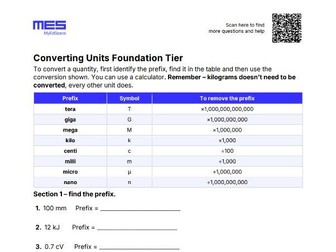
Build students’ confidence with unit conversions using this structured Foundation Tier resource pack. Tasks break the process into three manageable stages: identifying a prefix, finding its meaning in a reference table, and applying the correct conversion. What’s included: 11 practice tasks across three sections, progressing from recognising prefixes to completing conversions. A prefix reference table showing symbols and the multiplication or division needed. Four worked example sections, modelling prefix identification, reading the table and converting units. Fill-in-the-blank scaffolds to guide students through each stage. Worked solutions and quick answers for efficient marking and self-assessment. PDF and editable Word versions of all resources, ready to print or adapt. Students practise conversions including megajoules to joules, kilometres and centimetres to metres, and millivolts to volts. Accessible wording and explicit multiplication and division instructions help students develop the skills needed before substituting values into physics equations. Ideal for GCSE Physics and Combined Science Foundation Tier lessons, homework, revision or targeted numeracy support. HT available on: https://www.tes.com/teaching-resource/-13607596
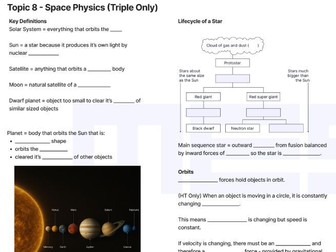
AQA GCSE Physics Topic 8: Space Physics Summary SheetQuick View
hannahdoesphysics

AQA GCSE Physics Topic 8: Space Physics Summary Sheet

(0)
A set of fill-in revision sheets covering AQA GCSE Physics Topic 8: Space Physics, complete with fully worked answer sheets. For triple science only. Ideal for consolidating learning in lessons, independent revision or homework. The resource covers the lifecycle of a star, orbits and redshift.
GCSE Physics AQA FT Topic 1: Energy - Power WorksheetQuick View
hannahdoesphysics

GCSE Physics AQA FT Topic 1: Energy - Power Worksheet

(0)
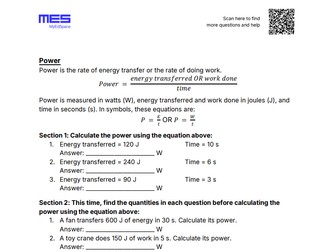
Build students’ confidence with power calculations using this structured Foundation Tier resource pack. Questions progress from substituting given values to identifying quantities in written questions, then calculating energy transferred, work done and time using supplied rearranged equations. What’s included: Nine practice questions organised into three sections with increasing challenge. Five step-by-step worked examples, modelling how to identify quantities, substitute values and calculate answers with the correct units. Fill-in-the-blank scaffolds to support students as they develop confidence working independently. Fully worked solutions for every question, plus a quick-answer list for efficient marking and self-assessment. PDF and editable Word versions of all resources, ready to print or adapt for your classes. Accessible wording, manageable numbers and equations written in words help students focus on the calculation process. Familiar contexts include fans, torches, lamps and toy cranes, covering power as both the rate of energy transfer and the rate of doing work. Ideal for GCSE Physics and Combined Science Foundation Tier lessons, homework, revision or targeted intervention. HT Resources on: https://www.tes.com/teaching-resource/-13603827
GCSE Physics AQA HT Topic 1: Energy - Power WorksheetQuick View
hannahdoesphysics

GCSE Physics AQA HT Topic 1: Energy - Power Worksheet

(0)
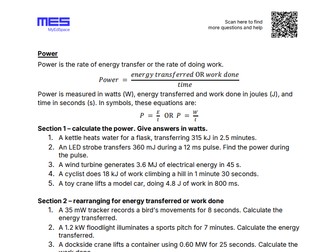
GCSE Physics Power – Higher Tier Worksheet, Worked Examples & Answers Build students’ confidence with power calculations using this structured Higher Tier resource pack. Questions cover power as the rate of energy transfer and the rate of doing work, progressing from calculating power to rearranging for energy, work done and time. What’s included: 15 practice questions organised into three sections: calculating power, energy transferred or work done, and time. Three step-by-step worked examples, modelling how to identify quantities, convert units, substitute and rearrange. Fill-in-the-blank scaffolds to support students as they develop confidence working independently. Fully worked solutions for every question, plus a quick-answer list for efficient marking and self-assessment. PDF and editable Word versions of all resources, ready to print or adapt for your classes. Students practise a range of unit conversions, including milli, kilo and mega prefixes, milliseconds to seconds, and times given in minutes and seconds. Varied contexts include LED pulses, wind turbines, wildlife trackers, rescue winches and sporting activities, helping students apply the equations in unfamiliar situations. Ideal for GCSE Physics and Combined Science Higher Tier lessons, homework, revision or targeted intervention. FT resources on: https://www.tes.com/teaching-resource/-13603833
GCSE Physics AQA FT Topic 1: Elastic Potential Energy WorksheetQuick View
hannahdoesphysics

GCSE Physics AQA FT Topic 1: Elastic Potential Energy Worksheet

(0)
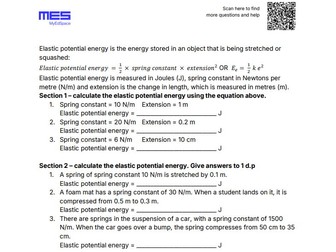
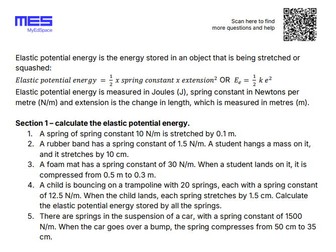
GCSE Physics Elastic Potential Energy – Foundation Tier Worksheet, Worked Examples & Answers Build students’ confidence with elastic potential energy calculations using this structured Foundation Tier resource pack. Questions progress from substituting given values to identifying quantities in written questions, then calculating spring constant and extension using supplied rearranged equations. What’s included: Nine practice questions organised into three sections with increasing challenge. Three step-by-step worked examples, modelling how to identify quantities, convert units and substitute values. Fill-in-the-blank scaffolds to support students as they develop confidence working independently. Fully worked solutions for every question, plus a quick-answer list for efficient marking and self-assessment. PDF and editable Word versions of all resources, ready to print or adapt for your classes. Accessible wording and equations written in words help students focus on the calculation process. Students practise squaring the extension, converting centimetres to metres, and calculating changes in length, with contexts including springs, foam mats and car suspension. Ideal for GCSE Physics and Combined Science Foundation Tier lessons, homework, revision or targeted intervention. Higher Tier version available at https://www.tes.com/teaching-resource/-13592031 Check out FREE GCSE notes on --> https://myedspace.co.uk/myresources/gcse/physics/aqa/revision-notes
GCSE Physics AQA HT Topic 1: Elastic Potential Energy WorksheetQuick View
hannahdoesphysics

GCSE Physics AQA HT Topic 1: Elastic Potential Energy Worksheet

(0)
GCSE Physics Elastic Potential Energy – Higher Tier Worksheet, Worked Examples & Answers Build students’ confidence with elastic potential energy calculations using this structured Higher Tier resource pack. Questions progress from direct substitution into Ee = ½ke² to rearranging for spring constant and extension, with unit conversions and multi-step problems providing additional challenge. What’s included: 15 practice questions organised into three sections: calculating elastic potential energy, spring constant and extension. Three step-by-step worked examples, modelling how to identify quantities, convert units, substitute and rearrange, including taking square roots. Fill-in-the-blank scaffolds to support students as they develop confidence working independently. Fully worked solutions for every question, plus a quick-answer list for efficient marking and self-assessment. PDF and editable Word versions of all resources, ready to print or adapt for your classes. Students practise distinguishing between extension and total length, calculating compression, and converting units including cm to m and mJ to J. Additional challenges include finding the energy stored in multiple trampoline springs and calculating an object’s final length after stretching or compression. Ideal for GCSE Physics and Combined Science Higher Tier lessons, homework, revision or targeted intervention. Foundation Tier version available at https://www.tes.com/teaching-resource/-13592038 Check out FREE GCSE notes on --> https://myedspace.co.uk/myresources/gcse/physics/aqa/revision-notes
AQA GCSE Physics Topic 7: Magnetism Summary SheetQuick View
hannahdoesphysics

AQA GCSE Physics Topic 7: Magnetism Summary Sheet

(0)
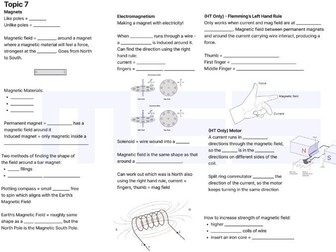
A set of fill-in revision sheets covering AQA GCSE Physics Topic 7: Magnetism, complete with fully worked answer sheets. Can be used with combined or triple. Ideal for consolidating learning in lessons, independent revision or homework. The resource covers magnets, electromagnets, and the Motor and Generator effects.
GCSE Physics AQA HT Topic 1: Energy - Gravitational Potential Energy WorksheetQuick View
hannahdoesphysics

GCSE Physics AQA HT Topic 1: Energy - Gravitational Potential Energy Worksheet

(0)
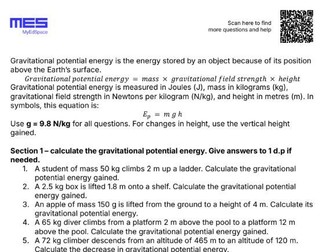
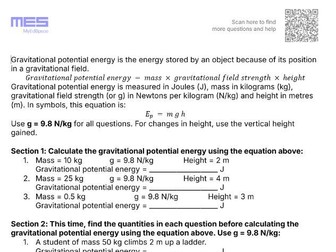
Build students’ confidence with gravitational potential energy calculations using this structured Higher Tier resource pack. Questions progress from direct substitution into Ep = mgh to rearranging for mass and height, with unit conversions and changes in vertical height providing additional challenge. What’s included: 15 practice questions organised into three sections: calculating gravitational potential energy, mass and height. Three step-by-step worked examples, modelling how to identify quantities, convert units, substitute and rearrange. Fill-in-the-blank scaffolds to support students as they develop confidence working independently. Fully worked solutions for every question, plus a quick-answer list for efficient marking and self-assessment. PDF and editable Word versions of all resources, ready to print or adapt for your classes. Students practise converting units including g to kg, cm and km to m, and mJ, kJ and MJ to J. Questions also develop understanding of the difference between final height and change in height, including situations where gravitational potential energy increases or decreases. Ideal for GCSE Physics and Combined Science Higher Tier lessons, homework, revision or targeted intervention. All calculations use g = 9.8 N/kg. Foundation tier resources available at: https://www.tes.com/teaching-resource/resource-13586515 Check out FREE GCSE revision notes on --> https://myedspace.co.uk/myresources/gcse/physics/aqa/revision-notes
GCSE Physics AQA FT Topic 1: Energy - Gravitational Potential Energy WorksheetQuick View
hannahdoesphysics

GCSE Physics AQA FT Topic 1: Energy - Gravitational Potential Energy Worksheet

(0)
Build students’ confidence with gravitational potential energy calculations using this structured Foundation Tier resource pack. Questions progress from substituting given values to identifying quantities in written questions, then calculating mass and height using supplied rearranged equations. What’s included: Nine practice questions organised into three sections with increasing challenge. Three step-by-step worked examples, showing students how to identify quantities, substitute values and include the correct units. Fill-in-the-blank scaffolds to support students as they develop confidence working independently. Fully worked solutions for every question, plus a quick-answer list for efficient marking and self-assessment. PDF and editable Word versions of all resources, ready to print or adapt for your classes. Accessible wording and equations written in words help students focus on the calculation process. Familiar contexts include climbing a ladder and lifting a box, with an additional challenge requiring students to calculate the vertical height gained between two platforms. Ideal for GCSE Physics and Combined Science Foundation Tier lessons, homework, revision or targeted intervention. All calculations use g = 9.8 N/kg. Higher tier resources available at:https://www.tes.com/teaching-resource/resource-13586511 Check out FREE GCSE revision notes on --> https://myedspace.co.uk/myresources/gcse/physics/aqa/revision-notes
AQA GCSE Physics Topic 6: Waves Summary SheetQuick View
hannahdoesphysics

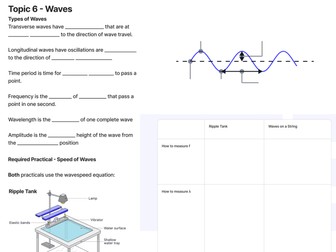
AQA GCSE Physics Topic 6: Waves Summary Sheet

(0)
A set of fill-in revision sheets covering AQA GCSE Physics Topic 6: Waves, complete with fully worked answer sheets. Can be used with combined or triple. Ideal for consolidating learning in lessons, independent revision or homework. The resource covers wave terminology, reflection and refraction, the EM spectrum and the required practicals.
AQA GCSE Physics Topic 5: Forces Summary SheetQuick View
hannahdoesphysics

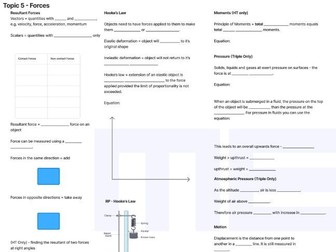
AQA GCSE Physics Topic 5: Forces Summary Sheet

(0)
A set of fill-in revision sheets covering AQA GCSE Physics Topic 5: Forces, complete with fully worked answer sheets. Can be used with combined or triple. Ideal for consolidating learning in lessons, independent revision or homework. The resource covers Newton’s Laws, distance and velocity-time graphs, pressure and the required practicals.
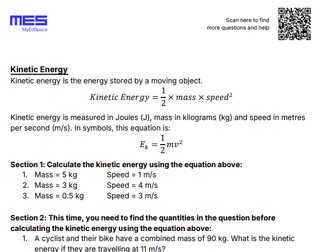
GCSE AQA Topic 1: Kinetic Energy HT WorksheetQuick View
hannahdoesphysics

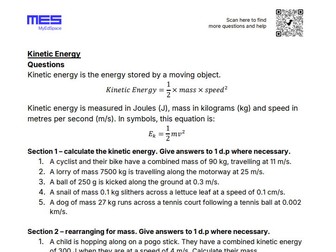
GCSE AQA Topic 1: Kinetic Energy HT Worksheet

(0)
Challenge students to apply and rearrange the kinetic energy equation through structured Higher Tier practice, worked examples and targeted mathematical support. This secondary science resource develops students’ ability to: Use the kinetic energy equation Identify relevant quantities in contextual questions Convert between units Rearrange the equation The worksheet contains 15 questions organised into three sections: calculating kinetic energy, rearranging for mass and rearranging for velocity. Questions include varied real-world contexts and increasingly demanding unit conversions. The pack includes: Student question sheet with 15 practice questions Fully worked examples for all three question types Scaffolding templates to support algebraic working Quick answers for efficient marking Detailed step-by-step solutions Editable Word versions and print-ready PDF versions Ideal for GCSE Physics and Combined Science Higher Tier students. It can be used for classroom practice, revision, homework, intervention, independent study or cover work. The separate scaffolding sheet supports differentiation while maintaining the mathematical challenge of the Higher Tier questions. FT version found at https://www.tes.com/teaching-resource/resource-13575618 Check out FREE GCSE notes on --> https://myedspace.co.uk/myresources/gcse/physics/aqa/revision-notes
AQA GCSE Physics Topic 4: Atomic Structure Summary SheetQuick View
hannahdoesphysics

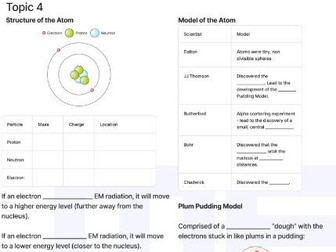
AQA GCSE Physics Topic 4: Atomic Structure Summary Sheet

(0)
A set of fill-in revision sheets covering AQA GCSE Physics Topic 4: Atomic Structure, complete with fully worked answer sheets. Can be used with combined or triple. Ideal for consolidating learning in lessons, independent revision or homework. The resource covers types of radiation, half life, irradiation and contamination.
GCSE AQA Topic 1: Kinetic Energy FT WorksheetQuick View
hannahdoesphysics

GCSE AQA Topic 1: Kinetic Energy FT Worksheet

(0)
Help students build confidence with the kinetic energy equation through clear explanations, worked examples, structured practice and step-by-step support. This secondary science resource develops students’ ability to: Use the kinetic energy equation Identify relevant quantities in written questions The questions are organised into three progressively challenging sections, beginning with direct substitution, moving on to contextual problems and finishing with using the rearranged equation. The pack includes: Student question sheet with nine practice questions Fully worked examples for each section Scaffolding templates to support calculations Quick answers for efficient marking Detailed worked solutions Editable Word versions and print-ready PDF versions Ideal for GCSE Physics and Combined Science or Triple Foundation Tier students. It can be used for independent practice, lesson activities, revision, homework, intervention or cover work. The separate scaffolding sheet also makes the resource suitable for differentiated teaching and supporting students who need additional guidance with mathematical problem-solving. Find the HT version at https://www.tes.com/teaching-resource/-13575621 Check out FREE GCSE notes on --> https://myedspace.co.uk/myresources/gcse/physics/aqa/revision-notes
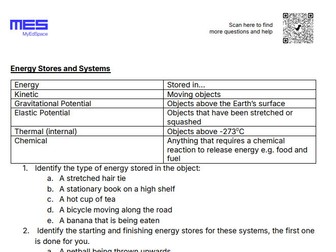
GCSE AQA Topic 1: Energy - Stores Worksheet (Foundation and Higher)Quick View
hannahdoesphysics

GCSE AQA Topic 1: Energy - Stores Worksheet (Foundation and Higher)

(0)
Help students build confidence identifying energy stores and describing energy transfers with this differentiated AQA GCSE Physics resource. The pack includes: Foundation and Higher Tier worksheets Separate answer sheets for both versions Editable versions for easy adaptation Clear summaries of common energy stores Familiar, accessible examples and scenarios Challenge and extension tasks to deepen understanding Students practise identifying kinetic, gravitational potential, elastic potential, thermal and chemical energy stores before applying their knowledge to energy transfers within different systems. The Foundation worksheet includes additional scaffolding and multiple-choice support, while the Higher worksheet requires more independent recall and explanation. Ideal for introducing energy stores, independent practice, homework, intervention or revision.
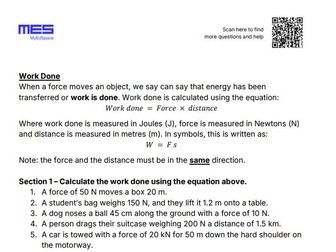
GCSE Physics AQA HT Topic 1: Energy - Work Done WorksheetQuick View
hannahdoesphysics

GCSE Physics AQA HT Topic 1: Energy - Work Done Worksheet

(0)
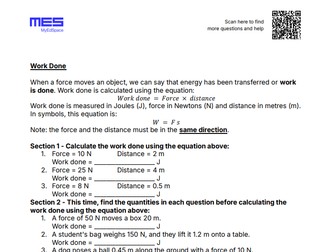
A complete set of Higher Tier worksheets to help GCSE Physics students master calculations involving work done using: Work done = force × distance The questions increase gradually in difficulty, beginning with calculating work done before progressing to rearranging the equation to calculate force or distance. Students must also convert between units and prefixes, including centimetres, kilometres, millijoules, kilojoules, megajoules, micronewtons and kilonewtons. This resource includes: Practice questions Clear worked examples A separate scaffolding sheet Quick answers and fully worked solutions Editable Word versions Ideal for classroom practice, independent study, homework, intervention or revision. The separate scaffolding allows students to complete the same Higher Tier questions with additional support. Suitable for Higher Tier students studying AQA GCSE Physics or Combined Science, as well as other GCSE exam boards. Foundation Tier version available at https://www.tes.com/teaching-resource/-13570333 Check out FREE GCSE notes on --> https://myedspace.co.uk/myresources/gcse/physics/aqa/revision-notes
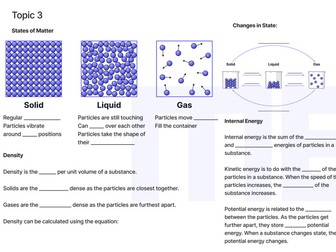
AQA GCSE Physics Topic 3:Particle Model of Matter Summary SheetQuick View
hannahdoesphysics

AQA GCSE Physics Topic 3:Particle Model of Matter Summary Sheet

(0)
A set of fill-in revision sheets covering AQA GCSE Physics Topic 3: Particle Model of Matter, complete with fully worked answer sheets. Can be used with combined or triple. Ideal for consolidating learning in lessons, independent revision or homework. The resource covers density, specific heat capacity, internal energy, pressure and the required practicals.
GCSE Physics AQA FT Topic 1: Energy - Work Done WorksheetQuick View
hannahdoesphysics

GCSE Physics AQA FT Topic 1: Energy - Work Done Worksheet

(0)
A complete set of Foundation Tier worksheets to help GCSE Physics students build confidence with calculating work done using: Work done = force × distance The questions increase gradually in difficulty, beginning with simple substitution before moving on to identifying quantities from written questions and using rearranged equations to calculate force or distance. This resource includes: Practice questions Clear worked examples A separate scaffolding sheet Quick answers and fully worked solutions Editable Word versions Ideal for classroom practice, independent study, homework, intervention or revision. The separate scaffolding allows students to access the same questions with an appropriate level of support. Suitable for Foundation Tier students studying AQA GCSE Physics or Combined Science, as well as other GCSE exam boards. Higher Tier version available at https://www.tes.com/teaching-resource/-13570337 Check out FREE GCSE notes on --> https://myedspace.co.uk/myresources/gcse/physics/aqa/revision-notes
AQA GCSE Physics Topic 2: Electricity Summary SheetQuick View
hannahdoesphysics

AQA GCSE Physics Topic 2: Electricity Summary Sheet

(0)
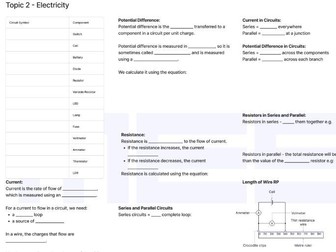
A set of fill-in revision sheets covering AQA GCSE Physics Topic 2: Electricity, complete with fully worked answer sheets. Can be used with combined or triple. Ideal for consolidating learning in lessons, independent revision or homework. The resource covers current and potential difference, resistance, power equations, household electricity and the required practicals.
AQA GCSE Physics Topic 1: Energy Summary SheetQuick View
hannahdoesphysics

AQA GCSE Physics Topic 1: Energy Summary Sheet

(0)
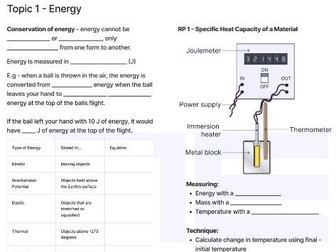
A set of fill-in revision sheets covering AQA GCSE Physics Topic 1: Energy, complete with fully worked answer sheets. Can be used with triple or combined. Ideal for consolidating learning in lessons, independent revision or homework. The resource covers energy stores and transfers, energy equations, power, efficiency, energy resources and the required practicals.