 Quick View
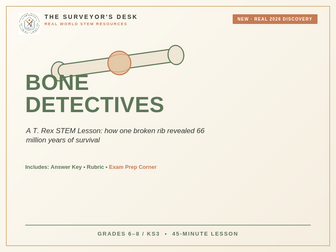
Bone Detectives: How a Broken Rib Revealed 66 Million Years of T. rex Survival
What can one broken rib tell us about the life of the biggest T. rex ever found?
In 2026, scientists used neutron and X-ray imaging to look inside a fractured rib from “Scotty,” without damaging it. They found something never seen in a fossil before: a preserved network of blood vessels that formed while the injury was healing.
Students become fossil detectives and follow the real investigation through five stages: Discovery, Imaging, Evidence, Interpretation, and Conclusion & New Questions. Along the way, they learn how scientists build a case from evidence, and why scientific conclusions can change when new technology comes along.
What’s inside (45-minute lesson):
Teacher lesson plan with timings and research background
Word bank for teachers and students
Student worksheet, including a “spot the healed fracture” bone diagram
Answer key
Scoring rubric (out of 16)
Exit ticket with reflection
Exam Prep Corner: 3 multiple-choice questions and a 4-mark data-response question, with answers
Exam links: This lesson on Scotty the T. rex is a great review for questions on fossil evidence, non destructive scientific methods, and skeletal biology and bone repair.
Suitable for: ages 11–14, KS3 (Years 7–9), US grades 6–8 (NGSS).
Easy to adapt for older or younger students. Also works for homeschool.