Solar System Planets - Montessori EYFSQuick View
LexAndFoxPress

Solar System Planets - Montessori EYFS

(0)
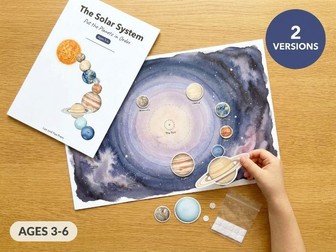
A hands-on solar system activity for EYFS and KS1. Children cut out nine planets and place them in order from the Sun onto a painted night-sky mat, then check their own work. What children will explore Order of the planets - which body comes next as you travel outward from the Sun Distance from the Sun - that each planet sits further out than the last, and the order never changes Naming and vocabulary - every planet named, read and matched independently Relative size - Jupiter the largest and Mercury the smallest, in the correct order of size Self-correction - each position on the mat is labelled, so children check their own work rather than waiting to be told Meet the planets The Sun - the star at the centre of it all Mercury, Venus, Earth and Mars - the four small rocky planets Jupiter and Saturn - the gas giants, one of them ringed with ice Uranus and Neptune - the ice giants, one pale green and one deep blue The Moon - included as Earth’s own satellite, for the word as much as the body What’s inside - 9 pages Two ordering mats: A4 for table work, A2 for floor work A printer-friendly version of each mat, using a fraction of the ink Cut-out planets in two sizes, one set scaled for each mat A how to use page covering printing, cutting and assembly Why teachers and parents love this pack Every target circle on the mat is identical, so the activity cannot be solved by matching a shape to a hole. Children have to know the order. The printed names make the material self-correcting, which frees the adult to observe rather than mark Planets are painted from the real thing, with correct colours and features and no cartoon faces The A4 mat suits one child at a table; the A2 mat suits a pair or a small group on the carpet It grows with the class: start with placing, move on to naming, then to ordering from memory Reusable. Add hook-and-loop dots once, laminate if you like, and it lasts for years Scissors are the only thing you need Instant PDF download, 9 pages. A4, also fits US Letter. The two large mat pages are A2 and can be printed at a copy shop or scaled to fit at home. Print as many copies as you need for your class or family.
October Nature Curriculum - Harvest and Pumpkins EYFSQuick View
LexAndFoxPress

October Nature Curriculum - Harvest and Pumpkins EYFS

(0)
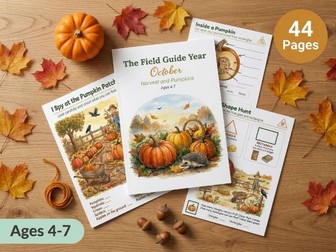
A complete weekly nature curriculum for October — five days of literacy, numeracy, science, art, music and outdoor exploration built around harvest, pumpkins and the changing autumn landscape. Each session runs about 20 minutes with no preparation needed. What children will explore Literacy — letter tracing and phonics for Pp, Mm and Tt, initial sound matching, and sight words (and, go, my, up, we, can) Numeracy — counting and writing 6 to 10, triangle and rectangle shape hunt, ABB and ABC pattern work, and pumpkin measurement using acorns as non-standard units with greater-than and less-than symbols Science — pumpkin dissection with labelling, drawing and sensory observation, bird migration mapping, and nocturnal animal sorting (owl, bat, hedgehog, fox) Art and music — spiderweb watercolour resist painting, Arcimboldo artist study, and Saint-Saëns composer study Cooking — roasted pumpkin seeds recipe with a maths connection Wellbeing — emotions matching and “I feel…” sentence completion Weekly rhythm Every week follows the same structure: Monday is Story Day, Tuesday is Numbers Day, Wednesday is Discovery Day, Thursday is Creative Day, and Friday is Nature Walk. Children learn the routine once and carry it all term. What’s inside — 44 pages Letter tracing and phonics worksheets for three letters Sight word practice pages Counting, shape hunt and pattern completion activities Pumpkin measurement challenge with comparison symbols Inside a pumpkin — dissection, labelling, drawing and sensory record Bird migration world map and birdwatching journal Nocturnal and diurnal animal sorting activity Emotions matching and sentence completion Fine motor skills — cutting lines, seed sorting with pincer grip, pumpkin threading card Spiderweb resist art, artist study and composer study I Spy pumpkin patch, Mistake Inspector, Would You Rather, Odd One Out Nature journal and month-end reflection Five read-aloud book recommendations Why teachers and parents love this pack No preparation — print and begin 20-minute sessions fit a Reception timetable or a home morning Covers literacy, numeracy, science, art, music, cooking and fine motor in one resource Weekly rhythm means the structure is learned once and repeated Aligned to UK EYFS, Australian EYLF and UAE MOE frameworks Includes built-in social and emotional learning throughout Instant PDF download, 44 pages. US Letter. Print as many copies as you need for your class or family.
Peru - World Geography Topic KS1 EYFSQuick View
LexAndFoxPress

Peru - World Geography Topic KS1 EYFS

(0)
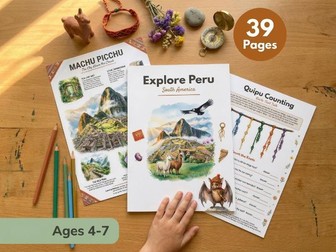
From the lost city of Machu Picchu to the pink dolphins of the Amazon, Peru packs more wonder per square mile than almost anywhere on Earth. Three ecosystems in one country — coast, Andes mountains, and Amazon jungle — across 39 pages of watercolour-illustrated activities. What children will explore Three climate zones - label a map of Peru’s coast, mountains, and jungle Inca mathematics - count knots on a quipu, the Inca knotted string number system Altitude science - discover why breathing gets harder at 5,200 metres Andean textiles - design a pattern using real geometric weaving motifs Nazca Lines - draw a giant desert drawing inspired by the real geoglyphs Llamas and alpacas - compare the two side by side Meet the wonders of Peru Machu Picchu - the city above the clouds Llamas and alpacas - the woolly helpers of the Andes Andean condor - king of the mountain skies Rainbow Mountain - the mountain of seven colours The Amazon rainforest - the greatest jungle on Earth Sacred Valley terraces - the garden of the Inca Nazca Lines - giant drawings in the desert Lake Titicaca - the highest navigable lake in the world What’s inside - 39 pages Eight illustrated spotlight pages with real geography, science, and cultural facts Three-zone map labelling activity Peruvian food sorting activity Pack a suitcase for three different climates Quipu counting, llama and alpaca comparison, animal habitat sorting Busy market I Spy challenge Condor wingspan measurement activity Andean textile design and Nazca Line drawing Vocabulary tracing, Inca Trail reading passage, and postcard writing Spot the difference and find the mistakes puzzles Machu Picchu colouring page and completion certificate Why teachers and parents love this pack Three ecosystems in one country — coast, mountains, and jungle Quipu counting teaches maths through real Inca history Altitude science introduces oxygen and breathing for young learners Six cross-curricular activities spanning geography, maths, science, art, and literacy Instant PDF download, 39 pages. A4 and US Letter. Print as many copies as you need for your class or family.
People Who Help Us - Community Helpers EYFS KS1Quick View
LexAndFoxPress

People Who Help Us - Community Helpers EYFS KS1

(0)
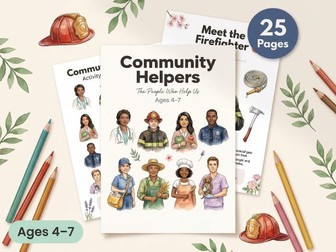
A 25-page printable pack introducing eight community helpers through botanical watercolour portraits, real facts about each job, and sorting, matching and reading activities. The eight helpers Doctor — keeping people healthy one check-up at a time Firefighter — the one who runs in when everyone else runs out Teacher — turning questions into learning every single day Police officer — keeping the community safe and helping when people are lost Postal worker — rain or shine, delivering letters to every door Farmer — growing the food that reaches every table Chef — turning ingredients into meals that bring people together Vet — the doctor for animals, from kittens to horses What children will learn Knowledge — four facts about each helper, an “I help by…” summary on every spotlight page, where each helper works and what they wear Sorting and matching — helpers to workplaces, tools to helpers, vehicles to helpers, uniforms to helpers Reading — six “Who Am I?” clue descriptions to read and solve, a passage about the people who help at school Maths — counting community-themed groups and completing patterns Writing and drawing — tracing helper names, writing about a favourite helper, drawing what they want to be when they grow up What’s inside — 25 pages Eight spotlight pages with watercolour portraits and four facts each Workplace sorting, tool matching and uniform matching Vehicle matching — fire engine, ambulance, police car, Royal Mail van, tractor, vet van Six “Who Am I?” clue cards and a reading comprehension passage Counting and pattern activities Tracing, writing and creative drawing pages Community street colouring scene and completion certificate Why teachers and parents love this pack Warm, realistic watercolour portraits — diverse across skin tones and genders UK version with correct uniforms, vehicles and vocabulary throughout Real curriculum content woven through every page — not just colouring Activities flow from meeting the helpers to sorting, matching, reading and imagining Instant PDF download, 25 pages. A4 and US Letter. Print as many copies as you need for your class or family.
Cat Breeds - All About Cats EYFS KS1Quick View
LexAndFoxPress

Cat Breeds - All About Cats EYFS KS1

(0)
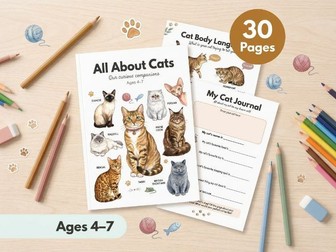
Eight cat breeds through watercolour portraits, real pet science, and a body language page that teaches children to read how a cat feels before reaching out. What children will explore Cat body language - five signals and what they mean Cat superpowers - night vision, whisker sensors, righting reflex, healing purr Cat communication - matching five sounds to their meanings Pet responsibility - what cats need before a family commits Meet the cat breeds Tabby - the classic cat with the letter M on its forehead Siamese - born completely white, with bright blue eyes Persian - the fluffy one who needs daily brushing Maine Coon - the gentle giant, up to one metre long Bengal - wild-looking with leopard spots Ragdoll - goes limp when you pick it up British Shorthair - the teddy bear of the cat world Sphynx - hairless and wears tiny sweaters What’s inside - 30 pages Eight breed profile pages with watercolour portraits and fun facts Body language matching activity Cat superpowers science page Sound matching activity Size sorting from Singapura to Maine Coon Responsible pet ownership page Dream cat designer and personal journal Cat cafe hidden picture search Breed collector flashcards and cut-out room scene Real-world scavenger hunt with ten challenges Counting, patterns, tracing, reading, and colouring pages Completion certificate Why teachers and parents love this pack A body language page that teaches a genuine life skill Real science framed as superpowers children remember A responsibility page families use before getting a pet Facts that stick - Siamese kittens born white, a group of cats is a clowder Instant PDF download, 30 pages. A4 and US Letter. Print as many copies as you need for your class or family.
Christmas Crafts - Make and Decorate KS1 EYFSQuick View
LexAndFoxPress

Christmas Crafts - Make and Decorate KS1 EYFS

(0)
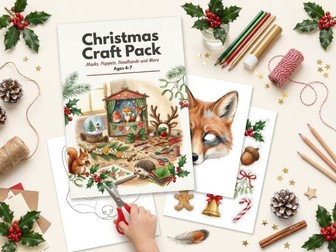
Fifty pages of printable Christmas crafts — masks, puppets, decorations, garlands, cards, gift wrap, and a gingerbread house, all in watercolour with woodland animals. Cut, fold, build, and colour through six craft categories in one download. What children will make Masks and wearables - four full-face animal masks (robin, fox, deer, hedgehog), two colour-your-own masks, reindeer antler and elf ear headbands, and a winter crown Finger puppets and theatre - four woodland puppets, a fold-out stage, story starter cards, a story dice cube, and a guided story writing page Decorations - garland shapes, bunting, an evergreen wreath, window silhouettes, and a 25-day countdown chain Paper craft - a snow globe, place cards, two fortune tellers, a fold-and-build gingerbread house, door hangers, napkin rings, and snowflake cut-outs Cards and gift giving - twelve gift tags, two gift wrap patterns, and a fold-and-write card with envelope Colour your own - six ornament shapes, six winter animals, and a full-page woodland colouring scene Why teachers and parents love this pack Six craft categories in one download — masks, puppets, decorations, construction, cards, and colouring Works for a single afternoon or weeks of Christmas countdown activities Nature-led Christmas — robins, foxes, deer, hedgehogs, holly, pinecones, and snowflakes Pre-coloured and colour-your-own versions for flexibility Everything prints on standard paper — card stock recommended for masks and puppets but not required Instant PDF download, 50 pages. A4 and US Letter. Scissors, glue stick, and coloured pencils are all you need. Print as many copies as you need for your class or family.
Colour Mixing and Natural Pigments KS1Quick View
LexAndFoxPress

Colour Mixing and Natural Pigments KS1

(0)
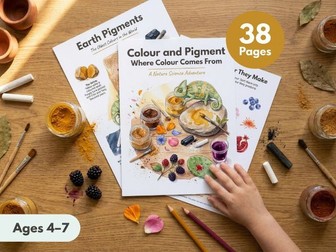
Where colour actually comes from - earth pigments, plant dyes, camouflage, and colour made by structure rather than pigment. Colour mixing for KS1, with the science behind it. Children crush soil into paint, pound petals for dye, and write with blackberry ink and a feather. The colour on the page is one they made. What children will explore Pigment - from rocks, petals, roots, spices and berries Colour mixing - a colour wheel, with predictions before the brush goes down Pigment colour and light colour - sorting which is which, and why they differ Camouflage and warning - what a creature’s colour is for Structural colour - made by surface, not pigment, as on a peacock Bioluminescence - creatures that make their own light Things to make and test Test three soils for the darkest earth pigment Paint like a cave artist, using that pigment and water Pound flower petals to release the dye hidden in them Make blackberry ink and write with a feather quill Grind colour powder from turmeric, beetroot and spinach Build a walking water rainbow, and watch colour travel between cups Make a paintbrush from twigs, grass, feathers and string Run a chromatography test on a marker pen What’s inside - 38 pages Seven colour-source spotlight pages, each with a challenge and a summary Sort natural materials by the colour they produce Label the parts of a flower that make its colour Match creatures to camouflage, warning, display or bioluminescence Sort pigment colour from light colour Fill a nature colour wheel with things collected outside Colour scavenger hunt, outdoors Design your own colour experiment, with predictions and results Vocabulary tracing, I spy scene, cut-and-build colour workshop, answer key Why teachers and parents love this pack Colour is a named element of the KS1 art curriculum, taught here through real materials Eight making activities, all from soil, petals, berries, spices and kitchen cupboards Goes past naming colours to structural colour and bioluminescence The chameleon guide is well chosen: its colour change is structural, not pigment Botanical watercolour illustrations throughout
Garden Drinks Stand - Enterprise and Maths KS1 KS2Quick View
LexAndFoxPress

Garden Drinks Stand - Enterprise and Maths KS1 KS2

(0)
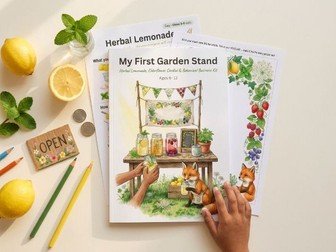
A 43-page printable enterprise kit where children plan, set up and run a real garden drinks stand — five recipes, pricing worksheets, profit tracking and everything needed for stand day. Meet Basil Basil is a young fox cub running his own stand. He eats the stock, charges too much and gets tangled in his own bunting. Every page asks the child to do better than Basil — and they will. The five recipes Herbal lemonade — the anchor drink, made with real lemons and fresh herbs Elderflower cordial — the premium product, steeped overnight Mint iced tea — the easy one a child can make independently Berry infusion — cold-steep overnight, turns a beautiful pink-red Cucumber-mint water — simple, refreshing and almost free to make What children will learn Enterprise — naming the stand, designing a poster and flyers, creating a menu board, planning stand day from morning to close Maths — writing a shopping list with a budget, setting prices, making change, tracking sales on a tally sheet, calculating profit and loss Communication — greeting customers, taking orders, handling complaints, collecting feedback, sending thank you cards What’s inside — 43 pages Five botanical recipe cards with step-by-step instructions Stand name banner, open/closed sign, menu board, price tags, jar labels and bunting Poster, letterbox flyers and invitation cards Shopping list, pricing worksheet, sales tally and profit tracker Conversation scripts and a tear-out order pad Six role badges — Head Chef, Cashier, Greeter, Sign Holder, Cup Washer, Taste Tester Taste test survey, customer feedback cards, VIP list and thank you cards Illustrated table layout guide and stand day checklist Why teachers and parents love this kit Real enterprise from start to finish — not a pretend shop but a working stand with real customers and real money Five tested recipes with allergy warnings, supervision levels by age and a hygiene checklist Real maths woven through every stage — budgeting, pricing, change-making, profit and loss Basil makes the mistakes so children learn through laughter Designed for seasonal reuse — lemonade in summer, hot chocolate in winter, apple cider in autumn Instant PDF download, 43 pages. A4 and US Letter. Print as many copies as you need for your class or family.
Daily Routine - Life Skills PSHE EYFS KS1Quick View
LexAndFoxPress

Daily Routine - Life Skills PSHE EYFS KS1

(0)
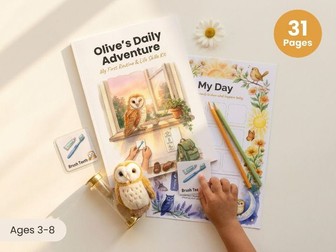
A 31-page printable life skills kit where children teach a confused baby barn owl how humans do things — from brushing teeth to setting the table. How it works Olive is a baby barn owl. She is nocturnal, so mornings confuse her entirely — she put cereal in a glass and wore her scarf as trousers. Every page asks the child to show Olive how to do something. They give the instructions, not follow them. What children will learn Self-care — getting dressed, brushing teeth, washing hands, packing a school bag, tying laces Healthy habits — healthy eating, drinking water, bedtime routines, the science of sleep Being with others — listening, kindness, saying please and thank you, taking turns and sharing Helping at home — setting the table, tidying up, weekly chores, doing things independently What’s inside — 31 pages Daily routine chart with 24 icon cards and 8 blank — laminate and reuse all year Six-step morning routine poster Weather dressing page — sunny, rainy and cold Lace-tying guide with two-colour diagrams Tooth-brushing quadrant timer and six-step handwashing School bag checklist and healthy breakfast sorting Daily water tracker and five-step evening routine Listening, kindness, manners and taking-turns activities Table-setting placemat template and tidy-up challenge Weekly chore chart, independence drawing page, report card and certificate Why teachers and parents love this kit The child is the teacher — every page frames them as the expert, building real confidence Routine chart designed for daily reuse — print once, laminate, use all year Eight blank icon cards so classrooms and families can add their own routines Olive makes the mistakes so children learn without pressure Visual schedules with calm colours and distinct icons — supportive for all children, especially those who benefit from predictable routines Instant PDF download, 31 pages. A4 and US Letter. Print as many copies as you need for your class or family.
Tree Life Cycle - Maple and Seasons KS1Quick View
LexAndFoxPress

Tree Life Cycle - Maple and Seasons KS1

(0)
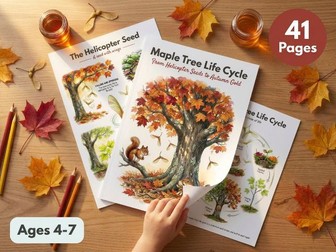
A tree followed through a full year - helicopter seed, seedling, growth rings, leaf factory, autumn colour - covering the KS1 objectives on naming trees, deciduous and evergreen, and seasonal change. The helicopter seed is the hook. Every child has thrown one and watched it spin; this pack explains why it spins, then has them test it outdoors. What children will explore Life cycle - six stages from winged seed to mature tree, as a wheel and a sequence Tree anatomy - label a tree from roots to crown, and look at what happens below ground Growth rings - count the rings to work out a tree’s age Deciduous and evergreen - sort ten trees into the two groups How leaves work - photosynthesis, and the pigment change behind autumn colour Seed aerodynamics - why a samara spins, tested with real seeds What’s inside - 41 pages Six stage spotlight pages, each with its own focus Life cycle wheel and sequencing pages Parts of a tree to label, and an above-and-below-ground page Growth ring reading and tree age calculation Deciduous or evergreen sorting, ten trees Leaf shape detective - match six maple species by leaf outline Season sorting - which events belong to which season Where maple syrup comes from, in six steps Samara helicopter experiment, outdoors with real seeds Leaf rubbing craft using a real leaf My tree through the seasons - a year-long observation record I spy on the forest floor, counting, word tracing, reading and guided writing Mistake inspector and odd one out Build a scene, colouring page, fun facts, recipe card and certificate Why teachers and parents love this pack Hits three Year 1 science objectives at once: naming trees, deciduous and evergreen, seasonal change Three activities happen outdoors, including one that works with seeds off any pavement in autumn Growth rings turn counting into real data from a real object The year-long observation record suits a class tree watched across all three terms Botanical watercolour illustrations throughout Instant PDF download, 41 pages. A4 and US Letter. Print as many copies as you need for your class or family.
EYFS Seasonal Bundle - 14 Nature PacksQuick View
LexAndFoxPress

EYFS Seasonal Bundle - 14 Nature Packs

(0)
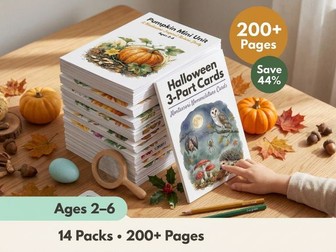
Fourteen EYFS nature packs covering a full year - vocabulary cards, playdough mats, magnifying match games, two mini units and two outdoor hunts. Print once, laminate, and rotate by season. Sixty nature subjects across the five card sets, all real species and plants, so the vocabulary work doubles as early science. The fourteen packs Autumn nature cards - twelve autumn subjects, picture, label and control Nocturnal nature cards - twelve night creatures, bats, spiders, moths and owls Winter nature cards - twelve winter subjects for the colder term Animal partnership cards - twelve animals that pair and raise young together Spring nature cards - twelve spring creatures and flowers Autumn magnifying match - large and miniature pairs for close looking Nocturnal magnifying match - the same game, night creatures Autumn playdough mats - pumpkin, leaf and toadstool outlines Spring playdough mats - lamb, chick and frog shapes Winter playdough mats - robin, reindeer and fox scenes Pumpkin mini unit - life cycle, cards, counting and a playdough recipe, 20 pages Night creatures mini unit - bats, spider counting and pumpkin science, 20 pages Summer toddler hunt - twenty outdoor nature cards Autumn toddler hunt - twenty seasonal nature cards What children are practising Vocabulary - naming sixty real plants and animals, with matching and control cards Close observation - finding a miniature match with a magnifying glass Fine motor - rolling, pinching and pressing playdough into outlines Early science - two life cycles, counting, sorting and symmetry Outdoor looking - two picture-card hunts for a walk or the school field Why teachers and parents love this bundle One download covers autumn, winter, spring and summer, so the shelf changes without another purchase Everything is laminate-and-reuse, across whole cohorts rather than one child Real species throughout, not generic shapes, so the cards work as nature study too Suits a nursery continuous provision shelf, a nature table, or a seasonal rotation Botanical watercolour illustrations on every card Instant download, fourteen packs, over 200 pages. A4 and US Letter.
Caves - Rocks and Stone Age KS1 KS2Quick View
LexAndFoxPress

Caves - Rocks and Stone Age KS1 KS2

(0)
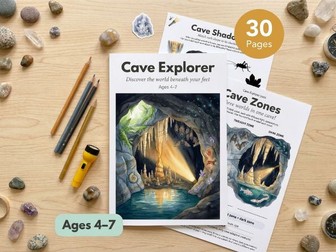
How caves form, what lives in them, and why people painted on their walls forty thousand years ago - a caves topic for KS1 and KS2 that lands on rocks, fossils and the Stone Age. Limestone dissolved by rainwater, stalactites at a centimetre a century, blind fish, bats in the dark zone, and a cave painting to make with the three colours the originals used. What children will explore How caves form - rainwater and carbon dioxide make a weak acid that dissolves limestone Formations - a four-stage stalactite diagram, and sorting ten formations by where they grow Cave zones - entrance, twilight and dark, and which creature lives in each Adaptation - blind cave fish, glow worms, the fasting olm, and bat echolocation Cave art - forty thousand years old, three materials, and one to make Fossils - why there are sea creatures in the walls of a cave What’s inside - 30 pages Five theme spotlight pages, each with a try-this-at-home activity Stalactite formation diagram in four stages Sort ten formations into ceiling or floor, with two deliberate trick answers Cave zone ecosystem page and six creature adaptation cards Shadow matching with deliberately similar silhouettes Pictograph code breaker using cave-art symbols, then write your own Underground navigation map with six chambers, compass only Mistake inspector with six errors that each test a fact from the pack Two truths and a fib, four sets, then children write their own Make a cave painting on a textured wall, in three colours Build a cave scene from eight cut-outs Ten-challenge cave safari that works without a cave I spy, counting, word tracing, reading, writing and colouring Certificate Why teachers and parents love this pack Covers the Year 3 rocks and fossils objectives inside a topic children want Cave painting gives a Stone Age unit its most memorable lesson Blind cave fish make adaptation concrete rather than abstract The safari works at home: grow a stalactite in a jar, find limescale on a tap, make echoes in a stairwell Children write their own fib and their own code, rather than only solving Instant PDF download, 30 pages. US Letter size - on A4, print at fit to page.
Movement and Brain Breaks - PE KS1 KS2Quick View
LexAndFoxPress

Movement and Brain Breaks - PE KS1 KS2

(0)
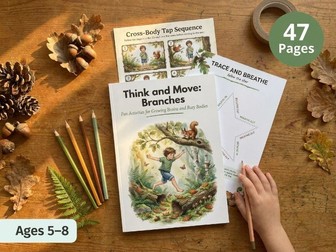
Forty-seven pages of movement breaks, coordination challenges, memory games and breathing exercises for KS1 and lower KS2 - printed cards and pages, no screen and no equipment. Five categories to dip into: crossing the midline, using both hands together, balance, working memory, and breathing. Each one has its own set of cards and pages. What children will do Cross-body movement - marching with opposite elbow to knee, tap sequences, figure-of-eight path tracing, and an opposite-commands game Both hands together - mirror drawing, two-handed doodling, a six-exercise finger gym, eight rhythm cards Balance - four poses including tree and flamingo, heel-to-toe walking, freeze dance, and a challenge ladder Working memory - Kim’s game, matching pairs, sequence recall, listen and draw, pattern continuation, story sequence jumble Breathing and calm - trace-and-breathe paths, square breathing, five senses grounding, and a body scan to colour Also included Brain break mini-cards - six quick movement cards to cut out and keep A passport with a stamp for each category completed A four-week tracker across six activity areas Answer key for the sequencing and pattern pages An adult guide explaining what each category practises and how to use the pack Certificate Why teachers and parents love this pack Works as a two-minute reset between lessons, a PE warm-up, or a full session Printed cards mean no screen, no apparatus, and nothing to set up Useful for children who concentrate better after moving, and for whole-class transitions Finger gym and rhythm cards double as fine motor and listening practice Watercolour illustrations with a red squirrel guide on every page Instant PDF download, 47 pages.
Calm Corner Posters - SEMH EYFS KS1Quick View
LexAndFoxPress

Calm Corner Posters - SEMH EYFS KS1

(0)
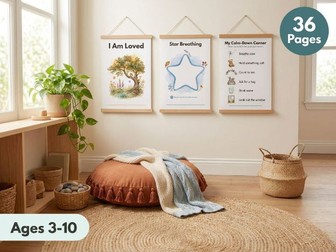
Thirty-four calm corner posters covering the whole regulation sequence - breathing, grounding, naming the feeling, self-kindness, and being ready to return to the group. Most calm corner sets stop at calming down. This one includes the return, which is the part a teacher actually has to manage. What the set covers Breathing, 8 posters - star, wave, spiral, box, rainbow, balloon belly, flower and candle, feather. Finger-traceable paths Grounding, 4 - five senses grounding, my calm place, listening ears, something soft to hold Feelings, 6 - a feelings garden of eight core feelings, how big is my feeling, where do I feel it, feelings come and go Affirmations, 6 - I am brave, I can do hard things, mistakes help me grow, I am still learning Self-kindness, 4 - talk to yourself like a friend, it is okay to ask for help, rest is not wasted time, I do not have to be perfect Reset and return, 6 - welcome to the calm corner, my calm-down choices, when I feel angry I can, when I feel worried I can, ready to return What children do Trace a breathing path with a finger to slow their breath down Name a feeling, and locate where in the body they notice it Work through the five senses to ground themselves Choose from a calm-down list when a big feeling arrives Check their body and breath before rejoining the group Why teachers and parents use this set Pre-readers use the illustrations, older children read the text, so one set covers a mixed class The sequence is complete: regulate, name, be kind, return Suits a classroom calm corner, a nurture space, a quiet area or a bedroom A setup guide for putting the corner together Soft botanical watercolour, so the corner looks calm rather than busy Notes on printing Thirty-four posters plus a setup guide. Print on A4 and laminate for durability, or frame a smaller selection. Instant PDF download, 36 pages. A4, with US Letter also included.
Recycling - Reduce Reuse Recycle KS1 KS2Quick View
LexAndFoxPress

Recycling - Reduce Reuse Recycle KS1 KS2

(0)
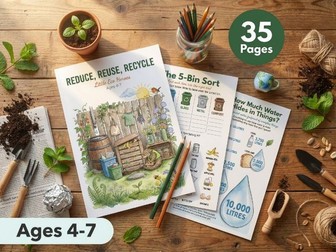
Eight materials followed from where they come from to where they go - a recycling and sustainability topic for KS1 and KS2, with a real home waste audit and tally-mark data. Children sort, survey, count and interview rather than colour in a happy planet. The pack ends with a bird feeder built from a plastic bottle. What children will explore Materials - paper, plastic, glass, metal, food waste and textiles, one spotlight each Where waste goes - the three Rs, a bottle’s journey in six panels, decomposition times Water and energy - the hidden water in everyday things, and saving electricity Data handling - a home waste audit in tally marks, and counting by category Enquiry - a family survey, and interviewing an adult about life before recycling Taking action - an eco checklist across home, school and outdoors What’s inside - 35 pages The three Rs explained, and eight material spotlight pages with four facts each Five-column waste sort with twenty items, and a bin mistakes page Decomposition time ladder, from a banana peel to materials that never break down Water footprint scale comparison and upcycling transformation pairs The bottle’s journey sequencing and a three Rs pattern set Home waste audit, family eco survey, interview an adult Count the recyclables, I spy at the recycling centre, texture detective cards Design your eco-home, ten illustrated fact cards, eco word tracing Lily’s Big Day story with comprehension questions Neighbourhood rubbish observation walk and an eco hero journal Bird feeder craft in six steps, earth promise pledge, certificate Answer key included Why teachers and parents love this pack Systems thinking: where a material comes from as well as where it ends up The waste audit produces real data to tally, count and talk about Survey and interview pages bring families into the topic Finishes with something made, not just something known Watercolour illustrations throughout Kerbside collections differ from council to council - check your local scheme before the sorting pages. Instant PDF download, 35 pages. US Letter size - on A4, print at fit to page.
Going to the Doctor - GP Visit EYFS KS1Quick View
LexAndFoxPress

Going to the Doctor - GP Visit EYFS KS1

(0)
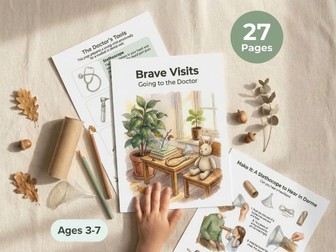
Preparing a child for a visit to the doctor - a picture sequence of what happens, six tools explained at child height, and four things to build and try at the kitchen table. The approach is demystification rather than distraction. A child who has made their own stethoscope and listened to a heartbeat walks in knowing what the real one is for. What children will explore What happens - two picture sequences through a check-up, from waiting room to goodbye The tools - six cards covering what each one looks like, does, and feels like How it feels - naming the feeling, and choosing calming strategies in advance Rehearsal - practising a check-up on a teddy before the real appointment People who help us - who greets you, who checks you, and why The four things to make A funnel stethoscope, to hear a grown-up’s heartbeat through the tube Warm water in one palm and cool in the other, to feel what a temperature check notices A gentle hand-pressure test, for the sensation of an ear check A message rolled inside a cardboard tube, showing why a doctor looks inside ears and throats Everything comes from a kitchen cupboard. Nothing to buy. What’s inside - 27 pages Two what-happens picture sequence pages Six doctor tool cards Four build-and-try experiment pages How I might feel, and a calm plan the child chooses themselves Practise on a teddy page I spy in a busy waiting room, with ten things to find Put it in order - eight steps of a check-up to cut out and sequence My brave tree, for something brave already done Adult guide pages with honest answers and language to use Why teachers and parents love this pack It says plainly that every room looks a little different from the pictures Nervous and brave are allowed to be true at the same time Pictures carry every child page, with captions read aloud, so pre-readers work independently The calm plan is chosen before it is needed, not imposed during the visit Useful for a child facing appointments, and for a people who help us topic Instant PDF download, 27 pages. A4 and US Letter. Print as many copies as you need for your class or family.
Mountains - Physical Geography KS1 KS2Quick View
LexAndFoxPress

Mountains - Physical Geography KS1 KS2

(0)
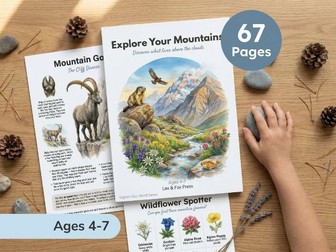
Mountain habitats from valley meadow to snow line - altitude zones, glaciers, contour maps and seven mountain species, across 67 pages for KS1 and KS2 geography. Half the pack is indoor map and diagram work, half is built for a walk, with twenty-four pocket cards to take out. What children will explore Altitude zones - a diagram of what lives where as a mountain rises Landforms - how a glacier carves a valley, and what rock layers record Rivers - tracking a stream from snowmelt down to the valley Map skills - reading a real contour map, and decoding trail markers Adaptation - seven species and the problems each has solved Mountain safety - weather, altitude, wildlife and trail rules Meet the mountain species Ibex - split hooves with hard rims and soft pads, for grip on rock Golden eagle - eyesight several times sharper than ours Marmot - an underground engineer that hibernates for up to eight months Mountain hare - white in winter, brown in summer Edelweiss - dense white hairs that work as its own sun protection Alpine salamander - a gestation of two to three years, among the longest on land Pika - cuts and dries grass into haypiles for winter What’s inside - 67 pages Seven species spotlights, each with a try-this-at-home activity Altitude zone diagram, stream source tracker, glacier formation Contour map challenge, trail marker decoder, animal sign search Wildflower spotter for eight real mountain flowers Weather watching, rock layers, and an echo investigation Mountain safety pages and a ten-question quiz I spy, mistake inspector, zoom in, odd one out, counting, word search Cut-and-build mountain scene and ten outdoor challenge cards Twenty-four pocket guide cards, discoveries map, certificate Five-page answer key Why teachers and parents love this pack Contours, glaciation and altitude zones give KS2 the real geography Independence badges on every page, and an I have learnt line to reflect on Pocket cards work on a school trip, a residential or a walk Nothing to prepare and no extra materials needed Field-guide watercolour illustrations, accurate enough to identify from Instant PDF download, 67 pages. US Letter size - on A4, print at fit to page. Print as many copies as you need for your class or family.
Growth Mindset - Thinking Traps KS1 KS2Quick View
LexAndFoxPress

Growth Mindset - Thinking Traps KS1 KS2

(0)
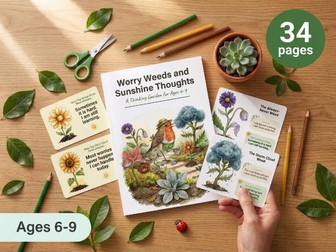
Eight unhelpful thinking patterns drawn as garden weeds for children to spot, name and replace with a sunshine thought - a growth mindset and mental wellbeing topic for KS1 and KS2. The garden metaphor does the work: weeds are sneaky rather than frightening, and every one has a sunshine thought to plant in its place. What children will explore Naming the pattern - eight thinking traps, each with its own weed character Spotting it in context - real scenarios, starting obvious and getting subtler Reframing - a sunshine thought for every weed, on cut-out cards Strategies that are theirs - building a personal weed-busting toolkit Noticing over time - a weekly tracker for the weeds they catch The eight weeds Always-Never - you always fail and will never get it right Storm-Cloud - one small worry becomes something terrible Fortune-Teller - predicts the worst before anything happens Mind-Reader - decides what other people are thinking Blame-Me - takes the blame even when it is not fair Grey-Filter - hides the good and shows only the bad Should Vine - demands perfection every time Feelings-Are-Facts - treats a worried feeling as proof What’s inside - 34 pages Eight illustrated weed cards with their sunshine thought answers Scenario pages that build from easy to subtle Weed or sunshine sorting mat with fourteen cut-out thought bubbles The Garden Path board game with a spinner, for two to four players Design your own weed for a worry the child has noticed Weed-busting toolkit page and a reusable weekly tracker Shrink the weed visual exercise and a sunshine garden celebration page Two-page adult guide with word-for-word scripts for every weed Why teachers and parents love this pack Goes past naming feelings to recognising and reframing the thought itself The scripts give an adult exact words for a bedtime, playground or after-a-mistake conversation Game, cards, sorting mat and tracker mean it is used repeatedly, not filed Botanical watercolour illustrations throughout, in keeping with the garden Instant PDF download, 34 pages. A4 and US Letter. Print on card for the weed cards and board game. Print as many copies as you need for your class or family.
Seaside and Rockpools - Coasts KS1 KS2Quick View
LexAndFoxPress

Seaside and Rockpools - Coasts KS1 KS2

(0)
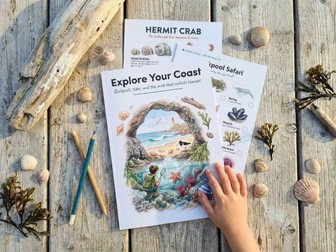
Rockpool identification, tide tracking and a one-metre beach transect - a 62-page seaside and coasts topic for KS1 and KS2, built for real fieldwork and wet afternoons. Half the pack goes outdoors with a clipboard, half works at a table - a coastal topic that survives British weather. What children will explore Rockpool life - seven creatures to identify, and a food chain from plankton to seal Tides - a tide clock log tracking high and low water across a full day Fieldwork - mark a one-metre transect, count what lives in it, keep a journal Classification - sort shells into bivalves and gastropods, label fish anatomy Coasts and people - lighthouses, beach huts and a marine litter tally Meet the rockpool Hermit crab - swaps shells, and queues up by size to do it Starfish - regrows its arms and digests food outside its body Limpet - grips like glue and returns to exactly the same spot Sea anemone - looks like a flower, hunts like a predator Oystercatcher - a beak used like a chisel on mussels and cockles Seaweed - not a plant at all, and the fastest growers add half a metre a day Puffin - up to sixty-two fish in one beak, nesting in clifftop burrows What’s inside - 62 pages Rockpool identification chart, hidden creature search, cut-out rockpool scene Tide clock log, seven-day weather and tide tracker, one-metre transect survey Shell sorting, coastal plant identification, fish anatomy and food chain Press real seaweed, grow salt crystals, make an ocean in a bottle Sandcastle engineering, pebble stacking, beach clean tally Two-day field journal, six specimen sketches, comprehension and vocabulary Spot the difference, odd one out, close-ups, what is wrong here, word searches Design a lighthouse and a beach hut Tear-out pocket cards, ten challenge cards and a certificate Why teachers and parents love this pack A real transect and tide log, so KS2 fieldwork is done rather than described Every page is tagged by independence level - solo, shared, or start together British species throughout, including oystercatcher, limpet and puffin Pocket cards tear out for a coach journey or a class trip to the coast Instant PDF download, 62 pages. A4 and US Letter. Print as many copies as you need for your class or family.
Scotland - Highlands Geography KS1 KS2Quick View
LexAndFoxPress

Scotland - Highlands Geography KS1 KS2

(0)
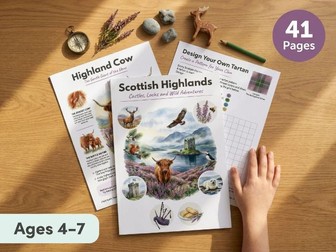
A region of the United Kingdom studied properly - Highland wildlife, castles, lochs, tartan, peat bogs and Gaelic, for KS1 and KS2 geography. Six Highland animals get a field-guide spotlight, and the pack is guided by Bramble the pine marten, a species that lives almost nowhere else in Britain. What children will explore A UK region - a hand-drawn map of Scotland, with landmarks matched to places Highland wildlife - six species, their habitats, and size comparisons Castles and clans - label a medieval castle, then design one of their own Culture and craft - tartan design on a colour grid, Harris Tweed, the bagpipe Weighing evidence - the Loch Ness question, argued both ways Gaelic - eight words traced, with their meanings Meet the Highland animals Highland cow - the gentle giant of the glens Golden eagle - almost every British pair nests in Scotland Red deer - the monarch of the glen, Britain’s largest land mammal Red squirrel - most of Britain’s remaining population lives here Atlantic puffin - the clown of the sea cliffs Grey seal - Britain holds a large share of the world’s population What’s inside - 41 pages Six animal spotlight pages and a habitat sorting activity Map of Scotland with landmark matching, and a Scottish food sort Highland Games matching and a tartan design grid Peat bog cross-section to label, and Harris Tweed sequencing Bagpipe parts to label, castle parts to label, design your own castle Loch Ness evidence page, Gaelic word tracing, animal size comparison I spy glen scene, eight mistakes, eight differences Counting and addition, comprehension story, write a postcard Twelve-piece cut-out glen scene, landscape colouring, certificate Two-page answer key Why teachers and parents love this pack A genuine UK region study, with Scottish species and Scottish industry Peat bogs and conservation bring real science into a geography topic The Loch Ness page teaches children to weigh evidence and decide for themselves Field-guide watercolour illustrations, accurate enough to identify from Works in colour or black and white Instant PDF download, 41 pages. US Letter size - on A4, print at fit to page. Print as many copies as you need for your class or family.
Pond Dipping - Habitats and Keys KS1 KS2Quick View
LexAndFoxPress

Pond Dipping - Habitats and Keys KS1 KS2

(0)
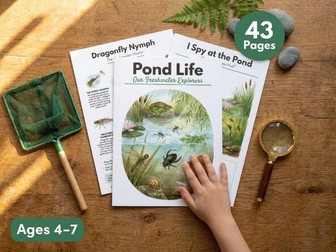
A pond dipping pack with a classification key, a food web and recording sheets - freshwater habitats for KS1 and KS2, ready for a garden pond, a park lake or a stream. The identification flowchart is a working dichotomous key, which puts this straight into the Year 4 classification objective rather than beside it. What children will explore Classification - an ID flowchart to identify real finds from a net Habitat zones - sorting creatures by surface, middle water and pond bottom Food webs - who eats whom, built up rather than given Adaptation - six creatures and how each one solves living in water Water quality - comparing a healthy pond with an unhealthy one Seasonal change - tracking one pond across the year Meet the pond creatures Dragonfly nymph - a hinged mouthpart that shoots out to seize prey Pond snail - a spiral shell, and a lung that sends it up for air Newt - an amphibian that can regrow a lost limb Water boatman - rows with oar-like legs and sings underwater Diving beetle - carries its own air supply beneath its wing cases Pond skater - stands on the surface film without breaking it What’s inside - 43 pages Six creature spotlight pages and a cut-out pond scene to build Creature identification flowchart and a pond dipping recording sheet Pond zone sorting and a food web to complete Healthy and unhealthy pond comparison, and a seasonal pond calendar Surface tension experiment with a paperclip, linked to the pond skater Paper water lily that opens on water I spy, zoom in, shadow matching and mistake inspector Reading, writing, tracing, counting, sorting, sequencing and colouring Answer key included Why teachers and parents love this pack A real classification key, so Year 4 children identify rather than label Built to go outside, with recording sheets for an actual pond visit The surface tension experiment explains the pond skater on the next page Field-guide watercolour illustrations, accurate enough to identify from Adult supervision is needed near water. In the UK, great crested newts are a protected species - look, record, and do not handle. Instant PDF download, 43 pages. A4 and US Letter. Print as many copies as you need for your class or family.