Online Safety & Phishing Investigation | Digital Literacy, Scam Messages, KS3 KS4 PSHEQuick View
BrownWolf

Online Safety & Phishing Investigation | Digital Literacy, Scam Messages, KS3 KS4 PSHE

(0)
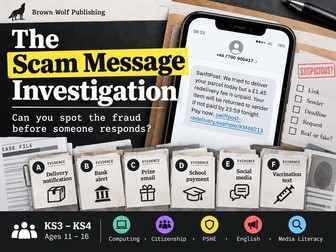
The Scam Message Investigation is a complete KS3 and KS4 online safety, phishing and digital literacy teaching resource for pupils aged 11 to 16. This classroom-ready investigation helps students identify online scams, analyse suspicious messages, recognise social engineering techniques and make safer decisions online. Students become digital fraud investigators and examine six realistic fictional messages involving a parcel delivery fee, bank security alert, prize email, school payment request, social media opportunity and vaccination consent message. They must distinguish warning signs from reliable evidence, identify manipulation tactics and recommend safe actions. The resource includes seven engaging activities: Initial Incident Report, Message Evidence Examination, Manipulation Map, Credibility Test, Decision Point Scenarios, Evidence Hearing and Final Investigation Report. Pupils use the Claim, Evidence, Verify and Decide framework to develop critical thinking, source evaluation, persuasive language analysis and digital citizenship skills. Three differentiated routes, Supported, Core and Challenge, make the activities accessible to a range of learners. Included are three PDF editions: a 28-page Complete Edition, an 18-page Student Edition without answers and a 12-page Teacher Edition with lesson plans, answer keys, model responses, assessment rubric and differentiation guidance. Suitable for Computing, Citizenship, PSHE, online safety, cyber security, media literacy and financial education. Designed for Years 7 to 11, ages 11 to 16. Teaching time is two to three lessons of 50 to 60 minutes. Printable A4 format, black-and-white friendly, with no student internet access required. All messages and organisations are fictional. Published by Brown Wolf Publishing as part of the Real-World Decision Files series.
The Price Was Never the Price|Consumer Contracts, Hidden Fees & Financial LiteracyQuick View
BrownWolf

The Price Was Never the Price|Consumer Contracts, Hidden Fees & Financial Literacy

(0)
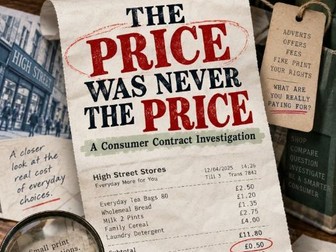
The Price Was Never the Price is an engaging KS3–KS4 financial literacy and consumer rights investigation for pupils aged 12–16. Pupils become consumer investigators examining hidden fees, misleading advertising, subscription traps, contract terms and unexpected charges. Through realistic evidence files, bank statements, checkout screens and customer correspondence, they analyse financial decisions and uncover the true cost of advertised offers. The resource includes twelve evidence exhibits, three additional consumer investigations, practical maths activities, a structured classroom hearing and an independent assessment. Ideal for Citizenship, PSHE, Business Studies and Maths, this resource develops critical thinking, financial awareness, numeracy and evidence-based reasoning. Includes a complete teacher edition with worked solutions, marking rubric and teaching guidance, plus a separate printable pupil edition. Suitable for three to five lessons. Published by Brown Wolf Publishing.
Dr Jekyll & Mr Hyde Ethics Case File | KS3–KS4 Close Reading & Analytical WritingQuick View
BrownWolf

Dr Jekyll & Mr Hyde Ethics Case File | KS3–KS4 Close Reading & Analytical Writing

(0)
A rigorous, ready-to-teach ethics and close-reading resource for Robert Louis Stevenson’s Dr Jekyll and Mr Hyde. Students investigate the novella as an ethical case: Who is responsible for the harm caused by Hyde? Through focused textual evidence, pupils examine Jekyll’s motives, secrecy, self-deception, scientific responsibility, respectability and the “double self”. Ideal for KS3, GCSE preparation and Cambridge International English classrooms. What’s included 28-page printable PDF Five evidence files built around key passages Ethical vocabulary and application task Evidence trackers and analytical organisers Responsibility scale; intent versus consequence analysis Close-reading prompts using quotation, inference and interpretation Ethical lenses activity Prosecution and defence hearing materials Witness examination and cross-examination prompts GCSE-style “to what extent” analytical writing task Extension choice board Teacher answer guidance and discussion notes Best for Teaching Dr Jekyll and Mr Hyde after pupils have read the novella KS3 English and Years 10–11 GCSE preparation Cambridge International lower-secondary or IGCSE-style literary analysis 2–4 lessons; independent work, pairs, groups or a whole-class hearing This resource treats character, motive and the double self as literary interpretation and ethical inquiry - not psychological or medical diagnosis.
The Evidence Doesn't Add Up | Free KS3 Critical Thinking Mystery | Source Reliability & InferenceQuick View
BrownWolf

The Evidence Doesn't Add Up | Free KS3 Critical Thinking Mystery | Source Reliability & Inference

(0)
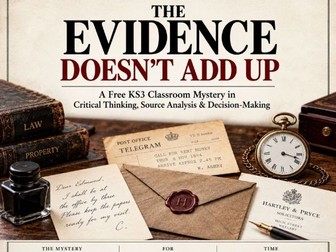
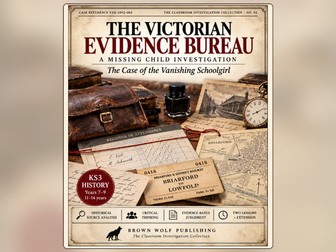
Can your pupils solve a Victorian mystery when the evidence doesn’t quite add up? In this FREE KS3 classroom investigation from Brown Wolf Publishing, pupils travel back to 1894 to examine the mysterious disappearance of an important envelope from a solicitor’s office. Using conflicting witness statements, a telegram receipt, a handwritten note and a puzzling office clock, pupils must separate observation from assumption, assess source reliability and reach an evidence-based conclusion. This resource includes: A complete fictional Victorian mystery Three witness statements Historical-style evidence documents A timeline and clock-reasoning challenge Pupil investigation worksheets A written verdict activity Teacher guidance and model answers Reflection and extension tasks Suitable for:* KS3 English, History, critical thinking, inference, source evaluation, enrichment and cover lessons. Teaching time: Approximately 25–35 minutes. No specialist equipment or internet access required. Part of The Classroom Investigation Collection from Brown Wolf Publishing. One question can change everything.
National Tree Week 2026 | Free KS3 Science InvestigationQuick View
BrownWolf

National Tree Week 2026 | Free KS3 Science Investigation

(0)
National Tree Week 2026 FREE KS3 Science Investigation Looking for free National Tree Week 2026 activities for secondary school pupils? Who Cut Down the Trees? is a printable KS3 science investigation exploring biodiversity, habitats, tree conservation and the environmental impact of removing trees. Celebrate National Tree Week, 21 to 29 November 2026, with this engaging science activity for pupils aged 11 to 14. Six trees have disappeared from an area near a school. What has happened to the wildlife, temperature and surrounding habitat? Pupils examine scientific observations, compare evidence, challenge assumptions and decide whether the removal of the trees was justified. WHAT IS INCLUDED This free 7 page A4 PDF includes a teacher guidance page, a fictional environmental investigation, scientific evidence, two printable pupil worksheets, observation and inference activities, questions about biodiversity and habitat change, and teacher answers. The resource is suitable for economical black and white printing. LEARNING OBJECTIVES Pupils learn to distinguish observations from inferences and unsupported claims, interpret environmental evidence, recognise the importance of trees in ecosystems and construct conclusions supported by scientific reasoning. CURRICULUM AND AGE RANGE Suitable for Key Stage 3 Science, Years 7, 8 and 9, ages 11 to 14. The resource supports ecology, biodiversity, habitats, scientific enquiry and environmental education. It also provides useful cross curricular links to Geography. TEACHING INFORMATION Suggested duration is 20 to 30 minutes. Minimal preparation is required. Teachers can use the activities individually, in pairs, for group discussion, as a lesson starter, a cover lesson or an independent investigation. NATIONAL TREE WEEK 2026 National Tree Week is a UK celebration of trees and the winter tree planting season. The 2026 theme is Trees Near You. This investigation encourages pupils to think critically about trees in their communities and the scientific consequences of removing them. Although particularly relevant to National Tree Week, this free science resource can be used throughout the school year when teaching ecology, deforestation, biodiversity, conservation and environmental decision making. ABOUT BROWN WOLF PUBLISHING Brown Wolf Publishing creates educational investigations that encourage curiosity, evidence analysis, scientific reasoning and independent thinking. Download this free KS3 National Tree Week science resource and invite your pupils to investigate what happens when the trees disappear.