KS3 Activate P2.1 Electricity: Using ElectromagnetsQuick View
drt-tuition

KS3 Activate P2.1 Electricity: Using Electromagnets

(0)
KS3 Science practical lesson on using electromagnets (Activate P2.1). Editable Year 7 PowerPoint with retrieval starter and answers. About this lesson Lesson 10 of 10 in the Year 7 Electricity unit (Activate P2.1). Pupils name uses of electromagnets, describe how a bell and a relay work and explain why an electromagnet suits each job. Includes a practical: make a simple motor. Includes an Equipment Request slide for your technician. Includes a careers slide (Electrical Engineer) with a link to the Gatsby benchmarks. Built into every lesson Retrieval starter: five questions check the prior knowledge pupils need for the lesson (answers in the notes) A concrete, surprising hook to get pupils talking Learning objectives pupils can act on, each with a ‘Show it’ task Formative assessment throughout: checks, hinge question, plenary and exit ticket Common misconceptions targeted: a hidden teacher slide and hinge questions from documented KS3 misconceptions Command words always come with a sentence starter or writing frame Four Tier 3 key words, with pronunciation and warnings about everyday meanings Booklet task slides, each followed by an expected-answers slide, so all the answers are in this PowerPoint Written for KS3 reading levels: one short idea per bullet Fully editable PowerPoint (the lesson only: the printable workbook is a separate, paid resource) The full series This lesson is part of a complete KS3 Science series that follows Activate 1 and 2, covering Years 7 and 8. Lessons carry their Activate topic code. Not affiliated with or endorsed by Oxford University Press. What is free and what is paid Lesson 1 (Charging Up) is FREE. This lesson is £2.50. The Scheme of Work (SoW) that goes with these resources is FREE. The P2.1 Electricity student workbook is NOT free and is NOT included in this lesson. It holds the pages pupils write in when the slides say ‘Turn to Page…’, and is sold separately for £5.00 per topic. It is designed to cut down copying from the board, so lesson time goes on checking understanding. A KS3 Practical Requisition Spreadsheet is sold separately for £5.00. It makes requesting practicals and demos with your technicians seamless. Save on the whole topic: all 10 lesson PowerPoints plus the workbook are available together as a bundle for £18. Last updated: October 2026 (first release).
KS3 Activate P2.1 Electricity: Investigating ElectromagnetsQuick View
drt-tuition

KS3 Activate P2.1 Electricity: Investigating Electromagnets

(0)
KS3 Science practical lesson on investigating electromagnets (Activate P2.1). Editable Year 7 PowerPoint with retrieval starter and answers. About this lesson Lesson 9 of 10 in the Year 7 Electricity unit (Activate P2.1). Pupils name three things that change the strength of an electromagnet, describe the pattern in their results and explain how to make an electromagnet stronger. Includes a practical: three tests of an electromagnet. Includes an Equipment Request slide for your technician. Built into every lesson Retrieval starter: five questions check the prior knowledge pupils need for the lesson (answers in the notes) A concrete, surprising hook to get pupils talking Learning objectives pupils can act on, each with a ‘Show it’ task Formative assessment throughout: checks, hinge question, plenary and exit ticket Common misconceptions targeted: a hidden teacher slide and hinge questions from documented KS3 misconceptions Command words always come with a sentence starter or writing frame Four Tier 3 key words, with pronunciation and warnings about everyday meanings Booklet task slides, each followed by an expected-answers slide, so all the answers are in this PowerPoint Written for KS3 reading levels: one short idea per bullet Fully editable PowerPoint (the lesson only: the printable workbook is a separate, paid resource) The full series This lesson is part of a complete KS3 Science series that follows Activate 1 and 2, covering Years 7 and 8. Lessons carry their Activate topic code. Not affiliated with or endorsed by Oxford University Press. What is free and what is paid Lesson 1 (Charging Up) is FREE. This lesson is £2.50. The Scheme of Work (SoW) that goes with these resources is FREE. The P2.1 Electricity student workbook is NOT free and is NOT included in this lesson. It holds the pages pupils write in when the slides say ‘Turn to Page…’, and is sold separately for £5.00 per topic. It is designed to cut down copying from the board, so lesson time goes on checking understanding. A KS3 Practical Requisition Spreadsheet is sold separately for £5.00. It makes requesting practicals and demos with your technicians seamless. Save on the whole topic: all 10 lesson PowerPoints plus the workbook are available together as a bundle for £18. Last updated: October 2026 (first release).
KS3 Activate P2.1 Electricity Student WorkbookQuick View
drt-tuition

KS3 Activate P2.1 Electricity Student Workbook

(0)
Printable Year 7 KS3 Science workbook for P2.1 Electricity: 100 pages for all 10 lessons. Tasks pupils transform, not copy. Use with the lesson PowerPoints. About this workbook The student workbook for the Year 7 Electricity unit (Activate P2.1), made to go with the KS3 Activate P2.1 Electricity lesson PowerPoints. Every lesson has its own pages: match-it and sort tables, sequencing, Venn diagrams, faded worked examples and, in practical lessons, a Predict-Observe-Explain box, results table and conclusion frame. Why use it Pupils transform what the slides show instead of copying it from the board, so lesson time goes on checking understanding Page numbers match the ‘Turn to Page…’ prompts on the slides Command words come with sentence starters and writing frames All the answers are in the lesson PowerPoints: an Expected answers slide follows every booklet task Editable Word file, A4, ready to print What you are buying This is the workbook only. The lesson PowerPoints are sold separately: lesson 1 is free and lessons 2 to 10 are £2.50 each. The whole topic (all 10 lessons plus this workbook) is £18 as a bundle. This workbook is part of a complete KS3 Science series that follows Activate 1 and 2, covering Years 7 and 8. Resources carry their Activate topic code. Not affiliated with or endorsed by Oxford University Press. The Scheme of Work (SoW) that goes with these resources is FREE. A KS3 Practical Requisition Spreadsheet is sold separately for £5.00. It makes requesting practicals and demos with your technicians seamless. Last updated: October 2026 (first release).
KS3 Activate B1.1 Cells: Microscope PracticalQuick View
drt-tuition

KS3 Activate B1.1 Cells: Microscope Practical

(0)
KS3 Science practical lesson on observing onion cells with a microscope (Activate B1.1). Editable Year 7 PowerPoint with retrieval starter and answers. About this lesson Lesson 3 of 6 in the Year 7 Cells unit (Activate B1.1). Pupils prepare a slide of onion cells, focus a microscope on each lens, lowest first, and draw what they see as a scientific drawing. Includes a practical: observing onion cells. Includes an Equipment Request slide for your technician. Includes a careers slide (Cell Biologist) with a link to the Gatsby benchmarks. Links to interactive tools made for this lesson: an ‘Explore’ tool and a ‘Check it’ tool. Built into every lesson Retrieval starter: five questions check the prior knowledge pupils need for the lesson (answers in the notes) A concrete, surprising hook to get pupils talking Learning objectives pupils can act on, each with a ‘Show it’ task Formative assessment throughout: checks, hinge question, plenary and exit ticket Common misconceptions targeted: a hidden teacher slide and hinge questions from documented KS3 misconceptions Command words always come with a sentence starter or writing frame Four Tier 3 key words, with pronunciation and warnings about everyday meanings Booklet task slides, each followed by an expected-answers slide, so all the answers are in this PowerPoint Written for KS3 reading levels: one short idea per bullet Fully editable PowerPoint (the lesson only: the printable workbook is a separate, paid resource) The full series This lesson is part of a complete KS3 Science series that follows Activate 1 and 2, covering Years 7 and 8. Lessons carry their Activate topic code. Not affiliated with or endorsed by Oxford University Press. What is free and what is paid Lesson 1 (Observing Cells) is FREE. This lesson is £2.50. The Scheme of Work (SoW) that goes with these resources is FREE. The B1.1 Cells student workbook is NOT free and is NOT included in this lesson. It holds the pages pupils write in when the slides say ‘Turn to Page…’, and is sold separately for £5.00 per topic. It is designed to cut down copying from the board, so lesson time goes on checking understanding. A KS3 Practical Requisition Spreadsheet is sold separately for £5.00. It makes requesting practicals and demos with your technicians seamless. Save on the whole topic: all 6 lesson PowerPoints plus the workbook are available together as a bundle for £12. Last updated: October 2026 (first release).
KS3 Activate B1.1 Cells: Specialised CellsQuick View
drt-tuition

KS3 Activate B1.1 Cells: Specialised Cells

(0)
KS3 Science lesson on specialised cells (Activate B1.1). Editable Year 7 PowerPoint with retrieval starter and answers. About this lesson Lesson 4 of 6 in the Year 7 Cells unit (Activate B1.1). Pupils identify five specialised cells from their shape, link a cell’s feature to its job and explain how a cell’s shape helps it do its job. Links to interactive tools made for this lesson: an ‘Explore’ tool and a ‘Check it’ tool. Built into every lesson Retrieval starter: five questions check the prior knowledge pupils need for the lesson (answers in the notes) A concrete, surprising hook to get pupils talking Learning objectives pupils can act on, each with a ‘Show it’ task Formative assessment throughout: checks, hinge question, plenary and exit ticket Common misconceptions targeted: a hidden teacher slide and hinge questions from documented KS3 misconceptions Command words always come with a sentence starter or writing frame Four Tier 3 key words, with pronunciation and warnings about everyday meanings Booklet task slides, each followed by an expected-answers slide, so all the answers are in this PowerPoint Written for KS3 reading levels: one short idea per bullet Fully editable PowerPoint (the lesson only: the printable workbook is a separate, paid resource) The full series This lesson is part of a complete KS3 Science series that follows Activate 1 and 2, covering Years 7 and 8. Lessons carry their Activate topic code. Not affiliated with or endorsed by Oxford University Press. What is free and what is paid Lesson 1 (Observing Cells) is FREE. This lesson is £2.50. The Scheme of Work (SoW) that goes with these resources is FREE. The B1.1 Cells student workbook is NOT free and is NOT included in this lesson. It holds the pages pupils write in when the slides say ‘Turn to Page…’, and is sold separately for £5.00 per topic. It is designed to cut down copying from the board, so lesson time goes on checking understanding. A KS3 Practical Requisition Spreadsheet is sold separately for £5.00. It makes requesting practicals and demos with your technicians seamless. Save on the whole topic: all 6 lesson PowerPoints plus the workbook are available together as a bundle for £12. Last updated: October 2026 (first release).
KS3 Activate B1.1 Cells: Plant and Animal CellsQuick View
drt-tuition

KS3 Activate B1.1 Cells: Plant and Animal Cells

(0)
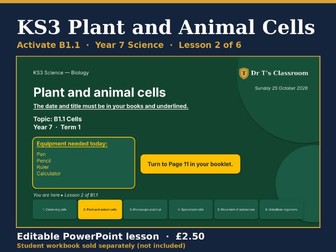
KS3 Science lesson on plant and animal cell structures (Activate B1.1). Editable Year 7 PowerPoint with retrieval starter and answers. About this lesson Lesson 2 of 6 in the Year 7 Cells unit (Activate B1.1). Pupils name the parts of an animal cell and a plant cell, match each cell part to its job and compare a plant cell with an animal cell. Links to interactive tools made for this lesson: an ‘Explore’ tool and a ‘Check it’ tool. Built into every lesson Retrieval starter: five questions check the prior knowledge pupils need for the lesson (answers in the notes) A concrete, surprising hook to get pupils talking Learning objectives pupils can act on, each with a ‘Show it’ task Formative assessment throughout: checks, hinge question, plenary and exit ticket Common misconceptions targeted: a hidden teacher slide and hinge questions from documented KS3 misconceptions Command words always come with a sentence starter or writing frame Four Tier 3 key words, with pronunciation and warnings about everyday meanings Booklet task slides, each followed by an expected-answers slide, so all the answers are in this PowerPoint Written for KS3 reading levels: one short idea per bullet Fully editable PowerPoint (the lesson only: the printable workbook is a separate, paid resource) The full series This lesson is part of a complete KS3 Science series that follows Activate 1 and 2, covering Years 7 and 8. Lessons carry their Activate topic code. Not affiliated with or endorsed by Oxford University Press. What is free and what is paid Lesson 1 (Observing Cells) is FREE. This lesson is £2.50. The Scheme of Work (SoW) that goes with these resources is FREE. The B1.1 Cells student workbook is NOT free and is NOT included in this lesson. It holds the pages pupils write in when the slides say ‘Turn to Page…’, and is sold separately for £5.00 per topic. It is designed to cut down copying from the board, so lesson time goes on checking understanding. A KS3 Practical Requisition Spreadsheet is sold separately for £5.00. It makes requesting practicals and demos with your technicians seamless. Save on the whole topic: all 6 lesson PowerPoints plus the workbook are available together as a bundle for £12. Last updated: October 2026 (first release).
KS3 Activate P1.4 Space: The Moon and Changing IdeasQuick View
drt-tuition

KS3 Activate P1.4 Space: The Moon and Changing Ideas

(0)
KS3 Science practical lesson on the phases of the Moon (Activate P1.4). Editable Year 7 PowerPoint with retrieval starter and answers. About this lesson Lesson 4 of 4 in the Year 7 Space unit (Activate P1.4). Pupils sequence the phases of the Moon in order, draw what the Moon looks like from Earth and judge which model fits Galileo’s evidence. Includes a practical: modelling the phases of the Moon. Includes an Equipment Request slide for your technician. Links to interactive tools made for this lesson: an ‘Explore’ tool and a ‘Check it’ tool. Built into every lesson Retrieval starter: five questions check the prior knowledge pupils need for the lesson (answers in the notes) A concrete, surprising hook to get pupils talking Learning objectives pupils can act on, each with a ‘Show it’ task Formative assessment throughout: checks, hinge question, plenary and exit ticket Common misconceptions targeted: a hidden teacher slide and hinge questions from documented KS3 misconceptions Command words always come with a sentence starter or writing frame Four Tier 3 key words, with pronunciation and warnings about everyday meanings Booklet task slides, each followed by an expected-answers slide, so all the answers are in this PowerPoint Written for KS3 reading levels: one short idea per bullet Fully editable PowerPoint (the lesson only: the printable workbook is a separate, paid resource) The full series This lesson is part of a complete KS3 Science series that follows Activate 1 and 2, covering Years 7 and 8. Lessons carry their Activate topic code. Not affiliated with or endorsed by Oxford University Press. What is free and what is paid Lesson 1 (The Night Sky) is FREE. This lesson is £2.50. The Scheme of Work (SoW) that goes with these resources is FREE. The P1.4 Space student workbook is NOT free and is NOT included in this lesson. It holds the pages pupils write in when the slides say ‘Turn to Page…’, and is sold separately for £5.00 per topic. It is designed to cut down copying from the board, so lesson time goes on checking understanding. A KS3 Practical Requisition Spreadsheet is sold separately for £5.00. It makes requesting practicals and demos with your technicians seamless. Save on the whole topic: all 4 lesson PowerPoints plus the workbook are available together as a bundle for £8. Last updated: October 2026 (first release).
KS3 Activate P1.4 Space: The EarthQuick View
drt-tuition

KS3 Activate P1.4 Space: The Earth

(0)
KS3 Science lesson on day, night and the seasons (Activate P1.4). Editable Year 7 PowerPoint with retrieval starter and answers. About this lesson Lesson 3 of 4 in the Year 7 Space unit (Activate P1.4). Pupils label the Earth’s axis, spin and orbit, explain why we have day and night and predict the season from the Earth’s tilt. Includes an Equipment Request slide for your technician. Links to interactive tools made for this lesson: an ‘Explore’ tool and a ‘Check it’ tool. Built into every lesson Retrieval starter: five questions check the prior knowledge pupils need for the lesson (answers in the notes) A concrete, surprising hook to get pupils talking Learning objectives pupils can act on, each with a ‘Show it’ task Formative assessment throughout: checks, hinge question, plenary and exit ticket Common misconceptions targeted: a hidden teacher slide and hinge questions from documented KS3 misconceptions Command words always come with a sentence starter or writing frame Four Tier 3 key words, with pronunciation and warnings about everyday meanings Booklet task slides, each followed by an expected-answers slide, so all the answers are in this PowerPoint Written for KS3 reading levels: one short idea per bullet Fully editable PowerPoint (the lesson only: the printable workbook is a separate, paid resource) The full series This lesson is part of a complete KS3 Science series that follows Activate 1 and 2, covering Years 7 and 8. Lessons carry their Activate topic code. Not affiliated with or endorsed by Oxford University Press. What is free and what is paid Lesson 1 (The Night Sky) is FREE. This lesson is £2.50. The Scheme of Work (SoW) that goes with these resources is FREE. The P1.4 Space student workbook is NOT free and is NOT included in this lesson. It holds the pages pupils write in when the slides say ‘Turn to Page…’, and is sold separately for £5.00 per topic. It is designed to cut down copying from the board, so lesson time goes on checking understanding. A KS3 Practical Requisition Spreadsheet is sold separately for £5.00. It makes requesting practicals and demos with your technicians seamless. Save on the whole topic: all 4 lesson PowerPoints plus the workbook are available together as a bundle for £8. Last updated: October 2026 (first release).
KS3 Activate P1.4 Space Student WorkbookQuick View
drt-tuition

KS3 Activate P1.4 Space Student Workbook

(0)
Printable Year 7 KS3 Science workbook for P1.4 Space: 35 pages for all 4 lessons. Tasks pupils transform, not copy. Use with the lesson PowerPoints. About this workbook The student workbook for the Year 7 Space unit (Activate P1.4), made to go with the KS3 Activate P1.4 Space lesson PowerPoints. Every lesson has its own pages: match-it and sort tables, sequencing, Venn diagrams, faded worked examples and, in practical lessons, a Predict-Observe-Explain box, results table and conclusion frame. Why use it Pupils transform what the slides show instead of copying it from the board, so lesson time goes on checking understanding Page numbers match the ‘Turn to Page…’ prompts on the slides Command words come with sentence starters and writing frames All the answers are in the lesson PowerPoints: an Expected answers slide follows every booklet task Editable Word file, A4, ready to print What you are buying This is the workbook only. The lesson PowerPoints are sold separately: lesson 1 is free and lessons 2 to 4 are £2.50 each. The whole topic (all 4 lessons plus this workbook) is £8 as a bundle. This workbook is part of a complete KS3 Science series that follows Activate 1 and 2, covering Years 7 and 8. Resources carry their Activate topic code. Not affiliated with or endorsed by Oxford University Press. The Scheme of Work (SoW) that goes with these resources is FREE. A KS3 Practical Requisition Spreadsheet is sold separately for £5.00. It makes requesting practicals and demos with your technicians seamless. Last updated: October 2026 (first release).
KS3 Activate B1.3 Reproduction: Seed DispersalQuick View
drt-tuition

KS3 Activate B1.3 Reproduction: Seed Dispersal

(0)
KS3 Science lesson on seed dispersal (Activate B1.3). Editable Year 8 PowerPoint with retrieval starter and answers. About this lesson Lesson 4 of 9 in the Year 8 Reproduction unit (Activate B1.3). Pupils name four ways seeds are dispersed, explain how a seed suits its method and measure how seed size affects distance. Includes a practical: fair test: does seed size change distance?. Includes an Equipment Request slide for your technician. Built into every lesson Retrieval starter: five questions check the prior knowledge pupils need for the lesson (answers in the notes) A concrete, surprising hook to get pupils talking Learning objectives pupils can act on, each with a ‘Show it’ task Formative assessment throughout: checks, hinge question, plenary and exit ticket Common misconceptions targeted: a hidden teacher slide and hinge questions from documented KS3 misconceptions Command words always come with a sentence starter or writing frame Four Tier 3 key words, with pronunciation and warnings about everyday meanings Booklet task slides, each followed by an expected-answers slide, so all the answers are in this PowerPoint Written for KS3 reading levels: one short idea per bullet Fully editable PowerPoint (the lesson only: the printable workbook is a separate, paid resource) The full series This lesson is part of a complete KS3 Science series that follows Activate 1 and 2, covering Years 7 and 8. Lessons carry their Activate topic code. Not affiliated with or endorsed by Oxford University Press. What is free and what is paid Lesson 1 (Flowers and Pollination) is FREE. This lesson is £2.50. The Scheme of Work (SoW) that goes with these resources is FREE. The B1.3 Reproduction student workbook is NOT free and is NOT included in this lesson. It holds the pages pupils write in when the slides say ‘Turn to Page…’, and is sold separately for £5.00 per topic. It is designed to cut down copying from the board, so lesson time goes on checking understanding. A KS3 Practical Requisition Spreadsheet is sold separately for £5.00. It makes requesting practicals and demos with your technicians seamless. Save on the whole topic: all 9 lesson PowerPoints plus the workbook are available together as a bundle for £16. Last updated: October 2026 (first release).
KS3 Activate B1.3 Reproduction: AdolescenceQuick View
drt-tuition

KS3 Activate B1.3 Reproduction: Adolescence

(0)
KS3 Science lesson on adolescence and puberty (Activate B1.3). Editable Year 8 PowerPoint with retrieval starter and answers. About this lesson Lesson 5 of 9 in the Year 8 Reproduction unit (Activate B1.3). Pupils state the difference between adolescence and puberty, sort changes into girls, boys or both and explain what causes puberty. Built into every lesson Retrieval starter: five questions check the prior knowledge pupils need for the lesson (answers in the notes) A concrete, surprising hook to get pupils talking Learning objectives pupils can act on, each with a ‘Show it’ task Formative assessment throughout: checks, hinge question, plenary and exit ticket Common misconceptions targeted: a hidden teacher slide and hinge questions from documented KS3 misconceptions Command words always come with a sentence starter or writing frame Four Tier 3 key words, with pronunciation and warnings about everyday meanings Booklet task slides, each followed by an expected-answers slide, so all the answers are in this PowerPoint Written for KS3 reading levels: one short idea per bullet Fully editable PowerPoint (the lesson only: the printable workbook is a separate, paid resource) The full series This lesson is part of a complete KS3 Science series that follows Activate 1 and 2, covering Years 7 and 8. Lessons carry their Activate topic code. Not affiliated with or endorsed by Oxford University Press. What is free and what is paid Lesson 1 (Flowers and Pollination) is FREE. This lesson is £2.50. The Scheme of Work (SoW) that goes with these resources is FREE. The B1.3 Reproduction student workbook is NOT free and is NOT included in this lesson. It holds the pages pupils write in when the slides say ‘Turn to Page…’, and is sold separately for £5.00 per topic. It is designed to cut down copying from the board, so lesson time goes on checking understanding. A KS3 Practical Requisition Spreadsheet is sold separately for £5.00. It makes requesting practicals and demos with your technicians seamless. Save on the whole topic: all 9 lesson PowerPoints plus the workbook are available together as a bundle for £16. Last updated: October 2026 (first release).
KS3 Activate B1.3 Reproduction: Fertilisation and GerminationQuick View
drt-tuition

KS3 Activate B1.3 Reproduction: Fertilisation and Germination

(0)
KS3 Science lesson on fertilisation and germination in plants (Activate B1.3). Editable Year 8 PowerPoint with retrieval starter and answers. About this lesson Lesson 3 of 9 in the Year 8 Reproduction unit (Activate B1.3). Pupils order the steps of fertilisation in a flower, describe what is inside a seed and explain what a seed needs to germinate. Built into every lesson Retrieval starter: five questions check the prior knowledge pupils need for the lesson (answers in the notes) A concrete, surprising hook to get pupils talking Learning objectives pupils can act on, each with a ‘Show it’ task Formative assessment throughout: checks, hinge question, plenary and exit ticket Common misconceptions targeted: a hidden teacher slide and hinge questions from documented KS3 misconceptions Command words always come with a sentence starter or writing frame Four Tier 3 key words, with pronunciation and warnings about everyday meanings Booklet task slides, each followed by an expected-answers slide, so all the answers are in this PowerPoint Written for KS3 reading levels: one short idea per bullet Fully editable PowerPoint (the lesson only: the printable workbook is a separate, paid resource) The full series This lesson is part of a complete KS3 Science series that follows Activate 1 and 2, covering Years 7 and 8. Lessons carry their Activate topic code. Not affiliated with or endorsed by Oxford University Press. What is free and what is paid Lesson 1 (Flowers and Pollination) is FREE. This lesson is £2.50. The Scheme of Work (SoW) that goes with these resources is FREE. The B1.3 Reproduction student workbook is NOT free and is NOT included in this lesson. It holds the pages pupils write in when the slides say ‘Turn to Page…’, and is sold separately for £5.00 per topic. It is designed to cut down copying from the board, so lesson time goes on checking understanding. A KS3 Practical Requisition Spreadsheet is sold separately for £5.00. It makes requesting practicals and demos with your technicians seamless. Save on the whole topic: all 9 lesson PowerPoints plus the workbook are available together as a bundle for £16. Last updated: October 2026 (first release).
KS3 Activate P2.2 Energy: Energy and TemperatureQuick View
drt-tuition

KS3 Activate P2.2 Energy: Energy and Temperature

(0)
KS3 Science lesson on energy and temperature (Activate P2.2). Editable Year 7 PowerPoint with retrieval starter and answers. About this lesson Lesson 3 of 8 in the Year 7 Energy unit (Activate P2.2). Pupils state the difference between energy and temperature, describe what happens to particles when they are heated and explain what equilibrium means. Includes a practical: observing: heating air. Includes an Equipment Request slide for your technician. Links to interactive tools made for this lesson: an ‘Explore’ tool and a ‘Check it’ tool. Built into every lesson Retrieval starter: five questions check the prior knowledge pupils need for the lesson (answers in the notes) A concrete, surprising hook to get pupils talking Learning objectives pupils can act on, each with a ‘Show it’ task Formative assessment throughout: checks, hinge question, plenary and exit ticket Common misconceptions targeted: a hidden teacher slide and hinge questions from documented KS3 misconceptions Command words always come with a sentence starter or writing frame Four Tier 3 key words, with pronunciation and warnings about everyday meanings Booklet task slides, each followed by an expected-answers slide, so all the answers are in this PowerPoint Written for KS3 reading levels: one short idea per bullet Fully editable PowerPoint (the lesson only: the printable workbook is a separate, paid resource) The full series This lesson is part of a complete KS3 Science series that follows Activate 1 and 2, covering Years 7 and 8. Lessons carry their Activate topic code. Not affiliated with or endorsed by Oxford University Press. What is free and what is paid Lesson 1 (Food for Fuels) is FREE. This lesson is £2.50. The Scheme of Work (SoW) that goes with these resources is FREE. The P2.2 Energy student workbook is NOT free and is NOT included in this lesson. It holds the pages pupils write in when the slides say ‘Turn to Page…’, and is sold separately for £5.00 per topic. It is designed to cut down copying from the board, so lesson time goes on checking understanding. A KS3 Practical Requisition Spreadsheet is sold separately for £5.00. It makes requesting practicals and demos with your technicians seamless. Save on the whole topic: all 8 lesson PowerPoints plus the workbook are available together as a bundle for £15. Last updated: October 2026 (first release).
KS3 Activate P2.2 Energy: Energy Adds UpQuick View
drt-tuition

KS3 Activate P2.2 Energy: Energy Adds Up

(0)
KS3 Science lesson on energy stores and transfers (Activate P2.2). Editable Year 7 PowerPoint with retrieval starter and answers. About this lesson Lesson 2 of 8 in the Year 7 Energy unit (Activate P2.2). Pupils name the five energy stores, describe energy before and after a change and calculate the % efficiency of a device. Includes a practical: observing: energy transfers circus. Includes an Equipment Request slide for your technician. Links to interactive tools made for this lesson: an ‘Explore’ tool and a ‘Check it’ tool. Built into every lesson Retrieval starter: five questions check the prior knowledge pupils need for the lesson (answers in the notes) A concrete, surprising hook to get pupils talking Learning objectives pupils can act on, each with a ‘Show it’ task Formative assessment throughout: checks, hinge question, plenary and exit ticket Common misconceptions targeted: a hidden teacher slide and hinge questions from documented KS3 misconceptions Command words always come with a sentence starter or writing frame Four Tier 3 key words, with pronunciation and warnings about everyday meanings Booklet task slides, each followed by an expected-answers slide, so all the answers are in this PowerPoint Written for KS3 reading levels: one short idea per bullet Fully editable PowerPoint (the lesson only: the printable workbook is a separate, paid resource) The full series This lesson is part of a complete KS3 Science series that follows Activate 1 and 2, covering Years 7 and 8. Lessons carry their Activate topic code. Not affiliated with or endorsed by Oxford University Press. What is free and what is paid Lesson 1 (Food for Fuels) is FREE. This lesson is £2.50. The Scheme of Work (SoW) that goes with these resources is FREE. The P2.2 Energy student workbook is NOT free and is NOT included in this lesson. It holds the pages pupils write in when the slides say ‘Turn to Page…’, and is sold separately for £5.00 per topic. It is designed to cut down copying from the board, so lesson time goes on checking understanding. A KS3 Practical Requisition Spreadsheet is sold separately for £5.00. It makes requesting practicals and demos with your technicians seamless. Save on the whole topic: all 8 lesson PowerPoints plus the workbook are available together as a bundle for £15. Last updated: October 2026 (first release).
KS3 Activate B2.1 Health and Lifestyle Student WorkbookQuick View
drt-tuition

KS3 Activate B2.1 Health and Lifestyle Student Workbook

(0)
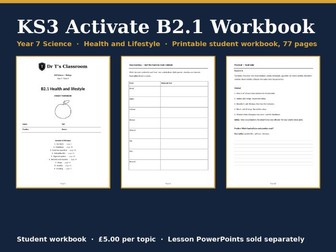
Printable Year 7 KS3 Science workbook for B2.1 Health and Lifestyle: 77 pages for all 9 lessons. Tasks pupils transform, not copy. Use with the lesson PowerPoints. About this workbook The student workbook for the Year 7 Health and Lifestyle unit (Activate B2.1), made to go with the KS3 Activate B2.1 Health and Lifestyle lesson PowerPoints. Every lesson has its own pages: match-it and sort tables, sequencing, Venn diagrams, faded worked examples and, in practical lessons, a Predict-Observe-Explain box, results table and conclusion frame. Why use it Pupils transform what the slides show instead of copying it from the board, so lesson time goes on checking understanding Page numbers match the ‘Turn to Page…’ prompts on the slides Command words come with sentence starters and writing frames All the answers are in the lesson PowerPoints: an Expected answers slide follows every booklet task Editable Word file, A4, ready to print What you are buying This is the workbook only. The lesson PowerPoints are sold separately: lesson 1 is free and lessons 2 to 9 are £2.50 each. The whole topic (all 9 lessons plus this workbook) is £16 as a bundle. This workbook is part of a complete KS3 Science series that follows Activate 1 and 2, covering Years 7 and 8. Resources carry their Activate topic code. Not affiliated with or endorsed by Oxford University Press. The Scheme of Work (SoW) that goes with these resources is FREE. A KS3 Practical Requisition Spreadsheet is sold separately for £5.00. It makes requesting practicals and demos with your technicians seamless. Last updated: October 2026 (first release).
KS3 Activate P2.2 Energy: Work, Energy and MachinesQuick View
drt-tuition

KS3 Activate P2.2 Energy: Work, Energy and Machines

(0)
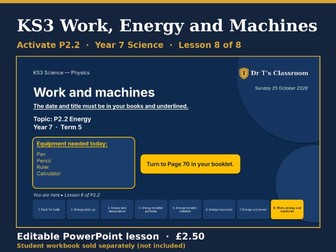
KS3 Science lesson on work, energy and machines (Activate P2.2). Editable Year 7 PowerPoint with retrieval starter and answers. About this lesson Lesson 8 of 8 in the Year 7 Energy unit (Activate P2.2). Pupils calculate the work done by a force, label the parts of a lever and decide if a machine gives extra energy. Includes a practical: measuring: does a lever save work? Includes an Equipment Request slide for your technician. Links to interactive tools made for this lesson: an ‘Explore’ tool and a ‘Check it’ tool. Built into every lesson Retrieval starter: five questions check the prior knowledge pupils need for the lesson (answers in the notes) A concrete, surprising hook to get pupils talking Learning objectives pupils can act on, each with a ‘Show it’ task Formative assessment throughout: checks, hinge question, plenary and exit ticket Common misconceptions targeted: a hidden teacher slide and hinge questions from documented KS3 misconceptions Command words always come with a sentence starter or writing frame Four Tier 3 key words, with pronunciation and warnings about everyday meanings Booklet task slides, each followed by an expected-answers slide, so all the answers are in this PowerPoint Written for KS3 reading levels: one short idea per bullet Fully editable PowerPoint (the lesson only: the printable workbook is a separate, paid resource) The full series This lesson is part of a complete KS3 Science series that follows Activate 1 and 2, covering Years 7 and 8. Lessons carry their Activate topic code. Not affiliated with or endorsed by Oxford University Press. What is free and what is paid Lesson 1 (Food for Fuels) is FREE. This lesson is £2.50. The Scheme of Work (SoW) that goes with these resources is FREE. The P2.2 Energy student workbook is NOT free and is NOT included in this lesson. It holds the pages pupils write in when the slides say ‘Turn to Page…’, and is sold separately for £5.00 per topic. It is designed to cut down copying from the board, so lesson time goes on checking understanding. A KS3 Practical Requisition Spreadsheet is sold separately for £5.00. It makes requesting practicals and demos with your technicians seamless. Save on the whole topic: all 8 lesson PowerPoints plus the workbook are available together as a bundle for £15. Last updated: October 2026 (first release).
KS3 Activate P2.2 Energy Student WorkbookQuick View
drt-tuition

KS3 Activate P2.2 Energy Student Workbook

(0)
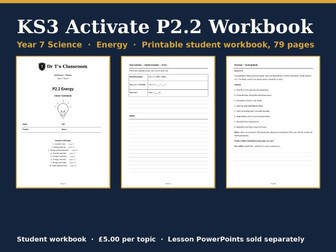
Printable Year 7 KS3 Science workbook for P2.2 Energy: 79 pages for all 8 lessons. Tasks pupils transform, not copy. Use with the lesson PowerPoints. About this workbook The student workbook for the Year 7 Energy unit (Activate P2.2), made to go with the KS3 Activate P2.2 Energy lesson PowerPoints. Every lesson has its own pages: match-it and sort tables, sequencing, Venn diagrams, faded worked examples and, in practical lessons, a Predict-Observe-Explain box, results table and conclusion frame. Why use it Pupils transform what the slides show instead of copying it from the board, so lesson time goes on checking understanding Page numbers match the ‘Turn to Page…’ prompts on the slides Command words come with sentence starters and writing frames All the answers are in the lesson PowerPoints: an Expected answers slide follows every booklet task Editable Word file, A4, ready to print What you are buying This is the workbook only. The lesson PowerPoints are sold separately: lesson 1 is free and lessons 2 to 8 are £2.50 each. The whole topic (all 8 lessons plus this workbook) is £15 as a bundle. This workbook is part of a complete KS3 Science series that follows Activate 1 and 2, covering Years 7 and 8. Resources carry their Activate topic code. Not affiliated with or endorsed by Oxford University Press. The Scheme of Work (SoW) that goes with these resources is FREE. A KS3 Practical Requisition Spreadsheet is sold separately for £5.00. It makes requesting practicals and demos with your technicians seamless. Last updated: October 2026 (first release).
KS3 Activate P2.1 Electricity: Investigating Series and ParallelQuick View
drt-tuition

KS3 Activate P2.1 Electricity: Investigating Series and Parallel

(0)
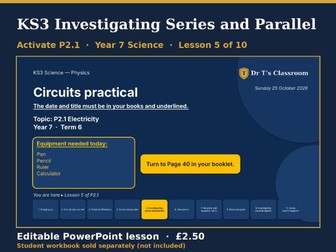
KS3 Science lesson on current and p.d. in series and parallel circuits (Activate P2.1). Editable Year 7 PowerPoint with retrieval starter and answers. About this lesson Lesson 5 of 10 in the Year 7 Electricity unit (Activate P2.1). Pupils measure current and p.d. in series and parallel circuits, compare current and p.d. in the two types of circuit and explain what happens to the current when a branch is added. Includes a practical: pattern seeking: current and p.d. at four stations. Includes an Equipment Request slide for your technician. Built into every lesson Retrieval starter: five questions check the prior knowledge pupils need for the lesson (answers in the notes) A concrete, surprising hook to get pupils talking Learning objectives pupils can act on, each with a ‘Show it’ task Formative assessment throughout: checks, hinge question, plenary and exit ticket Common misconceptions targeted: a hidden teacher slide and hinge questions from documented KS3 misconceptions Command words always come with a sentence starter or writing frame Four Tier 3 key words, with pronunciation and warnings about everyday meanings Booklet task slides, each followed by an expected-answers slide, so all the answers are in this PowerPoint Written for KS3 reading levels: one short idea per bullet Fully editable PowerPoint (the lesson only: the printable workbook is a separate, paid resource) The full series This lesson is part of a complete KS3 Science series that follows Activate 1 and 2, covering Years 7 and 8. Lessons carry their Activate topic code. Not affiliated with or endorsed by Oxford University Press. What is free and what is paid Lesson 1 (Charging Up) is FREE. This lesson is £2.50. The Scheme of Work (SoW) that goes with these resources is FREE. The P2.1 Electricity student workbook is NOT free and is NOT included in this lesson. It holds the pages pupils write in when the slides say ‘Turn to Page…’, and is sold separately for £5.00 per topic. It is designed to cut down copying from the board, so lesson time goes on checking understanding. A KS3 Practical Requisition Spreadsheet is sold separately for £5.00. It makes requesting practicals and demos with your technicians seamless. Save on the whole topic: all 10 lesson PowerPoints plus the workbook are available together as a bundle for £18. Last updated: October 2026 (first release).
KS3 Activate P2.1 Electricity: Potential DifferenceQuick View
drt-tuition

KS3 Activate P2.1 Electricity: Potential Difference

(0)
KS3 Science lesson on potential difference (Activate P2.1). Editable Year 7 PowerPoint with retrieval starter and answers. About this lesson Lesson 3 of 10 in the Year 7 Electricity unit (Activate P2.1). Pupils name the unit and the meter for potential difference, calculate the p.d. across each part of a series circuit and explain why more cells make a bulb brighter. Includes a practical: pattern seeking: p.d. in a series circuit. Includes an Equipment Request slide for your technician. Built into every lesson Retrieval starter: five questions check the prior knowledge pupils need for the lesson (answers in the notes) A concrete, surprising hook to get pupils talking Learning objectives pupils can act on, each with a ‘Show it’ task Formative assessment throughout: checks, hinge question, plenary and exit ticket Common misconceptions targeted: a hidden teacher slide and hinge questions from documented KS3 misconceptions Command words always come with a sentence starter or writing frame Four Tier 3 key words, with pronunciation and warnings about everyday meanings Booklet task slides, each followed by an expected-answers slide, so all the answers are in this PowerPoint Written for KS3 reading levels: one short idea per bullet Fully editable PowerPoint (the lesson only: the printable workbook is a separate, paid resource) The full series This lesson is part of a complete KS3 Science series that follows Activate 1 and 2, covering Years 7 and 8. Lessons carry their Activate topic code. Not affiliated with or endorsed by Oxford University Press. What is free and what is paid Lesson 1 (Charging Up) is FREE. This lesson is £2.50. The Scheme of Work (SoW) that goes with these resources is FREE. The P2.1 Electricity student workbook is NOT free and is NOT included in this lesson. It holds the pages pupils write in when the slides say ‘Turn to Page…’, and is sold separately for £5.00 per topic. It is designed to cut down copying from the board, so lesson time goes on checking understanding. A KS3 Practical Requisition Spreadsheet is sold separately for £5.00. It makes requesting practicals and demos with your technicians seamless. Save on the whole topic: all 10 lesson PowerPoints plus the workbook are available together as a bundle for £18. Last updated: October 2026 (first release).
KS3 Activate P2.1 Electricity: Circuits and CurrentQuick View
drt-tuition

KS3 Activate P2.1 Electricity: Circuits and Current

(0)
KS3 Science lesson on circuits and current (Activate P2.1). Editable Year 7 PowerPoint with retrieval starter and answers. About this lesson Lesson 2 of 10 in the Year 7 Electricity unit (Activate P2.1). Pupils draw a series circuit using the correct symbols, describe what current is and what measures it and explain why a series circuit has the same current everywhere. Includes a practical: pattern seeking: current in a series circuit. Includes an Equipment Request slide for your technician. Built into every lesson Retrieval starter: five questions check the prior knowledge pupils need for the lesson (answers in the notes) A concrete, surprising hook to get pupils talking Learning objectives pupils can act on, each with a ‘Show it’ task Formative assessment throughout: checks, hinge question, plenary and exit ticket Common misconceptions targeted: a hidden teacher slide and hinge questions from documented KS3 misconceptions Command words always come with a sentence starter or writing frame Four Tier 3 key words, with pronunciation and warnings about everyday meanings Booklet task slides, each followed by an expected-answers slide, so all the answers are in this PowerPoint Written for KS3 reading levels: one short idea per bullet Fully editable PowerPoint (the lesson only: the printable workbook is a separate, paid resource) The full series This lesson is part of a complete KS3 Science series that follows Activate 1 and 2, covering Years 7 and 8. Lessons carry their Activate topic code. Not affiliated with or endorsed by Oxford University Press. What is free and what is paid Lesson 1 (Charging Up) is FREE. This lesson is £2.50. The Scheme of Work (SoW) that goes with these resources is FREE. The P2.1 Electricity student workbook is NOT free and is NOT included in this lesson. It holds the pages pupils write in when the slides say ‘Turn to Page…’, and is sold separately for £5.00 per topic. It is designed to cut down copying from the board, so lesson time goes on checking understanding. A KS3 Practical Requisition Spreadsheet is sold separately for £5.00. It makes requesting practicals and demos with your technicians seamless. Save on the whole topic: all 10 lesson PowerPoints plus the workbook are available together as a bundle for £18. Last updated: October 2026 (first release).
KS3 Activate P2.1 Electricity: Series and ParallelQuick View
drt-tuition

KS3 Activate P2.1 Electricity: Series and Parallel

(0)
KS3 Science lesson on series and parallel circuits (Activate P2.1). Editable Year 7 PowerPoint with retrieval starter and answers. About this lesson Lesson 4 of 10 in the Year 7 Electricity unit (Activate P2.1). Pupils spot how many loops a circuit has, sort circuits and features into series or parallel and predict which bulbs stay lit when one is removed. Includes an Equipment Request slide for your technician. Built into every lesson Retrieval starter: five questions check the prior knowledge pupils need for the lesson (answers in the notes) A concrete, surprising hook to get pupils talking Learning objectives pupils can act on, each with a ‘Show it’ task Formative assessment throughout: checks, hinge question, plenary and exit ticket Common misconceptions targeted: a hidden teacher slide and hinge questions from documented KS3 misconceptions Command words always come with a sentence starter or writing frame Four Tier 3 key words, with pronunciation and warnings about everyday meanings Booklet task slides, each followed by an expected-answers slide, so all the answers are in this PowerPoint Written for KS3 reading levels: one short idea per bullet Fully editable PowerPoint (the lesson only: the printable workbook is a separate, paid resource) The full series This lesson is part of a complete KS3 Science series that follows Activate 1 and 2, covering Years 7 and 8. Lessons carry their Activate topic code. Not affiliated with or endorsed by Oxford University Press. What is free and what is paid Lesson 1 (Charging Up) is FREE. This lesson is £2.50. The Scheme of Work (SoW) that goes with these resources is FREE. The P2.1 Electricity student workbook is NOT free and is NOT included in this lesson. It holds the pages pupils write in when the slides say ‘Turn to Page…’, and is sold separately for £5.00 per topic. It is designed to cut down copying from the board, so lesson time goes on checking understanding. A KS3 Practical Requisition Spreadsheet is sold separately for £5.00. It makes requesting practicals and demos with your technicians seamless. Save on the whole topic: all 10 lesson PowerPoints plus the workbook are available together as a bundle for £18. Last updated: October 2026 (first release).