Edexcel IGCSE Chemistry Unit 1 – Principles of Chemistry: Lesson 3, Solutions and SolubilityQuick View
ChemWorks

Edexcel IGCSE Chemistry Unit 1 – Principles of Chemistry: Lesson 3, Solutions and Solubility

(0)
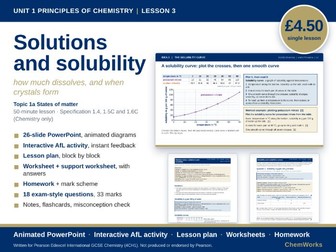
Edexcel IGCSE Chemistry (4CH1) Unit 1 Principles of Chemistry, Lesson 3: Solutions and Solubility. A complete, ready-to-teach lesson: animated PowerPoint, interactive AfL activity, a worksheet and a scaffolded support worksheet (both with answers) and homework. Crystals form when a saturated solution cools because the solubility falls, not because “the water evaporates”. This lesson shows pupils where the crystals come from. The PowerPoint is animated, with moving diagrams drawn for the lesson and worked examples that build a click at a time. Its interactive AfL activity is answered by clicking, and the slide gives instant feedback with the reason, so you see straight away who has got it. Pupils learn solvent, solute, solution and saturated solution, then work out a solubility in g per 100 g of water and scale it when there is not 100 g. The “Saturated or not?” activity tests the idea in six cases. They plot a solubility curve as one smooth curve, read it up and across or across and down, and use it to find the mass of crystals formed on cooling, including with less water. The plenary has them spot three mistakes. No practical is needed. Specification points: 1.4, 1.5C and 1.6C (the C points are Chemistry only). What you get 26-slide animated, editable PowerPoint with an interactive AfL activity and speaker notes giving the answers and timings Two-page lesson plan, block by block Worksheet with full answers (18 marks) Scaffolded support worksheet with full answers: the same questions, with gap-fills and word banks Homework with mark scheme (15 marks, about 15 to 20 minutes): yours to set or not Student notes, flashcards (plus a text file for Quizlet or Anki) and a misconception check with key A one-page Feedback and questions note, to report anything that needs fixing or to ask a question 18 exam-style questions worth 33 marks; 11 resources, every document as PDF and editable Word Save more on ChemWorks: this lesson is also in the Topic 1a States of Matter pack (Lessons 1 to 4, £12) and the complete Unit 1 Principles of Chemistry pack (33 lessons, both unit tests with mark schemes and all the unit documents, £112). Lesson 1 of the unit is free, so you can try before you buy. Written for Pearson Edexcel International GCSE Chemistry (4CH1). Not produced or endorsed by Pearson.
Edexcel IGCSE Chemistry Unit 1 – Principles of Chemistry: Lesson 2, Diffusion and DilutionQuick View
ChemWorks

Edexcel IGCSE Chemistry Unit 1 – Principles of Chemistry: Lesson 2, Diffusion and Dilution

(0)
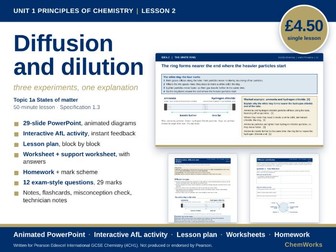
Edexcel IGCSE Chemistry (4CH1) Unit 1 Principles of Chemistry, Lesson 2: Diffusion and Dilution. A complete, ready-to-teach lesson: animated PowerPoint, interactive AfL activity, a worksheet and a scaffolded support worksheet (both with answers) and homework. The white ring forms nearer the heavier gas, not the lighter one, and “move randomly” is a mark on its own. This lesson turns three experiments into one explanation. The PowerPoint is animated, with moving diagrams drawn for the lesson and worked examples that build a click at a time. Its interactive AfL activity is answered by clicking, and the slide gives instant feedback with the reason, so you see straight away who has got it. Pupils explain why bromine spreads through both gas jars and where the white ring forms in the ammonia and hydrogen chloride tube, then in the same tube with hydrogen bromide. A demonstration tests whether potassium manganate(VII) spreads faster in hot water than in cold, and the class sets two crystals in a Petri dish of still water to see what forms between them. The “Picture it” activity works through five cases, and dilution shows a solution getting paler each time but still coloured. Specification point: 1.3. What you get 29-slide animated, editable PowerPoint with an interactive AfL activity and speaker notes giving the answers and timings Two-page lesson plan, block by block Worksheet with full answers (16 marks) Scaffolded support worksheet with full answers: the same questions, with gap-fills and word banks Homework with mark scheme (13 marks, about 15 to 20 minutes): yours to set or not Student notes, flashcards (plus a text file for Quizlet or Anki) and a misconception check with key Technician notes with the kit and hazards A one-page Feedback and questions note, to report anything that needs fixing or to ask a question 12 exam-style questions worth 29 marks; 12 resources, every document as PDF and editable Word Save more on ChemWorks: this lesson is also in the Topic 1a States of Matter pack (Lessons 1 to 4, £12) and the complete Unit 1 Principles of Chemistry pack (33 lessons, both unit tests with mark schemes and all the unit documents, £112). Lesson 1 of the unit is free, so you can try before you buy. Written for Pearson Edexcel International GCSE Chemistry (4CH1). Not produced or endorsed by Pearson.
Edexcel IGCSE Chemistry Unit 1 – Principles of Chemistry: Lesson 13, Configuration and PositionQuick View
ChemWorks

Edexcel IGCSE Chemistry Unit 1 – Principles of Chemistry: Lesson 13, Configuration and Position

(0)
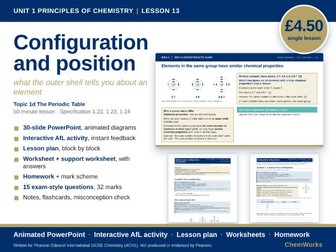
Edexcel IGCSE Chemistry (4CH1) Unit 1 Principles of Chemistry, Lesson 13: Configuration and Position. A complete, ready-to-teach lesson: animated PowerPoint, interactive AfL activity, a worksheet and a scaffolded support worksheet (both with answers) and homework. A full outer shell is Group 0, never “Group 8”, and helium’s full shell holds only 2. This lesson teaches pupils to read a group and a period straight from a configuration. The PowerPoint is animated, with moving diagrams drawn for the lesson and worked examples that build a click at a time. Its interactive AfL activity is answered by clicking, and the slide gives instant feedback with the reason, so you see straight away who has got it. Two worked examples take pupils from a configuration to a position: the shells give the period and the outer electrons give the group, including when the outer shell is full. Pupils then explain why a group reacts alike (the same number of electrons in the outer shell, not just “the same number of electrons”) and why the noble gases do not readily react. The “Same group, same period or neither” activity has them decide for six cases, and the plenary asks pupils to write the question for each answer. No practical is needed. Specification points: 1.22 why elements in the same group have similar chemical properties; 1.23 why the noble gases do not readily react; 1.24 the position of an element from its electronic configuration. What you get 30-slide animated, editable PowerPoint with an interactive AfL activity and speaker notes giving the answers and timings Two-page lesson plan, block by block Worksheet with full answers (20 marks) Scaffolded support worksheet with full answers: the same questions, with gap-fills and word banks Homework with mark scheme (12 marks, about 15 to 20 minutes): yours to set or not Student notes, flashcards (plus a text file for Quizlet or Anki) and a misconception check with key A one-page Feedback and questions note, to report anything that needs fixing or to ask a question 15 exam-style questions worth 32 marks; 11 resources, every document as PDF and editable Word Save more on ChemWorks: this lesson is also in the Topic 1d The Periodic Table pack (3 lessons for £12: £4 a lesson, £1.50 less than buying them singly, with the topic documents), and in the complete Unit 1: all 33 lessons, both unit tests with mark schemes and the unit documents for £112 (£3.50 for each paid lesson, £32 less than buying the lessons singly). Lesson 1 of the unit, States of matter, is free on ChemWorks, so you can try a complete lesson before you buy. Written for Pearson Edexcel International GCSE Chemistry (4CH1). Not produced or endorsed by Pearson.
Edexcel IGCSE Chemistry Unit 1 – Principles of Chemistry: Lesson 14, Metals and Non-metalsQuick View
ChemWorks

Edexcel IGCSE Chemistry Unit 1 – Principles of Chemistry: Lesson 14, Metals and Non-metals

(0)
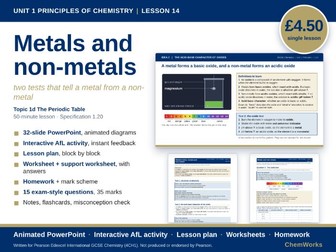
Edexcel IGCSE Chemistry (4CH1) Unit 1 Principles of Chemistry, Lesson 14: Metals and Non-metals. A complete, ready-to-teach lesson: animated PowerPoint, interactive AfL activity, a worksheet and a scaffolded support worksheet (both with answers) and homework. Graphite conducts electricity, and it is not a metal. This lesson teaches pupils to back a conductivity result with the oxide test. The PowerPoint is animated, with moving diagrams drawn for the lesson and worked examples that build a click at a time. Its interactive AfL activity is answered by clicking, and the slide gives instant feedback with the reason, so you see straight away who has got it. Pupils learn that a metal forms a basic oxide and a non-metal an acidic oxide, with magnesium and sulfur as worked examples, and that the oxide is basic while its solution is alkaline. They then use both tests together, because a conductivity result on its own can mislead. In the “Spot the mistake” activity pupils find the error in five cases, and the plenary asks them to fix a chain of reasoning. No practical is needed. Specification points: 1.20 identifying an element as a metal or a non-metal from its position, its electrical conductivity and the acid-base character of its oxide. What you get 32-slide animated, editable PowerPoint with an interactive AfL activity and speaker notes giving the answers and timings Two-page lesson plan, block by block Worksheet with full answers (23 marks) Scaffolded support worksheet with full answers: the same questions, with gap-fills and word banks Homework with mark scheme (12 marks, about 15 to 20 minutes): yours to set or not Student notes, flashcards (plus a text file for Quizlet or Anki) and a misconception check with key A one-page Feedback and questions note, to report anything that needs fixing or to ask a question 15 exam-style questions worth 35 marks; 11 resources, every document as PDF and editable Word Save more on ChemWorks: this lesson is also in the Topic 1d The Periodic Table pack (3 lessons for £12: £4 a lesson, £1.50 less than buying them singly, with the topic documents), and in the complete Unit 1: all 33 lessons, both unit tests with mark schemes and the unit documents for £112 (£3.50 for each paid lesson, £32 less than buying the lessons singly). Lesson 1 of the unit, States of matter, is free on ChemWorks, so you can try a complete lesson before you buy. Written for Pearson Edexcel International GCSE Chemistry (4CH1). Not produced or endorsed by Pearson.
Edexcel IGCSE Chemistry Unit 1 – Principles of Chemistry: Lesson 15, Catch-up and Revision (1a–1d)Quick View
ChemWorks

Edexcel IGCSE Chemistry Unit 1 – Principles of Chemistry: Lesson 15, Catch-up and Revision (1a–1d)

(0)
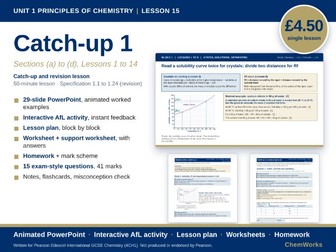
Edexcel IGCSE Chemistry (4CH1) Unit 1 Principles of Chemistry, Lesson 15: Catch-up and Revision 1. A complete, ready-to-teach lesson: animated PowerPoint, interactive AfL activity, a worksheet and a scaffolded support worksheet (both with answers) and homework. The lesson to teach before the mid-unit test: everything from Lessons 1 to 14 that the test asks for, with the commonest slips named as they come up, from an Rf value worked upside down to a group read from the wrong end of a configuration. The PowerPoint is animated, with worked examples that build a click at a time. Its interactive AfL activity is answered by clicking, and the slide gives instant feedback with the reason, so you see straight away who has got it. Two short blocks re-teach Lessons 1 to 8 (states, solutions and separating, with a solubility curve read twice for crystals and an Rf value from two distances) and Lessons 9 to 14 (atoms and the Periodic Table, from an atom’s symbol to its particles, its shells and its place in the table). An “Odd one out” activity of five cases sits between the blocks, and in the plenary pupils rate themselves on each line of a self-assessment check, then answer its question. No practical is needed. The mid-unit test itself isn’t in this download: both unit tests and their mark schemes come only with the complete unit. Specification points: 1.1 to 1.24 revised (1.5C, 1.6C and 1.7C are Chemistry only). What you get 29-slide animated, editable PowerPoint with an interactive AfL activity and speaker notes giving the answers and timings Two-page lesson plan, block by block Worksheet with full answers (24 marks) Scaffolded support worksheet with full answers: the same questions, with gap-fills and word banks Homework with mark scheme (17 marks, about 15 to 20 minutes): yours to set or not Student notes, flashcards (plus a text file for Quizlet or Anki) and a misconception check with key A one-page Feedback and questions note, to report anything that needs fixing or to ask a question 15 exam-style questions worth 41 marks; 11 resources, every document as PDF and editable Word Save more on ChemWorks: this lesson is not in a topic pack, because it revises several topics, but it comes in the complete Unit 1: all 33 lessons, both unit tests with mark schemes and the unit documents for £112 (£3.50 for each paid lesson, £32 less than buying the lessons singly). The topic packs of teaching lessons are £4 a paid lesson. Lesson 1 of the unit, States of matter, is free on ChemWorks, so you can try a complete lesson before you buy. Written for Pearson Edexcel International GCSE Chemistry (4CH1). Not produced or endorsed by Pearson.
Edexcel IGCSE Chemistry Unit 1 – Principles of Chemistry: Lesson 8, Chromatography and Rf ValuesQuick View
ChemWorks

Edexcel IGCSE Chemistry Unit 1 – Principles of Chemistry: Lesson 8, Chromatography and Rf Values

(0)
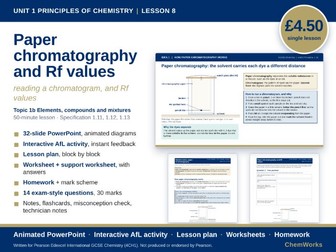
Edexcel IGCSE Chemistry (4CH1) Unit 1 Principles of Chemistry, Lesson 8: Chromatography and Rf Values. A complete, ready-to-teach lesson: animated PowerPoint, interactive AfL activity, a worksheet and a scaffolded support worksheet (both with answers) and homework. A pencil start line, the centre of the spot, and the spot on top: an Rf value above 1 means the division is upside down. The PowerPoint is animated, with moving diagrams drawn for the lesson and worked examples that build a click at a time. Its interactive AfL activity is answered by clicking, and the slide gives instant feedback with the reason, so you see straight away who has got it. The class sets up chromatograms of food colourings A, B and C and a food X early, and leaves them running while pupils learn to read a chromatogram from the height and colour of each spot. They then calculate Rf values, with no units, and identify a spot from a table. In the “Spot the mistake” activity pupils find the error in five cases, and the plenary is a quick-fire ladder. Specification points: 1.11 how chromatography separates substances; 1.12 using chromatograms and Rf values to find what is in a mixture; 1.13 the practical with inks or food colourings. What you get 32-slide animated, editable PowerPoint with an interactive AfL activity and speaker notes giving the answers and timings Two-page lesson plan, block by block Worksheet with full answers (16 marks) Scaffolded support worksheet with full answers: the same questions, with gap-fills and word banks Homework with mark scheme (14 marks, about 15 to 20 minutes): yours to set or not Student notes, flashcards (plus a text file for Quizlet or Anki) and a misconception check with key Technician notes with the kit and hazards A one-page Feedback and questions note, to report anything that needs fixing or to ask a question 14 exam-style questions worth 30 marks; 12 resources, every document as PDF and editable Word Save more on ChemWorks: this lesson is also in the Topic 1b Elements, compounds and mixtures pack (4 lessons for £16: £4 a lesson, £2 less than buying them singly, with the topic documents), and in the complete Unit 1: all 33 lessons, both unit tests with mark schemes and the unit documents for £112 (£3.50 for each paid lesson, £32 less than buying the lessons singly). Lesson 1 of the unit, States of matter, is free on ChemWorks, so you can try a complete lesson before you buy. Written for Pearson Edexcel International GCSE Chemistry (4CH1). Not produced or endorsed by Pearson.
Edexcel IGCSE Chemistry Unit 1 – Principles of Chemistry: Lesson 9, The Structure of the AtomQuick View
ChemWorks

Edexcel IGCSE Chemistry Unit 1 – Principles of Chemistry: Lesson 9, The Structure of the Atom

(0)
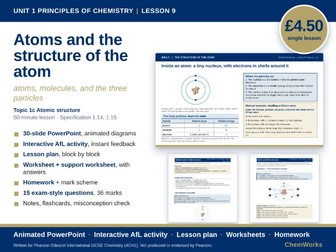
Edexcel IGCSE Chemistry (4CH1) Unit 1 Principles of Chemistry, Lesson 9: The Structure of the Atom. A complete, ready-to-teach lesson: animated PowerPoint, interactive AfL activity, a worksheet and a scaffolded support worksheet (both with answers) and homework. Neutrons do not cancel the electrons’ charge: the protons do. And two atoms side by side are not a molecule unless they are chemically bonded. The PowerPoint is animated, with moving diagrams drawn for the lesson and worked examples that build a click at a time. Its interactive AfL activity is answered by clicking, and the slide gives instant feedback with the reason, so you see straight away who has got it. Pupils learn what an atom and a molecule are, then where the protons, neutrons and electrons sit: a tiny nucleus, with electrons in shells around it. They use the relative masses and charges to explain why an atom has no overall charge and why almost all of its mass is in the nucleus. The “Which particle?” activity works through six cases, and the plenary is an odd-one-out with a reason. No practical is needed. Specification points: 1.14 atom and molecule; 1.15 the positions, relative masses and relative charges of protons, neutrons and electrons. What you get 30-slide animated, editable PowerPoint with an interactive AfL activity and speaker notes giving the answers and timings Two-page lesson plan, block by block Worksheet with full answers (21 marks) Scaffolded support worksheet with full answers: the same questions, with gap-fills and word banks Homework with mark scheme (15 marks, about 15 to 20 minutes): yours to set or not Student notes, flashcards (plus a text file for Quizlet or Anki) and a misconception check with key A one-page Feedback and questions note, to report anything that needs fixing or to ask a question 15 exam-style questions worth 36 marks; 11 resources, every document as PDF and editable Word Save more on ChemWorks: this lesson is also in the Topic 1c Atomic structure pack (3 lessons for £12: £4 a lesson, £1.50 less than buying them singly, with the topic documents), and in the complete Unit 1: all 33 lessons, both unit tests with mark schemes and the unit documents for £112 (£3.50 for each paid lesson, £32 less than buying the lessons singly). Lesson 1 of the unit, States of matter, is free on ChemWorks, so you can try a complete lesson before you buy. Written for Pearson Edexcel International GCSE Chemistry (4CH1). Not produced or endorsed by Pearson.
Edexcel IGCSE Chemistry Unit 1 – Principles of Chemistry: Lesson 10, Atomic & Mass Numbers, ShellsQuick View
ChemWorks

Edexcel IGCSE Chemistry Unit 1 – Principles of Chemistry: Lesson 10, Atomic & Mass Numbers, Shells

(0)
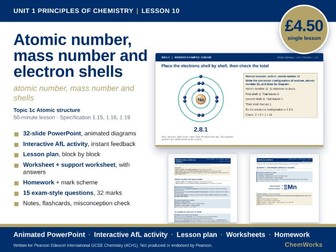
Edexcel IGCSE Chemistry (4CH1) Unit 1 Principles of Chemistry, Lesson 10: Atomic & Mass Numbers, Shells. A complete, ready-to-teach lesson: animated PowerPoint, interactive AfL activity, a worksheet and a scaffolded support worksheet (both with answers) and homework. The mass number is not the number of neutrons: take away the atomic number first. And 2.8.9 is never right. The PowerPoint is animated, with moving diagrams drawn for the lesson and worked examples that build a click at a time. Its interactive AfL activity is answered by clicking, and the slide gives instant feedback with the reason, so you see straight away who has got it. Pupils learn what the atomic number and the mass number count, then use the two numbers to find the protons, electrons and neutrons in an atom. Electrons fill the shells from the inside out, 2, then 8, then 8, shown in worked examples on sodium and potassium, with a check that the total matches the atomic number. In the “Find the atom” activity pupils work through five cases, and the plenary has them spot the two mistakes. No practical is needed. Specification points: 1.15 the structure of the atom, used to count its particles; 1.16 atomic number and mass number; 1.19 the electronic configurations of the first 20 elements. What you get 32-slide animated, editable PowerPoint with an interactive AfL activity and speaker notes giving the answers and timings Two-page lesson plan, block by block Worksheet with full answers (16 marks) Scaffolded support worksheet with full answers: the same questions, with gap-fills and word banks Homework with mark scheme (16 marks, about 15 to 20 minutes): yours to set or not Student notes, flashcards (plus a text file for Quizlet or Anki) and a misconception check with key A one-page Feedback and questions note, to report anything that needs fixing or to ask a question 15 exam-style questions worth 32 marks; 11 resources, every document as PDF and editable Word Save more on ChemWorks: this lesson is also in the Topic 1c Atomic structure pack (3 lessons for £12: £4 a lesson, £1.50 less than buying them singly, with the topic documents), and in the complete Unit 1: all 33 lessons, both unit tests with mark schemes and the unit documents for £112 (£3.50 for each paid lesson, £32 less than buying the lessons singly). Lesson 1 of the unit, States of matter, is free on ChemWorks, so you can try a complete lesson before you buy. Written for Pearson Edexcel International GCSE Chemistry (4CH1). Not produced or endorsed by Pearson.
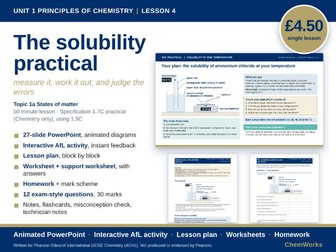
Edexcel IGCSE Chemistry Unit 1 – Principles of Chemistry: Lesson 4, Solubility Practical (1.7C)Quick View
ChemWorks

Edexcel IGCSE Chemistry Unit 1 – Principles of Chemistry: Lesson 4, Solubility Practical (1.7C)

(0)
Edexcel IGCSE Chemistry (4CH1) Unit 1 Principles of Chemistry, Lesson 4: The Solubility Practical (1.7C). A complete, ready-to-teach lesson: animated PowerPoint, interactive AfL activity, a worksheet and a scaffolded support worksheet (both with answers) and homework. “It made the result inaccurate” earns nothing. Every error pushes a solubility one way, too high or too low, and this lesson teaches pupils to say which and how to fix it. The PowerPoint is animated, with moving diagrams drawn for the lesson and worked examples that build a click at a time. Its interactive AfL activity is answered by clicking, and the slide gives instant feedback with the reason, so you see straight away who has got it. Each group measures the solubility of ammonium chloride at its own temperature, from 20 to 60 °C, weighing the water into the tube and adding solid until a few grains will not dissolve. Pupils turn the balance readings into g per 100 g of water, then meet a second method with an evaporating basin. In the “Find the fault” activity they find the error in five cases, and an anomalous result shows a solution that was never saturated. Specification points: 1.7C (the practical) and 1.5C (both Chemistry only). What you get 27-slide animated, editable PowerPoint with an interactive AfL activity and speaker notes giving the answers and timings Two-page lesson plan, block by block Worksheet with full answers (16 marks) Scaffolded support worksheet with full answers: the same questions, with gap-fills and word banks Homework with mark scheme (14 marks, about 15 to 20 minutes): yours to set or not Student notes, flashcards (plus a text file for Quizlet or Anki) and a misconception check with key Technician notes with the kit and hazards A one-page Feedback and questions note, to report anything that needs fixing or to ask a question 12 exam-style questions worth 30 marks; 12 resources, every document as PDF and editable Word Save more on ChemWorks: this lesson is also in the Topic 1a States of Matter pack (Lessons 1 to 4, £12) and the complete Unit 1 Principles of Chemistry pack (33 lessons, both unit tests with mark schemes and all the unit documents, £112). Lesson 1 of the unit is free, so you can try before you buy. Written for Pearson Edexcel International GCSE Chemistry (4CH1). Not produced or endorsed by Pearson.
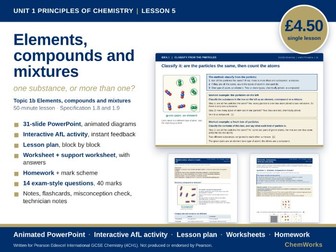
Edexcel IGCSE Chemistry Unit 1 – Principles of Chemistry: Lesson 5, Elements, Compounds and MixturesQuick View
ChemWorks

Edexcel IGCSE Chemistry Unit 1 – Principles of Chemistry: Lesson 5, Elements, Compounds and Mixtures

(0)
Edexcel IGCSE Chemistry (4CH1) Unit 1 Principles of Chemistry, Lesson 5: Elements, Compounds and Mixtures. A complete, ready-to-teach lesson: animated PowerPoint, interactive AfL activity, a worksheet and a scaffolded support worksheet (both with answers) and homework. Joined atoms do not make a compound. Pupils learn to count the types of atom: one type is an element, joined or not. The PowerPoint is animated, with moving diagrams drawn for the lesson and worked examples that build a click at a time. Its interactive AfL activity is answered by clicking, and the slide gives instant feedback with the reason, so you see straight away who has got it. Pupils classify substances from their particles, then sort six cases in the “Element, compound or mixture?” activity. A teacher demonstration heats iron and sulfur in a tube and tests with a magnet before and after, to show that a compound is a new substance and not a mixture of its elements. They then use melting and boiling points to tell a pure substance from a mixture, one fixed temperature or a range, and the plenary has them mark an answer. Specification points: 1.8 element, compound, mixture and pure substance, and how a mixture differs from a compound; 1.9 using melting and boiling points to tell a pure substance from a mixture. What you get 31-slide animated, editable PowerPoint with an interactive AfL activity and speaker notes giving the answers and timings Two-page lesson plan, block by block Worksheet with full answers (25 marks) Scaffolded support worksheet with full answers: the same questions, with gap-fills and word banks Homework with mark scheme (15 marks, about 15 to 20 minutes): yours to set or not Student notes, flashcards (plus a text file for Quizlet or Anki) and a misconception check with key Technician notes with the kit and hazards A one-page Feedback and questions note, to report anything that needs fixing or to ask a question 14 exam-style questions worth 40 marks; 12 resources, every document as PDF and editable Word Save more on ChemWorks: this lesson is also in the Topic 1b Elements, compounds and mixtures pack (4 lessons for £16: £4 a lesson, £2 less than buying them singly, with the topic documents), and in the complete Unit 1: all 33 lessons, both unit tests with mark schemes and the unit documents for £112 (£3.50 for each paid lesson, £32 less than buying the lessons singly). Lesson 1 of the unit, States of matter, is free on ChemWorks, so you can try a complete lesson before you buy. Written for Pearson Edexcel International GCSE Chemistry (4CH1). Not produced or endorsed by Pearson.
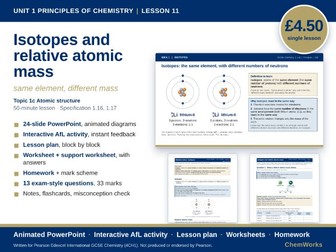
Edexcel IGCSE Chemistry Unit 1 – Principles of Chemistry: Lesson 11, Isotopes, Relative Atomic MassQuick View
ChemWorks

Edexcel IGCSE Chemistry Unit 1 – Principles of Chemistry: Lesson 11, Isotopes, Relative Atomic Mass

(0)
Edexcel IGCSE Chemistry (4CH1) Unit 1 Principles of Chemistry, Lesson 11: Isotopes, Relative Atomic Mass. A complete, ready-to-teach lesson: animated PowerPoint, interactive AfL activity, a worksheet and a scaffolded support worksheet (both with answers) and homework. Isotopes react the same way because of their electrons, not their protons: the same number, in the same arrangement. The PowerPoint is animated, with moving diagrams drawn for the lesson and worked examples that build a click at a time. Its interactive AfL activity is answered by clicking, and the slide gives instant feedback with the reason, so you see straight away who has got it. Pupils learn that isotopes have the same number of protons and different numbers of neutrons, and that relative atomic mass is an average no single atom need have. They calculate it as the total mass of 100 atoms divided by 100, one bracket for each isotope, then extend the method to more than two isotopes and check that the answer lies between the lightest and the heaviest. The “Isotopes or not?” activity tests six cases, and in the plenary pupils decide how many of 5 marks an answer earns. No practical is needed. Specification points: 1.16 atomic number, mass number, isotopes and relative atomic mass; 1.17 calculating relative atomic mass from the abundances of isotopes. What you get 24-slide animated, editable PowerPoint with an interactive AfL activity and speaker notes giving the answers and timings Two-page lesson plan, block by block Worksheet with full answers (19 marks) Scaffolded support worksheet with full answers: the same questions, with gap-fills and word banks Homework with mark scheme (14 marks, about 15 to 20 minutes): yours to set or not Student notes, flashcards (plus a text file for Quizlet or Anki) and a misconception check with key A one-page Feedback and questions note, to report anything that needs fixing or to ask a question 13 exam-style questions worth 33 marks; 11 resources, every document as PDF and editable Word Save more on ChemWorks: this lesson is also in the Topic 1c Atomic structure pack (3 lessons for £12: £4 a lesson, £1.50 less than buying them singly, with the topic documents), and in the complete Unit 1: all 33 lessons, both unit tests with mark schemes and the unit documents for £112 (£3.50 for each paid lesson, £32 less than buying the lessons singly). Lesson 1 of the unit, States of matter, is free on ChemWorks, so you can try a complete lesson before you buy. Written for Pearson Edexcel International GCSE Chemistry (4CH1). Not produced or endorsed by Pearson.
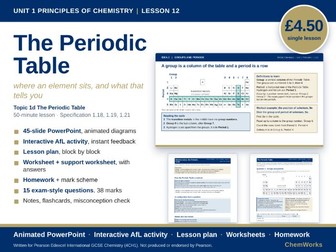
Edexcel IGCSE Chemistry Unit 1 – Principles of Chemistry: Lesson 12, The Periodic TableQuick View
ChemWorks

Edexcel IGCSE Chemistry Unit 1 – Principles of Chemistry: Lesson 12, The Periodic Table

(0)
Edexcel IGCSE Chemistry (4CH1) Unit 1 Principles of Chemistry, Lesson 12: The Periodic Table. A complete, ready-to-teach lesson: animated PowerPoint, interactive AfL activity, a worksheet and a scaffolded support worksheet (both with answers) and homework. The Periodic Table is in order of atomic number, not mass, and a group is a column, not a row. This lesson fixes both, then reads an atom’s electrons from its box. The PowerPoint is animated, with moving diagrams drawn for the lesson and worked examples that build a click at a time. Its interactive AfL activity is answered by clicking, and the slide gives instant feedback with the reason, so you see straight away who has got it. Pupils learn how the table is ordered and how to give any element its group and period, then work out an electronic configuration from a position in steps, including an element in Group 0, where the outer shell is full. The dividing line between metals and non-metals is checked element by element, never a whole group at once. In the “Find the box” activity pupils find the right box on the table, five cases over, and the lesson ends on an exam question. No practical is needed. Specification points: 1.18 how the Periodic Table is arranged: in order of atomic number, in groups and periods; 1.19 the electronic configurations of the first 20 elements from their positions; 1.21 metal or non-metal from position. What you get 45-slide animated, editable PowerPoint with an interactive AfL activity and speaker notes giving the answers and timings Two-page lesson plan, block by block Worksheet with full answers (25 marks) Scaffolded support worksheet with full answers: the same questions, with gap-fills and word banks Homework with mark scheme (13 marks, about 15 to 20 minutes): yours to set or not Student notes, flashcards (plus a text file for Quizlet or Anki) and a misconception check with key A one-page Feedback and questions note, to report anything that needs fixing or to ask a question 15 exam-style questions worth 38 marks; 11 resources, every document as PDF and editable Word Save more on ChemWorks: this lesson is also in the Topic 1d The Periodic Table pack (3 lessons for £12: £4 a lesson, £1.50 less than buying them singly, with the topic documents), and in the complete Unit 1: all 33 lessons, both unit tests with mark schemes and the unit documents for £112 (£3.50 for each paid lesson, £32 less than buying the lessons singly). Lesson 1 of the unit, States of matter, is free on ChemWorks, so you can try a complete lesson before you buy. Written for Pearson Edexcel International GCSE Chemistry (4CH1). Not produced or endorsed by Pearson.
Edexcel IGCSE Chemistry Unit 1 – Principles of Chemistry: Lesson 18, The MoleQuick View
ChemWorks

Edexcel IGCSE Chemistry Unit 1 – Principles of Chemistry: Lesson 18, The Mole

(0)
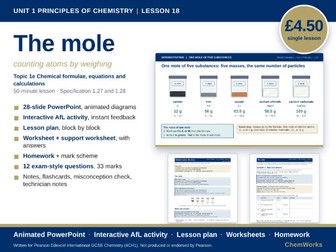
Edexcel IGCSE Chemistry (4CH1) Unit 1 Principles of Chemistry, Lesson 18: The Mole. A complete, ready-to-teach lesson: animated PowerPoint, interactive AfL activity, a worksheet and a scaffolded support worksheet (both with answers) and homework. One mole of Cl2 is 71 g. Pupils learn to go by the formula, not by one atom, and to divide or multiply the right way round. The PowerPoint is animated, with moving diagrams drawn for the lesson and worked examples that build a click at a time. Its interactive AfL activity is answered by clicking, and the slide gives instant feedback with the reason, so you see straight away who has got it. A demonstration puts out one mole of each of five substances to look at and lift: five masses, the same number of particles. Pupils then convert mass to amount and amount to mass with the relative formula mass, and the “Which is bigger?” activity compares two quantities in five cases. A worked example uses a mass and an amount to identify an unknown element, changing the mass into grams first, and the plenary is a quick-fire ladder of five questions, each harder than the last. Specification points: 1.27 the mole (mol) as the unit for the amount of a substance; 1.28 calculations with amount of substance, relative atomic mass and relative formula mass. What you get 28-slide animated, editable PowerPoint with an interactive AfL activity and speaker notes giving the answers and timings Two-page lesson plan, block by block Worksheet with full answers (18 marks) Scaffolded support worksheet with full answers: the same questions, with gap-fills and word banks Homework with mark scheme (15 marks, about 15 to 20 minutes): yours to set or not Student notes, flashcards (plus a text file for Quizlet or Anki) and a misconception check with key Technician notes with the kit and hazards A one-page Feedback and questions note, to report anything that needs fixing or to ask a question 12 exam-style questions worth 33 marks; 12 resources, every document as PDF and editable Word Save more on ChemWorks: this lesson is also in the Topic 1e Chemical formulae, equations and calculations pack (7 lessons for £28: £4 a lesson, £3.50 less than buying them singly, with the topic documents), and in the complete Unit 1: all 33 lessons, both unit tests with mark schemes and the unit documents for £112 (£3.50 for each paid lesson, £32 less than buying the lessons singly). Lesson 1 of the unit, States of matter, is free on ChemWorks, so you can try a complete lesson before you buy. Written for Pearson Edexcel International GCSE Chemistry (4CH1). Not produced or endorsed by Pearson.
Edexcel IGCSE Chemistry Unit 1 – Principles of Chemistry: Lesson 19, Reacting MassesQuick View
ChemWorks

Edexcel IGCSE Chemistry Unit 1 – Principles of Chemistry: Lesson 19, Reacting Masses

(0)
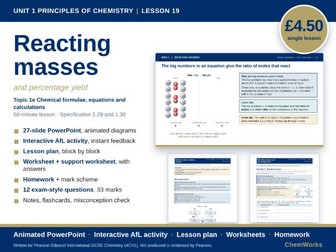
Edexcel IGCSE Chemistry (4CH1) Unit 1 Principles of Chemistry, Lesson 19: Reacting Masses. A complete, ready-to-teach lesson: animated PowerPoint, interactive AfL activity, a worksheet and a scaffolded support worksheet (both with answers) and homework. The big numbers in an equation count moles, not grams. Pupils learn to use the ratio once, the right way up, in the middle of three steps. The PowerPoint is animated, with moving diagrams drawn for the lesson and worked examples that build a click at a time. Its interactive AfL activity is answered by clicking, and the slide gives instant feedback with the reason, so you see straight away who has got it. A reacting mass is worked in three steps, mass to moles, ratio, moles to mass, then the same steps are run backwards from a product to a reactant. In the “Spot the mistake” activity pupils hunt for the error in five cases. Percentage yield follows, actual divided by theoretical, with why some product is always lost, and the lesson ends on an exam question on a reacting mass and its yield. No practical is needed. Specification points: 1.29 reacting masses from experimental data and chemical equations; 1.30 percentage yield. What you get 27-slide animated, editable PowerPoint with an interactive AfL activity and speaker notes giving the answers and timings Two-page lesson plan, block by block Worksheet with full answers (18 marks) Scaffolded support worksheet with full answers: the same questions, with gap-fills and word banks Homework with mark scheme (15 marks, about 15 to 20 minutes): yours to set or not Student notes, flashcards (plus a text file for Quizlet or Anki) and a misconception check with key A one-page Feedback and questions note, to report anything that needs fixing or to ask a question 12 exam-style questions worth 33 marks; 11 resources, every document as PDF and editable Word Save more on ChemWorks: this lesson is also in the Topic 1e Chemical formulae, equations and calculations pack (7 lessons for £28: £4 a lesson, £3.50 less than buying them singly, with the topic documents), and in the complete Unit 1: all 33 lessons, both unit tests with mark schemes and the unit documents for £112 (£3.50 for each paid lesson, £32 less than buying the lessons singly). Lesson 1 of the unit, States of matter, is free on ChemWorks, so you can try a complete lesson before you buy. Written for Pearson Edexcel International GCSE Chemistry (4CH1). Not produced or endorsed by Pearson.
Edexcel IGCSE Chemistry Unit 1 – Principles of Chemistry: Lesson 7, Simple & Fractional DistillationQuick View
ChemWorks

Edexcel IGCSE Chemistry Unit 1 – Principles of Chemistry: Lesson 7, Simple & Fractional Distillation

(0)
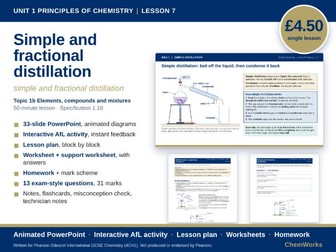
Edexcel IGCSE Chemistry (4CH1) Unit 1 Principles of Chemistry, Lesson 7: Simple & Fractional Distillation. A complete, ready-to-teach lesson: animated PowerPoint, interactive AfL activity, a worksheet and a scaffolded support worksheet (both with answers) and homework. The vapour condenses in the condenser, it does not “melt”, and the cold water goes in at the bottom. Small words, real marks. The PowerPoint is animated, with moving diagrams drawn for the lesson and worked examples that build a click at a time. Its interactive AfL activity is answered by clicking, and the slide gives instant feedback with the reason, so you see straight away who has got it. A demonstration distils ink from the start of the lesson, while pupils learn simple distillation and where the dissolved solid ends up. The class distils pure water from salt water in a boiling tube, with a cold test tube in ice and water as the condenser. Fractional distillation follows: why the liquid with the lowest boiling point comes off first, and how the thermometer shows which liquid is coming off. In the “Which technique?” activity pupils choose filtration, crystallisation, simple or fractional distillation for five mixtures, and the plenary has them mark an answer. Specification points: 1.10 separating mixtures by simple distillation and fractional distillation. What you get 33-slide animated, editable PowerPoint with an interactive AfL activity and speaker notes giving the answers and timings Two-page lesson plan, block by block Worksheet with full answers (17 marks) Scaffolded support worksheet with full answers: the same questions, with gap-fills and word banks Homework with mark scheme (14 marks, about 15 to 20 minutes): yours to set or not Student notes, flashcards (plus a text file for Quizlet or Anki) and a misconception check with key Technician notes with the kit and hazards A one-page Feedback and questions note, to report anything that needs fixing or to ask a question 13 exam-style questions worth 31 marks; 12 resources, every document as PDF and editable Word Save more on ChemWorks: this lesson is also in the Topic 1b Elements, compounds and mixtures pack (4 lessons for £16: £4 a lesson, £2 less than buying them singly, with the topic documents), and in the complete Unit 1: all 33 lessons, both unit tests with mark schemes and the unit documents for £112 (£3.50 for each paid lesson, £32 less than buying the lessons singly). Lesson 1 of the unit, States of matter, is free on ChemWorks, so you can try a complete lesson before you buy. Written for Pearson Edexcel International GCSE Chemistry (4CH1). Not produced or endorsed by Pearson.
Edexcel IGCSE Chemistry Unit 1 – Principles of Chemistry: Lesson 6, Filtration and CrystallisationQuick View
ChemWorks

Edexcel IGCSE Chemistry Unit 1 – Principles of Chemistry: Lesson 6, Filtration and Crystallisation

(0)
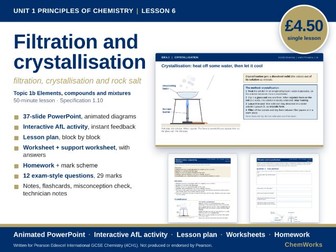
Edexcel IGCSE Chemistry (4CH1) Unit 1 Principles of Chemistry, Lesson 6: Filtration and Crystallisation. A complete, ready-to-teach lesson: animated PowerPoint, interactive AfL activity, a worksheet and a scaffolded support worksheet (both with answers) and homework. The dissolved salt does not stay in the filter paper, and the basin is not heated until it is dry. Each step of the method has a reason, and each reason is a mark. The PowerPoint is animated, with moving diagrams drawn for the lesson and worked examples that build a click at a time. Its interactive AfL activity is answered by clicking, and the slide gives instant feedback with the reason, so you see straight away who has got it. Pupils learn filtration, naming the residue and the filtrate, and crystallisation, stopping the heating when crystals form on the glass rod. The “Where does it end up?” activity follows the substances through six cases. They then separate a soluble solid from an insoluble one, and the class makes pure salt from rock salt: dissolve, filter, heat the filtrate until crystals form on the rod, and leave it to cool. The plenary has them spot the mistakes. Specification points: 1.10 separating mixtures by filtration and crystallisation. What you get 37-slide animated, editable PowerPoint with an interactive AfL activity and speaker notes giving the answers and timings Two-page lesson plan, block by block Worksheet with full answers (16 marks) Scaffolded support worksheet with full answers: the same questions, with gap-fills and word banks Homework with mark scheme (13 marks, about 15 to 20 minutes): yours to set or not Student notes, flashcards (plus a text file for Quizlet or Anki) and a misconception check with key Technician notes with the kit and hazards A one-page Feedback and questions note, to report anything that needs fixing or to ask a question 12 exam-style questions worth 29 marks; 12 resources, every document as PDF and editable Word Save more on ChemWorks: this lesson is also in the Topic 1b Elements, compounds and mixtures pack (4 lessons for £16: £4 a lesson, £2 less than buying them singly, with the topic documents), and in the complete Unit 1: all 33 lessons, both unit tests with mark schemes and the unit documents for £112 (£3.50 for each paid lesson, £32 less than buying the lessons singly). Lesson 1 of the unit, States of matter, is free on ChemWorks, so you can try a complete lesson before you buy. Written for Pearson Edexcel International GCSE Chemistry (4CH1). Not produced or endorsed by Pearson.
Edexcel IGCSE Chemistry Unit 1 – Principles of Chemistry: Lesson 17, Relative Formula MassQuick View
ChemWorks

Edexcel IGCSE Chemistry Unit 1 – Principles of Chemistry: Lesson 17, Relative Formula Mass

(0)
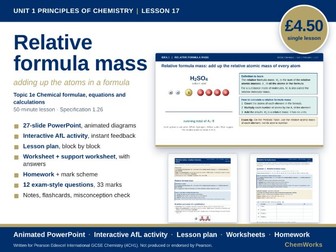
Edexcel IGCSE Chemistry (4CH1) Unit 1 Principles of Chemistry, Lesson 17: Relative Formula Mass. A complete, ready-to-teach lesson: animated PowerPoint, interactive AfL activity, a worksheet and a scaffolded support worksheet (both with answers) and homework. 7H2O is 7 × 18, not 14 hydrogens and one oxygen, and Mr has no units. Small slips like these cost the marks on a formula mass. The PowerPoint is animated, with moving diagrams drawn for the lesson and worked examples that build a click at a time. Its interactive AfL activity is answered by clicking, and the slide gives instant feedback with the reason, so you see straight away who has got it. Pupils add up the relative atomic mass of every atom in a formula, then deal with a number after a bracket and the water in a hydrated compound. The “Odd one out” activity follows, five cases. They then work out the percentage by mass of an element, counting its atoms before dividing by the formula mass, and the plenary has them mark a student’s answer. No practical is needed. Specification points: 1.26 calculating relative formula masses (including relative molecular masses), Mr, from relative atomic masses, Ar. What you get 27-slide animated, editable PowerPoint with an interactive AfL activity and speaker notes giving the answers and timings Two-page lesson plan, block by block Worksheet with full answers (20 marks) Scaffolded support worksheet with full answers: the same questions, with gap-fills and word banks Homework with mark scheme (13 marks, about 15 to 20 minutes): yours to set or not Student notes, flashcards (plus a text file for Quizlet or Anki) and a misconception check with key A one-page Feedback and questions note, to report anything that needs fixing or to ask a question 12 exam-style questions worth 33 marks; 11 resources, every document as PDF and editable Word Save more on ChemWorks: this lesson is also in the Topic 1e Chemical formulae, equations and calculations pack (7 lessons for £28: £4 a lesson, £3.50 less than buying them singly, with the topic documents), and in the complete Unit 1: all 33 lessons, both unit tests with mark schemes and the unit documents for £112 (£3.50 for each paid lesson, £32 less than buying the lessons singly). Lesson 1 of the unit, States of matter, is free on ChemWorks, so you can try a complete lesson before you buy. Written for Pearson Edexcel International GCSE Chemistry (4CH1). Not produced or endorsed by Pearson.
Edexcel IGCSE Chemistry Unit 1 – Principles of Chemistry: Lesson 16, Balancing EquationsQuick View
ChemWorks

Edexcel IGCSE Chemistry Unit 1 – Principles of Chemistry: Lesson 16, Balancing Equations

(0)
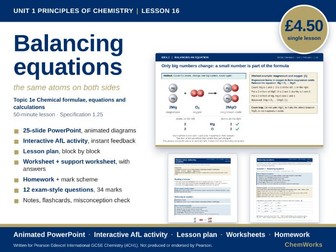
Edexcel IGCSE Chemistry (4CH1) Unit 1 Principles of Chemistry, Lesson 16: Balancing Equations. A complete, ready-to-teach lesson: animated PowerPoint, interactive AfL activity, a worksheet and a scaffolded support worksheet (both with answers) and homework. Change a small number and you have made a different substance. Pupils learn to balance with the big numbers only, and to count every element again after every change. The PowerPoint is animated, with moving diagrams drawn for the lesson and worked examples that build a click at a time. Its interactive AfL activity is answered by clicking, and the slide gives instant feedback with the reason, so you see straight away who has got it. It starts with what a formula shows, brackets included, then balances equations one element at a time. In the “Correct or not?” activity pupils judge the balancing, case by case, five times over. They then go from a description to an equation in three steps: formulae first, then balance, then the state symbols, with water as (l), not (aq). The plenary is three whiteboard questions. No practical is needed. Specification points: 1.25 word equations and balanced chemical equations with state symbols, including for unfamiliar reactions. What you get 25-slide animated, editable PowerPoint with an interactive AfL activity and speaker notes giving the answers and timings Two-page lesson plan, block by block Worksheet with full answers (22 marks) Scaffolded support worksheet with full answers: the same questions, with gap-fills and word banks Homework with mark scheme (12 marks, about 15 to 20 minutes): yours to set or not Student notes, flashcards (plus a text file for Quizlet or Anki) and a misconception check with key A one-page Feedback and questions note, to report anything that needs fixing or to ask a question 12 exam-style questions worth 34 marks; 11 resources, every document as PDF and editable Word Save more on ChemWorks: this lesson is also in the Topic 1e Chemical formulae, equations and calculations pack (7 lessons for £28: £4 a lesson, £3.50 less than buying them singly, with the topic documents), and in the complete Unit 1: all 33 lessons, both unit tests with mark schemes and the unit documents for £112 (£3.50 for each paid lesson, £32 less than buying the lessons singly). Lesson 1 of the unit, States of matter, is free on ChemWorks, so you can try a complete lesson before you buy. Written for Pearson Edexcel International GCSE Chemistry (4CH1). Not produced or endorsed by Pearson.
Edexcel IGCSE Chemistry Unit 1 – Principles of Chemistry: Lesson 22, Concentration and Gas VolumesQuick View
ChemWorks

Edexcel IGCSE Chemistry Unit 1 – Principles of Chemistry: Lesson 22, Concentration and Gas Volumes

(0)
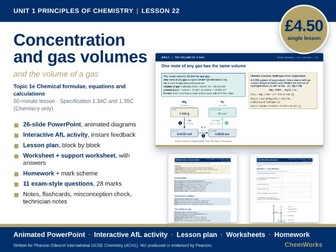
Edexcel IGCSE Chemistry (4CH1) Unit 1 Principles of Chemistry, Lesson 22: Concentration and Gas Volumes. A complete, ready-to-teach lesson: animated PowerPoint, interactive AfL activity, a worksheet and a scaffolded support worksheet (both with answers) and homework. More solute does not mean more concentrated. Pupils learn to compare amount divided by volume, with the volume in dm³, not cm³. The PowerPoint is animated, with moving diagrams drawn for the lesson and worked examples that build a click at a time. Its interactive AfL activity is answered by clicking, and the slide gives instant feedback with the reason, so you see straight away who has got it. Pupils work out concentrations in mol/dm³ and g/dm³, and the “Which is more concentrated?” activity asks them to choose A, B or “the same”. A solution then becomes a new way into the three steps from a balanced equation, and one mole of any gas has the same volume, 24 dm³ at room temperature and pressure. In the practical pupils predict the volume of hydrogen that magnesium will give, then collect it in an upside-down burette to check. The plenary has them mark a student’s answer. Specification points: 1.34C mole calculations with volumes and concentrations in mol/dm³; 1.35C gas volumes from the molar volume, 24 dm³ at rtp (both Chemistry only). What you get 26-slide animated, editable PowerPoint with an interactive AfL activity and speaker notes giving the answers and timings Two-page lesson plan, block by block Worksheet with full answers (15 marks) Scaffolded support worksheet with full answers: the same questions, with gap-fills and word banks Homework with mark scheme (13 marks, about 15 to 20 minutes): yours to set or not Student notes, flashcards (plus a text file for Quizlet or Anki) and a misconception check with key Technician notes with the kit and hazards A one-page Feedback and questions note, to report anything that needs fixing or to ask a question 11 exam-style questions worth 28 marks; 12 resources, every document as PDF and editable Word Save more on ChemWorks: this lesson is also in the Topic 1e Chemical formulae, equations and calculations pack (7 lessons for £28: £4 a lesson, £3.50 less than buying them singly, with the topic documents), and in the complete Unit 1: all 33 lessons, both unit tests with mark schemes and the unit documents for £112 (£3.50 for each paid lesson, £32 less than buying the lessons singly). Lesson 1 of the unit, States of matter, is free on ChemWorks, so you can try a complete lesson before you buy. Written for Pearson Edexcel International GCSE Chemistry (4CH1). Not produced or endorsed by Pearson.
Edexcel IGCSE Chemistry Unit 1 – Principles of Chemistry: Lesson 23, Ions and Ionic BondingQuick View
ChemWorks

Edexcel IGCSE Chemistry Unit 1 – Principles of Chemistry: Lesson 23, Ions and Ionic Bonding

(0)
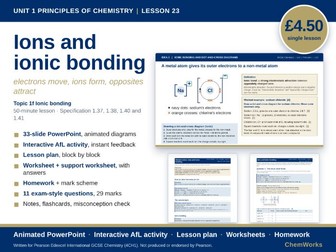
Edexcel IGCSE Chemistry (4CH1) Unit 1 Principles of Chemistry, Lesson 23: Ions and Ionic Bonding. A complete, ready-to-teach lesson: animated PowerPoint, interactive AfL activity, a worksheet and a scaffolded support worksheet (both with answers) and homework. Only electrons move, and the ionic bond is the attraction between the ions, not the electron transfer. This lesson gets both right from the first diagram. The PowerPoint is animated, with moving diagrams drawn for the lesson and worked examples that build a click at a time. Its interactive AfL activity is answered by clicking, and the slide gives instant feedback with the reason, so you see straight away who has got it. Pupils work out how an atom becomes an ion and the charge it carries, for a metal and then for oxygen, then learn the twelve ions whose charges cannot come from the group. Dot-and-cross diagrams follow as worked examples: magnesium oxide, magnesium chloride, then lithium oxide with the ratio the other way. The “Spot the mistake” activity finds the error in five cases, and the lesson ends on an exam question. No practical is needed. Specification points: 1.37 how ions form by losing or gaining electrons; 1.38 the charges of the ions to know; 1.40 dot-and-cross diagrams for ionic compounds; 1.41 ionic bonding as an electrostatic attraction. What you get 33-slide animated, editable PowerPoint with an interactive AfL activity and speaker notes giving the answers and timings Two-page lesson plan, block by block Worksheet with full answers (15 marks) Scaffolded support worksheet with full answers: the same questions, with gap-fills and word banks Homework with mark scheme (14 marks, about 15 to 20 minutes): yours to set or not Student notes, flashcards (plus a text file for Quizlet or Anki) and a misconception check with key A one-page Feedback and questions note, to report anything that needs fixing or to ask a question 11 exam-style questions worth 29 marks; 11 resources, every document as PDF and editable Word Save more on ChemWorks: this lesson is also in the Topic 1f Ionic bonding pack (3 lessons for £12: £4 a lesson, £1.50 less than buying them singly, with the topic documents), and in the complete Unit 1: all 33 lessons, both unit tests with mark schemes and the unit documents for £112 (£3.50 for each paid lesson, £32 less than buying the lessons singly). Lesson 1 of the unit, States of matter, is free on ChemWorks, so you can try a complete lesson before you buy. Written for Pearson Edexcel International GCSE Chemistry (4CH1). Not produced or endorsed by Pearson.
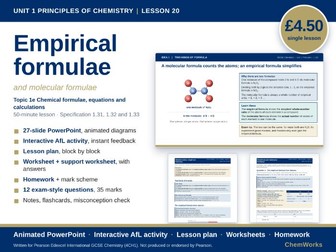
Edexcel IGCSE Chemistry Unit 1 – Principles of Chemistry: Lesson 20, Empirical FormulaeQuick View
ChemWorks

Edexcel IGCSE Chemistry Unit 1 – Principles of Chemistry: Lesson 20, Empirical Formulae

(0)
Edexcel IGCSE Chemistry (4CH1) Unit 1 Principles of Chemistry, Lesson 20: Empirical Formulae. A complete, ready-to-teach lesson: animated PowerPoint, interactive AfL activity, a worksheet and a scaffolded support worksheet (both with answers) and homework. A ratio of 1 : 1.5 is not 1 : 2. Pupils learn to multiply to whole numbers, never round, and to divide oxygen by 16, not 32. The PowerPoint is animated, with moving diagrams drawn for the lesson and worked examples that build a click at a time. Its interactive AfL activity is answered by clicking, and the slide gives instant feedback with the reason, so you see straight away who has got it. Pupils see what a molecular and an empirical formula each show, then turn masses into a ratio of moles and the ratio into a formula, using the same table to find the water molecules in hydrated crystals. The “Which formula?” activity has them choose the formula in five cases. Percentages are then treated as masses in 100 g, and the formula mass turns an empirical formula into a molecular one. The plenary has them award the marks on a student’s answer, then say how to earn the rest. No practical is needed. Specification points: 1.31 to 1.33 calculating empirical and molecular formulae from experimental data. What you get 27-slide animated, editable PowerPoint with an interactive AfL activity and speaker notes giving the answers and timings Two-page lesson plan, block by block Worksheet with full answers (18 marks) Scaffolded support worksheet with full answers: the same questions, with gap-fills and word banks Homework with mark scheme (17 marks, about 15 to 20 minutes): yours to set or not Student notes, flashcards (plus a text file for Quizlet or Anki) and a misconception check with key A one-page Feedback and questions note, to report anything that needs fixing or to ask a question 12 exam-style questions worth 35 marks; 11 resources, every document as PDF and editable Word Save more on ChemWorks: this lesson is also in the Topic 1e Chemical formulae, equations and calculations pack (7 lessons for £28: £4 a lesson, £3.50 less than buying them singly, with the topic documents), and in the complete Unit 1: all 33 lessons, both unit tests with mark schemes and the unit documents for £112 (£3.50 for each paid lesson, £32 less than buying the lessons singly). Lesson 1 of the unit, States of matter, is free on ChemWorks, so you can try a complete lesson before you buy. Written for Pearson Edexcel International GCSE Chemistry (4CH1). Not produced or endorsed by Pearson.