PK-K Science Graphic Organizers | Worksheet PackQuick View
SyzygyScience

PK-K Science Graphic Organizers | Worksheet Pack

(0)
Fifteen science graphic organizers for pre-kindergarten and kindergarten, each one built as a set of three pages. Children answer with their hands: they cut, sort, match, glue, point, and place, and the finished surface is the record the class claim rests on. The first page of each set is the teacher page. At this band the model is a demonstration: the page carries a short script to say aloud while you work the first example in front of the class, a picture of the setup, and a short list of what to watch for. The second page is the activity surface, the mat, strip, or panel the child works on, with labels and icons and print sized for young hands. The third page is the pieces page: the cards and pictures to cut out, sort, match, and place. What is inside: Pages 5 to 6: the standards index covering all eight kindergarten performance expectations, each printed in full with the organizers that carry it Pages 7 to 51: the fifteen organizer sets, three pages per organizer: teacher page, activity surface, pieces page Page 52: More from Syzygy Science, with the free lab sample, the Inquiry Builder, and the elementary organizer line The fifteen organizers: picture hunt card, draw and name page, See Think Wonder frame, circle the change pair, sorting mat, match pairs cards, stage picture chain, same or different panels, tally count strip, picture token graph, predict and reveal flap, icon setup strip, star the drawing, picture web, part card match plate. Pages print clean in black and white. Color codes the work on each page, and every color is backed by a label, an icon, or a pattern, so a grayscale photocopy keeps the code intact. The pack serves all eight kindergarten performance expectations. A standards index on pages 5 to 6 prints every expectation in full, with its clarification statement, and names the organizer that carries it. Pre-kindergarten children work toward these same expectations, and the pack presents them the standard way, with PK as preparation.
Grade 3 Science Graphic Organizers | Models and Guided PagesQuick View
SyzygyScience

Grade 3 Science Graphic Organizers | Models and Guided Pages

(0)
Twelve science graphic organizers for grade 3, each one built as a set of three student pages. Students draw the cycles and processes they study, turn data tables into bar graphs, order evidence, and build claims with reasoning. The first page of each set is a completed model. Students study a worked science example before they use the organizer themselves. The second page is guided. It carries a second science topic with the data or specimens printed on the page, so students complete the thinking with support in front of them. The third page is a blank master of the same organizer, ready for the teacher’s own lesson. What is inside: Pages 5 to 8: the standards index covering all fifteen grade 3 performance expectations, each printed in full with the organizers and pages that carry it Pages 9 to 12: a teacher guide with one condensed entry for each organizer, a small diagram of its shape, and the student pages for that organizer Pages 13 to 48: the twelve student sets, three pages per organizer Pages 49 to 50: teacher notes for the guided pages, with the expected patterns for pages that carry fixed data Page 51: More from Syzygy Science, with the free lab sample, the Inquiry Builder, and the elementary organizer line The twelve organizers: KWL chart, cause and effect chain, cycle diagram, process flowchart, Frayer model, bar graph from a data table, claim evidence reasoning frame, cipher wheel and symbol key, compare matrix, annotated drawing page, evidence ordering strip, layered flap book. Every guided page supplies its own data. Students work from numbers, observations, or specimen notes printed on the page they hold. Pages print clean in black and white. Color codes the work on each page, and every color is backed by a label, a badge, or a pattern, so a grayscale photocopy keeps the code intact. The claim, evidence, and reasoning set uses seedling growth under different light as its model. Its guided page gives students a design problem that a magnet can solve, with paper clip counts as the evidence. The pack covers all fifteen grade 3 Next Generation Science Standards performance expectations. A standards index on pages 5 to 8 prints the full text of each performance expectation and names the pages where the student work addresses it. The work sits at worksheet depth. Students perform the practice named in the standard on supplied science content, and the pages give investigations the recording and argument forms they need.
Life Cycle of a Fungus | Mold Growth Lab for Grade 3Quick View
SyzygyScience

Life Cycle of a Fungus | Mold Growth Lab for Grade 3

(0)
A slice of bread goes into a clear bag, and the bag is sealed in front of the class. Nobody opens it again. Day by day, fuzzy patches spread across the bread and dark dots form on top of the patches. Nothing was planted and nothing was added. The lab is built on the question that follows: where did the fuzz come from, and how does it live, grow, and make more of itself? Students answer by building a model of the mold life cycle and revising it against evidence. Each student draws a first model of where the fuzz came from. The class gathers evidence from the bread itself and from a pack of photographic evidence cards, runs a class test, and revises the model when the evidence stops fitting it. The lab ends with a transfer task in a new situation, a moldy strawberry in a lunchbox, scored against a printed rubric. The lab runs in five sessions of about forty minutes, spread across about two weeks. The work between the sessions is flexible by design: the activities are not a fixed sequence, and the teacher guide explains how to choose among them by the state of understanding in the room. What is inside: Pages 3 to 12: the teacher guide, with the standard presented in full, a session guide for each of the five sessions, and an index to the evidence pack Page 5: the Lab at a Glance sheet, with the lab question, the five sessions and their times, the materials list, and the preparation step that starts seven days ahead Pages 13 to 16: the Evidence Pack, twelve photographic cards in four sets Page 17: Words for This Lab, the vocabulary strip Page 18: the See-Think-Wonder protocol sheet Pages 19 to 24: Student Journal A, the model revision journal, with a first model, two evidence cycles, and a final model of the whole life cycle Pages 25 to 29: Student Journal B, the same journal pages with fuller sentence frames and word chips Page 30: Our Class Claim, the display piece Page 31: the Reference Card students build from their own work during the lab Page 32: the Transfer Assessment, The Strawberry in the Lunchbox Page 33: the rubric and scored examples for the transfer assessment Page 35: The Standard, Revisited, the closing standards spread with scoring notes Page 36: More from Syzygy Science, with the free lab sample, the Inquiry Builder, and the elementary organizer line The lab addresses 3-LS1-1, the grade 3 performance expectation on life cycles, and the Start Here pages print the expectation in full with its clarification statement and assessment boundary. The named practice is Developing and Using Models: students draw a model, test it against evidence, and revise it, and the final model is where the standard is measured. Preparation is one step a week ahead. The teacher starts three bags of bread seven days before the first session, and page 8 gives the exact preparation. A class that cannot give the bread a head start can run the lab from the evidence cards alone, because the first card is a day by day picture recor
Grades 1-2 Science Graphic Organizers | Models and Guided PagesQuick View
SyzygyScience

Grades 1-2 Science Graphic Organizers | Models and Guided Pages

(0)
Sixteen science graphic organizers for grades 1 and 2, each one built as a set of three student pages. On the pages, students draw and label observations, sort and compare materials and specimens, chart growth, and frame predictions and claims. The first page of each set is a completed model. Students study a worked science example before they use the organizer themselves. The second page is guided. It carries a second science topic with the data or specimens printed on the page, so students complete the thinking with support in front of them. The third page is a blank master of the same organizer, ready for the teacher’s own lesson. The pages are built for beginning readers and writers. Print is large and lines are wide. Tasks ask for single words, a circled choice, a drawing, or one sentence frame, and a word bank sits on the page beside its task. What is inside: Pages 5 to 12: the standards index covering all twenty grade 1 and grade 2 performance expectations, each in full with its three dimensions Pages 13 to 18: a teacher guide with one condensed entry for each organizer, a small diagram of its shape, and the student pages for that organizer Pages 19 to 66: the sixteen student sets, three pages per organizer Pages 67 to 70: four cut-out sheets, word cards and picture cards that the guided pages name as their material Pages 71 to 72: teacher notes for the guided pages, with the expected answers and patterns for pages that carry fixed data Page 73: More from Syzygy Science, with the free lab sample, the Inquiry Builder, and the elementary organizer line The sixteen organizers: dated observation drawing page, draw and label from a word bank, word search, two box word sort, paired comparison panels, Venn diagram, T-chart, column growth chart, prediction sentence frame, setup picture chart, claim frame with evidence bookmark, conclusion choice table, statement judgment strip, label the diagram from a word bank, identification coloring plate, picture code strip. Every guided page supplies its own data. Students work from numbers, observations, or specimen notes printed on the page they hold. Pages print clean in black and white. Color codes the work on each page, and every color is backed by a label, a badge, or a pattern, so a grayscale photocopy keeps the code intact. The pack covers all twenty performance expectations for grades 1 and 2. A standards index on pages 5 to 12 prints every expectation in full, with its three dimensions named under it, and names the organizers that carry it. The work sits at worksheet depth. Students carry out the practice named in the standard on supplied science content, and the pages give investigations the recording and argument forms they need.
Grade 4 Science Graphic Organizers | Models and Guided PagesQuick View
SyzygyScience

Grade 4 Science Graphic Organizers | Models and Guided Pages

(0)
Eleven science graphic organizers for grade 4, each one built as a set of three student pages. Students plan fair tests, map how a structure does its job, pair data tables with maps, and argue claims against counterclaims. The first page of each set is a completed model. Students study a worked science example before they use the organizer themselves. The second page is guided. It carries a second science topic with the data or specimens printed on the page, so students complete the thinking with support in front of them. The third page is a blank master of the same organizer, ready for the teacher’s own lesson. What is inside: Pages 5 to 7: the standards index covering all fourteen grade 4 performance expectations, each printed in full with its clarification statement Pages 8 to 11: a teacher guide with one condensed entry for each organizer, a small diagram of its shape, and the student pages for that organizer Pages 12 to 44: the eleven student sets, three pages per organizer Pages 45 to 47: teacher notes for the guided pages, with the expected patterns for pages that carry fixed data Page 48: More from Syzygy Science, with the free lab sample, the Inquiry Builder, and the elementary organizer line The eleven organizers: fishbone diagram, anticipation guide, exit frame, claim and counterclaim chart, data table and map pair, structure and function map, fair test planner, decision matrix, review puzzle, model and revise page, data summary frame. Every guided page supplies its own data. Students work from numbers, observations, or specimen notes printed on the page they hold. Pages print clean in black and white. Color codes the work on each page, and every color is backed by a label, a badge, or a pattern, so a grayscale photocopy keeps the code intact. One set, the fair test planner, plans a test of which paper towel soaks up the most water, measuring the water left in the tray in milliliters. Its guided page plans a falling weight test, where a weight on a string pulls a toy car and students work out how the fall height changes how far the car rolls. The pack covers all fourteen grade 4 Next Generation Science Standards performance expectations. A standards index on pages 5 to 7 prints the full text of each performance expectation with its clarification statement, and names the organizers and pages where the student work addresses it. The work sits at worksheet depth. Students perform the practice named in the standard on supplied science content, and the pages give investigations the recording and argument forms they need.
Grade 5 Science Graphic Organizers | Models and Guided PagesQuick View
SyzygyScience

Grade 5 Science Graphic Organizers | Models and Guided Pages

(0)
Eleven science graphic organizers for grade 5, each one built as a set of three student pages. Students read one set of data two ways and weigh the evidence for each claim, map concepts, plan fair tests, and revise a model when the data changes. The first page of each set is a completed model. Students study a worked science example before they use the organizer themselves. The second page is guided. It carries a second science topic with the data or specimens printed on the page, so students complete the thinking with support in front of them. The third page is a blank master of the same organizer, ready for the teacher’s own lesson. What is inside: Pages 5 to 8: the standards index, printing all thirteen grade 5 performance expectations in full, each with its clarification statement, its assessment boundary, and the organizers and pages that carry it Pages 9 to 12: a teacher guide with one condensed entry for each organizer, a small diagram of its shape, and the student pages for that organizer Pages 13 to 45: the eleven student sets, three pages per organizer Pages 46 to 48: teacher notes for the guided pages, with the expected patterns for pages that carry fixed data Page 49: More from Syzygy Science, with the free lab sample, the Inquiry Builder, and the elementary organizer line The eleven organizers: fishbone diagram, anticipation guide, exit frame, claim and counterclaim chart, paired data display, concept map, fair test planner, decision matrix, design a code or puzzle for peers, model and revise page, data summary frame. Every guided page supplies its own data. Students work from numbers, observations, or specimen notes printed on the page they hold. Pages print clean in black and white. Color codes the work on each page, and every color is backed by a label, a badge, or a pattern, so a grayscale photocopy keeps the code intact. One set, the claim and counterclaim chart, reads four weeks of bean plant data two ways: one claim says the plants built their new material from the water, the other says they built it from the light, and the page carries the evidence each side can use. Its guided page reads a salt and water record the same way. The pack covers all thirteen grade 5 Next Generation Science Standards performance expectations. A standards index on pages 5 to 8 prints the full text of each performance expectation in the three dimension colors and names the organizers and pages that carry it. The work sits at worksheet depth. Students perform the practice named in the standard on supplied science content, and the pages give investigations the recording and argument forms they need.
What Seeds Need to Grow | Radish Plant Growth Lab for Grade 2Quick View
SyzygyScience

What Seeds Need to Grow | Radish Plant Growth Lab for Grade 2

(0)
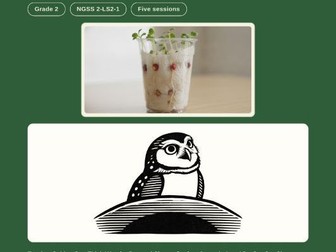
Two cups of radish seeds sit on the same shelf. Both hold seeds from the same packet, planted on the same day on damp paper towels. One cup gets water every day, and its sprouts stand tall and green, with roots visible through the cup. The other cup gets no water, and its seeds look almost the same as the day they went in. The class answers one question with evidence: what do seeds need to grow? Students draw a first idea about what a seed needs. The class then plans a seed test together before anyone plants: what to change, what to keep the same, and what to watch. Four cups go into the test, changing one variable at a time, and students visit the cups daily to record what changes. The lab builds toward one claim the evidence supports: water starts the growth, and water with sunlight keeps it strong. It ends with a transfer task in a new situation, scored on a printed checklist with scored examples. The lab runs in five sessions spread across about two weeks. Four sessions run twenty-five to thirty minutes, Session 3 is a twenty-minute sitting, and the daily cup visits fit between sessions. The teacher plants the two phenomenon cups five days before the first session; the students plant the test cups themselves in the second session. What is inside: Pages 3 to 12: the teacher guide, with the standard presented in full, a session guide for each of the five sessions, and the Findings Key Page 5: the Lab at a Glance sheet, with the lab question, the five sessions and their times, the materials list, and the two phenomenon cups the teacher plants five days ahead Page 13: Words for This Lab, the vocabulary strip Page 14: the read-aloud text, How a Seed Starts Pages 15 to 16: the See-Think-Wonder protocol sheet Pages 17 to 29: Student Journal A, with the first idea, the seed test plan, a prediction, the cup watching pages, and the class claim Pages 30 to 43: Student Journal B, the same journal pages with fuller sentence frames and word chips, and the final model on its own page Page 44: the cut-out sheet for the sequencing strip in each journal Page 45: the Class Growth Chart, the display piece Page 46: the Reference Card students build from their own work during the lab Pages 47 to 48: the Transfer Task Page 49: the scoring checklist and scored examples for the transfer task Page 51: The Standard, Revisited, the closing standards spread with scoring notes Page 52: More from Syzygy Science, with the free lab sample, the Inquiry Builder, and the elementary organizer line The lab addresses 2-LS2-1, the grade 2 performance expectation on what plants need to grow, and the Start Here pages print the expectation in full with its clarification statement and assessment boundary. The named practice is Planning and Carrying Out Investigations: the class plans the test collaboratively and produces the data the claim rests on. The lab also holds an accuracy line its own evidence teaches: seeds start growing without light, using fo
Science Graphic Organizers Super Pack | Elementary Grades PK-5Quick View
SyzygyScience

Science Graphic Organizers Super Pack | Elementary Grades PK-5

(0)
The complete Syzygy elementary graphic organizer line in one volume: five packs, one for each grade band from pre-kindergarten through grade 5, gathered behind a combined contents and a shared introduction, 281 pages in all. Every pack in the line is built the same way at its band’s reading level. Each organizer comes as a set of three pages: a model or teacher page first, a guided page with its data or specimens printed on it, and a blank master for the teacher’s own lesson. Each pack opens with a standards index that prints its performance expectations in full, with the dimensions named and the organizers that carry each one. Together the five packs cover all seventy K-5 science performance expectations. What is inside: PK-K Science Graphic Organizers, 52 pages. Fifteen organizers built for children who cannot yet read the page: a teacher think-aloud page, an activity surface, and a pieces page of cut-out cards for every set. Responses are physical: cut, sort, match, glue, point, and place. Grades 1-2 Science Graphic Organizers, 73 pages. Sixteen organizers for beginning readers and writers, with large print, wide lines, word banks on the page, and tasks that ask for a word, a circled choice, a drawing, or one sentence frame. Grade 3 Science Graphic Organizers, 51 pages. Twelve organizers, among them a claim, evidence, and reasoning frame, a cycle diagram, and a bar graph built from a data table. Grade 4 Science Graphic Organizers, 48 pages. Eleven organizers, among them a fair test planner, a fishbone diagram, and a data table and map pair. Grade 5 Science Graphic Organizers, 49 pages. Eleven organizers, among them a claim and counterclaim chart, a concept map, and a model and revise page. Every guided page supplies its own data. Students work from numbers, observations, or specimen notes printed on the page they hold. Pages print clean in black and white. Color codes the work on each page, and every color is backed by a label, a badge, or a pattern, so a grayscale photocopy keeps the code intact. A school that staffs science across the elementary grades gets one recording system for the whole building: the same organizer shapes, the same standards treatment, and the same model, guided, blank rhythm from a child’s first sorting mat to a fifth grader’s claim and counterclaim chart.