Cambridge IGCSE Physics Paper 6 — Five Ways to Lose Marks (Free Booklet)Quick View
shannon_ren

Cambridge IGCSE Physics Paper 6 — Five Ways to Lose Marks (Free Booklet)

(0)
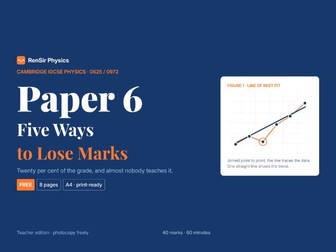
Paper 6 is 20% of the Cambridge IGCSE Physics grade, and it is the paper nobody teaches. It is the Alternative to Practical — experiments on paper. School practises the doing; Paper 6 marks the writing. A student who is excellent at the bench can still drop ten marks here, not because the physics is wrong, but because the format is. This free 8-page teacher booklet takes the five sentences that turn up on scripts every year, and shows why each one quietly costs marks: 01 “I joined all the points with a ruler.” 02 “There may be parallax error.” / “Human error.” 03 “The results support my prediction.” 04 “length (cm)”, units in every cell, averages to 3 d.p. 05 “I will change X and measure Y.” Every page gives the same three things: what students actually write, why it loses marks, and one test to carry into the exam. Page 8 is a ten-point checklist — print it as a starter, run it against three past papers, then pair up the students whose ticks disagree. That argument is the lesson. WHAT YOU GET • 8 pages, A4, print-ready PDF • 5 mistake pages with the exact student sentences • A model answer per mistake, written at mark-scheme length • A ten-point checklist mapped to the five skill workbooks • Teacher edition — free to photocopy for your own classes Covers 0625 (A*–G) and 0972 (9–1). Core and Extended candidates sit the same paper. No past-paper questions, no screenshots, no mark-scheme extracts — every sentence, data set and diagram is original. Independent study guide. Not endorsed by, or affiliated with, Cambridge University Press & Assessment.
Cambridge IGCSE Physics Paper 6: Designing an Experiment (7 Units, Answers)Quick View
shannon_ren

Cambridge IGCSE Physics Paper 6: Designing an Experiment (7 Units, Answers)

(0)
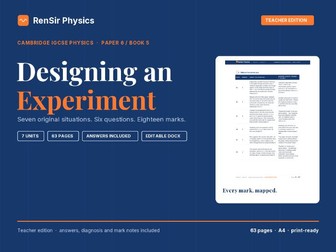
Paper 6 is the one question with no data at all. In the Alternative to Practical, every other question hands the candidate something to read: a scale, a table, a graph. The design question hands over nothing but a situation. The student has to invent the apparatus, the variables, the table and the conclusion — and write them in the order a marker ticks. This 63-page teacher workbook builds that order, seven times over. EACH UNIT One original situation — ramp height, sliding friction, cooling, refraction, sound insulation, pencil lead, electromagnet — and the same six-part, 18-mark question: (a) independent and dependent variables (b) three control variables, each with a method © five values of the independent variable and how each one is set (d) a results table with headings and units (e) how the data is processed and what the graph must show (f) one specific source of error and its remedy Beside every question: a plan frame, part-by-part mark notes (“credit is given for / where it is lost”), a full model answer, two weak answers with a diagnosis and an in-class fix, a seven-line rule card, two transfer questions and three self-checks. Writing space is left on the page. THE FRONT MATTER Section A — why the design question needs a rhythm of its own, and the fixed order of the six parts. Section B — the six lines on the marker’s list; the one rule (marks are for completeness, not length); a fault table for units, controls, repeats and conclusions. Section C — ready-made control-variable sentences by topic, a safety bank with apparatus-specific measures, and a ten-point checklist. WHAT YOU GET • 63 pages, A4, print-ready PDF • Editable DOCX with embedded fonts — change a situation, keep the layout • 7 units x 18 marks = 126 marks of original questions • Full answers, mark notes, weak answers and diagnosis for every unit • Plan frames and writing space for students • Marking tables kept whole on one page; full-width apparatus diagrams • A free 14-page preview is available on this store Covers 0625 (A*–G) and 0972 (9–1). Core and Extended candidates sit the same paper. No past-paper questions, no screenshots, no mark-scheme extracts — every situation, data set and diagram is original. Need a clean handout with no answers? The Student Edition (41 pages) is on this store. Independent study guide. Not endorsed by, or affiliated with, Cambridge University Press & Assessment.
Cambridge IGCSE Physics Paper 6: Designing an Experiment (Student Workbook)Quick View
shannon_ren

Cambridge IGCSE Physics Paper 6: Designing an Experiment (Student Workbook)

(0)
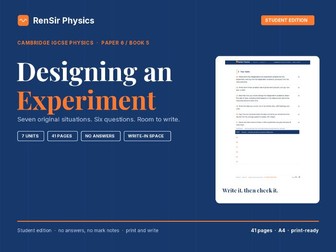
Seven original experiment-design questions, with room to write the answer — and nothing that gives it away. Paper 6 (Alternative to Practical) asks candidates to plan an investigation from a situation alone: name the variables, fix the controls, choose the values, draw the table, say what the graph will show, name one source of error. There is no data to lean on. The only way to get good at it is to write it out, then have it marked against the six things a marker ticks. This 41-page student workbook gives them seven chances to do exactly that. EACH UNIT • One original situation, with the apparatus described and drawn • The same six-part, 18-mark question (a)–(f) • A plan frame — one line per part, before the full answer • Dotted writing lines for the full written answer • A seven-line rule card, two transfer questions and three self-checks THE FRONT MATTER Section A — the fixed order of the six parts. Section B — the six lines on the marker’s list, and a fault table for units, controls, repeats and conclusions. Section C — control-variable sentence bank by topic, an apparatus-specific safety bank, and a ten-point checklist. WHAT YOU GET • 41 pages, A4, print-ready PDF — no answers, no mark notes, no diagnosis • Editable DOCX with embedded fonts • 7 units x 18 marks = 126 marks of original questions • Generous writing lines and full-width apparatus diagrams • Print one unit per lesson, or the whole booklet as a homework pack • A free 14-page preview is available on this store Covers 0625 (A*–G) and 0972 (9–1). Core and Extended candidates sit the same paper. No past-paper questions, no screenshots, no mark-scheme extracts — every situation, data set and diagram is original. Teaching it rather than setting it? The Teacher Edition (63 pages) has the mark notes, full answers, weak-answer diagnosis and in-class fixes. Independent study guide. Not endorsed by, or affiliated with, Cambridge University Press & Assessment.
Free Preview — Paper 6 Designing an Experiment (IGCSE Physics 0625/0972)Quick View
shannon_ren

Free Preview — Paper 6 Designing an Experiment (IGCSE Physics 0625/0972)

(0)
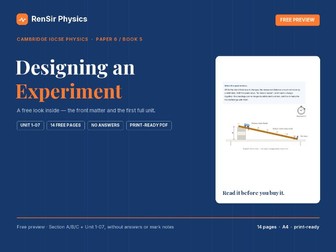
Would you buy a 63-page workbook without seeing the inside first? This is a free 14-page preview of Paper 6 / Book 5: Designing an Experiment. It shows you exactly how the workbook is built, before you spend anything. WHAT IS INCLUDED • The full front matter — Section A (why the design question needs its own rhythm, and the fixed order of the six parts), Section B (the six lines on the marker’s list), Section C (control-variable sentence bank, safety bank, ten-point checklist) • Unit 1-07 in full — “Ramp height and the average speed of a trolley”: the situation, a full-width apparatus diagram, all six questions (a)–(f), 18 marks, and the plan frame with writing space • A final page listing exactly what the complete Teacher and Student Editions contain WHAT IS NOT INCLUDED No answers, no mark notes, no weak-answer diagnosis and no marking tables. This preview is intentionally answer-free — it shows the structure, not the solutions. ONE THING TO NOTE The preview pages are taken from the Teacher Edition, so the running header says “TEACHER EDITION” and the footer reads “Page 12 / 63”. That is the page number in the full book, not the length of this file. This PDF is 14 pages. WHY THIS MIGHT BE USEFUL Paper 6 is 20% of the IGCSE Physics grade and barely taught. The design question gives candidates nothing but a situation — they must invent the apparatus, variables, table and conclusion, in the order a marker ticks. If you want to see whether a booklet actually teaches that order, this is the fastest way to judge. Covers 0625 (A*–G) and 0972 (9–1). Core and Extended candidates sit the same paper. The full Teacher Edition (63 pages) adds full model answers, part-by-part mark notes, two weak answers with diagnosis and an in-class fix for each of seven units. The Student Edition (41 pages) is the answer-free write-in version. Both are available on this store. Independent study guide. Not endorsed by, or affiliated with, Cambridge University Press & Assessment.