*** AVAILABLE NOW to purchase from TES*** £9.99 for a whole year’s weekly Maths lessons. Please download and leave feedback. Thanks
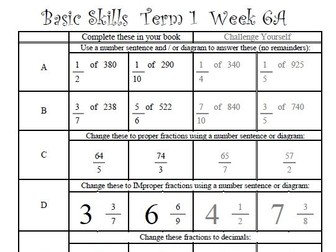
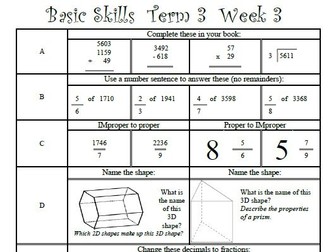
These worksheets are a lesson in themselves, once a week. They are a consolidation of lessons during the week and formalising written methods to solve these problems.
KS2 Basic Skills is a downloadable book of weekly worksheets (for a whole year!) and support the KS2 curriculum - good for Y4 extension, Y5 SAT revision and preparation for 11+ and Common Entrance exams and Y6 revision.
It’s ONE lesson per week you don’t need to plan for!!!
Buy the whole series here from TES:
https://www.tes.co.uk/teaching-resource/basic-skills--standard-edition-10001944
https://www.tes.co.uk/teaching-resource/basic-skills--challenge-edition-10001943
37 Weeks’ Worth of Maths Worksheets
With Answers
And Parent Guidance Sheets
Excellent for an hour lesson OR homework perhaps over 2 nights
Follows the National Curriculum and tests the current skill plus revising previous skills in each sheet
Basic Skills is a weekly worksheet that revises all of the Mathematics covered in the curriculum. It tracks the curriculum, changing to accommodate new skills while still keeping past lessons fresh in children’s minds. For example, the first week is simply addition, subtraction, multiplication and division, where as later in the term, it covers the four functions but also revises fractions of decimals, shape, time and rotation, addition of decimals and fractions, all in varying difficulty. Excellent for Common Entrance preparation, Y5 SATs revision and Gifted and Talented extension.
(Please note that some questions are not to scale)
37 Weeks’ Worth of Maths Worksheets
With Answers
And Parent Guidance Sheets
Excellent for an hour lesson OR homework perhaps over 2 nights
Follows the National Curriculum and tests the current skill plus revising previous skills in each sheet
Basic Skills is a weekly worksheet that revises all of the Mathematics covered in the curriculum. It tracks the curriculum, changing to accommodate new skills while still keeping past lessons fresh in children’s minds. For example, the first week is simply addition, subtraction, multiplication and division, where as later in the term, it covers the four functions but also revises fractions of decimals, shape, time and rotation, addition of decimals and fractions, all in varying difficulty. Excellent for Common Entrance preparation, Y5 SATs revision and Gifted and Talented extension.
(Please note that some questions are not to scale)
37 Weeks’ Worth of Maths Worksheets
With Answers
And Parent Guidance Sheets
Follows the development of the weekly mathematics curriculum and reinforces skills - as the pack progresses, the weekly skill is tested but examples of revisited (past) skills are also tested.
Excellent for 1 x hour lesson or a longer homework (perhaps over 2 nights)
Basic Skills is a weekly worksheet that revises all of the Mathematics covered in the curriculum. It tracks the curriculum, changing to accommodate new skills while still keeping past lessons fresh in children’s minds. For example, the first week is simply addition, subtraction, multiplication and division, where as later in the term, it covers the four functions but also revises fractions of decimals, shape, time and rotation, addition of decimals and fractions, all in varying difficulty. Excellent for Common Entrance preparation, Y5 SATs revision and Gifted and Talented extension.
(Please note that some questions are not to scale)
**37 Weeks’ Worth of Maths Worksheets**
**With Answers**
**And Parent Guidance Sheets**
Excellent for an hour’s lesson
Or homework over two nights
Basic Skills is a weekly worksheet that revises all of the Mathematics covered in the curriculum. It tracks the curriculum, changing to accommodate new skills while still keeping past lessons fresh in children’s minds. For example, the first week is simply addition, subtraction, multiplication and division, where as later in the term, it covers the four functions but also revises fractions of decimals, shape, time and rotation, addition of decimals and fractions, all in varying difficulty. Excellent for Common Entrance preparation, Y5 SATs revision and Gifted and Talented extension.
(Please note that some questions are not to scale)
A COMPLETE PACKAGE!!
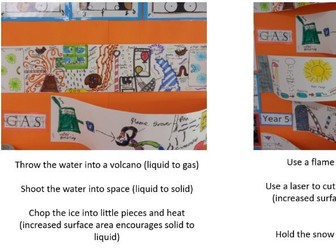
Introduce the lesson on changing state machines. Liken them to function machines in Maths.
Discuss heat sources (ideas doc) and the relevant key words (vocab PDF). I’ve included everything you need from posters to print out to photos of how I displayed it in my lab. On strips of A3 card, the children use the hints sheet (ideas doc) and make their own &‘machine&’;. Good luck - it was a lot of fun!
The files were too large for one post, please see part 2 for the rest of the files.
*** Please leave feedback on how you used this in your Science lessons*** Many thanks
See part 2 here:
https://www.tes.co.uk/teaching-resource/changing-state-machines--display-part-2-6435586
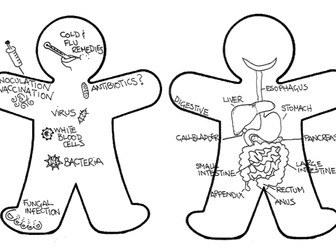
I have been teaching sex and relationship education in Year 6 as part of a unit on organs of the body. The SRE aspect is taught in a lesson on how a baby is conceived and includes how identical twins and non identical twins occur.
It's a passive way to get the pupils to talk about the different parts of the reproductive organs as it is in conjunction with a fascination with twins - although the sex part is secondary, they are more comfortable taking about the organs as it is not the main feature of the lesson.
The attached diagrams are a re-hash of one widely available on Pinterest and other websites. I took a stab at it to make the diagrams more relevant to my lessons.
I use one as a lesson on virus vs bacterial infection and when it is time to take antibiotics... and when not to...
Other lessons are on digestion, muscle and bone names, glands skin & hair (what happens when they go through puberty), respiration and the heart, organs that remove waste and the mystery of the brain and nervous system (more adapted to para / quadriplegic discussions).
You can either put one in the middle of each page in their book and write information around it, or use it as a book itself, made from concertina folding card.
Each of the lessons I back up with Youtube (mostly TedEd) clips and other resources like glow in the dark skeletons (£1 shop at Hallowe'en) with laminated labels for all of the major bone names.
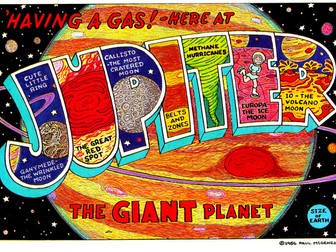
Colourful and lively pictures of the planets. I have added a post card to the base of each. I usually ask students to do a research project on a planet, then they are given the post card. The purpose is to get the students to link fact to fiction.
For example: if the gravity is more than Earth, the student would write ‘the people here are so short and stocky, but that is because the gravity is 2.5 times greater than Earth’ or ‘the winds are so strong in the big red spot on Jupiter, but great for windsurfing!’
Makes a wonderful display. Anyone finishing early can make astronauts to decorate the gaps between the postcards and cut out some gold and silver stars.
Picture credits to: Paul McGehee
https://i.pinimg.com/originals/e8/ff/84/e8ff84a08815f43a6c8ea9bf33a6cb12.jpg
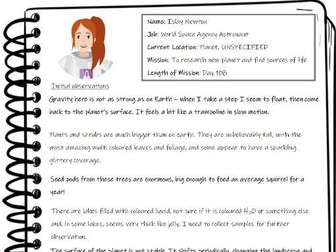
Read a scientist’s description of a newly discovered planet and its characteristics. Watch a few YouTube clips (links in the Word document) of humanoid and other types of aliens, then discuss adaptations (with pictures as discussion points).
Design an alien and around the image, label the different specialist adaptations, explaining why it is suited to living on this new planet.
PART 2
A COMPLETE PACKAGE!!
Introduce the lesson on changing state machines. Liken them to function machines in Maths.
Discuss heat sources (ideas doc) and the relevant key words (vocab PDF). I've included everything you need from posters to print out to photos of how I displayed it in my lab. On strips of A3 card, the children use the hints sheet (ideas doc) and make their own &'machine&';. Good luck - it was a lot of fun!
*** Please leave feedback on how you used this in your lessons*** Many thanks
See part 1 here:
https://www.tes.co.uk/teaching-resource/changing-state-machines--lesson-plan-and-display-6435584
This is a poster that can be used as sorting cards, matching activity and a philosophical discussion about sound in Science. I have made them into laminated sorting cards to stimulate group discussion (printed on A3, cut out & laminated)
With the use of iPads - the pupils explore questions they generate: what sound does a heart make? How do animals like birds make noise? Is it language or just communication?
I also use it as a poster on the wall and print out small copies for the pupils to stick in their book and record their brainstorm ideas around it.
A great springboard for generating ideas on sound and a good starter for the sound unit in KS2 Science.
*** PLEASE leave feedback on how this worked in your Science lessons*** Many thanks
A lot of fun, with a few difficult vegetables thrown in for the G&T pupils. While it may not be perfect (!!) it has been a really useful resource at the end of a unit, or a springboard at the beginning.
Follow on lessons were to use a blank periodic table and find 5 different categories (eg: mammals, amphibians, reptiles, birds & fish) and make their own periodic table.
Enjoy and please leave feedback.
These are a few samples of my Year 5 Chemistry unit. In total (in the paid version), there are 61 files to download which include:
Self evaluation
Key word lists
Around 20 different activities
Homework activities
Teacher sheets
Activities for a Science Club
Test at the end
The resources required are basic and do not use chemicals. Some glassware is required but can be easily purchased off the internet (as can most of the consumable resources).
I teach Year 5 twice a week for 1h20m and this unit takes me 12 - 14 weeks to get through (Usually January to April) and a summative test is included for assessment at the end.
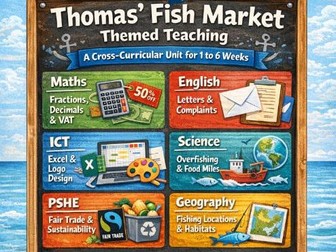
Thomas Fish Market is an engaging, project-based learning resource designed for key stage two pupils. Whether it is Year 5, Year 6 or even Year 7 as revision, this is an engaging and beneficial resource. Using a realistic fish market scenario, it helps bridge the gap between abstract maths concepts and real-world application while introducing key digital skills.
Students take on the role of a market assistant, tasked with fulfilling an order from a variety of shopping lists. They calculate costs based on different weights and quantities, applying mathematical skills in a meaningful, real-life context.
This is a ready-to-use, cross-curricular resource combining mathematics with digital literacy.
Mathematical Concepts Covered
Fractions, Decimals & Percentages
Students explore the relationships between these forms, converting between fractions decimals and percentages.
Multiplication & Division
Clear modeling of strategies, including using division to convert fractions into decimals.
Weight & Measurement
Practical use of kilograms (kg), including whole, half, and quarter values in real-life problem-solving.
Digital Literacy & Spreadsheet Skills
Creating Formula
Students learn that all spreadsheet formulas begin with an equals sign (=) and use operators such as * for multiplication.
Automated Calculations
Demonstrates how spreadsheets update values dynamically when inputs change.
Using SUM Functions
Introduction to calculating totals using simple formulas such as SUM.
Step-by-step guidance to support independent or guided learning
Opportunities for mathematical reasoning and discussion
Differentiation & Extension
Easily adaptable to suit a range of abilities
Student-led projects: learners can create their own versions (e.g. fruit shop, supermarket, deli)
Encourages creativity, ownership, and deeper understanding
Why Teachers Love It
Grab-and-go resource minimal preparation required
Covers multiple curriculum areas in one project
Engaging real-world context that motivates learners
Builds both numeracy and digital skills simultaneously