Task Initiation Toolkit – When a Child Won’t Start | KS2 SENDQuick View
hollawolla

Task Initiation Toolkit – When a Child Won’t Start | KS2 SEND

(0)
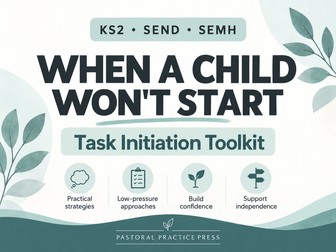
A practical, low-demand task initiation toolkit for KS2 pupils who find it difficult to begin work, even when they may understand what is expected. Designed for SEND, SEMH, pastoral, nurture and 1:1 support. This 15-page resource supports adults to make starting tasks more manageable without automatically interpreting hesitation as refusal or creating long-term dependence on adult prompting. The toolkit explores why a child may appear unable or unwilling to begin, including uncertainty about where to start, the task feeling too large, wanting reassurance before beginning, or having reduced capacity in that moment. It encourages adults to describe what they can see before deciding what the behaviour means. Practical strategies include: making the first step smaller making the task visually clearer reducing start-up demands beginning alongside the child, then stepping back offering a manageable choice of entry point responding to “I can’t” without arguing reducing over-prompting gradually building independence The Make the First Step Smaller page gives staff concrete alternatives to broad instructions such as “Start your work”, “Do the page” or “Get ready”, replacing them with one visible, achievable action. The resource also helps adults reduce the start-up load by considering materials, language, decisions and the environment before expecting the child to begin. The Start Together, Then Step Back section supports adults to model the first step, begin alongside the child and then gradually reduce support once momentum has started. A Quick Task-Start Check provides a reusable framework for considering: what the task is the smallest useful first step what can be reduced what support may help when adult support should step back what happens after the first part is complete The toolkit also addresses repeated adult prompting and encourages a gradual move from adult prompts towards visual prompts, brief reminders and more independent starts. A reusable My Task-Starting Support Plan allows pupils and adults to record what starting looks like when it is difficult, helpful adult responses, preferred ways of receiving information, useful first steps and how support can reduce over time. Suitable for: KS2 / ages 7–11 SEND and SEMH provision pastoral and nurture support teaching assistants and SEND staff 1:1 pupil support pupils who struggle to initiate tasks pupils who rely heavily on adult prompting children who frequently say “I can’t” before beginning building independence and reducing prompt dependency The emphasis throughout is: Make the start smaller. Reduce the load. Build independence gradually. Please note: This is an educational and pastoral resource. It is not a replacement for safeguarding procedures, professional assessment, individual support plans or specialist support.
KS2 Regulation, De-escalation & Reconnection BundleQuick View
hollawolla

KS2 Regulation, De-escalation & Reconnection Bundle

3 Resources
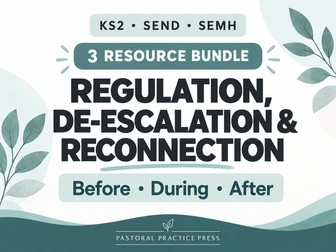
A practical three-resource KS2 SEND, SEMH and pastoral support bundle for supporting children before, during and after difficult moments. This Pastoral Practice Press bundle brings together three complementary low-pressure toolkits designed to help teachers, teaching assistants, SEND staff, pastoral teams and nurture practitioners respond across the whole cycle of a difficult situation. Before It Escalates – Early Support & De-escalation Toolkit Designed for the early stages of difficulty, when a child may still be able to communicate, make choices and respond to support but is beginning to find the situation harder to manage. The toolkit helps adults notice early changes, reduce unnecessary pressure, simplify demands, make choices more manageable and give one clear next step before the situation becomes more difficult. When a Child Shuts Down – Low-Pressure Support Toolkit Designed for moments when a child becomes quiet, withdrawn, still or unable to engage in the way they usually would. The resource supports adults to reduce language and questioning, offer alternative ways to communicate, keep connection available without demanding engagement and allow the child to re-engage gradually. After a Difficult Moment – Repair & Reconnection Toolkit Designed for the period after a difficult moment, when the immediate situation has passed but the child may not yet be ready for a full explanation, apology or restorative conversation. The toolkit supports reconnection, returning to routine, meaningful repair, communication without pressure and reviewing what may help next time. Together, the three resources provide practical support across: BEFORE — noticing early signs, reducing pressure and preventing unnecessary escalation. DURING — supporting reduced communication or shutdown without forcing conversation, eye contact or immediate responses. AFTER — reconnecting, returning to routine, repairing relationships and reflecting when the child has greater capacity to take part. Throughout the bundle, the emphasis is on maintaining appropriate boundaries while reducing unnecessary pressure. The resources do not assume that behaviour automatically tells us what a child is thinking or feeling, and they avoid making immediate emotional disclosure the goal. Children are offered different ways to communicate, including talking, pointing, choosing, writing, drawing, gestures or responding later. The bundle includes practical staff guidance, ready-to-use phrases, pupil-facing worksheets, quick decision-making tools and reusable individual support plans. Suitable for KS2 / ages 7–11, SEND and SEMH provision, pastoral and nurture support, teaching assistants, SEND staff, 1:1 work, de-escalation, regulation support, relationship-based practice and restorative work. Three practical toolkits. One joined-up approach. Before • During • After Please note: These are educational and pastoral resources. They are not replacements for safeguarding procedures, professional assessment, individual behaviour or safety plans, or specialist support.
De-escalation Toolkit – Before It Escalates | KS2 SENDQuick View
hollawolla

De-escalation Toolkit – Before It Escalates | KS2 SEND

(0)
A practical, low-pressure early support and de-escalation toolkit for KS2 pupils, designed for SEND, SEMH, pastoral, nurture and 1:1 support. This 15-page resource is designed for the early stages of difficulty, when a child may still be able to communicate, make choices and respond to support but is beginning to find the situation harder to manage. The aim is to notice changes early, reduce unnecessary pressure and make the next step more manageable before the situation becomes more difficult. The toolkit encourages adults to notice changes from the child’s usual pattern rather than waiting for obvious distress or behaviour. It explores possible changes in communication, movement, task engagement and interaction without assuming that any one behaviour tells us exactly what the child is thinking or feeling. It includes practical strategies for: reducing questions, instructions, people and decisions adjusting the task, environment, communication or timing breaking situations into smaller next steps offering manageable choices using short, neutral language noticing what may be adding pressure responding calmly when a child says “no” reviewing what helped creating an individual early-support plan The Make the Next Step Smaller page helps adults separate what needs to happen now, what happens next and what can safely wait. The toolkit also includes ready-to-use low-pressure phrases such as: “You only need to do this part.” “We can deal with the rest later.” “Take a moment. I’ll stay nearby.” These are designed to keep communication calm, clear and manageable. A Quick Early-Support Check gives staff a simple way to consider what has changed, what pressure can be reduced, what needs to happen now, what can wait, how the child can respond and what support may help next. The resource also includes guidance for responding to refusal without turning the interaction into a power struggle. It emphasises checking what is genuinely essential, making requests smaller where appropriate and maintaining boundaries without unnecessary confrontation. The reusable My Early Support Plan can be completed with the child or by supporting adults to record early changes, helpful responses, possible pressures, preferred ways to communicate, useful next steps and things that can wait. Suitable for: KS2 / ages 7–11 SEND and SEMH provision pastoral and nurture support teaching assistants and SEND staff 1:1 pupil support early intervention relationship-based behaviour support de-escalation pupils who benefit from reduced language, clearer choices or smaller steps The emphasis throughout is: Notice early. Reduce pressure. Make the next step easier. The adult guidance also makes clear that de-escalation is not about removing every expectation or “giving in”, but about responding in a way that makes successful engagement more likely.
Repair & Reconnection Toolkit – After a Difficult Moment | KS2Quick View
hollawolla

Repair & Reconnection Toolkit – After a Difficult Moment | KS2

(0)
A practical, low-pressure repair and reconnection toolkit for KS2 pupils, designed for SEND, SEMH, pastoral, nurture and 1:1 support. This 15-page resource is designed for the period after a difficult moment, when the immediate situation has passed but the child may not yet be ready for a full conversation, explanation, apology or restorative discussion. The focus is on reconnecting first, dealing with what genuinely needs attention, and returning to reflection or repair when the child has more capacity to take part. The toolkit encourages adults to separate what needs attention now from what can safely wait, helping to reduce repeated questioning, unnecessary explanations and pressure to respond immediately. It also explores different forms of repair. Rather than treating a spoken “sorry” as the only successful outcome, pupils can be supported to put something right through words, practical actions, time, supported communication or another meaningful response. The pack includes: How to Use This Toolkit Not Every Difficult Moment Needs an Immediate Debrief What Needs Attention Now? Reconnect Before Review Returning to the Routine Repair Can Look Different Apologies Without Pressure Tell Me in Your Way What Needs to Be Put Right? If Another Person Was Involved What May Help Next Time? My Repair & Reconnection Plan Adult Guidance: Repair Without Pressure Safeguarding and professional-use guidance The pupil-facing pages allow children to communicate through talking, writing, drawing, choosing or responding later, rather than requiring an immediate verbal account. The resource also includes practical guidance for situations where another child or adult has been affected. It emphasises safety, avoiding forced face-to-face contact, preparing both people before restorative work and recognising that repair does not require both people to remember an incident in exactly the same way. A reusable My Repair & Reconnection Plan helps identify what may help first, what the child may need, alternative ways to communicate, how to reconnect, ways to repair and anything that should be reviewed later. Suitable for: KS2 / ages 7–11 SEND and SEMH provision pastoral and nurture support teaching assistants and SEND staff 1:1 pupil support restorative and relationship-based practice returning to routine after dysregulation or conflict supporting meaningful repair without forced apologies The emphasis throughout is: Reconnect first. Repair without pressure. Review when the child is ready. Please note: This is an educational and pastoral resource. It is not a replacement for safeguarding procedures, professional assessment or specialist support.
Shutdown Support Toolkit – When a Child Shuts Down | KS2 SENDQuick View
hollawolla

Shutdown Support Toolkit – When a Child Shuts Down | KS2 SEND

(0)
A practical, low-pressure support toolkit for KS2 pupils who become quiet, withdrawn, still or find it difficult to respond or engage. Designed for SEND, SEMH, pastoral, nurture and 1:1 support. This 15-page resource gives adults practical ways to reduce pressure while keeping connection and communication available. Rather than making immediate talking, eye contact or explanation the goal, the toolkit helps staff consider what can be simplified, delayed or communicated in another way. The resource explores how reduced engagement may look different from child to child and encourages adults to notice changes from the pupil’s usual pattern rather than assuming that one particular behaviour tells them exactly what the child is thinking or feeling. It includes practical guidance on reducing questions and language, simplifying instructions, reducing the audience, offering alternative ways to respond, making choices easier and giving one clear next step at a time. Children can be supported to communicate through pointing, choosing, nodding, writing, drawing or responding later when speaking is difficult. The toolkit also supports adults to distinguish between what genuinely needs to happen now, what can be returned to later, and what may be not needed in that moment. As the child begins to re-engage, the resource encourages a gradual return rather than immediately restarting questions or expectations. It includes guidance for returning to conversations later in a way that does not recreate the original pressure. Included in the pack: How to use this toolkit Shutdown does not always look the same What to do first Give another way to respond Keep connection without pressure Reduce the language Make choices easier Now, Later or Not Needed? When the child starts to re-engage Come Back to It Later What May Help Next Time? My Low-Pressure Support Plan Adult Guidance: Supporting Shutdown Moments Safeguarding and professional-use guidance The My Low-Pressure Support Plan provides a reusable summary of what adults may notice, what may help first, alternative ways the child can respond, useful adult phrases, things that may add pressure and strategies to try later. Suitable for KS2 / ages 7–11, SEND and SEMH provision, pastoral and nurture work, teaching assistants, SEND staff, 1:1 support and pupils who may find talking, choosing or responding difficult during periods of increased demand. The emphasis throughout is simple: Reduce demand. Keep connection. Leave communication open. Please note: This is an educational and pastoral resource and is not a replacement for safeguarding procedures, professional assessment or specialist support. The resource also advises following first-aid or emergency procedures if a child is unusually unresponsive, appears physically unwell or there is an immediate safety concern.
KS2 SEND & SEMH Pastoral Support Starter BundleQuick View
hollawolla

KS2 SEND & SEMH Pastoral Support Starter Bundle

3 Resources
A practical KS2 SEND, SEMH and pastoral support bundle containing three low-pressure resources for communication, connection and change. This Pastoral Practice Press starter bundle brings together three complementary resources designed for teachers, teaching assistants, SEND staff, pastoral teams and nurture practitioners working with children who may find direct questioning, emotional discussion or uncertainty difficult. The bundle includes: When They Say ‘I Don’t Know’ – Communication Toolkit A practical low-demand toolkit for moments when a child repeatedly responds with “I don’t know”. It includes alternative ways to communicate, conversation starters, drawing and pointing options, adult phrase prompts and simple check-in tools. 30 Five-Minute Connection Activities Thirty short, low-prep activities designed to build positive adult-child connection without making personal conversation or disclosure the purpose of the interaction. Activities include drawing, imagining, noticing, building, problem-solving and playful shared tasks. Change & Transition Toolkit A low-pressure toolkit for helping children understand change, uncertainty and new routines. It includes practical pages covering what is changing and staying the same, what is known and unknown, people and places, first/next/after sequencing, questions, changed plans, returning after time away and moving class, year group or school. Together, the resources support three common pastoral situations: Communication — when a child cannot or does not want to answer direct questions. Connection — when relationship-building is more useful than immediately discussing difficulties. Change — when clearer information and reduced uncertainty may be more helpful than repeated questions about feelings. The approach throughout is deliberately low-pressure. Children can communicate through talking, pointing, choosing, drawing, writing or shared activity, and there is no expectation that a child must disclose personal information in order to receive support. Suitable for KS2 / ages 7–11, SEND and SEMH provision, nurture, pastoral support, 1:1 work, teaching assistants, SEND staff and relationship-building work. All three resources include guidance for adults and appropriate safeguarding boundaries. Please note: These are educational and pastoral resources and are not replacements for safeguarding procedures, professional assessment or specialist support.
Change & Transition Toolkit – KS2 SEND & SEMH SupportQuick View
hollawolla

Change & Transition Toolkit – KS2 SEND & SEMH Support

(0)
A practical, low-pressure Change & Transition Toolkit for KS2 pupils, designed for SEND, SEMH, pastoral, nurture and 1:1 support. This 15-page resource helps adults reduce uncertainty around change without requiring a child to explain how they feel. It can be used before planned transitions, following unexpected changes, when returning after time away, or whenever a pupil needs clearer information about what will happen next. The toolkit focuses on helping children understand: what is changing and what is staying the same what they already know and what they do not know yet who will be there what will happen first, next and afterwards questions they may want answered what may help when things feel uncertain what happens if the plan changes returning after time away moving class, year group or school who they can ask when they need more information The pupil-facing pages allow children to write, draw, point, tick or work alongside an adult, rather than relying on verbal discussion. There is no expectation that a child must disclose worries or explain their feelings in order to receive practical support. The pack includes: guidance for adults on using the toolkit “What is changing? What is staying the same?” “What I know / What I don’t know yet” “Who will be there?” a First / Next / After planning page a Questions I Have page practical ideas for reducing uncertainty an If the Plan Changes page Returning After Time Away support Moving Class, Year Group or School support a reusable My Transition Snapshot adult guidance on reducing uncertainty safeguarding and professional-use guidance The My Transition Snapshot provides a simple one-page summary of the change, what is already known, what still needs to be known, who the pupil can ask, what may help and the first step. Suitable for: KS2 / ages 7–11 SEND and SEMH support pastoral and nurture provision teaching assistants and SEND staff 1:1 pupil support class or year-group transitions school transitions returning after absence changes to routines, staff or plans pupils who benefit from clear, predictable information The approach is deliberately practical: clarity before pressure to talk. Adults are encouraged to give concrete information, avoid guessing when information is not yet known, reduce repeated questioning and revisit information gradually. Please note: This is an educational and pastoral resource. It is not a replacement for safeguarding procedures, professional assessment or specialist support.
Connection Activities – 30 Five-Minute KS2 SEND & SEMH ActivitiesQuick View
hollawolla

Connection Activities – 30 Five-Minute KS2 SEND & SEMH Activities

(0)
30 low-pressure, low-prep connection activities for KS2 pupils, designed for SEND, SEMH, pastoral, nurture and 1:1 support. This practical pack gives adults simple activities they can use when building connection feels more appropriate than beginning with questions about feelings, behaviour or difficult experiences. The activities are designed for short shared moments between an adult and child. They can be used during nurture provision, pastoral support, SEND interventions, transition time, 1:1 sessions or whenever a pupil may benefit from calm, positive shared attention. The emphasis throughout is connection without forced conversation. A child can take part without having to discuss worries, emotions, home life or behaviour. If conversation develops naturally, the guidance encourages adults to listen and follow the child’s lead rather than turning the activity into a series of questions. This 15-page PDF includes: • 30 printable connection activity cards • 2 blank cards for adding your own successful activities • a Quick Activity Chooser to help staff select an activity to suit the moment • activities grouped by talking and imagining, drawing and creating, looking and noticing, thinking and problem-solving, and making and doing • a simple equipment guide showing which activities need nothing, paper and pen, or ordinary classroom objects • guidance on connection before conversation • advice for adults on what to do if conversation develops naturally • safeguarding guidance and professional-use information Activities include Completely Wrong Answers, One-Line Doodle, Tiny Tower, Sound Detective, Superpower With a Catch, Mini Treasure Hunt, Fortunately… Unfortunately… and many more. Most activities need no preparation or specialist equipment. Where materials are used, they are generally ordinary items already available in a classroom, nurture room or pastoral space. The pack is designed to be flexible. Activities do not need to be completed perfectly or used exactly as written, and five minutes of positive shared attention can be worthwhile even if no deeper conversation follows. Suitable for: • KS2 / ages 7–11 • SEND and SEMH support • pastoral and nurture provision • teaching assistants and SEND staff • 1:1 pupil support • relationship-building and low-pressure interaction The activity cards can be printed, cut out and laminated for repeated use, or used directly from the PDF. Please note: This is an educational and pastoral resource. It is not a replacement for safeguarding procedures, professional assessment or specialist support.
Communication Toolkit – When They Say “I Don’t Know” | KS2 SENDQuick View
hollawolla

Communication Toolkit – When They Say “I Don’t Know” | KS2 SEND

(0)
A practical 14-page low-demand communication toolkit for KS2 pupils who find direct questioning difficult or frequently respond with “I don’t know”. Designed for teachers, teaching assistants, SEND staff, pastoral teams and nurture practitioners, this resource provides practical alternatives to repeated questioning and gives children different ways to communicate through talking, pointing, choosing, drawing or writing. The toolkit includes adult guidance alongside reusable child-facing printables, including: Change the Question quick-reference sheet How Would You Like to Answer? communication choices Point Instead of Talk worksheet Finish the Sentence prompts 24 low-demand conversation starters Draw It Instead activities Help Me Understand choices Listen or Fix? sheet One-Minute Check-In Adult Phrase Bank safeguarding guidance The resource is designed to reduce pressure around communication while still supporting adults to remain curious, available and responsive. Suitable for KS2, SEND, SEMH, pastoral support, nurture and 1:1 work. PDF format. Print individual pages as required or use the toolkit as a complete resource. Please note: This is an educational and pastoral resource and is not a replacement for safeguarding procedures, professional assessment or specialist support.
10 Low-Pressure Phrases – FREE KS2 SEND & SEMH Staff GuideQuick View
hollawolla

10 Low-Pressure Phrases – FREE KS2 SEND & SEMH Staff Guide

(0)
A free staff quick-reference resource for KS2, SEND, SEMH, pastoral, nurture and 1:1 support. This practical 3-page Pastoral Practice Press resource provides 10 short, low-pressure phrases that can help adults reduce pressure while keeping communication and connection open during difficult moments. It is designed for use by teachers, teaching assistants, SEND staff, pastoral teams and nurture practitioners. The phrases are intended for moments when a child may be: overwhelmed struggling to respond finding talking difficult finding it hard to choose finding it hard to begin needing calm, low-pressure adult support The resource includes: a clean front cover 10 low-pressure phrases with a short explanation of when each might help a practical quick-reference page on when these phrases may be useful a short reminder for adults about tone, pace, expectations and body language a gentle signpost to the wider Pastoral Practice Press range on Tes Included phrases include: “You only need to do this part.” “We can deal with the rest later.” “You can take your time.” “You don’t have to answer now.” “I’m here.” “Write it or tell me?” “Here or there?” “First this. Then we’ll see.” “We can come back to this.” “Let’s just do the next thing.” This free resource is ideal as: a staff-room quick reference a SEND / pastoral prompt sheet a gentle introduction to low-demand, supportive language a companion resource to wider work on de-escalation, connection and communication Suitable for: KS2 / ages 7–11 SEND SEMH pastoral support nurture provision 1:1 support low-demand practice relationship-based support Free staff quick reference. Practical. Calm. Ready to use.