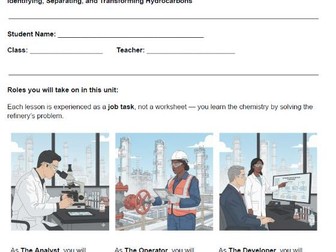
A complete GCSE Combined Science C7 Organic Chemistry unit built around an immersive refinery role.
Students progress from crude oil to cracking through structured, exam-aligned tasks that build deep understanding and confidence.
Print-ready, low cognitive load, and designed to reduce teacher planning time.
Include complete teacher answer guide, feedback and fix-it activities.
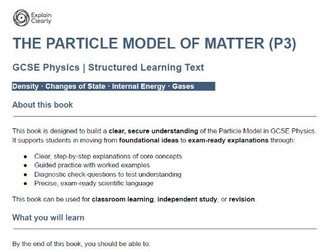
A structured GCSE Physics workbook for the Particle Model of Matter (P3), designed to build clear understanding through step-by-step explanations, purposeful visuals, and exam-ready practice.
Explain Clearly: GCSE Physics — Particle Model of Matter (P3)
Structured Learning Workbook
This workbook is designed to help students develop a secure conceptual understanding of the Particle Model in GCSE Physics.
It prioritises clear explanations before memorisation, supporting students to move from foundational ideas to exam-ready scientific explanations.
What’s included
Clear, step-by-step explanations of core concepts
Explicit use of the particle model and energy ideas
Guided practice with worked examples
Diagnostic hinge questions to check understanding
Structured fluency and exam-style questions
Calm, accessible layout suitable for mixed-ability classes
Topics covered
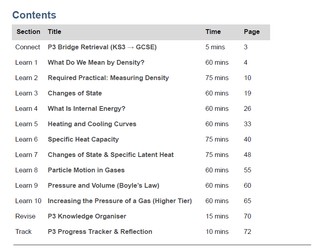
Density of materials
Changes of state
Internal energy
Specific heat capacity
Specific latent heat
Particle motion in gases
Gas pressure (Boyle’s Law – Higher Tier)
How this resource is best used
As a lesson workbook
For guided revision or intervention
For independent study with clear scaffolding
Specification alignment
Aligned to AQA GCSE Physics (Combined Science & Triple Science).
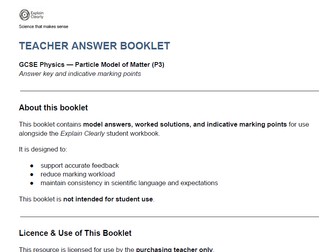
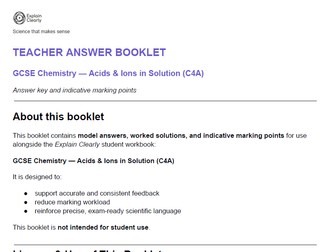
Teacher answer booklet for the Explain Clearly P3 workbook, including model answers and indicative marking points to support accurate feedback and reduce marking workload.
Explain Clearly: GCSE Physics — Particle Model of Matter (P3)
Teacher Answer Booklet
This booklet contains model answers, worked solutions, and indicative marking points to support teaching and assessment when using the student workbook.
It is designed to:
support consistent scientific language
reduce marking time
clarify expected exam-style responses
This resource is not intended for student use.
This bundle includes the student workbook and the corresponding teacher answer booklet for the Particle Model of Matter (P3), supporting clear teaching, accurate feedback, and exam-ready understanding.
GCSE Chemistry: Acids & Ions in Solution
Complete Teaching & Learning Bundle (AQA C4)
This bundle provides a clear, structured, and exam-ready unit for teaching Acids & Ions in Solution as part of GCSE Chemistry – Chemical Changes.
It supports students in moving from basic descriptions of reactions to confident explanations using ions, equations, and calculations, helping them secure marks across knowledge, application, and extended response questions.
What’s included
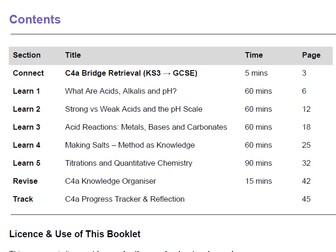
Student Learning Booklet
A comprehensive student booklet covering:
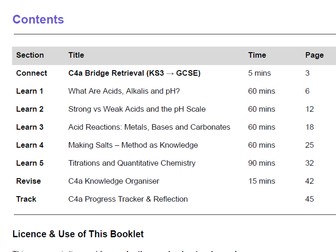
Acids, alkalis, bases, and aqueous solutions
The pH scale and hydrogen ion concentration
Strong vs weak acids
Acid reactions with metals, bases/alkalis, and carbonates
Making soluble salts using standard laboratory methods
Titrations and calculating concentration
Worked examples, practice questions, and exam-style tasks
Designed for:
Lesson delivery
Independent work
Revision and catch-up
Built-in Retrieval and Progress Checks
Starter retrieval tasks to activate prior knowledge
Carefully sequenced questions to check understanding
End-of-lesson reflection and confidence tracking
Exam-Focused Practice
Clear use of GCSE command words
Structured calculation walkthroughs
Opportunities to practise 4–6 mark explanations
Explicit links between methods, equations, and calculations
Practical Methods Explained Clearly
Salt preparation using insoluble bases/carbonates
Titration method and endpoint
Emphasis on accuracy, repetition, and reliability
Clear explanation of why each step is used
Why teachers choose this bundle
✔ Reduces planning workload
✔ Improves student explanations, not just recall
✔ Helps students avoid common exam errors
✔ Suitable for mixed-attainment classes
✔ Ready to teach straight away
Specification Coverage
AQA GCSE Chemistry (8462 / 8464)
C4 Chemical Changes:
Acids and pH
Neutralisation
Salt preparation
Titrations
Concentration calculations
Who this is for
GCSE Chemistry teachers
Teachers running revision or intervention groups
Departments seeking consistent, high-quality resources
Teachers who want clarity, structure, and exam alignment
Licensing
This resource is licensed for single-teacher classroom use only. It may not be shared, uploaded, or redistributed.
A structured GCSE Chemistry workbook that builds a secure understanding of acids as ion-producing substances, linking pH, reactions, salt preparation, and titrations through clear explanations and exam-ready practice.
Explain Clearly: GCSE Chemistry — Acids & Ions in Solution (C4A)
Knowledge-Rich Student Workbook
This booklet is designed to develop a clear and coherent understanding of acids, alkalis, and ions in solution as part of AQA GCSE Chemistry Topic C4: Chemical Changes.
It focuses on why acid reactions are predictable, how pH works, and how chemists prepare salts accurately and safely, moving students from foundational ideas to confident exam explanations.
What this booklet is
This is a knowledge-rich learning booklet, not a worksheet pack.
It supports:
classroom teaching
independent study
structured exam revision
The emphasis is on explanation before memorisation, with careful sequencing and precise scientific language throughout.
What students will learn
By the end of this booklet, students should be able to:
explain acids and alkalis using ions
interpret and apply the pH scale
predict and explain acid reactions
explain salt-making methods
carry out and calculate titrations
What’s included
Clear, step-by-step explanations of core ideas
Explicit use of ions and equations, not just observations
Worked examples and guided practice
Diagnostic hinge questions to check understanding
A topic knowledge organiser
A student progress tracker and reflection section
Specification coverage
Aligned to AQA GCSE Chemistry (8462 / 8464):
C4 Chemical Changes
Acids and pH
Neutralisation
Salt preparation
Titrations
How this resource is best used
As a lesson booklet for Topic C4A
For structured revision or intervention
To support secure understanding before practical or exam work


 Quick View