Year 6 British Empire PlanningQuick View
benroberts92

Year 6 British Empire Planning

(0)
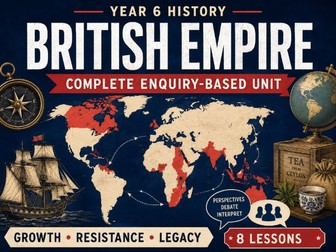
A complete Year 6 History unit on the British Empire, designed around enquiry-based learning so that pupils build historical knowledge through questioning, evidence, interpretation and discussion rather than simply being given information. The unit explores the British Empire from its growth through to its decline and lasting legacy. Pupils consider why Britain built an empire, how it gained control, what life was like for different people living under British rule, Britain’s involvement in slavery and exploitation, resistance across the Empire, decolonisation, migration and how the Empire is remembered today. The lessons deliberately present pupils with different perspectives and interpretations, encouraging them to make evidence-based historical judgements rather than reducing the Empire to a simple positive/negative narrative. The unit includes: Lesson 1: What is an empire and why do countries build them? Lesson 2: How and why did the British Empire grow? Lesson 3: What was life like for different people living under British rule? Lesson 4: How did slavery and exploitation contribute to Britain’s Empire? Lesson 5: Why did people resist British rule? – including Gandhi and India, Benin, and Sam Sharpe’s rebellion in Jamaica Lesson 6: How is the legacy of Empire visible in our local area? Lesson 7: Why did the British Empire decline and end? Lesson 8: How should Britain remember the British Empire? Resources include differentiated activities, historical sources, images, enquiry questions, sentence stems, vocabulary, discussion tasks and opportunities for extended historical judgement. Important note about Lesson 6: Lesson 6 is specifically written for Enfield, London and explores how the legacy of the British Empire can be seen in Enfield today, particularly through migration, the Commonwealth and the development of the local community. Anyone downloading this resource outside Enfield will need to adapt Lesson 6 for their own locality. The lesson structure and enquiry approach can be retained, but the local examples, photographs, migration links and place-specific information should be replaced with evidence relevant to your own area. Suitable for Year 6 / Upper KS2 and particularly useful for schools looking for a more balanced, challenging and genuinely enquiry-led approach to teaching the British Empire. Please note: This resource includes ActivInspire flipcharts. PDF versions are also provided so that all lesson content can be accessed without ActivInspire. If you would like to use the interactive flipchart files, ActivInspire can be downloaded from the official Promethean website. YouTube also has guides explaining installation and activation.
Year 5 Properties and Changes of Materials PlanningQuick View
benroberts92

Year 5 Properties and Changes of Materials Planning

(0)
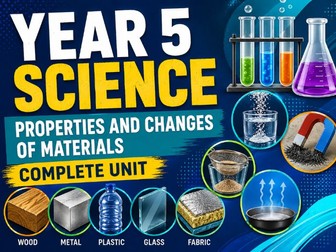
A fully planned and resourced Year 5 Science unit covering Properties and Changes of Materials, with PowerPoint lessons, detailed planning, pupil resources, practical investigations, and SEND/EAL scaffolds. The unit follows an enquiry-based approach, encouraging pupils to predict, test, observe and explain while developing secure scientific knowledge and vocabulary. Lessons are clearly structured with learning objectives, success criteria, key vocabulary, practical activities and plenaries. What’s included: PowerPoint presentations for each lesson Detailed unit planning Pre- and post-unit quizzes Differentiated pupil resources SEND/EAL scaffolds and sentence stems Practical investigations Scientific vocabulary and assessment opportunities Topics covered: Comparing and grouping materials Choosing materials for different purposes Thermal conductors and insulators Dissolving and solutions Fair testing Separating mixtures Filtration and evaporation Reversible and irreversible changes Rusting and chemical reactions This resource is classroom-ready, inclusive and carefully sequenced, supporting Upper KS2 National Curriculum objectives while reducing planning time.
Year 6 WW2 PlanningQuick View
benroberts92

Year 6 WW2 Planning

(0)
This fully planned Year 6 World War Two unit provides a rich, enquiry-based learning journey covering key events, people and impacts of WW2. Designed for Spring Term, it includes detailed lesson planning, differentiated tasks, key vocabulary and structured outcomes to support all learners. The unit explores major historical themes such as propaganda, evacuation, the Holocaust, Alan Turing and codebreaking, VE Day, rationing, the role of women, and the long-term consequences of WW2, with strong links to critical thinking, equality, and modern-day relevance. Video link (BBC Bitesize) for Lesson 2: Chamberlain and Appeasement Lessons are carefully scaffolded with: Clear learning objectives and success criteria High-quality historical vocabulary Primary sources and discussion prompts Differentiated tasks for HA, MA, LA, SEND and EAL pupils Engaging activities such as debates, Diamond Nine rankings, diary writing, timelines, role-play and enquiry questions Thoughtful plenaries focused on reflection, values and historical judgement The planning supports enquiry-based learning, promotes awe and wonder, and encourages pupils to make connections between past and present, including issues of bias, discrimination, human rights and equality. Perfect for: Year 6 WW2 units Spring term history planning Ofsted-ready curriculum evidence Teachers wanting ready-to-teach, in-depth planning What’s included: Full medium-term planning Lesson-by-lesson breakdowns Differentiation guidance Vocabulary lists and enquiry questions Clear progression across the unit A thorough, engaging and thoughtfully structured WW2 unit that saves planning time while delivering high-quality history teaching. Please note: This resource includes ActivInspire flipcharts. PDF versions are also provided so that all lesson content can be accessed without ActivInspire. If you would like to use the interactive flipchart files, ActivInspire can be downloaded from the official Promethean website. YouTube also has guides explaining installation and activation.
Year 6 Evolution and Inheritance PlanningQuick View
benroberts92

Year 6 Evolution and Inheritance Planning

(0)
A comprehensive, enquiry-based Year 6 Science unit covering Evolution and Inheritance, carefully planned across 8 progressive lessons. This unit develops pupils’ scientific understanding while embedding key skills such as questioning, observing patterns, using evidence, and evaluating ideas. Each lesson is clearly structured with learning objectives, success criteria, key vocabulary, enquiry questions, practical activities, differentiation, mini-writing opportunities, and plenaries, making it ideal for confident, consistent delivery across a half term. Topics covered: Inheritance and how characteristics are passed on Variation within species Adaptations and survival in different environments Natural selection and evolution over time Fossils as evidence of life in the past Extinction and human impact How scientific ideas change with new evidence Ethical debates around de-extinction Teaching approach: Enquiry-based learning throughout Strong focus on scientific vocabulary and reasoning Regular misconception checks Practical investigations (e.g. finch beak simulation, fossil evidence analysis) Discussion-rich lessons that promote critical thinking and debate Clear links to real-world science and ethical issues Differentiation & inclusion: Differentiation built into every lesson (LA / MA / HA) Visual supports and structured tasks for lower attainers Challenge prompts for higher-attaining pupils SEND scaffolding included Ideal for: Year 6 teachers Subject leaders Enquiry-focused science teaching Mixed-ability classes Reducing planning time while maintaining curriculum depth This unit fully supports Upper KS2 National Curriculum expectations for Evolution and Inheritance, while promoting curiosity, scientific thinking, and meaningful discussion. Please note: This resource includes ActivInspire flipcharts. If you would like to use the interactive flipchart files, ActivInspire can be downloaded from the official Promethean website. YouTube also has guides explaining installation and activation.
Year 6 Light and Electricity PlanningQuick View
benroberts92

Year 6 Light and Electricity Planning

(0)
A fully planned and resourced Year 6 Science unit covering Light and Electricity, delivered through ActivInspire flipcharts and supported by detailed lesson planning, pupil resources, and inclusive SEND/EAL scaffolds. This unit follows an enquiry-based learning approach, encouraging pupils to predict, test, observe and explain, while building secure scientific understanding and vocabulary. Every lesson is clearly structured with learning objectives, success criteria, key vocabulary, enquiry questions, practical investigations, and plenaries, making it ideal for confident delivery with minimal preparation. What’s included: ActivInspire flipcharts for every lesson (clear visuals, modelling and questioning) Detailed lesson planning for Light and Electricity Science Planning Practical investigations (circuits, batteries, components, reflection, shadows) Clear progression across sessions, revisiting and building knowledge step by step SEND scaffolds including simplified instructions, visual supports and sentence stems EAL resources, including English–Turkish vocabulary and sentence support Scientific vocabulary lists embedded in each lesson Assessment opportunities through discussion, diagrams, tables and explanations Topics covered: Building and testing simple electrical circuits Circuit symbols and scientific drawings How batteries and components affect circuits How light travels and how we see Reflection and mirrors How different surfaces reflect light How shadows are formed and how they change Ideal for: Year 6 teachers using ActivInspire Mixed-ability classes SEND and EAL learners Small-group intervention ECTs and non-specialist teachers Reducing planning time without reducing quality This resource is classroom-ready, inclusive, and carefully sequenced, while fully meeting Upper KS2 National Curriculum expectations for Science.
Year 6 SPAG GuideQuick View
benroberts92

Year 6 SPAG Guide

(0)
A clear, pupil-friendly SPaG revision booklet designed for Year 6 learners who need simple explanations but still want to cover the full SATs grammar, punctuation and language content. This guide breaks down key word classes (determiners, adjectives, nouns, noun phrases, expanded noun phrases, prepositions and prepositional phrases, verbs, modal verbs, adverbs, conjunctions, pronouns, relative clauses and omitted relative pronouns) using step-by-step definitions, SATs tips, and model sentences. The punctuation section includes colons, semi-colons, hyphens, speech punctuation (direct and indirect speech), apostrophes (possession and contractions), and commas (lists, fronted adverbials, parenthesis, subordinate clauses, and clarity). It also includes an easy-to-apply “Pause Trick” to help pupils choose the correct punctuation when reading aloud. Further sections cover clauses (main, subordinate, relative), sentence types, tenses (including progressive and perfect), active vs passive voice, and the subjunctive. There is a dedicated section on Standard vs Non-Standard English with common SATs traps (was/were, did/done, double negatives, me/I) and tick-box style practice. Finally, the booklet includes 10 “Tricky SATs Questions Made Easy” with the full question included and simple, pupil-friendly explanations, focusing on comma meaning, formality, conjunction meaning, and identifying prepositions vs subordinating conjunctions.