This pack contains for teaching/revising Elasticity off Supply.
This resource includes:
Clear explanations of key economic concepts
Structured activities to develop knowledge, understanding, analysis and evaluation.
Suitable for:
A Level Economics (all exam boards)
Classroom teaching, independent study, testing and exam practice.
Topics covered:
Price Elasticity of Supply (PES) - Concepts and calculation
Factors affecting Price Elasticity of Supply
Real world examples & application of PES
This resource includes
PES Application Lesson plan.
Full editable Powerpoint Presentation
Student handouts (editable)
Student work worksheets (editable)
Multiple Choice quiz (editable)
Three 15 mark exam questions with model answers
This resource is designed to reduce teacher workload while supporting students in developing confident, exam-focused economic analysis.
Please leave a review if you find this resource useful.
This complete A Level Economics elasticity teaching pack provides everything needed to teach Price Elasticity of Demand (PED), Income Elasticity of Demand (YED) and Cross Elasticity of Demand (XED) with confidence and clarity.
The materials are carefully structured to move students from secure understanding of key concepts and calculations through to application, analysis and evaluation, fully supporting the demands of A Level assessment.
The unit follows a logical teaching sequence of PED → YED → XED and is suitable for AQA, Edexcel and OCR specifications.
What’s included in this resource?
20+ student-friendly PDF resources, combined in two printable/digital workbook
5 fully editable PowerPoint presentations for teacher-led delivery
Worked examples and calculation practice
Exam-style questions targeting AO1, AO2, AO3 and AO4
Clear diagrams and structured written-response tasks
All materials are ready to use and designed to reduce planning time while maintaining high academic standards.
Topics covered
Price Elasticity of Demand (PED)
Definition and calculation
Interpretation of PED values
PED along a linear demand curve
Determinants of PED
PED, revenue and pricing decisions
Income Elasticity of Demand (YED)
Normal, inferior and luxury goods
Interpretation of YED values
YED and economic growth
Sectoral change and real-world application
Cross Elasticity of Demand (XED)
Substitutes, complements and unrelated goods
Calculation and interpretation
Competitive strategy and market relationships
The pack also includes opportunities to compare PED, YED and XED, address common misconceptions, and practise exam technique.
Why this resource works in the classroom
Clear explanations that students can follow independently
Strong focus on exam skills and written responses
Flexible design — suitable for classwork, homework or revision
Editable PowerPoints allow easy adaptation for different groups
Ideal for new teachers or experienced teachers seeking high-quality, ready-made materials
Perfect for:
A Level Economics (KS5)
Classroom teaching or blended learning
Revision and consolidation
Cover lessons or targeted intervention
This resource is designed to support teachers in delivering elasticity confidently while helping students build the analytical and evaluative skills required for success at A Level
These are some samples of resources contained in my Elasticity of Demand Teaching Pack.
I hope these samples allow you to purchase the full resource pack with confidence
What’s included in the full resource pack?
20+ student-friendly PDF resources, combined in two printable/digital workbooks
5 fully editable PowerPoint presentations for teacher-led delivery
Worked examples and calculation practice
Exam-style questions targeting AO1, AO2, AO3 and AO4
Clear diagrams and structured written-response tasks
All materials are ready to use and designed to reduce planning time while maintaining high academic standards.
Topics covered
Price Elasticity of Demand (PED)
Definition and calculation
Interpretation of PED values
PED along a linear demand curve
Determinants of PED
PED, revenue and pricing decisions
Income Elasticity of Demand (YED)
Normal, inferior and luxury goods
Interpretation of YED values
YED and economic growth
Sectoral change and real-world application
Cross Elasticity of Demand (XED)
Substitutes, complements and unrelated goods
Calculation and interpretation
Competitive strategy and market relationships
The full pack also includes opportunities to compare PED, YED and XED, address common misconceptions, and practise exam technique.
Why the full resource pack works in the classroom
Clear explanations that students can follow independently
Strong focus on exam skills and written responses
Flexible design — suitable for classwork, homework or revision
Editable PowerPoints allow easy adaptation for different groups
Ideal for new teachers or experienced teachers seeking high-quality, ready-made materials
The full resource pack is perfect for: A Level Economics (KS5)
Classroom teaching or blended learning
Revision and consolidation
Cover lessons or targeted intervention
The full resource pack is designed to support teachers in delivering elasticity confidently while helping students build the analytical and evaluative skills required for success at A Level.
I hope these samples allow you to purchase the full resource pack with confidence
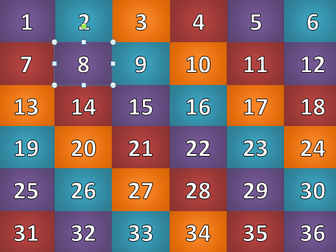
This is a fun and productive way to end your A level economics course and is directed at students who have done their revision.
It is a powerpoint template which you can easily adapt and change the questions to suit other times of the year, with other groups and even other subjects
Student choose a number from 1 -36 - click on that and it takes you to the question
Click back on the number to hyperlink back to the numbers screen - the number chosen is then not displayed so cannot be chosen again
Use as team game or students could complete individually using mini white boards
My wife says my rules are too complicated but you can easily change these to suit your class
A series of 15 Christmas questions with answers based on the types of questions asked in the Distinctly Average Round on Richard Osman’s House of Games.
Students compete in pairs. They are asked questions with a numerical answer. Each student writes their guess without conferring with their partner. Each pair’s are then revealed. The students then calculate the average of their two individual guesses. The pair who get closest to the real answer score a point.
Alternatively students could answer individually with points for the nearest answer. or it could be used as a maths resource with points been awarded for answers within say 10% or 20% of the correct answer.
A series of 25 questions with answers based around the types of questions asked in the Distinctly Average Round on Richard Osman’s House of Games.
Students compete in pairs. They are asked questions with a numerical answer. Each student writes their guess without conferring with their partner. Each pair’s are then revealed. The students then calculate the average of their two individual guesses. The pair who get closest to the real answer score a point.
Alternatively students could answer individually with points for the nearest answer. or it could be used as a maths resource with points been awarded for answers within say 10% or 20% of the correct answer.
A series of sports based questions with answers. Questions are the types of questions asked in the Distinctly Average Round on Richard Osman’s House of Games.
Students compete in pairs. They are asked questions with a numerical answer. Each student writes their guess without conferring with their partner. Each pair’s are then revealed. The students then calculate the average of their two individual guesses. The pair who get closest to the real answer score a point.
Alternatively students could answer individually with points for the nearest answer.
Use the answers and guidance and you can adapt it to ask for not just the numerical answer but for specific answers.


 Quick View