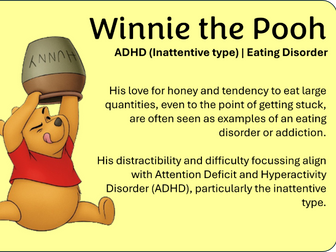
Winnie the Pooh Disorders DisplayQuick View
kristinajayne

Winnie the Pooh Disorders Display

(0)
Winnie the Pooh Pathology & Character Disorders Classroom Display Bring psychology and mental health awareness to life in your classroom with this engaging and educational Winnie the Pooh-themed display set. This unique resource uses beloved characters from the Hundred Acre Wood to explore psychological concepts and disorders in a way that is accessible, memorable, and thought-provoking for students. What’s Included: Pooh Character Disorders Presentation A character-by-character breakdown linking each Winnie the Pooh character to a psychological disorder or trait: Winnie the Pooh - ADHD (Inattentive Type), Eating Disorder Piglet – Generalised Anxiety Disorder (GAD) Eeyore – Depression Rabbit – Obsessive Compulsive Disorder (OCD) Tigger – ADHD (Hyperactive Type) Owl – Dyslexia, Learning Difficulty Christopher Robin – Schizophrenia Roo – Autism Spectrum Disorder (ASD) Kanga – Social Anxiety A companion resource that introduces key psychological and medical terms such as: Pathology, Disease, Symptom vs. Sign Chronic Conditions, Impulse Control Attachment Theory, Traits Nature vs. Nurture Educational Value: Encourages empathy and understanding of mental health. Supports curriculum topics in psychology, health, and social care. Promotes discussion around emotional wellbeing and personality traits. Helps students relate abstract concepts to familiar characters. Perfect For: Health & Social Care or Psychology classrooms Mental health awareness weeks SEN (Special Educational Needs) discussions School counsellor offices Interactive bulletin boards
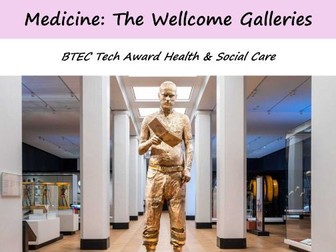
Science Museum Workbook - Health and Social CareQuick View
kristinajayne

Science Museum Workbook - Health and Social Care

(0)
This workbook has been designed to guide Year 9 and 10 students through an engaging, curriculum‑linked exploration of Medicine: The Wellcome Galleries at the Science Museum. It supports learning for Component 1: Human Lifespan Development of the BTEC Tech Award in Health and Social Care, helping students apply classroom knowledge to real‑world contexts. Through structured tasks, reflection prompts, and gallery‑based investigations, students develop their understanding of: Life stages and the characteristics of Physical, Intellectual, Emotional and Social (PIES) development. Factors affecting human growth and development, including biological, social, cultural, environmental, economic and lifestyle influences. Significant life events and how individuals adapt to them using formal and informal support. The workbook encourages students to make connections between museum exhibits—such as medical technologies, public health displays, patient stories, and historical treatments—and the human experiences behind them. Each activity invites them to think critically, interpret evidence, and reflect on how health, medicine and care have shaped people’s lives across different time periods and life stages. Designed for use during the museum visit, the workbook promotes active engagement, independent thinking and meaningful links to vocational learning. It also provides opportunities for assessment, self‑reflection, and rich discussion back in the classroom.