AQA  Psychology Social Influence Revision Booklet | Essay Planning & Exam PracticeQuick View
froggy901

AQA Psychology Social Influence Revision Booklet | Essay Planning & Exam Practice

(0)
Comprehensive Social Influence revision booklet for AQA A Level Psychology (Year 12/AS or Year12 revision). Includes retrieval practice, AO2 application, 16-mark essay planning and exam technique activities. This resource has been designed to help students revise the entire Social Influence topic while developing the exam skills needed for assessment. Rather than simply reading notes, students can actively practice key terminology, application skills, essay planning and evaluation. This booklet is particularly useful for: End of topic revision Mock exam preparation Independent study / homework Intervention sessions Revision lessons Flipped learning Contents: Key terminology retrieval table: Students can revise and define key Social Influence concepts AO2 application practice: A range of scenario based questions - students are required to identify and apply psychological concepts to unfamiliar scenarios 16-mark essay planning grids: Structured planning activities for 5 essay questions containing AO1 prompts, AO3 development prompts and optional criticism sections to support students of all abilities Exam technique challenge: students review their essay plans and are guided to identify the most effective evidence for shorter answers and under timed conditions Specification Designed for: AQA A Level Psychology (Social Influence) Year 12 Psychology Year 13 revision **File Type: ** PowerPoint (.pptx) - designed as easy-to-edit A4 pages This booklet can be edited to suit your own teahcing style, class needs or specification.
Racism in Society: The School That Tried to End RacismQuick View
froggy901

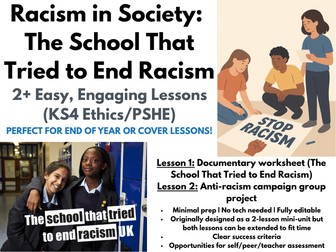
Racism in Society: The School That Tried to End Racism

(0)
Two engaging, low-prep lessons on racism in society – ideal for KS4 Ethics, Citizenship, or PSHE This flexible mini-unit includes two thoughtfully designed lessons that explore racism in an age-appropriate, accessible way. It’s perfect for end-of-year teaching, cover lessons, or as a ready-to-use resource to support meaningful discussion and creative thinking with minimal teacher prep required. What’s included: 1 editable PowerPoint – covers both lessons with clear instructions, visual prompts, optional discussion questions, support/inspiration for students, and success criteria 1 editable worksheet to accompany Episode 1 of the Channel 4 documentary The School That Tried to End Racism 1 editable planning worksheet for the group campaign task –* includes guiding questions and built-in scaffolding* Lesson 1: Documentary and Discussion Students watch The School That Tried to End Racism (Episode 1), currently free to stream for Amazon Prime subscribers. Some clips may also be available on YouTube or through educational platforms. The included worksheet supports comprehension, personal reflection, and purposeful discussion. You can easily extend this lesson depending on how many episodes you choose to show (or assign different episodes to different groups). Lesson 2: Anti-Racism Campaign Project Students work in small groups to design their own anti-racism campaign (poster, slogan, and short speech/script). The task encourages creativity, empathy, and practical solutions to challenge racism in school or the wider community. The campaign task works brilliantly as a standalone lesson, but also makes a great follow-up to the documentary. It can easily be extended into 2–3 lessons by allowing more time for students to create high-quality resources and using the built-in success criteria for self, peer, or teacher assessment. Optional extension ideas: Group presentations Carousel/market-stall activity to view and give feedback on each group’s campaign Display final posters in class or around the school Who is it for? KS4 (ages 14–16) – suitable for Ethics, PSHE, Citizenship, or tutor sessions Designed with challenging or mixed-ability classes in mind – minimal tech, no computer room needed, and easy to manage Whether you want to make the most of your final weeks with a class or introduce a deeper look at racism through real-life context and student voice, this resource gives you everything you need.
GCSE / A-Level Sociology – Education Topic Revision Carousel | Independent, Homework, or Cover TaskQuick View
froggy901

GCSE / A-Level Sociology – Education Topic Revision Carousel | Independent, Homework, or Cover Task

(0)
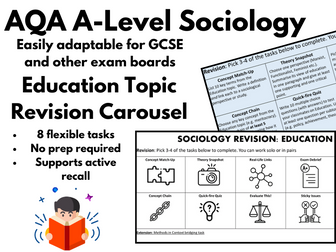
This flexible, low-prep revision carousel is perfect for consolidating learning at the end of the Education topic in AQA A-Level Sociology (though it can easily be adapted for GCSE or other exam boards). Designed for maximum versatility, this task grid encourages active recall, higher-order thinking, and independent learning. Students choose from a range of 8 tasks covering theory, key concepts, debate, and exam application. Tasks are varied and accessible, making this ideal for: Independent revision lessons Homework or flipped learning Engaging cover work with no printing needed Small group or paired discussion tasks End-of-topic review and retrieval practice Each task encourages depth and critical thinking, with built-in stretch and challenge. The grid format also allows differentiation by choice - students can pick the tasks that best suit their confidence level or interests. Also included is an optional extension task to help bridge into the next topic (Methods in Context), encouraging students to think like sociologists by applying methods to education-based issues.
AQA GCSE Psychology Paper 1 Exam Style QuestionsQuick View
froggy901

AQA GCSE Psychology Paper 1 Exam Style Questions

(0)
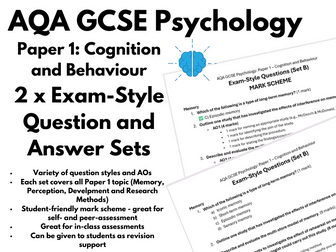
Two sets of exam-style questions AND answer sheets / mark schemes, covering all Paper 1 topics of the AQA GCSE Psychology spec. Each set contains a selection of MCQs, short answer questions and extended response (9 markers) for each section of Paper 1 (Memory, Perception, Development and Research Methods). Assesses knowledge and understanding, application and evaluation, and includes a ‘design a study’ style question. Mark schemes are student-friendly to support peer- and self-marking, containing breakdowns of how marks are awarded and example responses. Can be used as in-class assessments, or given to students as a revision resource.
AQA Sociology: Intro to Crime & DevianceQuick View
froggy901

AQA Sociology: Intro to Crime & Deviance

(0)
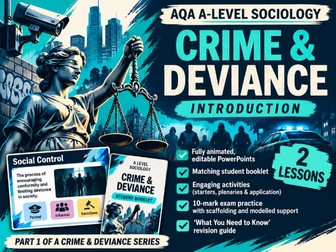
Two fully editable AQA A-Level Sociology lessons and matching student booklet covering the introduction to Crime and Deviance. Created by a Sociology teacher with over 10 years’ experience, this ready-to-teach resource covers the introductory Crime and Deviance content. The lessons and booklet are designed to work together, with clear explanations, engaging activities and structured support for exam skills. What’s included? Fully animated, editable PowerPoint lessons with explanations, discussion prompts, activities and suggested answers. Matching student booklet with key definitions, reference notes and space to apply learning. ’What You Need to Know’ pages with learning checklists, key terms, synoptic links and revision guidance. Starters, plenaries and application activities to develop understanding and encourage discussion. 10-mark exam-style question with paragraph planning, worked modelling and step-by-step support for explanation and analysis. Synoptic links to relevant sociologists and Year 12 content. Topics covered Lesson 1: Introduction to Crime and Deviance Crime, deviance, norms and values Social construction of crime and deviance Contextual, cultural, historical and age relativity Scaffolded 10-mark exam practice Lesson 2: Social Order and Social Control Social order and conformity Formal and informal social control Positive and negative sanctions Agencies of social control: police, courts, schools, family, peers, religion and media Synoptic links to Durkheim, Parsons, Bowles and Gintis, and Becker Designed for the classroom The booklet provides key definitions and notes, reducing time spent copying and leaving more time for discussion, application and exam practice. Animated slides guide explanations and model answers, while the editable files let you adapt the lessons to your classes. Suitable for AQA A-Level Sociology (Year 13 / Year 2). Part 1 of my Crime and Deviance series. Further topics will be available separately, each with teaching slides and matching booklet materials.
AQA Sociology Year 13 Revision SessionsQuick View
froggy901

AQA Sociology Year 13 Revision Sessions

(0)
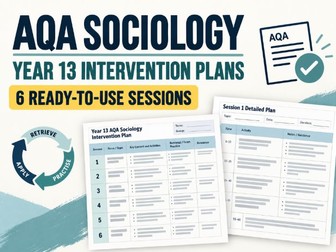
Six ready-to-use AQA Sociology revision / intervention sessions for Year 13, revisiting key Year 12 content through retrieval practice and exam skills. What is included? An overview and complete scheme of work for six standalone 45–50 minute intervention sessions Detailed timings, teacher prompts, suggested answers, common misconceptions and assessment-for-learning guidance A shortened route for each session when less time is available Coverage of key Year 12 content from Education, Families and Households, Research Methods and Methods in Context Exam practice including 10-mark analysis, 20-mark evaluation, short methods questions and applied Methods in Context work Session topics External factors affecting educational achievement Labelling, self-fulfilling prophecy and pupil responses Changing family patterns and family diversity Domestic labour, decision-making and power within couples Practical, ethical and theoretical factors affecting research-method choice Investigating teacher labelling using non-participant observation Designed for practical intervention teaching These sessions were created for Year 13 students who need focused revision of Year 12 knowledge alongside regular exam practice. Each session is self-contained, so students can still benefit when intervention attendance varies. The sequence follows a consistent evidence-informed routine: retrieve from memory → check and correct → retrieve again → apply to an exam task → reflect This helps students identify genuine gaps rather than simply rereading notes. The activities also require them to improve causal explanations, use sociologists accurately, apply items and context, and turn knowledge into developed exam answers. Minimal teacher preparation No specialist equipment or newly created worksheets are required. Sessions use students’ existing notes or booklets, lined paper, two coloured pens and a white-board. Suggested content and answers are included within each session plan. The opening check also allows the teacher to respond to an urgent shared need in the moment. If there is no clear group-wide gap, the prepared session can be delivered immediately. Each plan includes clear prompts, misconceptions to watch for and guidance on what strong responses should contain. Suitable for intervention lessons, small-group revision, targeted support, resit preparation or structured exam-skills sessions. Plan is in spreadsheet format - first sheet shows the SOW, subsequent sheets for each session. I just printed it all out and used it as a reference when delivering. Questions can be asked verbally or written on whiteboard. No need for PPTs etc. First in a series - if you like it, please check out my others!