Mastering Science Skills: The Ultimate slideshow, activities and workbook comboQuick View
rc_mitchell

Mastering Science Skills: The Ultimate slideshow, activities and workbook combo

(0)
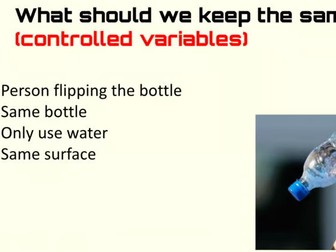
Are you looking for a way to make the “Scientific Method” actually stick? Move beyond dry definitions and get your students doing science from Day 1! This high-engagement bundle transitions students from basic observations to designing their own controlled experiments using relatable, hands-on activities like the Bottle Flip Challenge and Paper Helicopter Investigations. What’s Inside? Interactive Instructional Slideshow (PPTX) Hook with Purpose: Starts with sensory observations (the Candle Lab) to teach the difference between qualitative and quantitative data. The “Bottle Flip” Method: Uses the viral trend to teach Independent, Dependent, and Controlled Variables in a way students never forget. Data Literacy: Step-by-step guidance on creating data tables, identifying anomalous results, and drawing lines of best fit. Error Analysis: Clear explanations of Random vs. Systematic errors to level up their evaluation skills. 2. Aligned Student Interactive Notebook (DOCX) Perfectly Synced: Every slide has a corresponding section in the workbook, including “Quick Fire” definition boxes and variable practice scenarios. Scaffolded Lab Reports: Includes a complete template for a Paper Helicopter Investigation where students must: Design a step-by-step method. Identify safety precautions. Calculate averages from multiple trials. Graph results and describe trends. Critical Thinking: A dedicated “Limitations and Improvements” table helps students move from “it was fun” to “here is how to improve the reliability of my data.” Why This Works: Zero Prep: Just print the workbooks and hit “Play” on the slideshow. IGCSE & Middle School Ready: Covers the core “Nature of Science” and “Experimental Skills” requirements found in most international curricula (including IGCSE 0620/0610/0625 Paper 6 prep). Active Learning: Students aren’t just watching; they are flipping bottles, dropping helicopters, and measuring results. Skill Progression: Moves from simple observations to complex evaluation and suggesting further research. Teacher Tip: I use the Bottle Flip section as a whole-class demonstration to build confidence, and then set the Paper Helicopter lab as their first “independent” assessment. It’s a fantastic way to see who has mastered variable control before moving into more complex chemistry or physics units! Reclaim your planning time and give your students a science foundation they’ll actually enjoy building. Add this bundle to your cart today!
Complete Human Reproduction & Health Unit: Slides, Notes, and AssessmentQuick View
rc_mitchell

Complete Human Reproduction & Health Unit: Slides, Notes, and Assessment

(0)
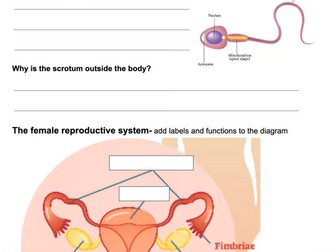
Teaching reproduction and sexual health can be a sensitive task. This comprehensive, “no-prep” bundle is designed to help you navigate this unit with maturity, scientific accuracy, and high student engagement. This bundle moves beyond basic biology to cover crucial life topics including puberty, the menstrual cycle, fetal development, contraception, and STI awareness. What’s Included? Interactive Instructional Slideshow (PPTX) Safe Space Setup: Begins with essential “Classroom Rules” and a “Question Box” strategy to ensure a respectful learning environment. Comprehensive Anatomy: Detailed breakdowns of the male and female reproductive systems (including the “why” behind anatomy, like scrotal temperature regulation). The Journey of Life: Clear, visual explanations of the menstrual cycle, fertilization, and the stages of pregnancy/birth. Health & Responsibility: Modern, factual slides on contraception methods (barrier, hormonal, LARC) and STI education. Check for Understanding: Includes a 15-question “Quick Quiz” at the end to review key concepts instantly. 2. Structured Student Companion Notes (DOCX) Perfect Alignment: Every slide in the presentation has a corresponding place in the notes. Students stay focused on the lecture rather than rushing to copy text. Active Learning: Includes diagram labeling, “journey of a sperm” creative writing prompts, and data-matching for STIs. Video Integration: Dedicated sections to accompany educational videos on birth and development. 3. Rigorous Summative Assessment (DOCX) Application-Based Testing: Moves beyond simple recall. Students must explain scientific misconceptions (e.g., “Can you get pregnant before your first period?”) and act as a “doctor” to diagnose fertility or health issues. Data Literacy: Includes a real-world data sheet on STI rates, requiring students to analyze trends, suggest reasons for infection spikes, and interpret graphs. Marking Guide Ready: Clearly defined mark allocations (e.g., 8-point story, 6-point diagnosis) to make grading transparent and easy. Why Teachers Love This Bundle: Sensitivity-First Approach: The “Rules of the Room” and “Question Box” slides help manage the “giggle factor” and create a professional atmosphere. Inclusive Content: Covers a wide range of topics including contraception and family planning, making it suitable for modern health and science curricula. Critical Thinking: The test doesn’t just ask “what is the cervix?”; it asks students to analyze CDC-style data and suggest logical reasons for public health trends. Zero Prep: From the first “hook” activity to the final unit test, your entire 2-3 week unit is planned. Teacher Tip: I recommend using the “Question Box” mentioned in the slides from Day 1. It allows students to ask the “embarrassing” questions anonymously, and you can use the last 5 minutes of each lesson to answer a few using the scientific terminology provided in the notes!
The Ultimate Separation Techniques Bundle: Slides, Interactive Notes, & TestQuick View
rc_mitchell

The Ultimate Separation Techniques Bundle: Slides, Interactive Notes, & Test

(0)
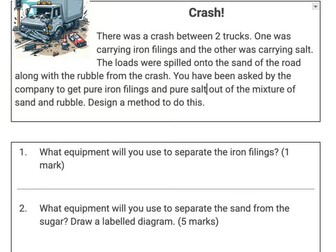
This comprehensive, “no-prep” bundle takes students from the basic definitions of mixtures to mastering complex lab procedures like Fractional Distillation and Rf Value Calculations. Featuring a high-interest Harry Potter-themed “Who Stole the Cloak?” Chromatography Lab, this unit is designed to keep engagement high while hitting rigorous academic standards. What’s Inside? Visual Instructional Slideshow (PPTX) Clear Key Definitions: Deep dives into Solute, Solvent, Solution, Soluble, and Insoluble. Step-by-Step Lab Guides: Visual instructions for Filtration, Evaporation, Decantation, Distillation, Magnetic Separation, and Winnowing. Safety First: Specific emphasis on safe heating (evaporating to 1/3 volume) and proper lab setup. Harry Potter Mystery: A complete slide deck for a “Who stole the invisibility cloak?” chromatography investigation. 2. Interactive Student Notebook (DOCX) Aligned Scaffolding: Perfectly follows the slideshow so students spend more time thinking and less time rushing to copy text. Graphic Organizers: Dedicated space for drawing and labeling lab apparatus (crucial for exam prep!). Practical Application: Includes the “Truck Crash” challenge where students must design a method to separate a complex mixture of iron filings, salt, sand, and rubble. 3. Comprehensive Unit Assessment (DOCX) Multi-Level Testing: Includes a mix of Multiple Choice (Section A), Free Response labeling and explanation (Section B), and “Challenge” scenarios (Section C). Real-World Logic: Tests students on survivalist science (solar stills) and forensic chromatography. Complete Mark Scheme: Includes a full answer key with point-by-point breakdowns to make grading your fastest task of the week! Why This Bundle is a Must-Have: The “Mystery” Hook: Students become forensic scientists to solve the “Ink Mystery,” making chromatography one of the most memorable lessons of the year. Critical Thinking: Rather than just memorizing steps, students are challenged with the “Survivalist” scenario, applying distillation and state changes to a real-life problem. Exam Ready: Covers technical skills like calculating Rf values and identifying residue vs. filtrate, aligning perfectly with middle school and introductory high school chemistry (including IGCSE Paper 6 prep). Print & Go: Everything is formatted for immediate classroom use. Before you print- please note that the mark scheme is in the same document as the assessment (and yes, I made the mistake of printing and handing out the mark scheme to a whole class!)
Atoms, Isotopes & Ions: Mini-UnitQuick View
rc_mitchell

Atoms, Isotopes & Ions: Mini-Unit

(0)
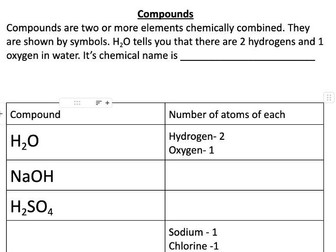
Are you looking for a way to bridge the gap between basic atomic structure and the complexities of ions and isotopes? This comprehensive mini-unit bundle is designed to help students master the “math of atoms” while building a visual understanding of matter. From calculating subatomic particles in charged ions to predicting the state of an element at room temperature, this resource covers the technical skills that often trip students up in introductory chemistry. What’s Inside? Visual Instructional Slideshow (PPTX) Atomic Math Simplified: Step-by-step guides for calculating protons, neutrons, and electrons—including a dedicated section on Cations and Anions. Isotope Exploration: Clear explanations of what isotopes are (Carbon-12 vs. Carbon-14) and their real-world uses in medicine and carbon dating. The Particle Model: High-quality “Atoms in Boxes” diagrams to help students visually distinguish between Elements, Compounds, and Mixtures. Chemical Formulas: A breakdown of how to read formulas. Interactive “Level Up” Notebook (DOCX) State of Matter Challenge: A data-driven activity where students use melting and boiling points to predict if an element is a solid, liquid, or gas at specific temperatures. The Ion Practice: Scaffolding to help students understand why losing an electron creates a positive charge (and vice-versa). Formula Decoding: Practice tables for counting the exact number of atoms in complex compounds. Summative “Atoms & Ions” Quiz (DOCX) 36-Mark Assessment: A rigorous check for understanding that covers every concept in the unit. Progressive Difficulty: Moves from basic subatomic counts to “Challenge” questions involving ions. Critical Thinking: Asks students to explain the “why” behind atomic charges and isotope mass. Ready-to-Use: Professionally formatted and ready to print for a formal end-of-unit check. Why Teachers Love This Mini-Unit: Conquers Concept Confusion: Many resources skip over ions and isotopes—this unit dives deep into them, ensuring students are ready for bonding and reaction units. Visual & Mathematical: Balances the abstract “Atoms in Boxes” models with the concrete calculations required for chemistry success. IGCSE & Middle School Ready: Perfectly aligned with core chemistry standards (including atomic structure requirements for IGCSE 0620 and high school physical science). Zero Prep: The slideshow directs students exactly where to fill in their notes, making it perfect for both experienced teachers and subs!
Rates of Reaction Complete Unit Bundle: slides, interactive notes and assessmentQuick View
rc_mitchell

Rates of Reaction Complete Unit Bundle: slides, interactive notes and assessment

(0)
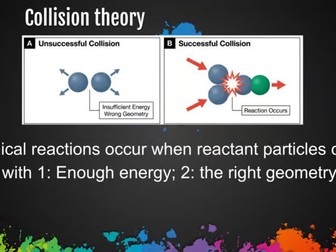
Unlock the secrets of chemical kinetics with this high-energy, “plug-and-play” unit bundle! Designed to take students from the basics of Collision Theory to mastering complex Rate Graphs, this resource is perfect for middle school science or introductory high school chemistry (including IGCSE 0620 prep). This bundle prioritizes student engagement through visual modeling and hands-on investigations, ensuring that abstract concepts like “activation energy” and “catalysts” become concrete. What’s Inside? Visual Instructional Slideshow (PPTX) Collision Theory Focus: Uses clear visual analogies to explain why “energy” and “geometry” are the two keys to a successful reaction. Graphing Mastery: Walk students through “A-B-C” graph analysis—understanding where a reaction is fastest, where it slows down, and why it eventually stops. Real-World Hooks: Relates chemistry to everyday life, from “glow sticks in hot water” to why we stir sugar into tea or keep food in the fridge. Integrated Checkpoints: Features built-in discussion prompts and “Learning Checks” to keep students active throughout the lesson. 2. Interactive Companion Notes (DOCX) The “No-Lost-Student” Design: The notes are perfectly synced to the slideshow, allowing students to fill in key definitions and state symbols (s, l, g, aq) without missing your lecture. Lab Technique Toolkit: Includes a structured comparison of experimental methods—from gas syringes and inverted measuring cylinders to the “disappearing cross” method. Critical Thinking Scenarios: Students must explain why certain methods won’t work for specific gases (like Hydrogen) and the purpose of equipment like cotton wool plugs. 3. Comprehensive 40-Mark Unit Test & Mark Scheme (DOCX)
Chemical Reactions Mastery Bundle: Slides, interactive notebook and 40 mark test.Quick View
rc_mitchell

Chemical Reactions Mastery Bundle: Slides, interactive notebook and 40 mark test.

(0)
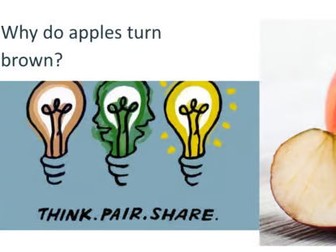
Transform your chemistry unit from “confusing formulas” into a hands-on exploration of the building blocks of the universe! This comprehensive bundle provides everything you need to teach Chemical vs. Physical Changes, Gas Tests, Word Equations, and the Law of Conservation of Mass. Featuring a “Brick Balancing” activity and high-engagement lab observations, this bundle is designed to build a rock-solid foundation for middle school or introductory high school chemistry students. What’s Inside? Instructional Slideshow (PPTX) Visual Transitions: Clear distinctions between physical changes (reversible) and chemical changes (new substances). Student Companion Notes (DOCX) Observation-Driven Learning: A structured lab log for students to record results from 5 different reactions (including heating sucrose and mixing magnesium with acid). Gas Test Toolkit: A handy reference table for identifying Hydrogen (“Squeaky Pop”), Oxygen (“Glowing Splint”), and Carbon Dioxide (“Limewater”). Scaffolded Practice: Exercises for identifying reactants vs. products and a dedicated “Balancing Equations” workspace with 10 increasingly difficult problems. Comprehensive 40-Mark Unit Test (DOCX) The “Steel Wool Practical” included in these notes is a game-changer for teaching the Law of Conservation of Mass. Seeing the mass increase on the scale usually confuses students—until they use the slideshow to realize they’ve actually “captured” oxygen from the air! It’s the ultimate “Aha!” moment. Before you print- the mark scheme is included in the same document as the test (and yes I have printed and given out the test with the mark scheme to a whole class!)