A-Level Lessons - Spies  L1-5Quick View
nikkitimms

A-Level Lessons - Spies L1-5

(0)
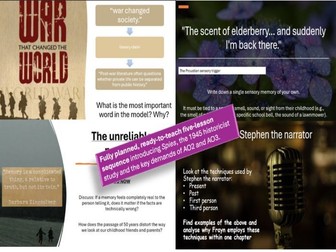
Students are introduced to the course, the 1945 historicist context and the opening chapters of Spies. Lessons focus particularly on sensory imagery, narrative voice and structure, with students encouraged from the outset to connect detailed textual analysis to the social, cultural and historical contexts surrounding the novel. The sequence balances teacher modelling, group analysis, discussion, independent written responses and regular formative assessment. Students encounter alternative interpretations and viewpoints, allowing them to consider how different readings of the text can be supported by evidence. Structured opportunities for collaborative reading and analysis are followed by individual written responses, establishing expectations for the analytical writing required throughout the course. The sequence builds towards a baseline assessment using Chapter 2 of Spies as an extract. This allows teachers to establish students’ starting points in relation to AO2/AO3 analysis and written argument before the course develops further. Included in the resource 5 fully planned lessons introducing Paper 2, the 1945 historicist study and Spies Structured Do Now / starter activities for every lesson Guided reading and annotation activities Detailed exploration of sensory imagery, narrative voice and structure Introduction to AO2 and AO3 Historical/contextual material on 1945 integrated into textual study Alternative viewpoints and interpretations for students to evaluate Structured opportunities for group discussion and collaborative analysis Independent written-response tasks to establish analytical writing habits A fully planned baseline assessment using Chapter 2 Homework tasks designed to extend students’ reading around the novel and its historical context A bonus student resource list to help students prepare for and succeed on the course A wider reading list offering accessible and more challenging texts connected to Spies, 1945 and the wider themes of the course The resources are designed to be used immediately, with the lesson sequence, student activities and assessment materials already structured for delivery. They provide a clear and purposeful starting point for AQA Paper 2 while establishing the analytical routines students will need throughout the A-level course.
Richard III - Camera Angles, Shots and MovementQuick View
nikkitimms

Richard III - Camera Angles, Shots and Movement

(0)
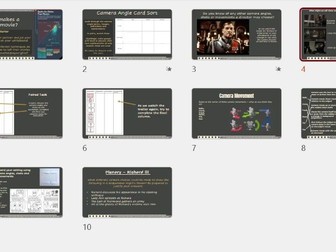
A complete lesson introducing students to different camera shots, angles and movement using a Richard III trailer. Students are introduced to the following shots/angles: low angle eye level angle high angle extreme close-up close-up long shot over the shoulder shot dolly crane track zoom tilt pan Students then use this to create their own storyboard of one of the scenes of the play. Resources included. Youtube links copied into slide notes.
Evil In MacbethQuick View
nikkitimms

Evil In Macbeth

(0)
Full resourced lesson tracking the theme of evil across the play, analysing key scenes and drawing on the ideas of literary critics. Students will examine the following: What is evil? Legitimate violence and how Macbeth’s actions are viewed differently as the play progresses The witches and the historical significance of prophecy The legitimation of patriarchy The metaphysic of evil Students will have the opportunity to work individually or in groups to analyse the following scenes: Act 1 scene 3 Act 3 scene 2 Act 4 scene 3 Students work on comparing act 3 scene 2 to act 1 scene 5. Students are presented with a sample paragraph at the end of the lesson which can be used to examine the mark scheme or as a style model for their own responses.
Feminine Gospels - BeautifulQuick View
nikkitimms

Feminine Gospels - Beautiful

(0)
Fully planned and resourced lessons (25 slides) on Carol Ann Duffy’s poem “Beautiful”. Created with the AQA A-Level Literature spec in mind, and comparison links made to The Color Purple, but can be adapted to suit other specifications and texts, or taught as a stand alone lesson or two analysing the poem. Depending on the pace of the group, this should take approximately 2 lessons. Lesson format: Guided discussion on beauty in society Context of the poem and the 4 figures presented by Duffy (group work) Guided analysis and annotation of the first section of the poem “Helen of Troy” Students present their analysis and annotations of the poem to the rest of the class Examination style question and sample paragraph provided
A Monster Calls - Book, Stage, Film AdaptationQuick View
nikkitimms

A Monster Calls - Book, Stage, Film Adaptation

(0)
Fully resourced lesson introducing the different conventions of prose, stage and film. Students examine extracts/clips from each and work individually/in pairs/in groups to track development. This lesson is based on A Monster Calls but can easily be modified for any novel adaptation. YouTube links, differentiated questions and worksheets included. Designed as an introduction to film for KS3 students but could be adapted to suit other key stages.
Feminine Gospels - Introduction and The DietQuick View
nikkitimms

Feminine Gospels - Introduction and The Diet

(0)
41 slides - includes 3 fully resourced lessons. Introduction to the anthology itself followed by analysis of the poem. Areas for class annotation and group work. Consideration of wider reading, how the writer shapes meaning, and context included. Created with the AQA A-Level English Literature spec in mind and students are encouraged to make links to “The Color Purple”. However, these slides are easily adaptable to include different texts, or removed entirely.
Racial Stereotypes in DisneyQuick View
nikkitimms

Racial Stereotypes in Disney

(0)
Fully planned and resourced lesson looking at racial stereotypes in Disney animated films. Students watch a variety of clips (youtube links in notes) and discuss how characters are portrayed. Students work in groups to read articles and then present their findings back to the class. Work leads up to analysis of how stereotypes are presented in a Disney movie. Students fill in the worksheet provided and would then move on to writing an essay response.
The Hunger Games - from Page to Stage to ScreenQuick View
nikkitimms

The Hunger Games - from Page to Stage to Screen

(0)
Fully resourced lesson introducing the different conventions of prose, stage and film. Students examine extracts/clips from each and work individually/in pairs/in groups to track development. This lesson is based on The Hunger Games but can easily be modified for any novel adaptation. YouTube links, differentiated questions and worksheets included. Designed as an introduction to film for KS3 students but could be adapted to suit other key stages.
Creating a News Broadcast - Lesson 1Quick View
nikkitimms

Creating a News Broadcast - Lesson 1

(0)
Part 1 of a 2-lesson end of term unit (could be extended to offer more time for script writing and editing, and filming and editing, if needed). Students form groups to become a newsroom and prepare to create their own news broadcast. In lesson 1, students will: consider the different roles people have in a newsroom discuss how to research news and ensure their facts are valid research current news articles and develop an informed response pitch an idea to the rest of their group delegate homework tasks to ensure the group is ready to write their script and film their broadcast next lesson Links to youtube clips and online news article sources are included in the slide notes.
The Color Purple - Revision NotesQuick View
nikkitimms

The Color Purple - Revision Notes

(0)
Revision notes on the following: Authorial context Context - Setting Theme: Race and Racism Theme: Gender and Sexism Note on each theme include detailed analysis of linguistic choices, examining how Walker shapes meaning through her methods.
Reading Starters, Progress Checks, Exit TicketsQuick View
nikkitimms

Reading Starters, Progress Checks, Exit Tickets

(0)
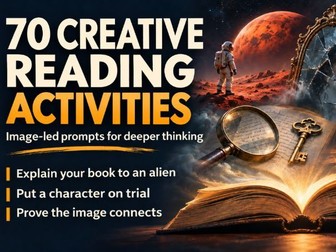
Make reading lessons more imaginative. This editable PowerPoint contains 70 creative reading Do Now/Progress Check/Exit Ticket activities, with one prompt per slide and a short teacher guide. Students can respond to whichever book they are reading, so the activities work even when everyone is on a different text or at a different point in the story. The prompts invite students to do more than recall the plot. They explore character motives, perspective, symbolism, cause and effect, and the choices authors make. Students might explain their book to an alien, put a character on trial, connect an unexpected image to their story, or change one tiny decision and predict the consequences. What’s included: 70 ready-to-display prompts across 72 slides Atmospheric images and large, classroom-friendly text A reminder to support each response with a detail from the book A simple 3–5 minute format for independent writing or discussion Ideal for KS3 and KS4 independent reading, library lessons, reading time, class readers. Fully adaptable.