End of Year Mega Quiz 2026 – Printable Classroom Quiz Pack - ONE PAGE QUIZ!Quick View
aries81

End of Year Mega Quiz 2026 – Printable Classroom Quiz Pack - ONE PAGE QUIZ!

(0)
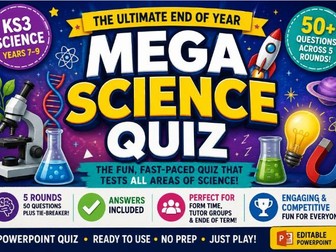
Bring the excitement to the end of term with this ready-to-use End of Year Mega Quiz, designed for secondary students. Perfect for the final lesson, tutor time, enrichment days or reward activities, this engaging resource encourages teamwork, discussion and friendly competition. The pack includes: A colourful 50-question quiz sheet featuring 5 themed rounds (10 questions per round). A teacher answer sheet with all answers in one place for quick and easy marking. A student response sheet with space for teams to record their answers. Team score boxes and a tie-breaker challenge. The questions cover a broad range of topics including geography, science, history, entertainment and sport, making the quiz accessible and enjoyable for students across Key Stage 3 and Key Stage 4. Ideal for: End-of-term lessons Tutor time Reward lessons Cover lessons House competitions Enrichment activities Simply print the quiz, answer sheet and response sheets, divide the class into teams and you’re ready to play—no preparation required. Contents 1 x Quiz Question Sheet 1 x Teacher Answer Sheet 1 x Student Response Sheet Tie-breaker Challenge A fun, engaging and low-preparation activity to finish the school year on a high.
Class SEND Snapshot | Teacher Overview & Adaptive Teaching PlannerQuick View
aries81

Class SEND Snapshot | Teacher Overview & Adaptive Teaching Planner

(0)
Description Support inclusive teaching with this practical one-page Class SEND Snapshot, designed to help teachers quickly identify learners’ strengths, barriers and the adaptive strategies that make the greatest difference. This editable planning document provides an at-a-glance overview of your class, helping you implement Quality First Teaching and adaptive practice throughout the academic year. It is ideal for class teachers, subject teachers, SENDCos and teaching assistants. Resource includes: Class SEND overview template Space to record strengths and barriers Top adaptive strategies for each learner Exam access arrangements Review dates and teacher notes Whole-class priorities section Ideal for: Primary and secondary schools Lesson preparation Handover between staff SEND reviews Ofsted-ready classroom practice
Pupil Passport - Student Voice & Inclusive Learning ProfileQuick View
aries81

Pupil Passport - Student Voice & Inclusive Learning Profile

(0)
Description This research-informed Pupil Passport places student voice at the centre of inclusive practice. Built around internationally recognised principles such as strengths-based practice, Universal Design for Learning (UDL), executive functioning support and trauma-informed approaches, it helps teachers understand how individual pupils learn best. The passport encourages collaborative conversations between pupils, families and school staff while promoting independence and belonging. Resource includes: About Me profile Strengths and interests What helps me learn Barriers to learning Communication preferences Regulation strategies Goals and aspirations Review section Ideal for: SEND pupils Transition meetings Annual reviews Student support plans Primary and secondary schools
Executive Function Checklist | Practical Classroom Support ToolQuick View
aries81

Executive Function Checklist | Practical Classroom Support Tool

(0)
Support pupils with executive function difficulties using this practical classroom checklist. The resource helps teachers identify potential barriers linked to organisation, planning, working memory, attention and self-regulation before selecting evidence-informed classroom strategies. Suitable for all learners but particularly beneficial for pupils with ADHD, autism, learning differences and SEND. Resource includes: Executive function domains Common classroom indicators Practical adaptive strategies Teacher self-audit Reflection notes Next steps planning Ideal for: Adaptive teaching SEND support Learning support departments Teacher CPD Primary and secondary schools
KS3 Science End of Unit Quiz – Cells editable PowerPoint QuizQuick View
aries81

KS3 Science End of Unit Quiz – Cells editable PowerPoint Quiz

(0)
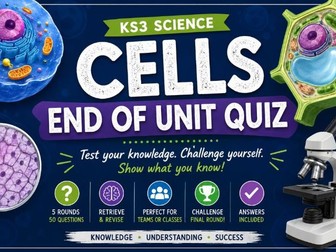
Assess your students’ understanding of the KS3 Cells unit with this engaging, classroom-ready PowerPoint quiz. Designed to consolidate learning at the end of the topic, this resource provides a fun and interactive way to review key knowledge before moving on to the next unit. The quiz is fully aligned with the National Curriculum for England and covers the core concepts taught during a KS3 cells topic. Questions progress from straightforward recall to more challenging application, making it suitable for whole-class revision, team competitions, or end-of-unit assessment. This resource includes: Interactive PowerPoint quiz 5 quiz rounds with separate answer slides 50 carefully written questions Final challenge round to stretch higher-attaining students Clear, easy-to-read layout designed for classroom projection Topics covered: Cell structure and function Plant and animal cells Specialised cells and their adaptations Microscopes Diffusion and exchange surfaces Cell division and growth Application and scientific reasoning Ideal for: KS3 Science Year 7 Biology Year 8 Biology revision End-of-unit assessments Retrieval practice Whole-class quizzes Tutor time or enrichment activities No preparation is required—simply open the PowerPoint and start the quiz. Answer slides are included throughout, making self-marking and class discussion quick and easy.
KS3 Science End of Year Mega QuizQuick View
aries81

KS3 Science End of Year Mega Quiz

(1)
KS3 Science End of Year Mega Quiz Finish the school year with a fun, engaging and fully editable science quiz designed specifically for KS3 students (Years 7–9). This ready-to-use PowerPoint contains 5 exciting rounds with 50 carefully selected questions covering biology, chemistry, physics, space and famous scientists, plus answer slides, tie-breakers and a winners’ slide. The quiz is ideal for end-of-term lessons, tutor time, enrichment activities or reward lessons. Questions are suitable for mixed-ability classes and encourage teamwork, discussion and retrieval of key scientific knowledge from across the KS3 curriculum. This resource includes: Fully editable PowerPoint presentation 5 themed quiz rounds (10 questions per round) Separate answer slides for quick self or peer marking Tie-breaker challenge questions Winner celebration slide Bright, engaging classroom-friendly design No preparation required – simply open and play! A perfect way to celebrate the end of the year while reinforcing important science knowledge in a fun and memorable way.
2026 Bumper End of Year QuizQuick View
aries81

2026 Bumper End of Year Quiz

(0)
The Ultimate Secondary School Quiz 10 Exciting Rounds • 100 Questions • Fully Editable PowerPoint Perfect for End-of-Term Lessons, Tutor Time & Reward Sessions Suitable for Years 7–11
AQA GCSE Chemistry: Acids, Alkalis and the pH Scale Worksheet | KS4 Revision & RetrievalQuick View
aries81

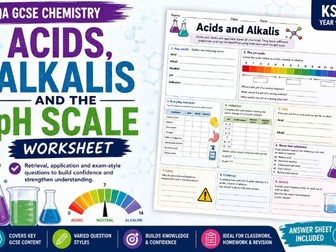
AQA GCSE Chemistry: Acids, Alkalis and the pH Scale Worksheet | KS4 Revision & Retrieval

(0)
Support your GCSE Chemistry students with this engaging, exam-focused worksheet on acids, alkalis and the pH scale. Designed for the AQA GCSE Chemistry specification (also suitable for Combined Science), this colourful one-page worksheet helps students consolidate key knowledge through a range of retrieval, application and extended-response activities. Students will practise: Defining key scientific vocabulary Identifying acids, alkalis and neutral substances Interpreting and applying the pH scale Understanding universal indicator colours Recognising everyday examples of acids and alkalis Applying knowledge of neutralisation Developing GCSE exam-style written responses The worksheet is ideal for lesson starters, independent classwork, homework, revision sessions, cover lessons or assessment for learning. It has been designed with clear layouts, scaffolded questions and GCSE-level language to build confidence while reinforcing essential chemistry concepts. Suitable for: AQA GCSE Chemistry AQA Combined Science: Trilogy KS4 (Years 9–11) A matching answer sheet is included, making the resource quick to use in the classroom and easy to self- or peer-assess.
Biology Mysteries: End of Year Challenge PackQuick View
aries81

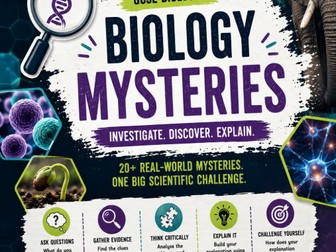
Biology Mysteries: End of Year Challenge Pack

(0)
Finish the year by thinking like a real scientist. This engaging resource contains a series of fascinating real-world biological mysteries inspired by current scientific discoveries, unusual organisms and cutting-edge research. Rather than recalling facts, students are challenged to apply their GCSE Biology knowledge to explain phenomena that scientists are still investigating today. Designed as an end-of-year enrichment activity, each mystery encourages curiosity, discussion and deeper scientific reasoning. Students develop their ability to hypothesise, gather evidence, evaluate ideas and communicate explanations using accurate biological terminology. The accompanying investigation workbook provides a structured framework for independent or collaborative enquiry, making it ideal for mixed-ability classes while still providing genuine stretch for higher-attaining students. Perfect for: End of Year lessons Post-exam GCSE enrichment STEM Days Science Week Cover lessons Higher Ability challenge Biology clubs Transition to Key Stage 5 Skills Developed Scientific enquiry Critical thinking Problem solving Application of GCSE Biology Evidence-based reasoning Evaluation and communication Students won’t simply answer questions—they’ll investigate mysteries such as whether humans could one day live to 200 years, why elephants rarely develop cancer, how ancient seeds can grow after centuries, and many more. This pack is designed to reignite curiosity about biology and show students that science is full of unanswered questions, making it the perfect way to end the academic year on an inspiring and thought-provoking note.
Mental Health Matters AssemblyQuick View
aries81

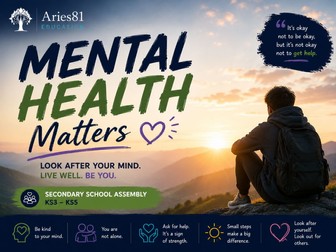
Mental Health Matters Assembly

(0)
Mental Health Matters Secondary School Assembly (KS3–KS5) Support positive conversations around mental health with this professionally designed, ready-to-deliver secondary school assembly. This engaging assembly helps students understand that everyone has mental health, explores practical ways to look after wellbeing, challenges common myths, and encourages students to seek support when needed. Designed to encourage reflection and discussion without overwhelming students, the presentation combines modern visuals, thought-provoking questions and evidence-informed messages suitable for whole-school or year group assemblies. Includes • Professionally designed PowerPoint presentation • Reflection activities • Tutor discussion prompts • Practical wellbeing strategies • Myth-busting content • Student challenge activities • Signposting to appropriate support Learning Objectives Students will: Understand that everyone has mental health. Recognise factors that can influence wellbeing. Identify practical ways to support their own mental health. Know how to support others appropriately. Understand when and how to seek help. Reflect on small actions that promote positive wellbeing. Ideal for ✓ KS3 ✓ KS4 ✓ KS5 ✓ Tutor Time ✓ PSHE
SEND Teacher Toolkit - Adaptive Teaching Strategies - ADHD, Autism, Dyslexia & MoreQuick View
aries81

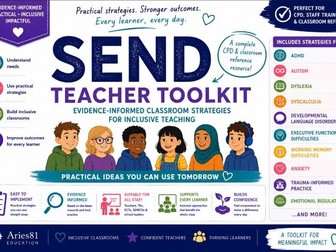
SEND Teacher Toolkit - Adaptive Teaching Strategies - ADHD, Autism, Dyslexia & More

(0)
Evidence-Informed Classroom Strategies for Inclusive Teaching Transform your classroom practice with this professionally designed SEND Teacher Toolkit, packed with practical, research-informed strategies that can be implemented immediately. Designed for teachers, ECTs, teaching assistants, SENCOs and school leaders, this resource supports inclusive, adaptive teaching that benefits every learner. What’s Included ✔ Welcome and introduction ✔ How to use the toolkit ✔ Understanding SEND ✔ Supporting Students with ADHD ✔ Supporting Students with Autism ✔ Supporting Students with Dyslexia ✔ Supporting Students with Dyscalculia ✔ Supporting Students with Developmental Language Disorder (DLD) ✔ Supporting Students with Executive Function Difficulties ✔ Supporting Students with Working Memory Difficulties ✔ Supporting Students with Anxiety ✔ Trauma-Informed Classroom Practice ✔ Supporting Emotional Regulation ✔ Universal Classroom Strategies ✔ Adaptive Teaching Checklist Every section includes • What is it? • What might you notice? • High-impact classroom strategies • Common pitfalls to avoid • Key take-away messages • Practical, evidence-informed approaches Perfect for ✓ Primary teachers ✓ Secondary teachers ✓ ECTs ✓ Teaching Assistants ✓ SENCOs ✓ Whole-school CPD ✓ Staff training ✓ Teacher reference ✓ Adaptive teaching ✓ Classroom inclusion This resource is based on current educational guidance and reflects evidence-informed practice, including adaptive teaching principles, cognitive science, executive function research and the SEND Code of Practice. Suitable for use as CPD, staff meetings, classroom reference or teacher professional development.
AQA GCSE Biology - Eukaryotic and Prokaryotic Cells Lesson | Bacteria | KS4Quick View
aries81

AQA GCSE Biology - Eukaryotic and Prokaryotic Cells Lesson | Bacteria | KS4

(0)
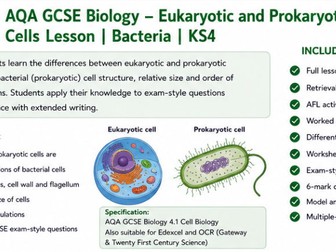
A fully resourced GCSE Biology lesson introducing eukaryotic and prokaryotic cells for AQA Combined Science and Triple Science. Students learn the differences between eukaryotic and prokaryotic cells, including cell structure, relative size, order of magnitude calculations and the functions of bacterial cell structures. The lesson includes retrieval practice, AFL checkpoints, worked examples, exam-style questions, model answers and differentiated worksheets. Students explore: • Eukaryotic cells • Prokaryotic cells (bacteria) • Circular DNA • Ribosomes • Cell wall • Flagellum • Relative cell size • Order of magnitude calculations • GCSE exam practice Specification: AQA GCSE Biology 4.1 Cell Biology Edexcel GCSE Biology OCR Gateway and Twenty First Century Science compatible Includes: ✔ Full lesson PowerPoint ✔ Retrieval starter ✔ AFL activities ✔ Worked examples ✔ Differentiated worksheet - separate from the PPT ✔ Answers ✔ Multiple-choice assessment ✔ Exam-style 6-mark question ✔ Model answers (developing to full marks)
AQA GCSE Biology - Animal and Plant Cells Lesson | Cell Structure | KS4Quick View
aries81

AQA GCSE Biology - Animal and Plant Cells Lesson | Cell Structure | KS4

(0)
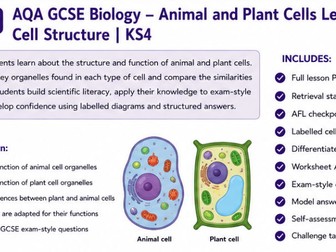
A fully resourced GCSE Biology lesson covering animal and plant cells for AQA Combined Science and Triple Science. Students learn the structure and function of key organelles including the nucleus, cytoplasm, cell membrane, mitochondria, ribosomes, chloroplasts, vacuole and cell wall. The lesson includes retrieval practice, AFL checkpoints, labelled cell diagrams, exam-style questions, model answers, self-assessment activities and a differentiated worksheet. Designed for GCSE Biology (9-1) and suitable for mixed-ability classes, with challenge tasks for higher-attaining students. Topics covered: • Animal cells • Plant cells • Cell organelles and functions • Differences between plant and animal cells • GCSE exam practice • Retrieval and AFL activities Specification: AQA GCSE Biology 4.1 Cell Biology Edexcel GCSE Biology OCR Gateway and Twenty First Century Science compatible Includes: ✔ Full lesson PowerPoint ✔ Differentiated worksheet - separate from PPT ✔ Answers ✔ Exam-style questions ✔ Model answers ✔ Self-assessment activities
GCSE Biology – Microscopes Lesson & Assessment PackQuick View
aries81

GCSE Biology – Microscopes Lesson & Assessment Pack

(0)
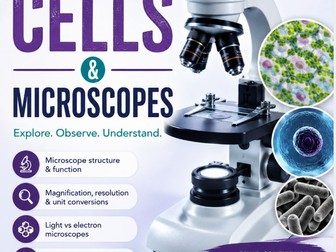
GCSE Biology – Microscopes Lesson & Assessment Pack A complete GCSE Biology lesson on microscopes, designed to build understanding from prior knowledge through to exam-style application. This resource includes engaging starter activities, retrieval practice, worked examples, microscope structure and function, magnification calculations, unit conversions, resolution, electron vs light microscope comparisons, and scaffolded exam practice. Students develop confidence with: Microscope parts and functions Calculating total magnification Converting between mm, μm and nm Magnification, image size and actual size calculations Resolution and image quality Comparing light and electron microscopes Required practical skills using onion epidermis cells GCSE exam-style extended response questions The lesson features: ✔ Clear teacher-led explanations ✔ AFL checkpoints throughout ✔ Worked examples and model answers ✔ Differentiated practice questions ✔ Retrieval and knowledge-check tasks ✔ Exam-style 6-mark question with mark scheme ✔ Student examiner activity using a GCSE mark scheme ✔ Grade 2, Grade 5 and full-mark model responses Perfect for GCSE Biology (AQA, Edexcel and OCR) and suitable for revision, cover lessons, intervention sessions or independent study. Contents: PowerPoint lesson, exam questions, model answers, mark schemes and student self-assessment activities.
AQA GCSE Knowledge Organiser - Topic 1 - Cells and TransportQuick View
aries81

AQA GCSE Knowledge Organiser - Topic 1 - Cells and Transport

(0)
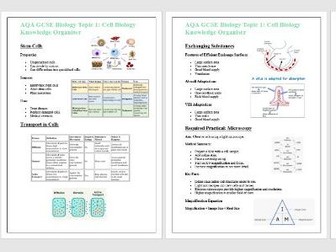
This Knowledge Organiser covers the key content from AQA GCSE Biology Topic 1: Cell Biology. It includes essential vocabulary, cell structure, specialised cells, microscopy, cell division, stem cells, transport in cells and exchange surfaces. Designed to support retrieval practice and revision, it provides students with the core knowledge required for success in GCSE Biology. Specification Content ✓ Cell Structure ✓ Microscopy and Magnification ✓ Cell Division (Mitosis) ✓ Stem Cells ✓ Cell Differentiation and Specialisation ✓ Diffusion ✓ Osmosis ✓ Active Transport ✓ Exchange Surfaces ✓ Alveoli and Gas Exchange ✓ Villi and Absorption ✓ Required Practical: Microscopy
KS3 Activate Biology – Retrieval Practice: Biodiversity and Conservation (Answers Included)Quick View
aries81

KS3 Activate Biology – Retrieval Practice: Biodiversity and Conservation (Answers Included)

(0)
This KS3 Biology retrieval practice worksheet is designed to help students consolidate their understanding of biodiversity and conservation. Students revisit key concepts including biodiversity, habitats, ecosystems, conservation, endangered species, and the impact of human activities on the environment. The resource includes a range of retrieval activities such as fill-in-the-gap tasks, multiple-choice questions, matching exercises, classification activities, spot-the-mistake questions, and short written responses to strengthen long-term memory and improve retention of key scientific vocabulary. Full answers and mark schemes are included to support self-assessment, peer assessment, and teacher feedback.
KS3 Activate Biology – Retrieval Practice: Microbes and Disease with answersQuick View
aries81

KS3 Activate Biology – Retrieval Practice: Microbes and Disease with answers

(0)
This resource is a quick, focused retrieval starter or plenary set designed to reinforce key knowledge about microbes and disease. It covers the basics of bacteria, viruses and fungi, how diseases spread, and how the body defends itself against infection. Ideal for KS3 students, the questions support recall practice and help consolidate essential vocabulary such as pathogen, microbe, vaccine, and infection. The set can be used as a starter activity, revision task, homework, or low-stakes quiz. Includes clear answers for easy marking or self-assessment.
Full KS3 Biology Retrieval pack with answersQuick View
aries81

Full KS3 Biology Retrieval pack with answers

12 Resources
This comprehensive KS3 Biology retrieval practice bundle contains a collection of topic-based worksheets designed to support long-term retention and mastery of key biological concepts. Aligned with the KS3 National Curriculum and suitable for schools following the Activate Science course, the resource covers a wide range of topics including cells and organisation, reproduction, plant reproduction, ecosystems, genes, variation, health and lifestyle, digestion, breathing and respiration, photosynthesis, adaptation and evolution, microbes and disease, and biodiversity and conservation. Each worksheet includes a variety of retrieval activities such as fill-in-the-gap tasks, matching exercises, sequencing activities, multiple-choice questions, spot-the-mistake challenges, classification tasks, diagram labelling, and short written responses. The resources are designed to strengthen recall, reinforce scientific vocabulary, identify misconceptions, and support regular low-stakes assessment. Ideal for starters, homework, revision, cover lessons, intervention sessions, and end-of-topic review, this bundle provides a consistent retrieval framework across the KS3 Biology curriculum. Full answers and mark schemes are included throughout to support self-assessment, peer assessment, and teacher feedback. Included Topics: • Cells and Organisation • Reproduction • Plant Reproduction • Ecosystems • Genes • Variation • Health and Lifestyle • Digestion • Breathing and Respiration • Photosynthesis • Adaptation and Evolution • Microbes and Disease • Biodiversity and Conservation TES Keywords: KS3 Biology, Activate Science, Biology Bundle, Retrieval Practice, Biology Revision, Secondary Science, Cells, Reproduction, Ecosystems, Genetics, Digestion, Respiration, Photosynthesis, Evolution, Biodiversity, Assessment for Learning, Homework, Revision Resources, Science Worksheets.
KS3 Activate Biology – Retrieval Practice: Breathing and Respiration (Answers Included)Quick View
aries81

KS3 Activate Biology – Retrieval Practice: Breathing and Respiration (Answers Included)

(0)
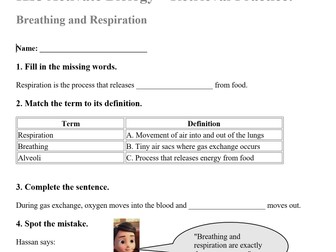
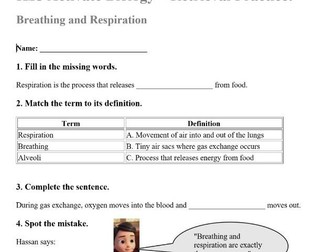
This KS3 Biology retrieval practice worksheet is designed to help students consolidate their understanding of breathing and respiration. Students revisit key concepts including gas exchange, the lungs, alveoli, aerobic respiration, and the effects of exercise on breathing rate. The resource includes fill-in-the-gap tasks, matching activities, spot-the-mistake questions, sequencing exercises, and short written responses to strengthen long-term memory and improve retention of key scientific vocabulary. Full answers and mark schemes are included.
KS3 Activate Biology – Retrieval Practice: Photosynthesis (Answers Included)Quick View
aries81

KS3 Activate Biology – Retrieval Practice: Photosynthesis (Answers Included)

(0)
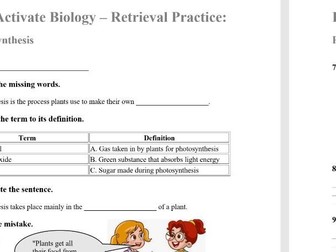
This KS3 Biology retrieval practice worksheet is designed to help students consolidate their understanding of photosynthesis and plant nutrition. Students revisit key concepts including the role of chlorophyll, the substances needed for photosynthesis, the products of the process, and how leaves are adapted for photosynthesis. The resource includes fill-in-the-gap tasks, matching activities, spot-the-mistake questions, sequencing exercises, leaf structure recall, and short written responses to strengthen long-term memory and improve retention of key scientific vocabulary. Full answers and mark schemes are included to support self-assessment, peer assessment, and teacher feedback.
KS3 Activate Biology – Retrieval Practice: Adaptation and Evolution (Answers Included)Quick View
aries81

KS3 Activate Biology – Retrieval Practice: Adaptation and Evolution (Answers Included)

(0)
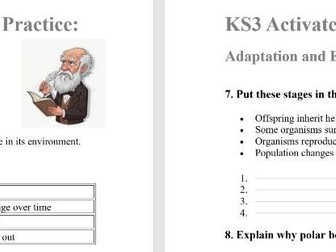
This KS3 Biology retrieval practice worksheet is designed to help students consolidate their understanding of adaptation and evolution. Students revisit key concepts including adaptations, natural selection, survival, reproduction, evolution, and extinction. The resource includes fill-in-the-gap tasks, matching activities, spot-the-mistake questions, sequencing exercises, classification tasks, and short written responses to strengthen long-term memory and improve retention of key scientific vocabulary. Full answers and mark schemes are included to support self-assessment, peer assessment, and teacher feedback.