The most successful businesses in today’s world are often the ones which are flexible
enough to respond quickly to the changing environment and meet their customers’
needs. Teamworking can help a business achieve these goals.
It is often said that TEAM stands for ‘Together Everyone Achieves More’. An effective
team is one that makes the best use of individual strengths so more can be achieved.
Team members should work together and support each other to solve problems more
easily with their collective knowledge and skills. In this unit you will investigate why
teams and teamworking are so important in business.
You will also come to understand the role and responsibilities of the team leader.
An effective team leader ensures that all team members understand and share the
same visions and values. Teams also need to go through stages of development,
with distinct roles being identified and filled. The team leader needs specific skills to
manage this process and build their team, whilst at the same time creating a sense
of common purpose and motivating individual members.
Effective communication skills are essential if a team is to meet its goals. This unit
focuses on the different ways of communicating with others in team situations, and
will allow you to develop your knowledge and understanding of interpersonal skills.
You will explore the different factors that make an effective team and have the
opportunity to develop and practise teamworking. It will also allow you to reflect
on and evaluate your own, as well as the team’s performance, and improve your
teamworking and communication skills.
Starting a small business is an ambition for many people. The business idea could be almost anything such as
a coffee shop, a courier service, a hairdresser, a motor vehicle repair workshop, a DJ service, a painting and
decorating business, an equipment hire operation, or an organic smallholding producing fruit and vegetables.
However, starting a small business can be fraught with difficulties and the idea may not always be successfully
realised. Those setting out on this venture need to consider the business idea, where funding will come from,
the potential market, the competition and a host of other issues that must be addressed if the business startup is to be successful.
This unit gives learners the opportunity to consider their business idea within structured business parameters,
such as the type of business, the attractiveness of the business idea, the target market and the need to balance
personal and business needs. Learners will also consider their ability to run the business, including the skills
they already have to support the business idea and what personal development they may have to undertake
in order for the venture to be successful.
Learners will also develop their knowledge and understanding of the legal status and trading terms and
conditions of their proposed business, legal aspects such as fire regulations, taxation, VAT and HM Revenue
and Customs, and financial aspects such as start-up and operational costs, as well as personal needs.
Learners will have the opportunity to devise an outline proposal for a business start up. This will cover the
reasons for preparing a business proposal and will include the components expected by financial advisers,
including the type of business, its target market, available resources, financial information and forward
planning.
One essential requirement in running and managing of an organisation is the need for clear, relevant
and accurate information. In particular, an organisation needs accounting information that gives a complete
picture of all financial transactions that have taken place and the current financial position of the organisation.
Accounting information is vital to the owners and managers of business organisations, and there are often
other stakeholders who have an interest in the financial performance and position of the business.
At an organisation’s financial year-end, the accountant will prepare financial statements including a trading and
profit and loss account and a balance sheet. The system that provides all the information for these final accounts
is known as the accounting system.
The quality and accuracy of the information presented in the final accounts depends entirely on using an
effective accounting system correctly. Beginning with the source documents that show financial transactions,
accounting staff will need to classify and encode the information before inputting the details into the system.
Manual accounting procedures, using double-entry bookkeeping, have been in operation for over 500
years. The system is still effective in providing managers with an analysis of income, profits, expenses, losses,
assets and liabilities. However, organisations need information quickly and manual systems can be slow.
Computerised accounting packages are based on double-entry principles and will give informative reports
in a matter of seconds.
Organisations will adopt the most suitable accounting system for their resources and needs. System users will
need training and, if the computerised option is chosen, hardware and software are essential requirements.
Whichever system is chosen, the year-end task of preparing the final accounts remains the same. Organisations
rely on effective control of resources including cash. Most organisations depend on making a profit. The
accounting system is an integral part of managing money so survival of an organisation depends on that system.
The attached workbook has a range of activities that can be used as ice breakers or develop an inset on stretch and challenge.
Ideal for a CPD for teaching and learning.
Understanding how a business operates and what makes it successful, requires knowledge of the accounting
process. Accounting involves recording business transactions and, this in turn, leads to the generation of financial
information which can be used as the basis of good financial control and planning. Inadequate record keeping
and a lack of effective planning ultimately lead to poor financial results. It is vital that owners and managers of
businesses recognise the indications of potential difficulties. Remedial action can then be taken.
The unit is divided into two parts. The first develops an understanding of the accounting processes necessary
to provide accurate and relevant financial information. The second part covers the practical aspect of carrying
out those accounting activities.
Learners will be introduced to accounting terminology as they study the purpose and function of accounting
and consider the various categories of business income and expenditure. It is important to know the sources of
an organisation’s income and the nature of its expenditure, as this clarifies the basis of its profitability and enables
more effective control of the business. Control begins with the planning process and learners will study the use
of a cash flow forecast which requires managers to set cash flow targets that can be monitored and adjusted on
a regular basis. Learners will consider the effective management of cash flow and the implications of cash flow
problems. The link between business failure and cash flow problems will be highlighted.
The measurement of an organisation’s financial performance and position requires an understanding of a basic
profit and loss account and balance sheet with this understanding learners can analyse profitability, liquidity and
efficiency of the organisation through the application of ratio analysis. Analysis will always require comparison
of current figures with those from a previous accounting period, or those of a similar business organisation.
Learners will discover how to carry out ratio analysis as well as the meaning and implication of the figures.
For hints and tips on teaching and learning, please view my youtube channel on:
Marketing is at the heart of every organisation’s activity. Its importance is also growing in the non-commercial,
public and voluntary sectors. Also, at the heart of marketing is the customer. This unit will introduce learners
to some of the tools and techniques all types of organisations use to achieve their objectives.
Firstly, learners will explore how different types of organisations use marketing principles to meet the needs
of their customers and achieve their objectives. The constraints under which organisations operate are
important and learners will study the legal requirements and voluntary codes that affect marketing.
Learners will then go on to investigate how organisations collect data through market research and turn
it into useful information which can be analysed and used to plan their marketing activities.
The segmentation and targeting of groups of customers is a key marketing technique and this is studied
in detail. This includes the different bases for segmentation of both consumer and business markets.
Next, learners will examine how a marketing mix is developed to meet the needs and aspirations of a
targeted group of prospective customers, before going on to develop a marketing mix for a new product
or service.
The unit gives a brief overview of the principles of marketing or can be used as a basis for further study
of specialist marketing units.
The attached is a full lesson in teaching percentages and ratio. Its a highly interactive lesson with a range of activities built in. Students will be working individually, paired and in groups. This can be used as a 90 minute lesson.
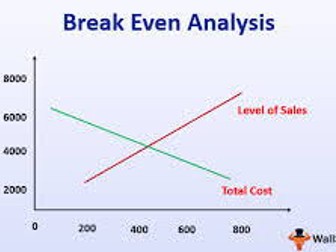
This is a pre coded MS Excel template that builds your breakeven graph as you type the figures in.
Great resource to use in the classroom to demonstrate ICT usage and numercy.
 Quick View

 Quick View
 Quick View
 Quick View
 Quick View
 Quick View
 Quick View
 Quick View
 Quick View
 Quick View
 Quick View
 Quick View
 Quick View
 Quick View
 Quick View
 Quick View