If you wish to find out how the pupils at your school view mathematics, a pupil voice, using a questionnaire like these, is a really useful starting point. When I first became a Maths Lead at school this is where I started the journey. I hope you find them useful. Feel free to adapt to your own needs.
A weeks unit of guided reading based on the first chapter of the book, ‘The Girl of Ink and Stars’ by Kiran Millwood Hargrave. This includes teacher led discussion questions and various independent activities for other learners. The teacher led discussion questions are grouped into looking (retrieval) questions, clue (inference) questions and thinking (personal response) questions.
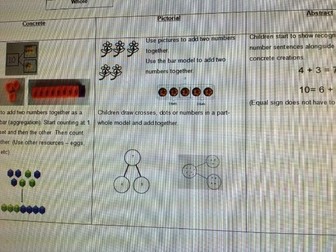
This is for any school looking to describe accurately (for teachers, TAs, Govenors, parents etc) what the teaching of mathematics for written calculation looks like across their school from EYFS to Year 6.
It shows the developmental stages needed for children to progress through addition, subtraction, multiplication and division for each year group. It includes examples of what this might look like in the children’s work, what the teachers might teach in a lesson, and the possible manipulatives they could use. It shows a clear CPA approach to the teaching of written calculations.
It is a fluid document that shows how children can progress through the stages, whilst also going back to previous stages. It shows the links between each stage of the journey and how children can make connections between those stages themselves. It explains where the ARE child should be at the end and the beginning of each year group and the knowledge they should possess at each year stage.
If your school uses a different written method at any particular point it can easily be adapted, or used as a starting point for your own school’s written calculation policy. It follows a similar structure to the White Rose policy but goes into much greater detail, and therefore is a useful guide for NQTs or new Maths Subject Leads.
This is a five week unit of work for Guided Reading sessions. The whole unit is based around foxes to link in with the book we were reading in class, called The Midnight Fox. The first week is based around songs and poems, week two is based on a non-fiction animal text, then week three is a fox film, and finally weeks four and five are based on the fiction book itself.
The resources include 5 weekly plans showing what each group in the class is doing; a set of 3 questions for the teacher to discuss with their group: a looking (retrieval), clue (inference) and thinking question (general personal response to the text); and various independent activites for non-teacher led groups, such as clarifying, predicting, summarising and visualising.
For teachers in Upper KS2, this unit of work (6 sessions initially, but could be extended through giving children more time to experiment with different designs/sketches and media, as well as linking to other subjects such as through creating biographies of the focus artist) focuses on the technicalities behind landscape drawing and painting. Towards the end of the unit, children will design their own landscape drawing and then collage it in the style of contemporary artist, Gordon Cheung (who they will also study). I have linked their final landscape to the Isle of Wight as the class had just been their for PGL, but this could easily be changed to link in to your local area and therefore inspire children more. Some PowerPoints are referred to, but not included here because they are somebody else’s work, however alternative ideas have been given, enabling you to create similar resources. TPs refers to Talk Partners (children have a fixed talk partner for the week to work with when discussing ideas).
An individual reward chart, helping a child to focus on hourly and daily positives in a busy classroom. Can be edited to personalise it for a particular child: edit the aims for the child (what they are trying to do successfully - could be behaviour or attitude or something else), the target number of points per day, the rewards available (I linked this to their home situation, but could easily be done for in class rewards), and consequences if the target amount is not successfully achieved (again, I linked this to their home situation, but could easily be done for in class rewards).
When I used it, rather than putting a number in each box, in the teacher row for each day, I put a face (a smiley face was five points, a straight lined face was three points, and a sad face was one point). The child created these symbols, but this could easily be adapted for the individual child.
Use and adapt this PowerPoint to help your class choose their next class book. The example shown is for Year 3. There is also a list of websites that you could use to find a suitable selection of class books for your Year group to put into the World Cup. I then use the book that wins as the class book that I read to the class for pleasure - no reading work is set to go with it. We read it almost every day for 15 minutes. Usually at the end of the day, but sometimes if we get a spare moment as well.
Twenty books for children to read between Years 5 and 6. Can they read them all to collect a prize! Feel free to adapt the template to include your own selection of books.
This booklet was handed out to parents at our ‘Calculations and Cake’ mathematics parent workshop. It aims to show parents how to engage and teach their children times table knowledge in a home environment.
This is for leaders wishing to introduce Bar Modelling as a concept to their staff. Personally, I used this to introduce the idea to TAs over two INSET sessions. It explains clearly the concept and gives examples of its use for the four operations.
If you are trying to show how to TEACH times tables in a variety of different ways, rather than just assessing times tables, here’s a PowerPoint to help. I’ve gather together a multitude of ideas and put them together in one place. Enjoy.