KS3 SEND Tutor Time — Me & My World (PSHE) 6 Ready-to-Run 15-Minute Form Time Sessions | Zero PrepQuick View
will_hamblin

KS3 SEND Tutor Time — Me & My World (PSHE) 6 Ready-to-Run 15-Minute Form Time Sessions | Zero Prep

(0)
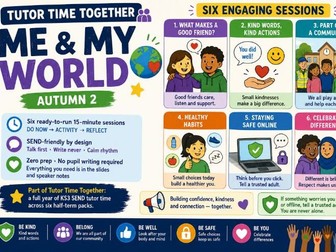
Autumn 2 Tutor time pack - with the six PSHE sessions: good friends, kindness in action, community helpers, healthy habits, online safety (traffic-light scenarios ending with “if something worries me, I will tell…”), and celebrating differences with a class strengths wall finale. Because this half term touches more personal territory than current affairs, I built in extra care: the tutor page explicitly flags that friendship and feelings topics can touch real situations (fictional examples only, never single pupils out, follow safeguarding procedures on any disclosure), the healthy habits session is deliberately gentle — noticing and choosing, no rules or numbers — and the online safety session is framed positively with “telling an adult is the strong move” as its core message.
KS3 SEND Tutor Time — In the News | 6 Ready-to-Run 15-Minute Form Time SessionsQuick View
will_hamblin

KS3 SEND Tutor Time — In the News | 6 Ready-to-Run 15-Minute Form Time Sessions

(0)
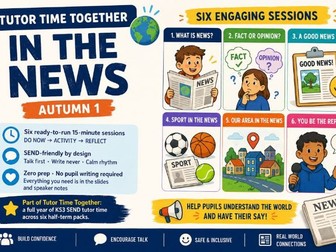
Six ready-to-run, 15-minute tutor time sessions on news and current affairs — built for KS3 SEND tutor groups, and brilliant for any form group that needs calm, predictable, zero-prep sessions. Half a term of form time, sorted. Every session follows the same rhythm — Do Now (settling talk task) → Activity (8–10 minutes) → Reflect (sentence-starter finish) — with colour-coded phases so pupils learn the routine within a fortnight. That predictability is the SEND adaptation: pupils always know what’s coming. THE SIX SESSIONS What is news? — the three tests: new, true, matters Fact or opinion? — “can we check it?” A good news story — comprehension and headlines Sport in the news — headline matching, class tally poll Our area in the news — local pride and community You be the reporter — pupils perform a class news report using every skill from the half term DESIGNED FOR SEND, USEFUL FOR EVERYONE No pupil writing required anywhere — every task works through talking, thumbs, pointing, sorting or miming, and “pass” is always allowed Full tutor guidance in the speaker notes of every slide: timings, answers, model responses, SEND tips and stretch ideas All stories and examples fictional — nothing topical to date, nothing sensitive to manage Sessions quietly build: fact vs opinion returns in the final reporter task 20 fully editable slides; one deck runs the whole half term Written by a former senior leader in a specialist setting. Part of the Tutor Time Together series — a full year of KS3 SEND form time across six half-term packs (Autumn 2: Me & My World is also available; further packs releasing through the year). Follow my shop to catch each release.
KS3 Financial Literacy - Full 6-Lesson Unit: Budgeting, Payslips, Banking, Spending T&SQuick View
will_hamblin

KS3 Financial Literacy - Full 6-Lesson Unit: Budgeting, Payslips, Banking, Spending T&S

(0)
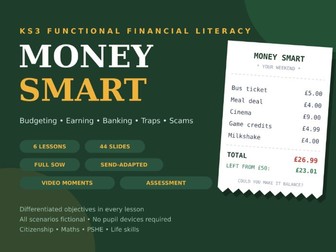
A complete, ready-to-teach 6-lesson Financial Literacy unit for KS3 — scheme of work, 44 fully-resourced slides, differentiated objectives and SEND adaptations throughout. All scenarios fictional, no pupil devices needed. “Money Smart” teaches the functional money skills pupils will actually use: building a budget that balances, reading a payslip and understanding gross vs net pay, choosing between debit and credit, resisting the spending traps built into apps and games, and beating scams with a rehearsed safe response. Financial education sits within the secondary Citizenship programme of study, and with young people spending real money younger than ever, this unit meets a genuine and growing need. WHAT’S INCLUDED Scheme of work (Word, fully editable): unit rationale, end points, medium-term plan, six detailed lesson plans, assessment guidance, a sensitivity/safeguarding note for teaching money topics, and a buyer’s copyright note. 44-slide PowerPoint covering all six lessons, each with a consistent structure: lesson divider with differentiated objectives (All/Most/Some), timed starter, video discussion moment, two teaching slides, a main task with materials built into the slides, and a plenary — plus teacher guidance in the speaker notes. Original illustrations throughout: a mock payslip for the Lesson 2 reading task, a fictional game-store screen for the Lesson 4 “Trap Hunt” (countdown timers, loot boxes, £4.99/week subscriptions — all annotatable), and a worked-example monthly budget for pupils to critique before the assessment. No real brands, no stock photos, no copyright worries. Suggested video moments with discussion questions for Lessons 1–5 (clips signposted to free Barclays LifeSkills, NatWest MoneySense and BBC Bitesize content — simply hyperlink your chosen clip). Summative assessment: “My Money Plan” — pupils budget a month for a fictional 16-year-old and write a three-rule advice guide, with success criteria and a peer stress-test plenary. THE SIX LESSONS Needs, Wants and Where the Money Goes — budgeting basics and the £50 Weekend challenge Earning It — wages, payslips, gross vs net, comparing first job offers Banks, Cards and Where Money Actually Lives — debit vs credit, interest, choosing how to pay Spending Traps — subscriptions, in-app purchases, dark patterns and true annual costs Scams: Keeping Your Money Safe — red flags, the safe response, and a family scam-proofing card to take home Assessment: My Money Plan — balanced budget plus Money Smart rules
Functional Skills Maths Workbook — Money & Everyday Maths | Entry Level 3 / Level 1  Worked ExampleQuick View
will_hamblin

Functional Skills Maths Workbook — Money & Everyday Maths | Entry Level 3 / Level 1 Worked Example

(0)
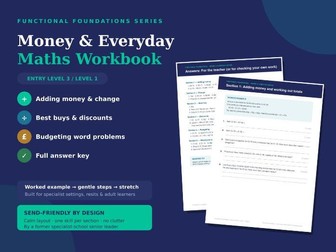
A print-and-go 9-page maths workbook for learners working at Entry Level 3 towards Level 1 — six skill-by-skill sections on money maths, each with a worked example, scaffolded practice and a full answer key. Designed for specialist settings, resit groups, alternative provision and adult learners. Money is the context that answers “when will I ever use this?” — every question in this workbook is the maths of real life: totalling a shop, checking change, spotting the best buy, working out a discount, making a budget stretch. WHAT’S INSIDE Section 1 — Adding money and working out totals Section 2 — Paying and giving change (counting-up method modelled) Section 3 — Best buy: which is better value? (unit cost) Section 4 — Discounts: 50%, 25% and 10% off Section 5 — Budgeting word problems (two-step) Section 6 — Mixed practice covering every skill — doubles as a baseline or progress check Full answer key for every question, with a marking tip on rewarding method Teacher notes page: who it’s for, how it’s built, SEND guidance and suggested use HOW IT’S BUILT (AND WHY) Written by a former senior leader in a specialist setting. Every section follows the same predictable rhythm: a boxed worked example, then questions that step up gently — and question 1 always mirrors the worked example almost exactly, a deliberate confidence-builder for learners who have experienced maths failure. The final question in each section stretches towards Level 1. The layout is deliberately calm: one skill per section, no decorative clutter, consistent command words (“work out”, “show your working”), answer lines provided so learners never face a blank page, and marks shown per question to build exam habits early. WHO IT’S FOR Learners preparing for Functional Skills Maths with any awarding organisation, GCSE resit students needing to rebuild foundations, Entry Level learners in specialist schools, alternative provision, and adult education. One section per session (15–25 minutes) works well. Pairs naturally with my “Money Smart” KS3 Financial Literacy unit — this workbook teaches the calculation skills; Money Smart teaches the life skills. Find it in my shop. This is an independent resource, not affiliated with or endorsed by any awarding organisation. All shops, names and prices are fictional. Fully printable PDF.
KS3 Media & AI Literacy — Full 6-Lesson Unit: Misinformation, Algorithms & AI | SOW + 44 Slides | SEQuick View
will_hamblin

KS3 Media & AI Literacy — Full 6-Lesson Unit: Misinformation, Algorithms & AI | SOW + 44 Slides | SE

(0)
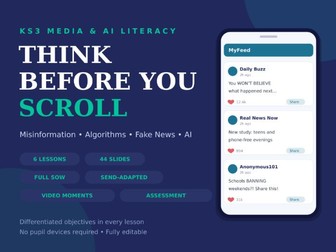
A complete, ready-to-teach 6-lesson Media & AI Literacy unit for KS3 — scheme of work, 44 fully-resourced slides, differentiated objectives and SEND adaptations throughout. No pupil devices needed. “Think Before You Scroll” teaches pupils to question what they see online: spotting misinformation and disinformation, understanding how recommendation algorithms and filter bubbles shape their feeds, knowing how AI chatbots actually work (and why they get things wrong), and using AI responsibly. The unit is aligned to the direction of the Curriculum and Assessment Review (2025), which puts media literacy and critical digital skills at the heart of the revised curriculum — so you can teach it now, ahead of 2028. WHAT’S INCLUDED Scheme of work (Word, fully editable): unit rationale, end points, medium-term plan, six detailed lesson plans, assessment guidance and a buyer’s copyright note. 44-slide PowerPoint covering all six lessons, each with a consistent structure: lesson divider with differentiated objectives (All/Most/Some), timed starter, video discussion moment, two teaching slides, a main task with materials built into the slides, and a plenary — plus teacher guidance in the speaker notes. Original illustrations throughout: phone-feed mockups, a “one story, two feeds” comparison task, and a worked-example campaign poster for pupils to critique. No stock photos, no copyright worries. Suggested video moments with discussion questions for Lessons 1–5 (clips signposted to free BBC Bitesize “Other Side of the Story” / “Solve the Story” and Common Sense Education content — simply hyperlink your chosen clip). Summative assessment: the “Digital Detective” campaign, with success criteria and peer-review plenary. THE SIX LESSONS Welcome to the Information Jungle — source, audience, purpose and the trust spectrum Fake or Fact? — misinformation vs disinformation and the SIFT fact-checking routine The Algorithm Knows You — recommendation systems, filter bubbles and echo chambers What Is AI, Really? — how chatbots predict text, hallucinations and bias Using AI Without Losing Yourself — academic honesty, deepfakes and consent Assessment: The Digital Detective Campaign — pupils teach a skill to Year 6 WHY THIS UNIT IS DIFFERENT Written by a senior leader from a specialist setting, every lesson includes a dedicated SEND adaptation row built on concrete-before-abstract tasks, reduced volume without reduced thinking, and multiple means of response — plus stretch and challenge for every lesson. The whole unit runs with printed and projected materials only, making it ideal for tutor time, Computing, Citizenship/PSHE or a standalone digital literacy programme in any school. Everything is fully editable so you can make it your own.
FREE Budget Planner — My Money Plan Worksheet | KS3 Financial Literacy, Budgeting, Needs & WantsQuick View
will_hamblin

FREE Budget Planner — My Money Plan Worksheet | KS3 Financial Literacy, Budgeting, Needs & Wants

(0)
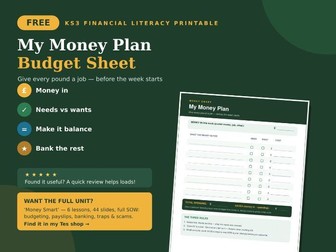
A free, print-and-go A4 budget planner that gets KS3 pupils giving every pound a job. Pupils record their money in, plan their spending with need/want tick columns, total it against income and bank the difference — with three memorable money rules built into the sheet. Use it as a budgeting lesson scaffold, a weekly tutor-time habit, a Citizenship or PSHE activity, a maths-in-context task, or send it home as a family money conversation starter. Works for upper KS2 too, and the whole-pound, calculator-friendly layout makes it accessible in specialist settings. This planner comes from my complete unit “Money Smart” — six fully-resourced KS3 Financial Literacy lessons (SOW + 44 slides) covering budgeting, payslips and earnings, banking, the spending traps inside apps and games, and beating scams — with differentiated objectives and SEND adaptations in every lesson. Find it in my shop. If you download this, a quick review really helps — thank you!
FREE SIFT Fact-Check Checklist — Spotting Misinformation & Fake News | KS3 Media Literacy PrintableQuick View
will_hamblin

FREE SIFT Fact-Check Checklist — Spotting Misinformation & Fake News | KS3 Media Literacy Printable

(0)
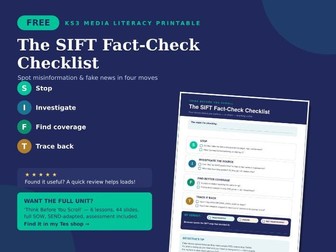
Title: FREE SIFT Fact-Check Checklist — Spotting Misinformation & Fake News | KS3 Media Literacy Printable Description: A free, print-and-go A4 checklist that teaches KS3 pupils the SIFT routine — the four moves to make before believing or sharing anything online. No prep needed: just print one per pupil. Pupils write the claim they’re investigating, work through tick-box questions for each of the four steps — Stop, Investigate the source, Find better coverage, Trace it back — then record a verdict (trustworthy / unsure / not trustworthy) with a written reason, giving you instant evidence of their thinking. A “Detective’s Tip” reinforces the key idea: false stories spread because they make people feel before they think. WAYS TO USE IT A scaffold for any fact-checking or fake news lesson A form-time or tutor-period activity with a claim of the day A display poster for your Computing, Citizenship or PSHE classroom A take-home talking point for parents’ evenings or online safety weeks Supporting evidence for digital literacy and online safety provision Works as a standalone printable in Computing, Citizenship, PSHE, tutor time or library sessions, and is suitable for upper KS2 too. WANT THE FULL UNIT? This checklist is the Lesson 2 toolkit from my complete unit, “Think Before You Scroll” — a six-lesson KS3 Media & AI Literacy scheme of work with 44 fully-resourced slides covering misinformation, algorithms and filter bubbles, how AI chatbots work, deepfakes and responsible AI use, with differentiated objectives and SEND adaptations in every lesson, finishing with an assessed Digital Detective campaign. Find it in my shop. If you download this checklist, a quick review really helps — thank you!