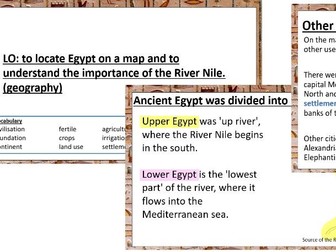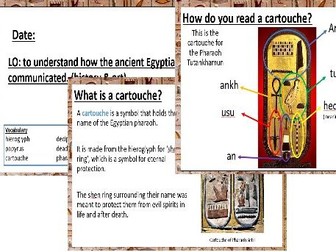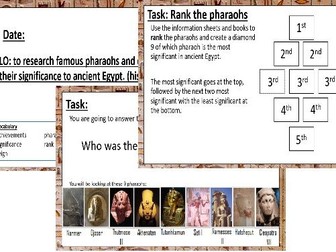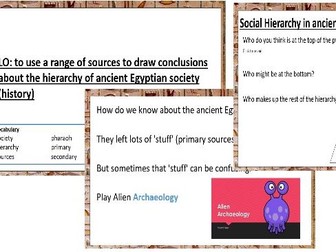
Powerpoint and activity to learn about society in ancient Egypt. Children work in groups and use different types of sources to find out about society. Includes Ancient Egypt Alien Archaeology.
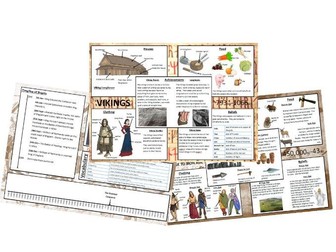
A collection of knowledge organisers for KS2 British history topics from Stone Age to the Normans.
The set includes the following organisers:
Stone Age to Iron Age
Romans
Vikings
Anglo-Saxons
Normans
Set includes Microsoft Publishers versions so you can edit for your school’s needs.
They are doubled sided. One side has the topic split into 5 different aspects (houses, food, clothing, beliefs and achievements). The other side has a timeline of events, an overall timeline, significant individuals, and vocabulary list.
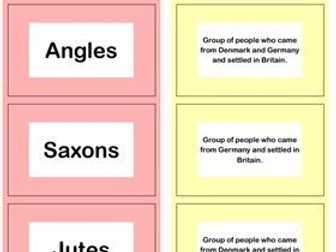
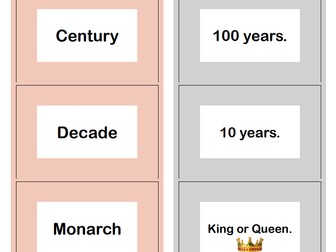
This resource can be printed and laminated to create a card game to help children with historical vocabulary. There are two ways to play.
How to play:
Game 1: Pairs
Match the word to the definition until there are no cards left.
Challenge—lay out all the cards face down and take it in turns to turn over two cards. If they match, you can take the cards. If they do not, you have to turn them back over. Winner is the player with the most cards when all have been turned over.
Game 2: Vocab snap
Split the cards between 2 players. Take it in turns to turn a card over into a pile. When the definition and word matches call ‘Snap’. The ‘Snap’ caller wins the pile. The winner of the game is the person who wins all the cards.
This resource can be printed and laminated to create a card game to help children with historical vocabulary. There are two ways to play.
How to play:
Game 1: Pairs
Match the word to the definition until there are no cards left.
Challenge—lay out all the cards face down and take it in turns to turn over two cards. If they match, you can take the cards. If they do not, you have to turn them back over. Winner is the player with the most cards when all have been turned over.
Game 2: Vocab snap
Split the cards between 2 players. Take it in turns to turn a card over into a pile. When the definition and word matches call ‘Snap’. The ‘Snap’ caller wins the pile. The winner of the game is the person who wins all the cards.
This resource can be printed and laminated to create a card game to help children with historical vocabulary. There are two ways to play.
How to play:
Game 1: Pairs
Match the word to the definition until there are no cards left.
Challenge—lay out all the cards face down and take it in turns to turn over two cards. If they match, you can take the cards. If they do not, you have to turn them back over. Winner is the player with the most cards when all have been turned over.
Game 2: Vocab snap
Split the cards between 2 players. Take it in turns to turn a card over into a pile. When the definition and word matches call ‘Snap’. The ‘Snap’ caller wins the pile. The winner of the game is the person who wins all the cards.
This resource can be printed and laminated to create a card game to help children with historical vocabulary. There are two ways to play.
How to play:
Game 1: Pairs
Match the word to the definition until there are no cards left.
Challenge—lay out all the cards face down and take it in turns to turn over two cards. If they match, you can take the cards. If they do not, you have to turn them back over. Winner is the player with the most cards when all have been turned over.
Game 2: Vocab snap
Split the cards between 2 players. Take it in turns to turn a card over into a pile. When the definition and word matches call ‘Snap’. The ‘Snap’ caller wins the pile. The winner of the game is the person who wins all the cards.
This resource can be printed and laminated to create a card game to help children with historical vocabulary. There are two ways to play.
How to play:
Game 1: Pairs
Match the word to the definition until there are no cards left.
Challenge—lay out all the cards face down and take it in turns to turn over two cards. If they match, you can take the cards. If they do not, you have to turn them back over. Winner is the player with the most cards when all have been turned over.
Game 2: Vocab snap
Split the cards between 2 players. Take it in turns to turn a card over into a pile. When the definition and word matches call ‘Snap’. The ‘Snap’ caller wins the pile. The winner of the game is the person who wins all the cards.
This resource can be printed and laminated to create a card game to help children with historical vocabulary. There are two ways to play.
How to play:
Game 1: Pairs
Match the word to the definition until there are no cards left.
Challenge—lay out all the cards face down and take it in turns to turn over two cards. If they match, you can take the cards. If they do not, you have to turn them back over. Winner is the player with the most cards when all have been turned over.
Game 2: Vocab snap
Split the cards between 2 players. Take it in turns to turn a card over into a pile. When the definition and word matches call ‘Snap’. The ‘Snap’ caller wins the pile. The winner of the game is the person who wins all the cards.
Card sets in this file:
Anglo-Saxons
Ancient Egypt
Ancient Greece
Ancient Maya
Romans
Stone Age to Iron Age
Tudors
Vikings
This resource can be printed and laminated to create a card game to help children with historical vocabulary. There are two ways to play.
How to play:
Game 1: Pairs
Match the word to the definition until there are no cards left.
Challenge—lay out all the cards face down and take it in turns to turn over two cards. If they match, you can take the cards. If they do not, you have to turn them back over. Winner is the player with the most cards when all have been turned over.
Game 2: Vocab snap
Split the cards between 2 players. Take it in turns to turn a card over into a pile. When the definition and word matches call ‘Snap’. The ‘Snap’ caller wins the pile. The winner of the game is the person who wins all the cards.
Included in the pack are
Vocab Cards
Card Box instructions
A PowerPoint game where children have to become archaeologists, look at objects and decide what they are.
Just like an alien looking at our objects here on Earth, an archaeologist can come across objects that are not used today and have to figure out what was their purpose.
Children are given 6 objects from a period in history and on scrap paper or a whiteboard, they have to write or draw what they think the object is. The answer follows.
Included in this set are:
Medieval
Tudors
Victorians
Vikings
World War II
Set of cards, one for each year group from year 2 to year 6. Can be printed out and/or laminated to create a matching game of historical vocabulary.
This resource can be printed and laminated to create a card game to help children with historical vocabulary. There are two ways to play.
How to play:
Game 1: Pairs
Match the word to the definition until there are no cards left.
Challenge—lay out all the cards face down and take it in turns to turn over two cards. If they match, you can take the cards. If they do not, you have to turn them back over. Winner is the player with the most cards when all have been turned over.
Game 2: Vocab snap
Split the cards between 2 players. Take it in turns to turn a card over into a pile. When the definition and word matches call ‘Snap’. The ‘Snap’ caller wins the pile. The winner of the game is the person who wins all the cards.
Included in the pack are
Vocab Cards
Card Box instructions
Card Box Cover
Back of Cards
This resource can be printed and laminated to create a card game to help children with historical vocabulary. There are two ways to play.
How to play:
Game 1: Pairs
Match the word to the definition until there are no cards left.
Challenge—lay out all the cards face down and take it in turns to turn over two cards. If they match, you can take the cards. If they do not, you have to turn them back over. Winner is the player with the most cards when all have been turned over.
Game 2: Vocab snap
Split the cards between 2 players. Take it in turns to turn a card over into a pile. When the definition and word matches call ‘Snap’. The ‘Snap’ caller wins the pile. The winner of the game is the person who wins all the cards.