Synonym Card Game | Happy Families Style | Vocabulary & Word Choice | KS1 & KS2 EnglishQuick View
Sarah_Sawkins

Synonym Card Game | Happy Families Style | Vocabulary & Word Choice | KS1 & KS2 English

(0)
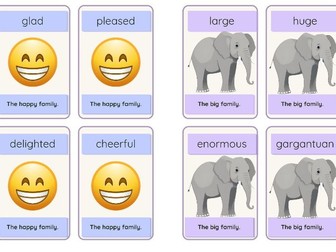
Build children’s vocabulary through play with this Happy Families style synonym card game. This engaging resource helps pupils recognise synonyms, expand their vocabulary and make better word choices in their speaking and writing while enjoying a classic card game. Players collect complete synonym families by asking one another for matching cards, just like the traditional game of Happy Families. This resource includes: 8 colour coded synonym families Happy Fast Smart Angry Scared Brave Big Small Clear game rules A follow up challenge sheet to reinforce learning and extend vocabulary The included challenge activities encourage pupils to: Identify and discuss synonyms Improve sentences by selecting more precise vocabulary Explain their word choices Use new vocabulary in their own writing Ideal for: Years 2 to 4 English lessons Vocabulary development Guided reading Small group work Literacy interventions Early finisher activities Home learning Simply print, cut out and play. This low preparation resource provides repeated opportunities for children to develop their understanding of synonyms through discussion, collaboration and meaningful practice. Curriculum links: This resource supports pupils in developing a rich vocabulary and understanding that words can have similar meanings while encouraging thoughtful word choice in both spoken and written English.
Year 5 Life Cycles | Interactive Life Cycle Wheels | Mammal, Amphibian, Bird & Insect | ScienceQuick View
Sarah_Sawkins

Year 5 Life Cycles | Interactive Life Cycle Wheels | Mammal, Amphibian, Bird & Insect | Science

(0)
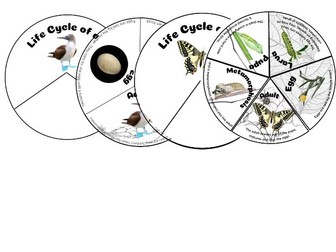
Support children in meeting the Year 5 science objective to describe the differences in the life cycles of a mammal, an amphibian, an insect and a bird with this interactive sequencing activity. This resource contains five printable life cycle wheels that encourage pupils to compare and discuss the life cycles of different animals through a practical, hands on activity. Included life cycles: Mammal Bird Amphibian Metamorphosing insect Non metamorphosing insect Children cut out the life cycle stages, sequence them correctly and stick them onto the wheel before assembling it with two paper plates and a split pin. The wheels can also be printed onto card if preferred. The outline backgrounds can be coloured to create an engaging finished resource that pupils can refer back to throughout the topic. This activity supports pupils in identifying similarities and differences between life cycles while developing sequencing skills and scientific vocabulary. Ideal for: Year 5 science Living things and their habitats Independent learning Small group activities Science centres Home learning Revision Resource includes: Five printable life cycle wheels Individual life cycle stage cards for sequencing Outline designs for colouring Flexible assembly using paper plates and split pins or printed card A practical, low preparation activity that helps pupils compare the life cycles of mammals, amphibians, birds and insects while producing an interactive resource they can use throughout the topic.
Year 7 Maths: Warhammer 40k Pictograms & Bar Charts – 30‑minute KS3 lessonQuick View
Sarah_Sawkins

Year 7 Maths: Warhammer 40k Pictograms & Bar Charts – 30‑minute KS3 lesson

(0)
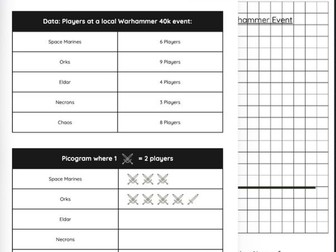
Overview A ready-to-use, Warhammer 40k‑themed 30‑minute lesson for Year 7 (KS3) designed for a single pupil or 1:1 home education. Ideal for middle‑ability learners who need short, engaging tasks and frequent feedback. National Curriculum links KS3 Mathematics: construct and interpret tables, charts and diagrams; use statistical diagrams for discrete data including bar charts. Learning objective Pupils will interpret and construct pictograms and bar charts from discrete data. What you get Teacher notes with timings and classroom strategies for a 30‑minute lesson Copy‑and‑paste printable worksheet text (Warhammer 40k theme) with starter, main task and extension Suggested answers and mark scheme Differentiation and support ideas (scaffolds, kinaesthetic counters) Extension tasks and assessment / plenary ideas Lesson structure Starter / hook (5 minutes) with pictogram questions Short teaching input and modelling (7 minutes) Main activity — draw a bar chart and answer questions (12 minutes) Plenary / exit ticket (6 minutes) Differentiation & support Scaffolded grid and partially drawn axes for pupils who need it Use of counters or miniatures for kinaesthetic learners Extension tasks: percentage conversion, changing scales, critique of misleading charts Resources required Pencil, ruler, coloured pencils, simple timer (Optional) small counters or Warhammer miniatures for hands‑on counting Ideal for Home educators, tutors, and teachers delivering 1:1 lessons Year 7 pupils preparing for KS3 assessments or consolidating KS2 data skills
Magizoologist Field Guide: Year 5 Non-Chronological Report LessonQuick View
Sarah_Sawkins

Magizoologist Field Guide: Year 5 Non-Chronological Report Lesson

(0)
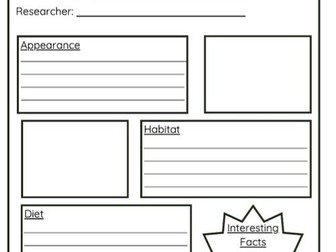
Engage reluctant writers with this game-based Year 5 English lesson where students create a non-chronological report about a fantastical creature. Perfect for pupils who struggle with confidence in writing or dislike traditional worksheets. What’s included: Warm-up creature guessing riddle to spark interest 3 sets of 10 research cards (Hippogriff, Phoenix, Unicorn) for active research Subheadings sheet to organise notes for a report Magizoologist field guide template for writing a structured report Mission log / points scoring sheet to make learning playful and competitive How it works: Students choose a creature, hunt for research cards, sort facts under headings, then write a field guide page using the template. Points and ranks turn the lesson into a wizarding mission, keeping engagement high. The lesson includes breaks and movement to support attention and energy. Skills covered: Non-chronological report writing Fact sorting and organisation Sentence structure and vocabulary Reading comprehension and research skills Ideal for home education, small group, or one-to-one sessions. Can be used as a standalone lesson or part of a series on fantasy creatures.
Year 3 Inference Matching CardsQuick View
Sarah_Sawkins

Year 3 Inference Matching Cards

(0)
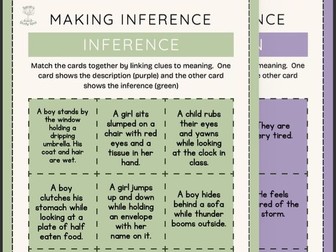
A simple and engaging activity to help pupils practise making inferences using clues from a short description. This resource contains 9 inference pairs. Pupils read a description card and match it to the correct inference card. The activity encourages children to identify evidence and explain how they reached their conclusion. Ideal for: Guided reading Reading interventions Literacy rotations Small group work Tutoring sessions Early finishers Children must use clues in the text such as body language, actions and context to work out what is really happening. What is included: 9 description cards (evidence) 9 inference cards (conclusions) Printable and easy to laminate for repeated use Curriculum links English Reading Comprehension Year 3 pupils should be able to: draw inferences such as characters’ feelings, thoughts and motives justify ideas using evidence from the text These cards support pupils in developing those skills in a clear and practical way.
KS3 Algebra: Simplifying Expressions & Perimeter with Necron Weapons (Warhammer 40K Theme)Quick View
Sarah_Sawkins

KS3 Algebra: Simplifying Expressions & Perimeter with Necron Weapons (Warhammer 40K Theme)

(0)
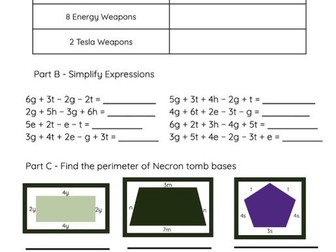
Engage KS3 students with this active, themed algebra lesson. Using a Necron-inspired Warhammer 40K armoury, students learn to: Represent repeated items using algebra (e.g., 5 Gauss weapons = 5g) Simplify expressions with addition and subtraction of like terms Calculate the perimeter of 2D shapes using algebraic expressions What’s included: Teacher Lesson Plan – step-by-step instructions for a 30-minute lesson Necron Armoury Key – symbols for Gauss (g), Hyperphase (h), Tesla (t), and Energy (e) weapons Simplifying Expressions Cards – active task cards for hands-on practice Necron Tomb Perimeter Sheets – rectangular and irregular shapes with algebra wall lengths Weapon Labels – visual aids for grouping like terms Student Worksheet - expression cards and perimeter sheet all on one page for each student to complete Answer Sheet – full solutions for quick marking Why it works: Active and hands-on, perfect for reluctant or disengaged learners Fully themed around Warhammer 40K for boys and students interested in sci-fi Combines algebra practice with real problem-solving context Suitable for: KS3 Maths (Years 7–9) Lessons on simplifying expressions and perimeter
KS3 English Debate Lesson – The Dragon Trial (Courtroom Argument Writing)Quick View
Sarah_Sawkins

KS3 English Debate Lesson – The Dragon Trial (Courtroom Argument Writing)

(0)
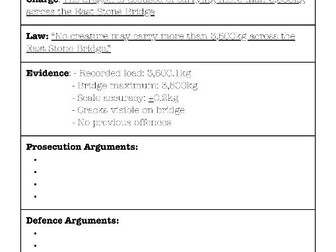
The Dragon Trial – KS3 Debate and Argument Writing Lesson A fully resourced, active KS3 English lesson built around a courtroom trial. Pupils investigate whether a dragon has broken the law and must construct formal arguments before delivering a verdict. This lesson develops structured argument, persuasive writing and formal spoken language through a roleplay format. Pupils analyse evidence, prepare prosecution and defence cases, respond to objections and write a justified verdict. Designed to move beyond worksheets and promote purposeful talk. Focus skills: Constructing structured arguments Using evidence to support claims Maintaining formal register Responding to challenge in debate Writing for purpose and audience Curriculum Links: KS3 Spoken Language: participate in formal debates and structured discussions KS3 Writing: organise ideas logically; write for a range of purposes and audiences; use Standard English confidently KS3 Maths: use approximation through rounding and estimate answers; understand limits of accuracy. What’s included: Case file Role cards Sentence starter cards Objection cards Visual aids Detailed teacher guidance Curriculum mapping Whole-class and small-group instructions Suitable for whole class, small group or 1:1.