The activity consists of a reading and a grid to fill in with the missing information in English.
2 versions:
- V1 was aimed towards my top set
- V2 was for my mixed abilities classes (before looking for the information, they have to complete a Find the French for)
The power point is also provided to go through the answers with the class.
Let me know if you find it helpful :)
This worksheet was set as part of the revision (house, rooms, there is/isn't), before moving on to furniture. It can also be used for cover work.
It includes fill in the gaps, translation, match up, label the rooms, a reading (true or false) and a writing.
Let me know if you found it useful :)
Merci bien !
Here is my own version of la maison bizarre.
First, students need to read the text in order to label the rooms of the house in French.
Then, they draw the rooms.
I've set this task as a homework for year 7 and motivated them with prizes available for best 3 works!
Please let me know if you found it useful :)
Merci bien!
As my year 11 have found some of the bullet points on the French Role-Play mock quite vague, I have made them some flashcards.
Each card has a bullet point from the Role-play used for 2019 AQA French GCSE. At the back, the information required is written in English and there is enough space below for students to write a few sentences in French.
Example:
Front
F – ROLE-PLAY 1: HOLIDAYS
• En vacances – où.
Back:
Say where you are on holiday.
Students can write underneath:
En ce moment, je suis à Barcelone en Espagne pour mes vacances.
6 first pages cover the Foundation tier and the last 6 cover the Higher tier.
Make sure to print on both sides (flip page on short edge).
Hope you find it useful :) !
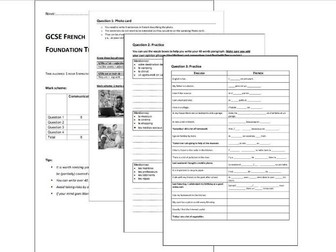
This booklet recap the 4 questions from the Foundation writing paper.
It includes the mark scheme, some examples and practice questions.
Whole booklet is 27 pages including the cover.
I am currently using it with my year 11 for their ‘last minute’ writing revision and practice.
All questions are from Past papers (2018 to 2023).
This set includes some worksheets useful when teaching food topic. I made these for my year 8 classes.
They include:
- a starter where students use cognates to identify French food as starter/main course/dessert + translation as an extension task
- a reading activity: read the sentences and fill in the grid with information in English. It also includes a slightly more difficult version.
- a 4 pages revision worksheet about food in general: 1 match up the food vocabulary, 2 readings, 1 translation and 1 gap fill. This one was made to prepare the students for their end of term reading test.
Please let me know if you found these resources useful with a review :)
Merci!
I made these resources for a lesson on the topics: family + physical description.
We spend most of the hour completing this activity (6 texts and quite a lot of information) and I would recommend it for a top set.
Please let me know if you found it useful!
Merci bien :)
3 pages long worksheet made for my year 7 class. Lesson was opinions about school subjects.
It includes:
- a starter (find the missing letter for school subjects + translate)
- unjumble the sentences
- 2 readings
- writing (answer the questions)
Please let me know if you found these useful!
Merci bien :)
This is the final version of La boîte à outils - tool kit for GCSE French
Vocabulary/Grammar/Tenses support card for KS4 French.
It includes:
On the first page ‘Vocabulary’:
time phrases (3 tenses)
connectives
opinion phrases (+ positive and negative)
adverbs of frequency
sequence words
intensifiers
On the second page ‘Grammar’:
Stressed pronouns
Possessive pronouns
Object pronouns
Comparative
Superlative
Articles
Modal verbs
Prepositions
On the third page ‘tenses 1’
subject pronouns
Imperfect tense
Past perfect tense with avoir
Present tense (3 regular groups)
Present tense for avoir, être, aller, faire
Near future
On the fourth page ‘tenses 2’
conditional mood
simple future tense
C’est + il y a (present, past future, conditional)
negatives + different tenses
Past perfect with être (Dr & Mrs Vandertramp)
Subjunctive mood
I have printed these double sided and laminated them for my KS4 classes. My students are used to referring to these cards when working on a piece of writing. They also have a reminder of how to build different tenses which they have found particularly useful.
They can use it during the lesson while completing some writing/speaking.
I will soon update a grammar version of this tool kit.
Please let me know if you found it useful!
2 pages worksheet including:
- practicing place of the colour adjectives
- the simple opinion (I like to wear)
Please let me know if you found it useful :)
Merci!
It includes the following topics:
- family
- sports with jouer
- invitations (roleplay phrases)
- town
Please let me know if you found these useful :)
Merci bien!
Each flashcard feature the verbs in the form ‘je’ conjugated in different tenses/moods (imperfect tense / past perfect tense / present tense / near future tense / simple future tense / conditional mood).
Each set includes 16 cards and is based on a module from Studio AQA.
These are verbs for module 2: Le temps des loisirs (free time).
Please let me know if you found these useful :) !
{These flashcards need to be printed double-sided and in colour.}
Here are resources I made when teaching a group of students learning French as a foreign language at university.
The lesson can be adapted for other ages. The lesson includes quite a lot as it was made for a two hours lesson (with faster pace to cover the year curiculum).
This beginner/elementary lesson includes the following:
- Comment saluer en français (greetings)
- Comment prendre congé (saying good-bye)
- Comment allez-vous ? (how do you do ?)
- Les nombres en français de 0 à 20 (numbers)
- Se présenter (introducing oneself)
- L’alphabet en français (French alphabet)
- Le verbe être (some grammar!)
I do not own any of the image.
Please let me know if you found it useful!
Here are resources I made when teaching a group of students learning French as a foreign language at university.
The lesson can be adapted for other ages. The lesson includes quite a lot as it was made for a two hours lesson (with faster pace to cover the year curiculum).
The students completed their learning using the textbook "french 1 palgrave foundations" (mentionned in the powerpoint and for homework).
This beginner/elementary lesson includes the following:
- La famille et les amis (vocabulary)
- C’est / Ce sont (to introduce your family)
- Les pronoms possessifs (possessive pronouns)
- Le verbe ‘avoir’ (at the present tense)
- Compréhension orale (listening)
- Présenter sa famille (speaking)
I do not own any of the image or the video (youtube).
Plus, the Simpsons are the best to introduce family :)
Please let me know if you found it useful!
Here are resources I made when teaching a group of students learning French as a foreign language at university.
The lesson can be adapted for other ages. The lesson includes quite a lot as it was made for a two hours lesson (with faster pace to cover the year curiculum).
The students completed their learning using the textbook "french 1 palgrave foundations" (mentionned in the powerpoint and for homework) as well as "Le Nouveau Taxi 1" (Hachette).
This beginner/elementary lesson includes the following:
- Remettez le dialogue dans l’ordre (n°1) (directions recap)
- à la gare : dialogue (listening)
- Rappel : dire l’heure (recap on time)
- Vocabulaire
- Compréhension orale (dialogue n°2) (listening)
- Jeu de rôles (roleplay)
I do not own any of the image. Some activities from the powerpoint are also from other resources available on the TES.
Please let me know if you found it useful!
Here is another worksheet I've used with my year 8 class on the topic clothes.
It extends the opinion (j'aime porter...) with a reason (parce que c'est...)
In my shop, the previous worksheet is also available (simple opinion about clothes, with j'aime + porter)
2 pages long, this worksheet includes:
- an adjectives match up (starter)
- a reading (read and fill in the grid)
- a translation
- a writing
Please let me know if you found this useful!
Merci bien :) !
Here are resources I made when teaching a group of students learning French as a foreign language at university.
The lesson can be adapted for other ages. The lesson includes quite a lot as it was made for a two hours lesson (with faster pace to cover the year curiculum).
The students completed their learning using the textbook "french 1 palgrave foundations" (mentionned in the powerpoint and for homework).
This beginner/elementary lesson includes the following:
- L’heure : l’expression usuelle (12 hour clock with 'quarter to/past, 5 to, 10 past, etc)
L’horloge des 12 heures
Les expressions et quart, et demie, moins le quart
Les expressions moins cinq, dix, vingt, vingt-cinq
Préciser : du matin, de l’après-midi, du soir
- L’heure : officielle (24 hour clock)
- La routine 1 (questions sur l’heure).
I do not own any of the image. Some activities from the powerpoint are also from other resources available on the TES.
Please let me know if you found it useful!
I made this worksheet for my year 7 class:
Learning objective is to be able to say what sport others do.
It includes match ups, reading, gap fill and a writing.
Please let me know if you found it useful :)
Merci bien !
Here are resources I made when teaching a group of students learning French as a foreign language at university.
I have used the textbook 'Le nouveau Taxi 1' (Hachette edition) to complete the resources.
The lesson can be adapted for other ages. The lesson includes quite a lot as it was made for a two hours lesson (with faster pace to cover the year curiculum).
This beginner/elementary lesson includes the following:
- Dialogue “Qui est-ce?” (introducing someone else)
- Les nationalités (nationalities for male/female person)
- Les pays : masculin ou féminin ? (countries' gender)
- Le pays d’origine (countries)
- Tu habites où ? (where do you live?)
- Les nombres de 21 à 69
- Les professions (jobs for male/female)
I do not own any of the image or audio.
Please let me know if you found it useful!
Minasan konnichiwa :) !
I have started a Japanese club (lunch time) in my school as a few students expressed some interest. I have studied Japanese 3 years at university and spent one year in Tokyo. I now occasionally visit to practice my Japanese.
I have used the textbook Genki for some tasks (hence free resource) but simplified it when needed.
This includes a PPT for a 25-30 minutes session + a mini vocabulary sheet.
Learning hiraganas/katakanas/kanjis will not be included in these resources since they are taught separatly (I usually have the main lesson on Thursday at lunch and the writing on Friday at lunch).
Please let me know if you have found these resources useful :)
Arigatou gozaimasu!
I personally don't like using more than one power point when teaching and would rather include all activities in the same presentation so I would not have to exit the slideshow.
I have updated my noughts and crosses slide by creating animation which make the noughts or crosses appear when clicking on their mini version. With a few sounds effects, that adds some dynamism (and can be of course edited. I have kept the same one for all).
This powerpoint can easily be adapted to any topic by simply changing the pictures and inserting them behind the large noughts and crosses when editing. If you are directly copy pasting these two slides in your own powerpoint, just expect some changes (you might have to drag a few picture back in position) because of the format (mine is quite larger).
Regarding the activity itself, I usually proceed this way:
- First slide is group work: here, for instance, boys are playing against girls. Of course you won't get to pick more than 9 pupils but you can use both hands up/no hands up if targeting certain pupils. This will also model what to do in preparation to next slide: the pupils will choose a box by saying out loud the word the picture represents (and in French of course!). If the activity seems a bit too easy for your class, challenge them by asking whole sentences.
- Second slide is pair work: to make sure everyone gets involved, pupils are asked to draw a blank 9 square grid on which they will draw their noughts or crosses. Make sure they don't also copy the pictures on the board!! The teacher will be able to walk around in the class and listen to pupils saying the words (or challenging themselves by saying a whole sentence) and give them immediate feedback.
Also, this is a good game as a mini plenary after going through all the vocabulary.
Voilà! Please let me know if you found it useful!