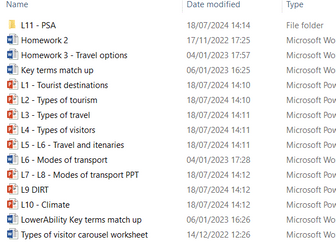
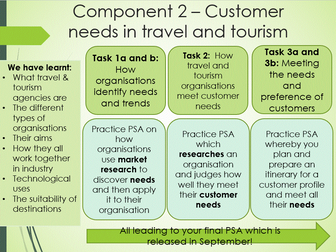
Full pack of Component 2 lessons for BTEC Tech Travel and Tourism Level 1 and 2. Department is outstanding and achieved over 90% L2P, distinction grades also achieved. Demographic of students SEN, lower ability and EAL.
Full lessons for component 2
Practice PSA with planning sheets and scaffolding
2 Homeworks
DIRT planned in with resources
Multitude of different retrieval practices
Feel free to message to buy any individual lessons
Full lessons to cover learning aim A and B in component 1 in BTEC Tech Travel and Tourism Level 1/2. Student demographic SEN, lower ability and EAL. Students have acheived L2D with these lessons, 90% L2P pass rate. Outstanding department.
All lessons have starters and LO’s and tasks throughout
DIfferentiated resources
2 Practice PSA’s with scaffolding sheets
Homeworks included
Retrieval practice a key area for the department - embedded throughout
Feel free to message to buy any individual lessons
2 lessons included, LO’s covered:
To understand what ‘HRM’, ‘organisational structure’ and ‘span of control’ are.
To analyse the benefits and drawbacks of a tall and flat organisational structure.
To understand what flat and tall organisational structures are; and assess the benefits and drawbacks of using them.
Tasks included:
Visual teaching of organisational structures with differentiated questions throughout building up to analysis questions
One lesson included.
LO: To understand the term ‘legislation’ and explain its importance, using case studies to support.
Tasks,
Visual starter, case studies to learn about legislation, headlines to analyse, plenary with Youtube link and analysis questions
3 Lessons included:
LO included:
To understand different technology which businesses use
TBAT explain how technology improves operations
To understand the term e-commerce
TBAT explain the impact e-commerce has on stakeholders
To analyse the effect technology has on business case studies
Tasks included:
Amazon case study, table task, plenaries, ranking popular websites, diamond 9, link to a kahoot, carousel activity for technology case studies and exam question
3 lessons included, LO’s covered:
TBAT define and explain what a gap in the market is
TBAT understand what a market map is and how to use it effectively
To understand how to answer low mark exam questions
Tasks included: Pictionary starter, A3 group task independent activity, learning check, drawing market map activity, plenary questions alongside exam questions and answers (with case studies)
5 Lessons included:
LOs covered:
To explain why businesses want to grow/expand
To state the different methods used to measure a businesses size.
To identify internal and external growth methods
To analyse a businesses choice of expansion
To define economies of scale
To use a graph to explain the impact of economies of scale on businesses.
To revisit economies of scale and explain its impact on expanding businesses.
To define diseconomies of scale
To use a graph to explain the impact of diseconomies of scale on businesses.
To understand the types of diseconomies of scale
To explain how diseconomies of scale can effect businesses
Multiple tasks included: Case studies on Apple, Microsoft and NHS to teach measurement strategies, carosel activity for case study analysis on internal and external, real life case studies to teach economies and diseconomies of scale, alongside graph drawing, multiple choice quiz, exam question
One lesson included:
To identify internal and external methods of recruitment
To assess the advantages and disadvantages.
Tasks included:
Exam questions with answers (low mark), visual cues to teach internal and external methods and Tesco case study with questions, plenary
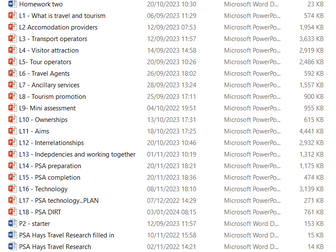
Full set of lessons for component 1 of BTEC Tech Travel and Tourism Level 1/2. Department has gained over 90% Level 2pass, and multiple merits. Outstanding department. Full lessons, with resources. Demographic of students SEN, Lower ability and EAL. Students have achieved Level2D with these resources
Key documents included:
Over 15 lessons
Whole of Learning aim B covered from C1
PSA practice included with planning and scaffolding
Differentiated resources
2 homeworks included
Retrieval practice embedded throughout
Opportunity for DIRT
Feel free to message to buy any individual lessons
Full bundle of lessons for Component 1 and 2 of BTEC Tech Travel and Tourism Level 1 and 2. All lessons have starters which are engaging, lessons filled with retrieval practice opportunities, homeworks, cover lessons, and practice PSA’s with DIRT opportunities.
3 Lessons included, LO’s covered:
To understand the term quality inspection and total quality management.
To assess the benefits and drawbacks of both methods.
To compare the similarities and differences between quality control methods and analyse which is most suited for a context.
To use knowledge on quality to build a strong analysis and evaluation.
Tasks included: birthday card creation practical activity to teach about different quality control methods, exam low mark questions with answers, exam case study questions (12 mark reflective)
2 lessons included, LO’s covered:
To understand the meaning of ‘quality’
To identify strategies to measure quality
To analyse the drawbacks of measuring quality
To assess the consequence of businesses having bad quality
Tasks included:
Targetting setting activity for businesses, Railcard scenario, case studies to learn about identifying problems, Samsung case study
Start of Unit 3 - Business Operations
3 lessons included. LO’s covered:
To understand the role of production in business.
TBAT explain how businesses decisions regarding production affects their success.
To understand what job and flow production is and analyse its impact on businesses
To analyse the methods of production
To use our knowledge to identify reasons a business uses a method of production, and justify if this is correct or not.
Tasks included:
Recap of CELL (factors of production), practical activity where students become business card creators to learn about job and flow production, analysis activity with case study and plenary
Two lessons included.
LO’s: To understand the impact of being in a market with few businesses
To understand risk and uncertainty within business
To explain why entrepreneurs take risks
Youtube clip with question, Premier Inn case study and analysis case study to reflect 12 mark question
Lesson one:
To understand the difference between unlimited and limited liability
To assess the advantages and disadvantages of being a sole trader
Case studies used to teach sole traders and practical task for teaching unlimited and limited liability
Lesson two:
TBAT define the term ‘partnership’
To investigate the advantages and disadvantages of being a partnership.
Story scenario to teach partnerships
Analysis 6 mark question with scaffolding at the end of the two lessons
Unit tests to replicate those of the exam, split into the same sections. Finance (unit 6) a smaller test than the rest. All with case studies and used, gaining grades from 3-9 in final examinations.
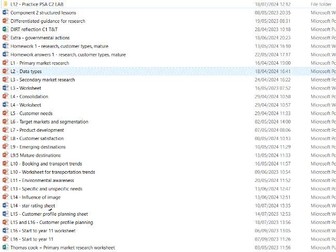
Complete lessons for component 1 LAA. More than 19 lessons. retrieval practice throughout, practice assessment based on Hays travel with scaffolded support sheets. Demographic of students taught lower ability, SEN, EAL. Department has over 90% L2P rate, including high proportion of distinctions. Department rated outstanding.
Headline lessons:
Starters included in all lessons
Visual approach to teaching
Scaffolding throughout
2 cover lessons included
2 homeworks included
Assessments included with answers
DIRT opportunities embedded
Happy to send a preview of some resources if required. Feel free to message to buy any individual lessons


 Quick View
 Quick View
 Quick View
 Quick View
 Quick View