GCSE Maths Algebra Mats & Worked AnswersQuick View
rpsmcmahon

GCSE Maths Algebra Mats & Worked Answers

(0)
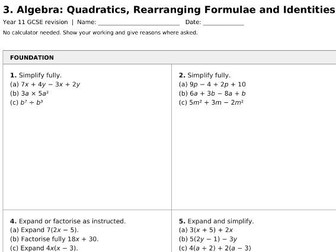
GCSE Maths algebra revision mats: 36 differentiated questions covering quadratics, rearranging formulae and identities, with worked answers. BEST PRINTED ON A3! This 12-page printable PDF provides structured algebra practice for Years 10 and 11. It supports Foundation revision, with progressively harder questions for confident Foundation students and those working around the Foundation/Higher crossover. WHAT’S INCLUDED • Pages 1–2: Foundation — 12 questions. • Pages 3–4: Foundation-plus — 12 questions. • Pages 5–6: Foundation/Higher borderline — 12 questions. • Pages 7–12: Matching worked answers showing the critical algebraic steps. Many questions include several parts. The A4 landscape revision-mat layout provides space for working, with solutions presented in smaller red text for easy marking. TOPICS COVERED Simplifying expressions, substitution, index laws, expanding single and double brackets, factorising, solving quadratic equations by factorisation, difference of two squares, rearranging formulae, function machines, identities and algebraic proof. Questions include identifying errors, finding missing coefficients, forming expressions from geometrical contexts and explaining mathematical relationships. CLASSROOM USE Suitable for revision lessons, targeted intervention, homework, tutoring and independent practice. Select a two-page section for a particular group or use the levels to progress from fluency to reasoning and multi-step applications. FORMAT One printable PDF; not editable. No calculator needed. Print pages 1–6 for students and retain pages 7–12 for marking or self-assessment. All questions are original. The difficulty labels describe progression within this resource; they are not official examination tiers. This listing contains the Algebra pack only.
GCSE Maths Volume Mats & Worked AnswersQuick View
rpsmcmahon

GCSE Maths Volume Mats & Worked Answers

(0)
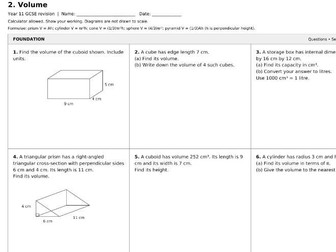
GCSE Maths volume revision mats: 36 differentiated questions on 3D solids, with worked answers, selected labelled diagrams and space for calculations. BEST PRINTED ON A3! This 12-page printable PDF provides structured volume practice for Years 10 and 11. It supports Foundation revision, with progressively harder applications for confident Foundation students and those working around the Foundation/Higher crossover. WHAT’S INCLUDED • Pages 1–2: Foundation — 12 questions. • Pages 3–4: Foundation-plus — 12 questions. • Pages 5–6: Foundation/Higher borderline — 12 questions. • Pages 7–12: Matching worked answers showing formulae, substitutions and key calculations. Many questions include several parts. The A4 landscape revision-mat layout provides space for working. A formula strip supports students, while smaller red worked solutions make answers easy to identify. TOPICS COVERED Cubes, cuboids, prisms, cylinders, cones, spheres, hemispheres, pyramids and composite solids. Applications include capacity conversions, missing dimensions, displacement, hollow solids, frustums, and melting and recasting. Students practise giving exact answers in terms of π, rounding appropriately and using correct units. CLASSROOM USE Suitable for revision lessons, targeted intervention, homework, tutoring and independent practice. Select a two-page section to match students’ needs or use the levels to build towards more demanding reasoning and multi-step problems. FORMAT One printable PDF; not editable. Calculator permitted. Print pages 1–6 for students and retain pages 7–12 for marking or self-assessment. All questions are original. The difficulty labels describe progression within this resource; they are not official examination tiers. This listing contains the Volume pack only.
GCSE Maths Probability Mats & Worked AnswersQuick View
rpsmcmahon

GCSE Maths Probability Mats & Worked Answers

(0)
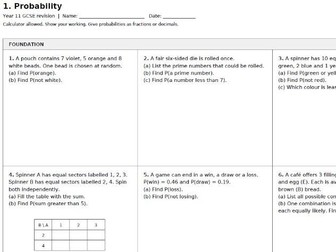
GCSE Maths probability revision mats: 36 differentiated questions across three difficulty levels, with worked answers and space for calculations. BEST PRINTED ON A3! This 12-page printable PDF provides structured probability practice for Years 10 and 11. It supports Foundation revision, with progressively harder questions for confident Foundation students and those working around the Foundation/Higher crossover. WHAT’S INCLUDED • Pages 1–2: Foundation — 12 questions. • Pages 3–4: Foundation-plus — 12 questions. • Pages 5–6: Foundation/Higher borderline — 12 questions. • Pages 7–12: Matching worked answers showing the key calculations and reasoning. Many questions include several parts. The A4 landscape revision-mat layout provides space for working, with answers presented in smaller red text for easy marking. TOPICS COVERED Single-event probability, complementary events, expected frequency, relative frequency, sample spaces, Venn diagrams, two-way tables, probability trees, independent events and selection with and without replacement. CLASSROOM USE Suitable for revision lessons, targeted intervention, homework, tutoring and independent practice. Select a two-page section for a particular group or use the levels to provide increasing challenge. Questions include skills practice, explanations and multi-step problems. FORMAT One printable PDF; not editable. Calculator permitted. Print pages 1–6 for students and retain pages 7–12 for marking or self-assessment. All questions are original. The difficulty labels describe progression within this resource; they are not official examination tiers. Independently produced for revision of topics within AQA GCSE Mathematics (8300). Not produced or endorsed by AQA. This listing contains the Probability pack only.
Introduction to FractionsQuick View
rpsmcmahon

Introduction to Fractions

(0)
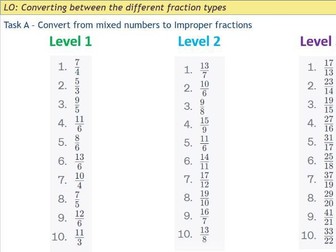
An introduction to fractions, could be used for KS3 or KS4 (foundation tier). This powerpoint introduces: The key parts of fractions The 3 fraction types Visualising fractions This powerpoint also contains differentiated exercises (and answers) on: Converting mixed numbers to improper fractions Converting improper fractions to mixed numbers Cancelling fractions Readings statements and forming fractions