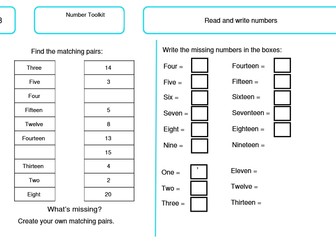
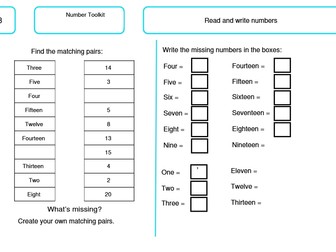
A complete answer booklet for the Number Toolkit resource, covering 24 activities linked to number, place value and calculation. It includes answers, worked examples and model responses to reasoning and problem-solving questions. The resource supports teachers with marking, modelling mathematical thinking and helping learners explain their answers clearly.
Number Toolkit is a collection of practical and engaging maths activities designed to develop pupils’ fluency, reasoning and problem-solving skills. It supports understanding of number and place value, addition, subtraction, multiplication and division.
The activities include matching tasks, missing-number problems, practical investigations and opportunities for pupils to explain their mathematical thinking. Clear instructions, visual representations and structured challenges make the resource particularly suitable for pupils with SEND and those who benefit from additional scaffolding.
The Man he killed.pptx is a KS3/KS4 English literature teaching resource that supports students in analysing conflict in Thomas Hardy’s poem The Man He Killed. The presentation introduces key literary concepts such as content, structure, language, and dramatic monologue before exploring the poem’s historical context, including its connection to the Boer War.
The resource guides students through:
Understanding the poem’s background and themes.
Exploring the speaker’s perspective as a soldier who reflects on killing an enemy in war.
Analysing how external conflict (war) and internal conflict (guilt, regret, and moral uncertainty) are presented.
Developing analytical skills through close examination of language, structure, and imagery.
Responding to exam-style questions using evidence, inference, contextual understanding, and evaluation of the writer’s methods.
The presentation includes teacher explanations, comprehension activities, note-taking opportunities, a video link, contextual information, stanza-by-stanza analysis, and scaffolded written response tasks designed to help students construct analytical paragraphs about conflict in the poem.
Suitable for: Secondary English lessons focusing on poetry analysis, conflict, war literature, and GCSE/KS4 poetry skills development.
Year 9 English literature resource that explores how Robert Minhinnick presents conflict in his poem The Yellow Palm. The lesson examines the impact of war on ordinary people in Baghdad, encouraging students to analyse how the poet uses imagery, repetition, juxtaposition, and symbolism to portray the realities of life in a conflict zone.
Students are introduced to key contextual knowledge about Iraq, including the rule of Saddam Hussein, the Iran-Iraq War, the Gulf War, and the 2003 invasion of Iraq. The resource develops understanding of important vocabulary such as muezzin, dinar, Tigris, and juxtaposition, while supporting students in close analysis of the poem’s structure and language choices.
The lesson includes retrieval activities, discussion tasks, contextual information, guided analysis of key stanzas, and scaffolded analytical writing tasks. Students are encouraged to explore how the poem contrasts everyday life with violence and suffering, and how the poet highlights the resilience of people living amidst conflict.
English literature teaching resource focused on William Blake’s poem A Poison Tree. The lesson explores how Blake uses the extended metaphor of a tree to develop ideas about anger, resentment, and the consequences of suppressing negative emotions.
The resource guides students through:
Revisiting prior learning on poetic terminology, including language, form, structure, and monologue.
Building subject vocabulary through the study of metaphor, extended metaphor, stanza, and symbolism.
Exploring the symbolism of trees and considering how they can represent growth, power, life, and human experiences.
Investigating the theme of anger and discussing the effects of dwelling on negative emotions.
Analysing Blake’s extended metaphor of the “poison tree” and examining how concealed anger develops into hatred and a desire for revenge.
Understanding how communication can resolve conflict, while repressed emotions can lead to harmful consequences.
The presentation includes vocabulary activities, discussion tasks, visual stimuli, teacher explanations, guided analysis of the poem, and scaffolded analytical writing tasks. Students are encouraged to support interpretations with evidence, make inferences, analyse language and structural choices, and consider Blake’s intended impact on the reader.
This resource is a phonics booklet designed to support early readers. It focuses on learning letter sounds, blending sounds to form words, and building confidence through repeated practice.
Activities and practice prompts help students use phonics skills to improve reading and spelling.


 Quick View