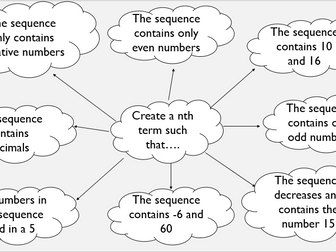
This is a selection of Rich tasks to use over a sequence of lessons on sequences. The slides are designed to be slotted in to a sequence of lessons to enhance the lesson, opposed to being a PowerPoint on teaching sequences. Enjoy!
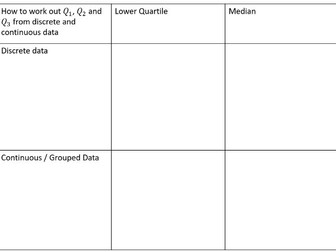
A grid that can be used to write down notes as the teacher is delivering the content.
Additionally, this grid could be given to pupils two or three weeks after the lesson and then be filled in from memory.
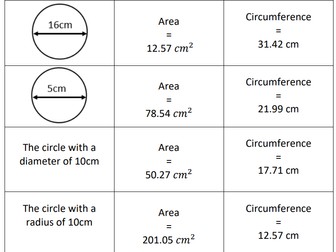
A matching task designed to develop fluency in finding the area and perimeter of circles. There are three cards that do not match the rest of the cards. An extension is to make the cards that fit these distracters; in some cases this will require starting with the circumference or the area and working backwards.
Answers are provided for the matching pairs.
The print out for the matching task is pre-jumbled so you do not need to worry about cutting them out prior to the lesson.
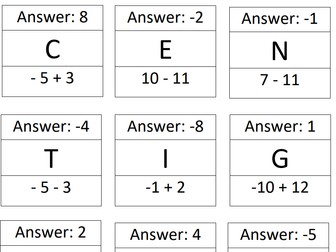
Two different treasure hunts for adding numbers to and subtracting numbers into negative numbers. A useful task to help embed pupils working between positive integers and negative integers.
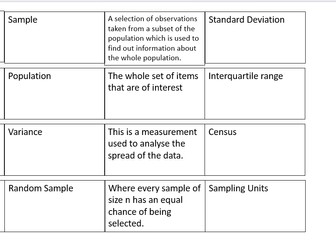
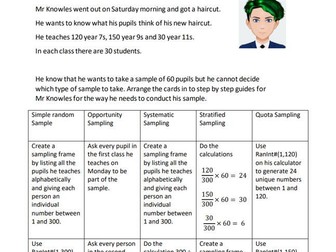
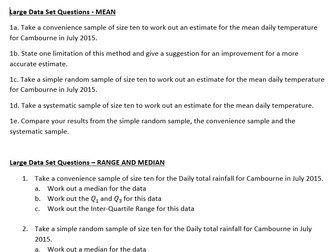
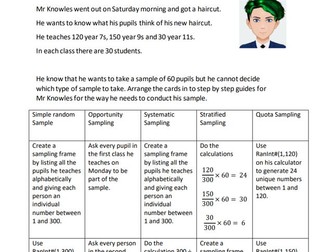
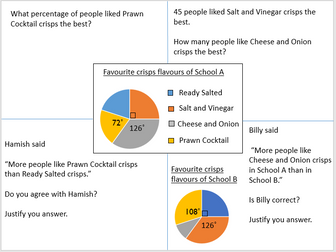
A task I made to enhance pupils explanations of different types of sampling. I found pupils were struggling to articulate how to complete different types of sampling and relate it specifically to the questions.
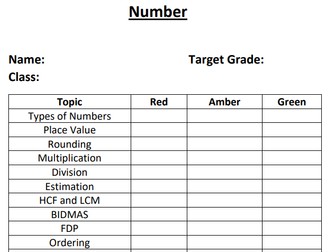
Revision booklets covering key foundation knowledge for Algebra, Data and Number.
Each booklet contains a variety of Red, Amber and Green questions based on the topics in that booklet.
Algebra:
Like Terms
Simplifying
Expanding Single
Expanding Double
Factorising Single
Factorising Double
Substitution
Sequences
Solving Equations 1
Solving Equations 2
Inequalities
Forming Expressions
Plotting Graphs
Rearranging Formula
Data
Averages
Bar and Tally
Stem and Leaf
Scatter Graphs
Conversion Graphs
Two-way Tables
Pie Charts
Distance Time Graphs
Frequency Polygons
Frequency Tables
Time Tables
Listing Outcomes
Probability
Probability Trees
Venn Diagrams
Number
Types of Numbers
Place Value
Rounding
Multiplication
Division
Estimation
HCF and LCM
BIDMAS
FDP
Ordering
Fractions of Amounts
Percentage of Amounts
Ratio
+, - Fractions
×,÷Fractions
Best Buys
Compound Interest
Converting Units
Negative Numbers
Compound measures
Currency Conversion
Using a Calculator
Standard Form
A set of 18 posters that showcase a variety of careers that use maths every day.
Designed to help my department meet the Gatsby Benchmark.
Editable in PPT, these could be edited for any subject.
These include:
Accountant
Architect
Barber
Beautician
Carpenter
Car Mechanic
Chef
Civil Engineer
Data Scientist
Doctor
Electrician
Investment Banker
Mechanic
Meteorologist
Nurse
Pilot
Plumber
Software Developer
Sports Analyst
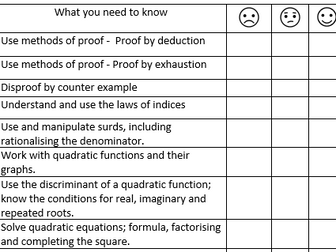
This checklist is based on the Edexcel AS level scheme of work. It can be found at https://qualifications.pearson.com/content/dam/pdf/A Level/Mathematics/2017/specification-and-sample-assesment/as-l3-mathematics-specification.pdf
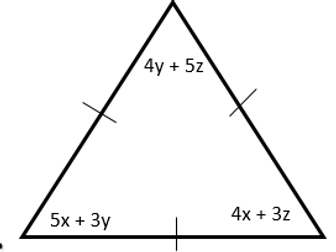
A problem based on simultaneous equations. This could be used as a starter, plenary or a question on a test. Designed originally for higher ability KS4 or early KS5.


 Quick View