Biosheets™ – Levels of Organisation (IGCSE / GCSE Biology Worksheet + Mark Scheme)Quick View
chem1984

Biosheets™ – Levels of Organisation (IGCSE / GCSE Biology Worksheet + Mark Scheme)

(0)
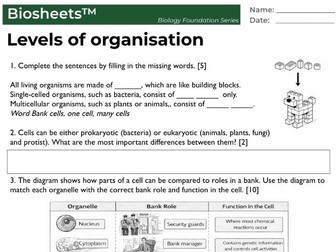
This worksheet introduces the levels of organisation and basic cell biology for IGCSE / GCSE students. It is designed as a structured foundation activity that moves from simple recall to deeper understanding of cell structure and plant cell function. Students complete a range of exam-style tasks including: • Fill-in-the-blank questions on cells and unicellular vs multicellular organisms • Short questions comparing prokaryotic and eukaryotic cells • A visual matching activity linking cell organelles to roles in a bank to help students understand organelle functions • Animal and plant cell labelling diagrams • Matching plant-specific organelles to their functions • A photosynthesis definition exercise with a word bank • Extended written questions on cell walls, vacuoles, and plant cell structure • A levels of organisation ordering activity (organelle → organism) • A 6-mark extended response explaining how plant cell structure supports photosynthesis • An extension research task on the endosymbiotic theory The worksheet includes clear diagrams, scaffolded questions, and space for written answers, making it suitable for classwork, homework, revision, or cover lessons. Includes: • Printable student worksheet (2 pages) • Full exam-style mark scheme • Extension research question for higher-ability students Ideal for: • IGCSE Biology • GCSE Biology • KS4 Cell Biology revision • Foundation or mixed-ability classes needing structured practice on cell structure and plant cells.
Biosheets™: Characteristics of living things (MRS GREN)Quick View
chem1984

Biosheets™: Characteristics of living things (MRS GREN)

(0)
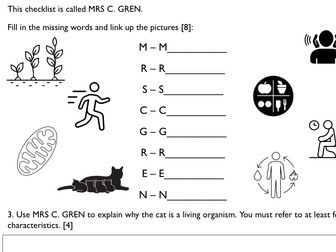
IGCSE Biology Worksheet – Characteristics of Living Organisms (MRS C. GREN) + Mark Scheme & Extension Task A structured, exam-focused worksheet designed to introduce and assess understanding of the Characteristics of Living Organisms. This resource takes students from everyday classification (stone, phone, cat) to scientific reasoning using MRS C. GREN (including Control/homeostasis). It moves beyond memorisation and develops explanation, comparison and evaluation skills. What’s included: • Engaging classification starter task • MRS C. GREN fill-in activity • Application and explanation questions • Higher-order thinking tasks (seed dormancy, virus debate, robot comparison) • Extension research question for stretch and challenge • Full mark scheme included Skills developed: • Scientific classification • Use of biological terminology • Written explanation • Addressing misconceptions • Evaluation of borderline cases Suitable for: • IGCSE Biology (Core & Extended) • GCSE Biology (Topic 1 foundations) • High-attaining KS3 students Estimated time: 40–45 minutes Printable worksheet format Ideal for consolidation, homework, cover work or short assessment.
How to answer IGCSE Practical Investigation Exam Questions using CORMMSSQuick View
chem1984

How to answer IGCSE Practical Investigation Exam Questions using CORMMSS

(0)
This PowerPoint is a focused, exam-ready resource designed to help IGCSE students confidently answer CORMMSS / variables and experimental design questions. It begins with a clear explanation of independent, dependent, and control variables, followed by a structured breakdown of the CORMMSS framework and how it should be applied in exam answers. The resource then works through three exam-style questions, modelling how marks are awarded and highlighting common mistakes students make. It is ideal for high-ability students who understand the science but want to improve method, clarity, and consistency in longer practical and planning questions. Suitable for self-study, small group teaching, or revision ahead of assessments.
Guide to SN1 and SN2 Mechanisms for A-Level and IB Chemistry StudentsQuick View
chem1984

Guide to SN1 and SN2 Mechanisms for A-Level and IB Chemistry Students

(0)
This engaging resource is a great tool for A-Level and IB Chemistry students aiming to master nucleophilic substitution mechanisms. It provides: • In-Depth Mechanisms: Step-by-step explanations of SN1 and SN2 processes, complete with annotated diagrams and examples. • Key Comparisons: A clear breakdown of the similarities and differences between SN1 and SN2, including reaction conditions, intermediates, and kinetics. • Stereochemistry Focus: Insightful discussions on stereochemical outcomes such as inversion and racemization. • Halogen Influence: Detailed analysis of how the halogen atom affects reaction rates and mechanisms. • Exam-Style Questions: A curated selection of exam questions with answers to test understanding and reinforce learning. Designed with clarity and precision, this resource is perfect for self-study, classroom use, or tutoring sessions. Empower your students to excel in their chemistry exams—download your copy today! Let me know if you’d like additional adjustments!
sp HybridisationQuick View
chem1984

sp Hybridisation

(1)
A concise set of slides covering the theory of sp1, sp2 and sp3 hybridisation, linking to shape of molecules and descriptions of carbon in single, double and triple bonds in organic compounds. Arranged in a way that is easy to understand and includes relevant examples. Would suit AQA, OCR, Edexcel, Cambridge or IB specifications.
CORMMS Biology IGCSE Exam-style questions with mark schemeQuick View
chem1984

CORMMS Biology IGCSE Exam-style questions with mark scheme

(0)
Worksheet with an introduction explaining the CORMMS mnemonic, followed by 8 high-quality exam-style questions and answers. I have added some hints to the questions so that the questions are more accessible to younger students who have not necessarily completed all of the required practicals.
Flame test colour mnemonicQuick View
chem1984

Flame test colour mnemonic

(0)
A couple of novel mnemonics with some humor to help revise the colours of the flame tests. This involved aligning Rainbow (ROYGBIV) with a new mnemonic for the flame colours as well as the classic Corgi mnemonic. Designed for AQA but could work equally well for IGCSE Edexcel.
Identification of common gases and ions - UPDATED!Quick View
chem1984

Identification of common gases and ions - UPDATED!

(0)
A set of slides helping revise all the common tests for gases and water, followed by all the cations and anions on the AQA spec. Updated to now include full methods, video links and exam-style questions to check for knowledge. I have also added in some novel mnemonics, revision tips and cat pictures to help with recall. It finished with a multiple choice quiz to for assessment. Common gases: Hydrogen, Oxygen, Carbon dioxide, Chlorine. Cations: Flame tests for Lithium, Sodium, Potassium, Calcium, Copper; Sodium hydroxide precipitates: Aluminium, Calcium, Magnesium, Copper, Iron (II), Iron (III). Anions: Halides, Sulfates, Carbonates.
Types of chemical reactionQuick View
chem1984

Types of chemical reaction

(0)
A concise summary of all types of chemical reaction in one place, with examples, followed by a quick quiz to assess knowledge. Great for a revision session as this is not usually taught as a single topic. Aimed at IB Chemistry level but also suitable for A-level. Reactions covered: Synthesis Decomposition Single displacement Double displacement Combustion Redox Disproportionation Neutralisation Precipitation Complexation Electrophilic addition Nucleophilic substitution Elimination Nucleophilic addition
Rules for Solubility (Edexcel)Quick View
chem1984

Rules for Solubility (Edexcel)

(0)
Single slide that uses an excellent mnemonic to remember the solubility rules for all ionic compounds on the Edexcel GCSE and IGCSE specifications, including all exceptions. “Some Curious Animals Never Get Cold Hands”
Uncertainty and Error for A-level or IB ChemistryQuick View
chem1984

Uncertainty and Error for A-level or IB Chemistry

(0)
Comprehensive slides that provide a great introduction to this topic for either A-level or IB Chemistry (with some cat photos). **Detailed explanations of: ** Uncertainty (absolute and relative/percentage) Random and systematic error Accuracy and precision Percentage error Specific focus on Titration Everything with worked examples. I have focused on the Titration practical method and calculation as this is commonly asked about. The slides finish with a quiz to assess knowledge.