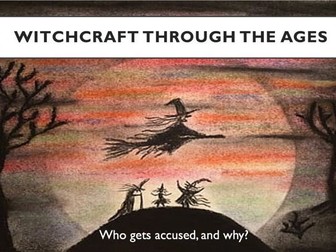
The History of Witchcraft UnitQuick View
emma_mcnaughton123

The History of Witchcraft Unit

(0)
This is a complete unit exploring the history of the reception of witches and witchcraft. It is intended to take around 16 lessons, however you can use and adapt as needed. Overview: The unit opens with aims and outcomes, clearly stating these in I will/ I can statements for students. Students will then briefly touch on two classical witches: Circe and Medea, before comparing them with the images/ perceptions of witches in the Middle Ages. Students will then look at how the development of Christianity created a deep-seated fear of witches and encouraged persecution. They will continue through history, before arriving at the 16th century. There they will learn about changes to the law in terms of dealing with witches, and how this was perpetuated by literature. They will consider texts such as the Malleus Melificarum and King James VI’s Daemonologie. They will study 5 real cases of witch trials before progressing briefly onto the Salem Witch Trials. Finally, students will be involved in an interactive witch trial - they will use the information they take from this to produce a pamphlet either denouncing the witch or the verdict. The Interactive Trials: 5 separate trials are included, with scripts and character prompts. By design, this would require involvement from other class teachers so the trials can run concurrently. However, they can be adapted to suit the needs of your classroom. If you do not have other classes to draw on, consider utilising the scripts to build your own witch trial with your class instead. Included in this pack are: The complete PowerPoint Witch Fact Files (for the real case study) Two forms of an Close Reading task - a Level 3/4 version and a differentiated version. Both include Marking Instructions. Salem Trials Source Analysis Worksheet Five Trials: each one has a script and collection character prompts. Pamphlet Scaffold I am using this to progress my class on to study Salem by David Calcutt, but this would work brilliantly as a standalone unit too. Please leave a review if you like this unit of work!
'The Test' by Angelica Gibb Resource PackQuick View
emma_mcnaughton123

'The Test' by Angelica Gibb Resource Pack

(0)
This is a resource pack designed to support students in completing a thematic study of Angelica Gibb’s 'The Test. This pack will support students in: learning about the historical context of the story; exploring themes of racism and sexism within the text; completing analytical writing (utilising the single-paragraph outline structure from The Writing Revolution in an adapted means). Within the pack you will find: Course PowerPoint Worksheet to support analysing examples of racism in the text. Building Up Analysis worksheet Paragraph creation planning sheet This is a complete pack enabling you to upskill students’ cultural and historical literacy, whilst also explicitly teaching analytical writing.
My Last Duchess Knowledge OrganiserQuick View
emma_mcnaughton123

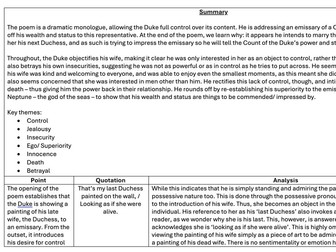
My Last Duchess Knowledge Organiser

(0)
This is an analytical Knowledge Organiser for Robert Browning’s dramatic poem ‘My Last Duchess’. Within the resource I have: provided an overview of the poem; identified a range key themes; identified a number of key quotations significant to the poem (these are in chronological order). For each quotation, I have provided: A ‘point’ (this can be developed into a topic sentence for students, but also provides them with a summary of the quotation - its key point). Analysis of the quotation, including references to key techniques contained within it (not an exhaustive list - but some that I believe are key) This resource will show students how to fully analyse quotations, providing them with an example of how to do so for each one. This is an excellent resource for anyone preparing for essay work on this poem.
Knowledge Organiser: Lady Macbeth's Character DevelopmentQuick View
emma_mcnaughton123

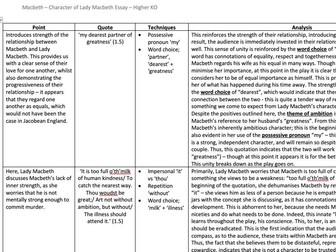
Knowledge Organiser: Lady Macbeth's Character Development

(0)
This is an analytical Knowledge Organiser for Shakespeare’s ‘Macbeth’. Within the KO, I have collated a range of key quotations demonstrating the development of Lady Macbeth’s character - these are in chronological order. For each quotation, I have provided: A ‘point’ (this can be developed into a topic sentence for students, but also provides them with a summary of the quotation - its key point). Techniques contained within it (not an exhaustive list - but some that I believe are key) Analysis of the quotation This resource will show students how to fully analyse quotations, providing them with an example of how to do so for each quotation. I would appreciate any feedback below!
Knowledge Organiser: Development of Macbeth's CharacterQuick View
emma_mcnaughton123

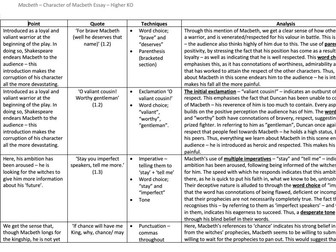
Knowledge Organiser: Development of Macbeth's Character

(0)
This is an analytical Knowledge Organiser for Shakespeare’s ‘Macbeth’. Within the KO, I have collated a range of key quotations demonstrating the development of Macbeth’s character - these are in chronological order. For each quotation, I have provided: A ‘point’ (this can be developed into a topic sentence for students, but also provides them with a summary of the quotation - its key point). Techniques contained within it (not an exhaustive list - but some that I believe are key) Analysis of the quotation This resource will show students how to fully analyse quotations, providing them with an example of how to do so for each quotation. I would appreciate any feedback below!
Animal Farm Knowledge OrganiserQuick View
emma_mcnaughton123

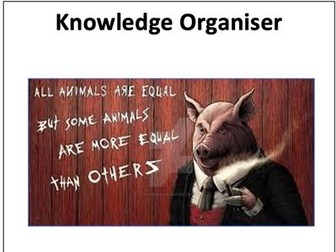
Animal Farm Knowledge Organiser

(0)
A Knowledge Organiser designed to support learners in engaging with the historical context of George Orwell’s Animal Farm. I work with the belief that an understanding of context is imperative to a comprehensive understanding of any text - this is abundantly true of Animal Farm. This resource includes information and questions on: George Orwell’s Life and Politics Russia Before the Revolution The Russian Revolution The Rise of the Soviet Union Stalin’s Rise to Power Stalin’s Regime Synopsis of the Text Exploration of Allegory within the Text Key Theme Symbols and Motifs Key Terms It also provides a chapter summaries for every chapter within the novella.