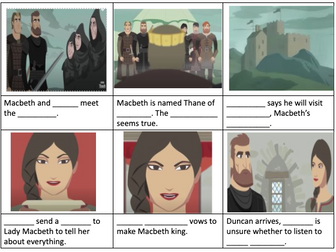
4 lessons which allow students to revise/learn the plot of Macbeth.
Each lesson contains a gap-fill storyboard which corresponds to animated short videos. The lessons focus on how Macbeth develops through the play.
There is also a focus on learning key quotations and vocabulary.
This was used with a low prior attaining group of SEN and EAL GCSE students. However, it could easily be adapted for KS2/3.
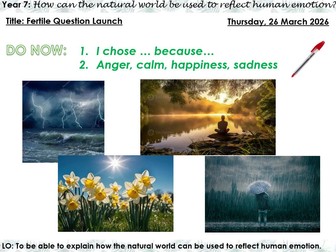
This unit aims to prepare students to read, annotate and analyse poems about nature. Across the unit they study a range of poems. The question that underpins the unit is "How do poets use the natural world to express human emotion?"
For each poem there is a lesson reading, annotating and understanding the ideas. Students are taught to approach unseen poems with the ‘story, ideas, methods’ approach to help them break down unseen poems.
The second lesson for each poem then focusses on improving their analysis of a key method. For example lessons on similes, metaphors, imagery, symbolism, rhyme, ceasura, enjambement.
In total there are 28 lessons in this unit.
There is an MTP with the overall plan
There is a formative and summative assessment
Whole class checks for understanding are planned in (ABCD)
The unit is vocabulary rich with vocabulary activities and chances to use new vocabulary in writing.
Talk is embedded through think, pair, share, debate/discussion, and paired tasks.
Challenging and creative questions are used in the first lesson for each poem to focus on big ideas. No death by PEA in this scheme. But there are ample opportunities for analytical thinking and writing.
A homework booklet to embed the practise of reading, understanding and analysing unseen poems.
Poems in the unit
Shall I compare thee to a summer’s day? (1609) William Shakespeare
I Wandered Lonely as a Cloud (1807) William Wordsworth
Hope is the thing with feathers (1861) Emily Dickinson
The Lake Isle of Innisfree (1890) Yeats
Autumn Song (1905) Soljini Naidu
Leisure (1911) – WH Davies
Dreams (1922) - Langston Hughes
Nature (1950) - Carberry
The Peace of Wild Things (1968) – Wendell Berry
Nature (2022) – George the Poet
Like a red red rose (summative assessment) 1794 – Robert Burns
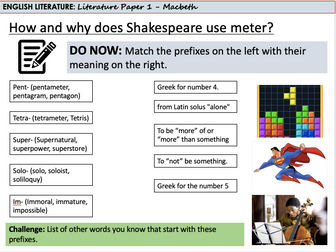
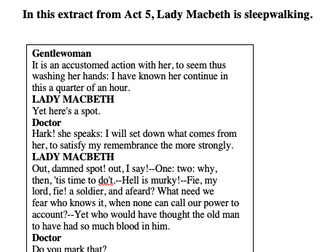
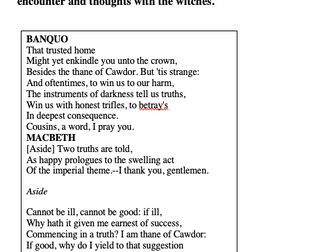
This lesson teaches students how to understand and analyse Shakespeares use of meter in Macbeth.
Suitable for a variety of levels but great for challenging the top end.
Includes:
Dual coded resources
Challenge present throughout
PPT with Do Now, reading task, comprehension questions, feedback at each stage and analytical writing.
Success Criteria
Pre-reading vocab work looking at word roots to help break down understanding of complex words.
Used for observation lesson but suitable for interview with KS4
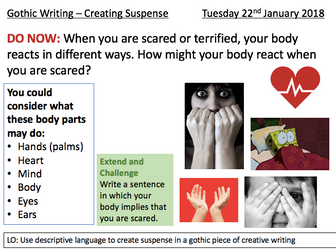
This is a lesson I taught for a successful interview where the students had to create suspense in their Gothic writing.
LO: Use descriptive language to create suspense in a Gothic piece of creative writing
The lesson focuses on sentence and narrative structure to help to build tension. Worksheets and all resources in the body of the ppt. There are differentiated tasks, a model, a word bank, success criteria for writing and an exit ticket.
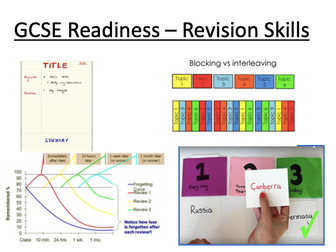
This is a sequence of 4 ppt lessons to be taught in form time to year 10 students. This could be used at KS3 and KS4 with y7-11. It focusses on evidence based flashcards, the Leitner Method, Cornell note taking and interleaving revision.
Each session will last 20-25 minutes with a chance for students to start putting into action their learning from these study skills sessions.
1- revision, memory, Ebbinghaus forgetting curve and research
2- flashcards using Leitner method
3 - Cornell Note taking
4- interleaving
This unit includes:
47 lessons (reading, extract based lessons, analysis, assessments and at the end of the unit creative writing based on the text)
Accompanying resources
A full SOW
Homework booklet
This is aimed at year 9 as there are some themes in the play that may not be suitable for lower KS3.
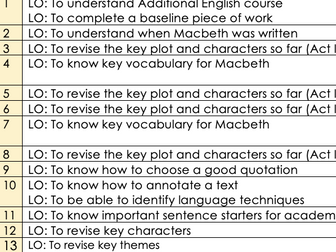
This SOW was used with an Additional English group and supplimented their mainstream English teaching. The SOW contains 12 lessons that focus on plot, vocabulary and some exam skills such as choosing quotations, planning essays and revising. Included is an MTP, all lesson plans and fully resourced PPTs.
This could be used as revision or intervention with a low prior attaining group and is great for SEND and EAL students. The resources would also be good for KS2 students learning Macbeth.
Each plot lesson contains gap-fill story boards that match videos for students to complete for each act.
The 'because, but, so" writing structure is used throughout to help students develop thoughts about characters.
Lots of printable worksheets included in the ppt lessons. This includes pre-made flash card templates for characters and themes.
A huge focus on teaching and entending vocabulary throughout the scheme.
This booklet and MTP introduces KS3 students to variety of Shakespearean texts and their heroes and villains. romeo and Juliet, Macbeth, Julius Ceaser, Titus Andronicus, Othello, Merchant of Venice, King Lear. The booklet was designed for cover but has an overview of each lesson with key extracts.
There are 19 lessons/extracts in the booklet (we had extra for revision/assessment).
There are some activities where I have uploaded the attachment. Unfortunately I can’t access the ppts and the booklet makes a couple of reference to accompanying slides. For example “look at the definitions (antagonist, protagonist, hubris) on the board”. However, for 95% of the booklet you need no slides/prior prep. Great for long term cover/independent work.
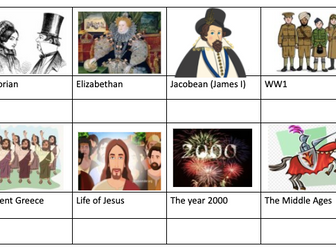
This lesson covers basic context of the time period that is relevant for further study of Macbeth - ruler/divine right of kings, entertainment and gender.
The lesson include a brainstorm do now, vocabulary activity, a worksheet about time-periods to measure understanding of chronology, reading and comprehension questions with a quick low -stakes quiz.
This was used with an additional English class in year 10 and would be suitable for other low prior attaining groups at KS4 or with groups at KS2 or KS3 depending on ability.
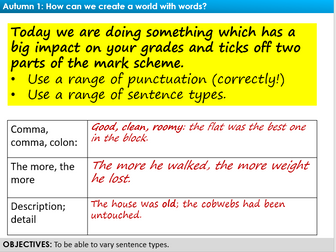
This Mini-SOW was used with a y10 low ability group of primarily EAL and SEN learners. The LO’s have the following focus. They focus heavily on AO6 skills as well as improving vocabulary, sentence types and crafting similes, semantic fields and interesting constructions for AO5.
All do now’s follow a similar structure for consistency. Most lessons have an I, we, you structure to model concepts to students. There are lots of opportunities for sharing their work at the end of lessons.
LO: To be able to use capital letters and full stops.
LO: To be able to use commas.
LO: To be able to use semi-colons.
LO: To be able to use a simile.
LO: To be able to use a range of adjectives.
LO: To be able to vary verbs.
LO: To be able to vary sentence types.
LO: To be able to use adverbs.
LO: To be able to use present participle constructions.
LO: To be able to use a semantic field.
LO: To be able to write effective similes and metaphors.
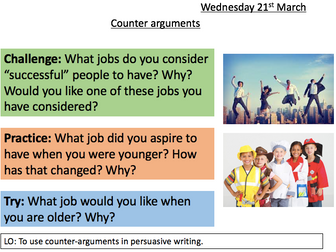
This set of lessons takes students through how to use counter arguments, anecdotes, fact and opinion in order to write about a range of topics. This covers a minimum of 5 lessons but could also be spread over a longer period.
Lessons come with model articles, embedded AfL, planning grids, differentiated tasks and success criteria.
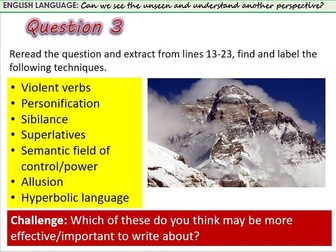
This set of 6 lessons takes students through a paper I have created.
One source is from the perspective of a early 20th century travel writer travelling to a socialist commune in Russia. The other is an article about social inequality and capitalism in America.
The lessons include students friendly mark schemes, differentiation and starter activities.
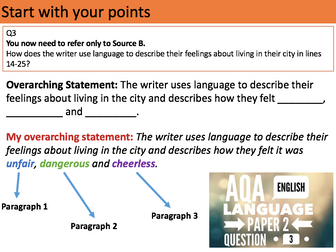
This lesson takes students through reading, annotating, writing an overarching statement and writing up a Question 3 response.
It includes a short quiz with answers, the extract, feedback opportunities and self/peer assessment.
This was created for an observation lesson and was praised for the great end results.
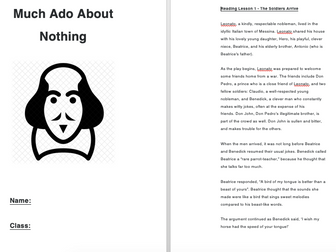
This prose version of Much Ado has been created to make access to the plot of the play more accessible. It includes:
13 pages of the key story
Speech using original or adapted quotations
Challenging vocabulary
This is suitable for KS2 or KS3 especially with SEN/Low literacy pupils in order to access the plot of the play.
This is also available as part of a bundle including 5 accompanying reading lessons.
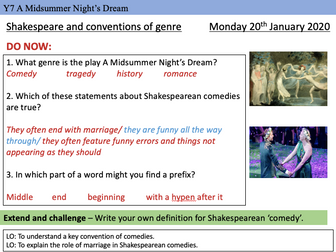
This lesson was an interview lesson for HOD position. It focusses on A Midsummer Night’s Dream and the comedy genre in Shakespeare.
It was taught to year 7 but could be used at KS3 or even adapted for KS4
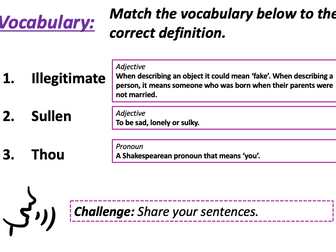
It can be taught to a class either starting to study the text or with an understanding of the play. Includes low stakes quizzing, challenging reading, vocabulary work, comprehsnion questions, AfL opportunities and independent writing at the end.
PPT and worksheet/reading sheet included
This mini SOW follows an easy reader version of Much Ado About Nothing that I have created. It is 13 pages and includes challenging vocabulary, speech and key quotations from Shakespeare’s play but in prose.
In the accompanying lessons the students read the text and complete:
Prediction (reciprocal reading skill)
Vocabulary work
Self Assessment
Summary (reciprocal reading skill)
Mini Quiz
This was made for a SEN/EAL KS3 group, but could also be used at KS2 for understanding the plot. Similarly it could be adapted for any KS3 class.
This is a paper that I have made following the structure of AQA’s language paper 1. I am an examiner so have made the questions and paper to try and replicate what has been in previous exams.
The paper comes with slides that can be displayed, some sentence starters and do now.


 Quick View